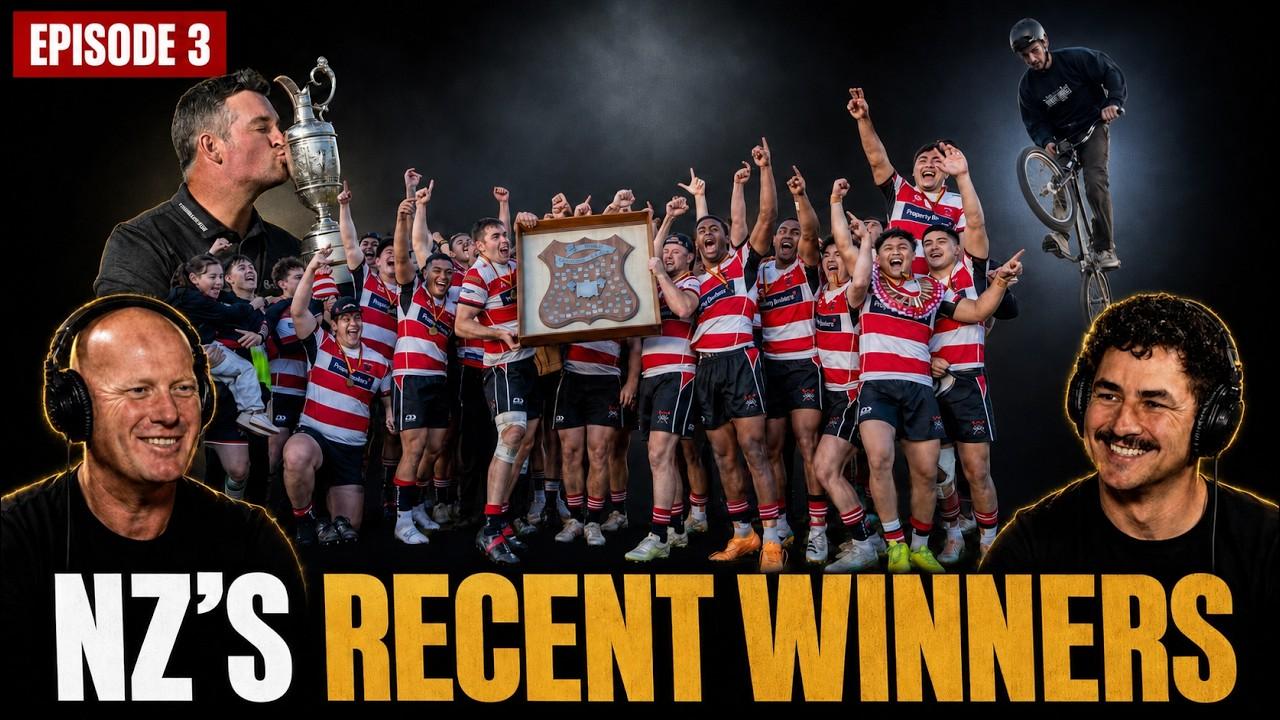
BMX · · 2 hr 16 min
Jed Mildon and Nick Franklin: World-First BMX Backflips, FMX and Life with Nitro Circus
Jed Mildon, the Taupō rider behind the world's first BMX triple and quad backflips, and FMX rider Nick Franklin of Nitro Circus and Red Bull X-Fighters talk foam pits, a 20-metre roll-in, the Trojan Horse jump, big injuries and what is next with Jason and Mark Davis.
Play audio here
Best bits
“It wasn't like let's just make this massive jump, it was actually we need the jump to be much bigger to get more flips.”
Jed Mildon
“You have to push through that fear, which kind of sucks at the time, but it makes it worthwhile on the other side.”
Jed Mildon
In this episode
- 00:00Cold open: foam pits, pay and Bolivia
- 04:16Welcome to the four-way episode
- 05:55How the triple backflip idea hatched
- 09:43Building the 20-metre roll-in at Spa Park
- 12:56Why a triple put him on the map
- 19:32Nick's path from Tokoroa farm to FMX
- 30:17Jumping the Trojan Horse in Turkey
- 33:05The quad and joining Nitro Circus
About this episode
Jed Mildon is the Taupō BMX rider who landed the world's first BMX triple backflip and later the world's first quad, and in episode 33 of ShedLife NZ he and freestyle motocross rider Nick Franklin tell Jason and Mark Davis how two kids with backyard ramps ended up on the world stage. Nick spent his career with Red Bull X-Fighters and Nitro Circus, including the day he jumped a dirt bike over the Trojan Horse in Turkey. It is a long, loose chat, and the best bits are the practical details of how these things actually got built.
How the Jed Mildon triple backflip came about
The idea started small. Jed landed his first double backflip at an event in Auckland called Roller Coaster, found it easy, and figured a bigger jump would give him three flips. The chat really got going when he and Nick were flown to Farm Jam together, and the Unit clothing crew who were backing the event offered to help. He built a roll-in about 14 metres tall at Nick's farm near Tokoroa and managed one run into the foam pit before the scaffold had to go back.
Then he heard Nitro Circus planned to do it live in Vegas. Two weeks later he had a 20-metre scaffold roll-in dug into the ground at Spa Park in Taupō, and he landed the triple in 2011, aged 24, beating them by four days. The take-off was Nick's super kicker, extended, hit at about 70 kilometres an hour over a 45-foot gap. The council backed it, a local McDonald's covered the Guinness fee, and he wore work boots because his heels were wrecked. The reason for the size was practical: Jed had spent three years in America missing the big contests, and he says he needed something that would get him noticed.
Nick Franklin: from a Tokoroa dairy farm to X-Fighters
Nick grew up on a farm near Tokoroa, raced motocross, and picked up freestyle just as racing was running out of road. He rode X-Air in Hamilton, won it one year, and that led to Red Bull X-Fighters and shows around the world. Getting paid to ride a dirt bike, he says, felt like winning the lottery, and in the early days a back flip could be worth over $10,000.
The foam pit at Franklin Farm came from Kiwi ingenuity: he saw silage stacks, dug into a hill and built one wall at the front, which was far cheaper than a full container. Later he did Red Bull activations in what he reckons was 70 to 80 countries, usually the first person many locals had seen do a straight jump. The Trojan Horse in Turkey drew a crowd of more than 100,000, and a show in high-altitude Bolivia meant riding a four-stroke that had lost around 30 percent of its power.
The quad, Nitro Circus and a boss who backed him
Jed says that straight after the triple he thought he could do four flips. He went for the quad about four years later with Nitro Circus, in a six-month window, without having landed another triple in between. Nitro wanted Kiwis for their 2013 tour and he was the Kiwi, which led to years of shows until Covid stopped them.
Before that he was a fabricator welder, working nine months to save and spending three travelling. When he rang his boss to quit and go to Australia for two weeks, the boss told him to just come back when he wanted a job, because he had a lifetime to learn to weld but not much time to do this. Nick has his own version: he missed out on a mill job that paid almost three times his wage, and thinks he might never have risked riding if he had got it.
Bones, head knocks and airbags
Nick reckons he has broken around 30 bones, but both riders say head injuries are the real worry. They talk through concussions, why sleep matters, why a full-face helmet matters, and what a cracked leg feels like when you ride on it for a month. Nick did a whole career landing on metal and wood before airbags arrived, and calls the arrival of airbags bittersweet.
Jed also talks about Dirt Dogs, a 60-foot dirt jump he built, where he applied for records for the longest 360, front flip and superman flip, and about snapping an ankle on a hill jump on New Year's Eve.
Franklin Farm and what comes next
The farm is now home to a mega box that Jed describes as one of the safer big ones: the youngest rider to hit it was nine. He is also behind RIDE, a new governing body for riders that aims to bring back a national calendar like X-Air gave them, with BMX park nationals on 21 November. Riders can join at ridebmx.co.nz, and there is a flight path development camp at the farm in the next school holidays.
Why it matters
Neither of them had an academy or a pathway. They had a farm, scaffolding and a stubborn streak, and now they are trying to build the pathway for the next lot. Jason finishes on the common theme: whatever the sport, it is good people doing it.
For more from this scene, see the Jed Mildon guest page, the NZ BMX and action sports guide, Kenny Short on riding BMX for Disney, BMX legend John Kelly at Fieldays 2026, or Mark Davis's own episode.
Questions people ask
Who is Jed Mildon?
How did Jed Mildon land the triple and quad backflips?
What injuries have Jed and Nick had?
Who is Nick Franklin?
What is it like touring with Nitro Circus?
Mentioned in this episode
Transcript
Generated from the audio, so expect the odd wrong word or name. Timestamps open that moment on YouTube.
0:00It definitely all starts with a thought and then taking action on that thought. But yeah, I landed my first double backflip at an event that we made the jump for in Auckland, an event called Roller Coaster and managed to double flip that really easy. So straight away I was like, oh mate, we can build a bigger jump and do three flips. And so that was when I started and that was when I came up with the idea and then that was the first point of action. It was after the triple flip I started getting paid from them.
0:27Yeah, yeah, sir. I was like, oh, I'm a professional now. The first time I wanted to go travelling I went to my boss and I said to him, oh, I've got to quit. I'm going to Aussie in two weeks. And he's like, oh, how long are you going for? And I was like, I'm just going for two weeks. And he was like, well, why are you quitting? And I was like, oh, because I really want to do it but I didn't think I could have my job back. And he's like, so tell me, what's this BMX you're going for? And I'm like, oh, I'm going to compete in this comp and this comp.
0:57And he goes, and so that's what you like to do, is it? I'm like, yeah, I love it. It's my passion. It's my life. And he's like, oh, what? And you don't want a job when you come back. And I'm like, well, yeah. He goes, just come back and see me if you're on a job. All of a sudden you're getting paid to ride a motorbike and that was like, you know, that was like the goal.
1:20That was like a dream that you're getting paid to go every weekend and just ride for like 20 minutes a weekend and get the same amount as like working all week. Like I said, it got paid, became obvious at one point, like you needed to be, to be doing backflips or else you just, you're going to get left behind.
Read the full transcript · about 119 min
1:36And there was people around the world with foam pits, but they kept them very, you know. Yeah. How did you learn them? Oh, I learned them straight to do it. Yeah.
1:47Yeah, yeah, yeah. With hay bales? Yeah, we, yeah. Kiwi ingenuity? Ate it. Yeah, just ate it, man. Yeah, I mean, the shows were already a thing in Franklin Farm. So Jed named it Franklin Farm. Yep. That's where we were training. And then it was just like, you know, bring the, bring the farm to the city sort of thing.
2:06And, you know, bring show over on what you're doing out there in a show environment. So you were getting paid per flips on the ship. Like if you were a flipper on a dirt bike. Yeah. It was like, it was probably over 10k for a one backflip. I remember hearing that like Nate Adams, when, so you had the super kick flip.
2:24And Nick was in the top first five people in the world. The long flip, the 75 foot flip, I remember hearing he got, he was getting like 20 US to go over to the state, over to like Europe and do that per night or per show. Yeah. 20,000, which would be like 30 New Zealand for. Yeah, yeah.
2:38That's a question I'd have for a bit. Because I know if you're going to go overseas with your BMX, you just put it into a bag and take it. How do you do it with a motorbike? Oh, so you have to get a bike. So it's like part of the, it can be dodgy because you get a bike over there.
2:50Yeah, so it's not like, I want my bike. So I ride, I ride KTM. So you, they source your bike over there. And that generally was like our, the bikes we rode the year before. So I had a few more hours on them, but still good bikes. Yeah. Whereas sometimes you're like, you'll turn up overseas and that the bike they've got, you know, not so more back in the day, you know, there's like a flogged out bike.
3:10And you're like, so you bring your suspension, you bring any parts that you've got, you know, made personally for you. You're like suspension, you're harder suspension or you, you know, load C to your handlebars. Yeah. So you bring those, which is already like a hassle because towards the end of my career, flying or suspension was like, you'd get more than 200 miles in there.
3:30We did a show in Bolivia at the time. So Bolivia is like the poorest country in South America, but it's amazing. And it's like crazy high altitude, like I think two or 3000 meters high. It's like maybe the highest city. I'm not sure on that, but beautiful, beautiful place. And we couldn't get two stroke motocross bikes, two stroke 250.
3:50So we had to ride four stroke 250, which is like way down on power. And so every, every thousand meters of altitude, you go up, you lose 10% of your horsepower. So you're riding this bike that's already got like 20% less horsepower and you're riding it like 3000 meters. So it's down like another 30% lower in the horsepower.
4:07And it's just, but yeah, still amazing trip. But yeah, the riding part of it was scary as hell. All right. Welcome to ShedLife. We've got an excellent episode today. This is going to be a lot of fun. It's our first four way episode. So we've got a double host situation and a double guest situation. In terms of the guests, we have got Jed Mildon, first ever human to triple backflip and then quadruple backflip a BMX.
4:33Mark talked about him on his podcast and now he's got him on the podcast. And then we've got Nick Franklin here. Won the tour X-Air in New Zealand. Freestyle motocross legend. Franklin Farms. Just awesome. And our man, brother, Mark Davis. So Mark, welcome aboard. Jed. No, reach over our black dog leaners. I won't do much talking. I'm going to hand it over to Mark and I'm just going to be enjoying some stories as well.
5:04Yeah, awesome. Oh, thank you. Yeah, it's awesome to be here with Jed and Nick. Jed, I've known for a long time since we were probably around sort of 17, 18. Two decades. Yeah, two decades of riding bikes, having fun, riding contests you've put on and doing all that good stuff. And then Nick, I've heard the name floated around for years.
5:23FMX rider, but haven't met you before. So looking forward to sort of hearing a bit more about your history and your backstory. About how you, yeah, come to be, had a giant foam pit on your Tokaroa farm and all of that good stuff. Yeah, that's fine. So I think maybe we'll just start it with the triple backflip.
5:41Get that underway first. Straight into it. Sweet, I like it. How did that come about? You know, like where did that idea come from? Like I remember watching Jay Mirren do a double backflip back in the day and then Dave Mirren first in contest to do the double. Did you see that and you got excited to do it or how did the dream hatch?
6:04Definitely all starts with a thought and then taking action on that thought. But yeah, I landed my first double backflip at an event that we made the jump for in Auckland. An event called Roller Coaster. And managed to double flip that really easy. So straight away I was like, oh mate, we can build a bigger jump and do three flips.
6:23Yeah. So that was when I started and that was when I came up with the idea and then that was the first point of action. But nothing really, I kind of, you know, just carry on. And then I guess it was when Nick and I got flown down to Farm Jam together that the conversation was actually ignited.
6:38You know, like I spoke to him and he's like, oh, you can use my phone put. I'm like, oh, sweet. We're heading in the right direction. You know, not really holding on to the idea too much. But it's just a nice goal. And then you met the right people at Farm Jam that were like, yeah, we can help you do that.
6:52Which is unit clothing. Yeah, sick. Yeah, because unit was big into it at that stage. Yeah. And then two weeks after that we had a rolling at the farm practicing it. Three months after that, four months after that I landed it. And were you already sponsored by unit at that stage or did they just come on board with you for that idea?
7:09They were sponsoring all the jams I was running. Yeah. They were quite, that's how they got into the scene. You know, that's what they like to do, action sports. So they looked after me that way. Always got product for them. But it was after the triple flip I started getting paid from them. Yeah, sick. I was like, oh, I'm a professional now.
7:28Cool. So that takes you to the Franklin Farm into your foam pit, Nick. So how long had you had your foam pit set up there for? At that stage it was maybe just under 10 years, just under a decade. Yeah, right. So you'd had a foam pit from sort of the get-go for yourself. Yeah, well, you know, freestyle motocross, it came clear pretty early after Kerry Hart landed a backflip.
7:54Then a few other dudes started like doing it. You know, first it was like, oh, it's going to be a one-off. And then it started getting landed like on a more regular basis. And Mike Mexica started, you know, hitting a ramp and backflipping was like, man, you need to do this. Otherwise, you might as well just go get a day job.
8:08Yeah. And so that was like, yeah, that was sort of the next step. No, actually breaking my leg was the next step. Nice. And then I was in Austria with Red Bull at the facility they have over there to, you know, sort of help get better again. And I, yeah, just sort of planted the idea with the Red Bull guys over there.
8:27And, yeah, that's how it eventuated. Came off with like the Kiwi ingenuity idea of be like, all right, let's dig into a hill because I saw silage stacks. Yeah. That's how they were done. So I was like, oh, that's way cheaper than like, you know, building a full, you know, four-sided big container to hold the foam. Yeah.
8:44Yep. Yeah. I'd often wondered that. I'd seen it and see stylish, silage stacks around. I was like, I'd drive past them and it'd just be like, that's like, you'd take the silage out and put foam in and that's a foam pit. Yeah. And all you got to do is build one wall at the front of it and you're away laughing.
8:59Yeah. Sick. All right. So then you obviously know motor on your bike. How do you get the speed to roll into this? Gravity. Real gravity fed. Yeah. Beautiful. Or pedal my ass off. Yeah. That's it, eh? Toad. Yeah. But yeah, it seems to be the way with BMX, especially freestyle BMX. Yeah. And like you see in the big park competitions now, it's about the guys trying to land smoothly and hold their momentum.
9:23You know, less pedals are better. Yeah. So you build a big roll and how did that go? What did you do? Oh, so the one we had at the farm was 12 meters and then I dug a hole into the ground, probably two meter hole with Nick's bobcat. Yeah. Nice. First time learning to use a bobcat, which is fun.
9:40And then I think we maybe put a meter on top. So we probably got to like 14 meters at the farm. Yeah. But then I only managed to get one around in the foam pit and then it was like five weeks in and they kind of wanted their scaffold back. Yeah. And I was like, okay. But I'd learned it, so I knew I could do it.
9:58And then I went back to work and I was back at work for like a month and then I got wind that Nitro. We're going to do it live in Vegas. So I was like, oh, this is my time. I've got to go. Yeah. And two weeks later we did it. Yes. In Spa Park. But I made the roll on about six meters taller.
10:16Yeah. It was 20 meters tall. Yeah. So all scaffolding just built up. Dug into the ground. Yeah. And how did you work out the takeoff? Troll and error. Just trial and error. Yeah. Because you'd been doing a lot of lake jumping before this. That was your foam pit before foam pit? Yeah. I could double backflip into water before I'd even done a single backflip on land.
10:38Yeah. So my muscle memories were pretty dull in that sense. Yeah. So you just went that quarter pipe and went bigger. Well, it was just always just finding the right opportunity. Yeah. In the right scenario. You know, like we had jumps but there was no point I was going to send them on it. Yeah. Because you'd probably get hurt.
10:55Yeah. Because that's where the human self-preservation kicks in. We're not silly. Yeah. Well, we're pretty, I'd like to think we're pretty calculated athletes. Yeah. And it's not like we weren't holding on to building those jumps. It was, they'd just always kind of flow state into our lap. Like the roller coaster event, you know. Yeah. And the real opportunity to build a mega ramp.
11:14I'm like, well, I'm going to build a mega box. Yeah. You know. And then we built this box and that worked. And then it was just scaling up from there. Yeah. And I think in the end we used Nick's super kicker. Right. An actual super kicker. Yeah. Extended two foot. Holy mackerel. And we're hitting it at 70 k's an hour.
11:30It was a 45 foot gap and a 13 foot step up. Yeah. It's crazy. It's insane the footage of what you did on that thing. It's probably still the gnarliest jump in BMX, I reckon. Yeah. And then the quad jumps. Yeah. Crazy as well. Crazy but did not look as crazy as that. To that scaffolded back landing with the big deck on it and everything.
11:51It was pretty hard. The quad was in proportion. Yeah. It's like so high but the triple was up. Big step up. I always see it now and I'm like, what were you thinking? Yeah. Like, how did you get in that state? Like, to be in that position? That's crazy. How old were you for the triple? 24.
12:10Yeah, 2011, eh? And it will be in three days it would have been 16 years. Right, kid. Yeah. So, it's coming on 16 years. Mark started from. Changed my life forever. Yeah. I was already travelling lots by then but then that just opened up all the doors. Yeah, yeah, that's it. It was the thing to put yourself.
12:29Like, we were sort of talking about this earlier. It came up in the age of magazines and everything. So, it was like you had to somehow make a name for yourself. Yeah, yeah. You couldn't just go and self-promote yourself. Like, you could now put up videos and do it. So, you had to. And how did, so, and how did that idea come that you needed to do something so big to put yourself on that world stage?
12:54Um, so, I'd been travelling America to three years before that. Yeah. And then never making the competitions. Yep. So, there's a thing called Open Qualifier. There's 50 riders and there's 12 spots available. And they jump in with the 18 riders that pre-qualified the year before. So, it makes a 30 rider circuit. Yep. And we're always trying to crack onto that.
13:14And we done some, it was actually Dane Seals. Yeah. And I, we actually done these mean runs. And we're watching the footage afterwards. And we're like, we fully beat them. Yeah. Like, we should have qualified. That's not cool. And then Dane's like, they just don't know who we are, bro. I'm like, what are you going to do?
13:30What are you going to do to make them know you? And he's like, I'm going to jump jumps twice as big as these guys. And then we pretty much, it was, we pretty much were about a month apart on our projects. Yeah. And completed. And then he's like, what are you going to do? And I was like, I'm going to do a triple flip.
13:43And I hadn't even done a double flip. Yeah. You know, I was like, I'm going to do a triple flip. Yeah. And then, yeah. And then when that happened, far out, we didn't pay for anything. Yeah. Nothing. Yeah. It was just red carpet everywhere. Yeah. Which was phenomenal. And then I got to meet everyone properly, you know.
14:02Yeah. I was like, oh, I've been here the last three years, but hi. You've noticed me. Which I'm totally cool with, you know. Yeah. It's not their fault, but it's nice to make yourself known. Yeah. It's kind of like a social status thing. Yeah. You know, like socially you're there, but you don't have any status in those circles.
14:19And then you do something to give yourself a bit of status. And then it's like, oh, that's who you are. Yeah. But as you say, there was a bunch of other dudes that were like right on it, just as good as you guys, also trying to make it. Yeah. So there's a lot of people wanting that extra bit of, you know, people knowing who you were, but doing something that big.
14:40And like Dane Seals, those jumps were just insane how big they were. And that's the difference. Like BMX has been going for like 35 years. Yeah. And we just so happened to luckily be enough, the ones in the position to make the jumps bigger. Yeah. You know, like anyone could have done it, but it was us. Yeah.
15:00Like it was quite neat. Yeah. But we had weird reasons to do it. Yeah. It wasn't like, let's just make this massive jump. It was actually, we need the jump to be much bigger to get more flips. Yeah. And to put it out there to catapult yourself into it. Yeah. So you're in Taupo on top of a, what, 20 meter rolling.
15:18Yeah. Ready to go. John Bull boots on. Yeah. And what was it? The rumor was that you had to, that was a part of getting the, getting the world record, the Guinness Book of Record. Was that you had to have steel cap boots on? Is that true? No, I did, I did shows like two weeks before up in Auckland and I front flipped a little box jump and I under rotated.
15:42Yeah. And my heels came off and they just went crack on the ground. And so there's a thing called flat heel. Yeah. Remember flat heel? Where you just bruise your heels so much you can barely walk on your, on your normal shoes on. Yeah. And the only time I could walk properly was in work boots. Like it took the, you know, the cushioning took the pain away.
15:59So I bought John Bulls. Yeah. Nice. You know, John Bull shoes. I don't want John Bull work boots, but I was like, oh, chair, they've got actual like skate shoes. Yeah. Oh yeah. Cause it was in a pair of like the Chucks ones. Yeah.
16:13But they were the only shoes I could wear without my shoes being, my feet being in agony. Yeah. Right. Holy, Holy. It makes it even gnarlier. Yeah. Sick. So you're in there up on it. And so, um, Unit had helped sponsor building their relationship. You actually roll in and then they helped sponsor the actual day where you did it at Sparpat.
16:38Yeah. They were the main sponsor. Yeah. Right. And the council come on board. You've always had. Phenomenal. Phenomenally came on board. Yeah. I worked with a man named Keith Crate. Yeah. He's passed away now, but when he was in council, we pretty much could do anything. He had a, he had a QSM to his name. Oh, yeah.
16:55Nice. Which is the Queen Service of America. And that was for his devotion to cycling in the area. And then when we met, he was like, oh my gosh, I love this stuff. Like, you know, I never met freestyle before. He's used to roadies and, you know, mountain bikers and whatnot. And then he meets these freestyle kids and he was just in awe.
17:12And then anything we wanted to do, any idea we had, he found funding. Yeah. All the Jedi jams. Yeah. Everything. Yeah. He's just like, whatever you want to do, I've got it. I'll do all your paperwork. Don't worry about it. What do you want to do? It was like, I was at the trip where I was like, oh, I'm going to dig a hole here and put the takeoff in there.
17:28And then sweet. And they turn up a few days later and they're like, that's not a hole. You've dug the whole bank away. I'm like, no, I said I didn't dig a hole.
17:38We're going to need fences and everything. I'm like, um, Keith. Can you help us please? So yeah, I always had a good, I was lucky to have a good relationship with the Table Council growing up there. Yeah. So it's a quite small community. So yeah. Awesome. They backed you. Oh, I'm sorry. McDonald's actually bought the Guinness, paid for the Guinness.
17:59Really? Yeah. The local McDonald's. Yeah. They got on board. Yeah. Cause it's like, you probably people think, oh, you just put your hand up on and do a Guinness so I could book records, but it's actually quite a thing to have that I've got to come out. Do they send somebody out? No. You can just prove it.
18:16Yeah. Send an adjudicator out. There's a few thousand dollars more. Yeah. I bet. Well, even more if they're sending it from the outside of the world. I think you might just be able to get a, um, the justice of peace. Is it? Yeah. Justice of peace. Judas peace. No. JB. Yeah. Justice of the peace. Yeah. Cool. Yeah.
18:36Um, I'll just ask two questions. Um, one was, so did you get wind that not someone at nitro circus was going to attempt the triple backflip? Yeah. Um, within two weeks that you just had to push it forward and get it done. Yeah. Stopped my job. Went straight to work. Yeah. Awesome. Found the location. Yeah. Just beat him by four days.
19:00Well, okay. And then I'm not sure he actually landed that one though. Yeah. But I mean, it obviously took the wind out of his sails, but because you had gone and done it. But I'd worked so hard and then I felt, got that news. I'm like, all right, I've already worked way too hard. This is it. Now I never, but otherwise I'd gone back to work and just carried on with work.
19:19Had no real intention of a date. Yeah. You know what I mean? Yeah. And then the guys, and that was the incentive I needed to go. Yeah. Come on. Can you kick in the ass? Yeah. Get out there. Like, oh, yeah. And say it. Yeah. It's awesome. It's interesting that A is sometimes internal motivation, but it's really an external motivator.
19:36Always. What I was wondering is if we could just take it back to the beginning a bit more with you guys is Nick, tell us how you got into freestyle motocross, how you ended up with a foam pit and you'd already had a foam pit for 10 years by the time that Jed wants to use it. You know, give us a bit of a background.
19:54Yeah. About how you got into it and how you ended up riding it. Yeah. Except all of it. Yeah. All of it's probably a lot, but you know.
20:05Two hours later. Yeah. So we grew up on a farm in Tokoro. Yeah. Five years old. And all my buddies had like, you know, DS80s and stuff. And my parents had like 20% mortgage. So there was no motorbikes for a long time. And eventually I got motorbikes and started racing motocross. And was it a dairy farm? Or sheep and beef?
20:27So we were, we were, we did not have dairy, but the rest of the road is. Oh, yeah. It's in the Matarawa Valley. And it's, I think it used to be like deemed like too steep for dairy, but now it's like the whole road is dairy. But still, yeah. So my parents still have the farm and they, dairy farmers leased the farm out now.
20:46But yeah, started racing and then sort of got to the point where I was like, you know, I'm probably not gonna, you know, be world champion. Yeah. Gonna kind of have to taper off. And just at that exact time was when freestyle motocross came about. So it was kind of, I was at the age, I would have been like 19 or 20 and didn't really have anything else going on.
21:09So just started, yeah, pushing for that. And that was fun. And yeah, ended up like going down that path. And then X year, here in Hamilton. And I was lucky, yeah, sort of won that one year. And then, you know, things just take off. Like once you start to get a little bit of a name and shout out Luke Price.
21:27He got us some shows for the monster truck circuit. And so I was working out at Kinleath. And man, as soon as we got like, you got paid to go and ride your motorbike, you know, because the whole like motocross days were your parents paying for you. So I was obviously very lucky that my parents were in a position by that time to do that.
21:47But yeah, then all of a sudden you're getting paid to ride a motorbike. And that was like, you know, that was like the goal. That was like a dream that you're getting paid to go every weekend and just ride for like 20 minutes a weekend and get the same amount as like working all week. And yeah, it just grew from there.
22:06And like I said, it got paid became obvious at one point, like you needed to be to be doing backflips or else you just you're going to get left behind. And there was people around the world with foam pits, but they kept them very, you know. How did you learn them? I learned them straight to do it.
22:24Yeah, yeah, yeah. Yeah, we just. Kiwi ingenuity. Ate it. Yeah, just ate it, man, for a long time. Yeah. Ate it and like you were trying to do them on a small jump to start with or you were just pretty. It was. Yeah, just. Pushed in probably, yeah. So we had this idea, me and my buddy Luke were like, we'll just dig a hole in the ground, take all that dirt out as the landing and then dump a ramp in that hole like in a big trench.
22:52Yeah. And that's what we did. And we had no idea like at the time, like, can you even backflip this? Like now you could double backflip like that setup. Yeah, right. Definitely did not have. Yeah. You know, now when we're teaching kids like on a dirt bike, you'd like learn on a BMX first because it's all the same other than throttle control.
23:10But back then it was just like young and dumb and just like BMX ain't my thing. So just went to crashing a dirt bike until finally they came around like 10 degrees at a time sort of thing. Yeah. And then, yeah, came back to it and did them again and then broke my leg. And that's, you know, when after that, it was like, yeah, you need a foam pit.
23:28Yeah. And, yeah, lucky I was sponsored by Red Bull for a lot of my career. So got to go over to Red Bull X Fighters and podium there like in 2002 or three or so. And, yeah, you know, once you sort of have a name, you get invited back to all sorts of places around the world from there on.
23:49Yeah. And is that the one you did body very ill? Oh, that was years later. Yeah, right. Yeah. And was that sort of your signature trick or were there a few dudes doing that? Nah, I didn't even invent that. Nah, it was just, I just kind of got onto it early, but it was scared the living bejesus out of me.
24:06Yeah. It's a pretty scary trick and you don't see them much. Like, you don't really see them at all in BMX. No. You see them occasionally. But, yeah, I'd seen a clip of you doing it the other day and I was like, yeah. Yeah. Yeah, they're pretty scary to learn because, like, even into a foam pit, like, you're traveling, if you're hitting the 75 foot, you're probably hitting that foam at, like, 50 kilometers an hour and you stop pretty quickly.
24:28Yeah. And if you're not connected to the bike, then you're hitting a bike, a piece of metal at 50 kilometers an hour. So, yeah. So, it's, like, scary because you need to grab back and get back on, whereas, like, a flip or something, you're with the bike the whole way. You're tight on the bike. Not to say you can't get hurt.
24:45But, yeah, it's more controlled. Yeah. You're going in as one. Yeah. As opposed to, yeah, sort of like if you lose a bike on a body of rear. So, just kind of scary to learn. Yeah. Crazy. Yeah. Can you just give me, when did you first start doing the freestyle motocross? Was this, like, early 90s, mid 90s?
25:02And, like, where did it begin from? Because it's just, yeah, just where did it begin from that then you're ending up in the XS and XFighters and this sort of stuff in the early 2000s. It's just. I mean, I think freestyle. Like, how does a boy from Tokoro end up traveling the world? Yeah. I'm still asking that question myself.
25:19Yeah. It's, you know, it sort of started out in the Junes in America. Those dudes were doing it in about the mid 90s, mid late 90s. And then it sort of started catching on. And then ramps were built, you know, metal ramps so that it was the same. The jump, it was the same every time. And for us, me and, like, a few friends, Luke Price and Peter Broxon, we just used to, when we were riding, you know, doing training for motocross, you'd just do a few, you know, you'd learn, like, a can-can because you saw someone doing it in a magazine because it didn't exist.
25:49And, yeah, just one thing after another. And eventually, you know, we had X-Air, Hammer and Hamilton, which was, like, without that, like, I never would have, there was no, that was, like, the path, you know, that created a path to go down. And, yeah, basically having been good enough to get into that. I think I did it one year in front of sixth.
26:11And then the next year, yeah, I won it. And, you know, it just opens doors. And was it in the first year in 2000s? You rid it for the first time. So I think in 2001 would have been my first year I rode it. Yeah, so that was the second year of it. 2000 was the tavern.
26:29Oh, yeah, okay. Yeah, right, so I didn't go to that one. I think I went to the next two. In Claude Lunds? Yeah, in Claude Lunds. I don't even know. I just remember getting in a car at, like, 13 with some older, like, 18-year-old BMXs and coming down and it was just all a blur. I just knew I was in Hamilton and that was about it.
26:48It was the place to be. Yeah, that's it. Because there was free Red Bull, eh? So we were, like, little kids drinking Red Bull. Well, I went down with all, like, Kevin and Lou Guilfoyle and all them and they were riding in it. And I just thought I was going to be able to get there and be, like, can I ride?
27:03Where I got to the gate on the first day and they let everybody in. They're, like, you're not allowed in. And I was, like, oh, that dude's got my keys to the hotel and then went in and just didn't come back out.
27:15So it was sweet. But, yeah, then. But, yeah, so then the second year you'd have ridden in it. And then did you ride in it in Wellington as well? Yeah, yeah, down in Wellington too. But, yeah, just thanks to that, to having that as a platform to start from. Yeah. And, yeah, then just got overseas with that.
27:33Used to go to Australia a lot. And then eventually got to Europe and then sort of did pretty good over there. And, yeah, then it just continues and you get invited more. You know, you go from paying to go to Australia to do comps to getting paid to go to Europe and whatnot, which is, like, the dream as a, I don't know, would have been a young 20s at that stage.
27:52And, yeah, it just takes off. Yeah. Yeah, it seems like a cool scene. I love how just I've had a lot of boxers or other, like, league players are saying, but it's competitive, but you can still get ahead with it, you know. You don't have to win every fight, you know. Like, you don't have to win every comp to get allowed into the next comp.
28:13You know, like, it just seems to be more collegial or something, almost, is that, hey, if you can, you've got to get to the comps first, then once you've got into that, and then you're invited back to the comps.
28:25I don't know. It just seems cool. When did all the support start coming in? Because it was the hottest ticket in town, you know, like, 90s, early 2000s.
28:37Oh, you know, the names escape me, but we watched it all the time, like, the MTV Worlds and, like, those shows that they were putting on, those bam-bams, you know, like, skating, BMX, motocross, all of that sort of stuff was so hot at that time. And so that sort of money was flowing into the sport, I suppose.
28:55Those Red Bull cheapskates, like, all these sort of brands are just. Yeah, you know, when I guess when a sport's new like that, it sort of just goes to crazy heights. Yeah. And then they tend to, after some years, sort of come down to their natural kind of viewership or something. But to start with, you know, so many sponsors are just one in because it's the latest ticket, right, the hot ticket at the time.
29:16So it was a primo time to be involved with it. Like, I wasn't there from the very start, but, like, pretty early on when the bar's still somewhat low. Yeah. Yeah, yeah, yeah. And then you got on Red Bull pretty early on, which is sort of cavity breathing. For sure. It's just like, you know, it just gives you, like, credibility, I guess, kind of what you're saying, that you just can, you know, these places are like, well, if you're good enough for that, then, yeah, we want you here kind of thing.
29:42And, yeah, opened all kinds of doors. Because I ended up doing a lot of later on in my career after a few injuries and not, like, sort of shooting for the top anymore. Just got to do a lot of activations around the world with Red Bull. So just going to all kinds of countries. Countries I've never even heard of, like Georgia and things like this.
30:01Yeah. Just going all around the world, getting to kind of be the people to introduce freestyle into that country or into that scene. Yeah. Which was pretty rad. Yeah, that's awesome. And so with an activate, so you'd go there as, like, an established name and then that had some more of the local guys would be going and do the tricks and putting on a show or you'd just be there.
30:22In a lot of situations, like, no one had ever even seen it before. Like, you just do a straight jump and people were just like, it was pretty rad, right? Because you'd have to be doing the latest trick to get a reaction. Like, you know, if you go somewhere else, it's kind of like,
30:35yeah, but why aren't you doing a double flip sort of thing? Like, ah. But, you know, you just do a straight jump and people would just be, like, losing their minds about it. We did all kinds of cool things. Like, we jumped over the horse of Troy. It's in a town called Conakaril in Turkey now. Yeah, like, and had, like, 100-something thousand people turn up to that activation and, yeah, just all kinds of real interesting.
30:56You jumped the horse of Troy. Jumped the horse of Troy, yeah. Yeah, I mean, it's not the original one. It's just a reboot one. But just cool stuff like that and getting to go to, like, I think I was counting and I've sort of forgotten. I think it's, like, between 70, 80 countries got to go and ride in.
31:12Wow. Yeah, which is just such an eye-opener of seeing, you know, because when you grow up in a little old New Zealand, you think everything here is normal. It's not until you sort of travel. Do you see, like, oh, that's just our normal. Like, every country's got its own norm and getting to experience that. It's pretty rad.
31:28Yeah, very cool. Yeah, very cool being able to extend your career by not having to just be on the top, be able to go around and do those things, still be involved. 100%, yeah. Show life's good life. Yeah, man. It is. And it's, like, I think, obviously, motocross the show life's been around longer, but then with Nitro Circus bringing in the BMX skate and stuff to the show life, it is really cool seeing how much more show life there is for guys to make a bit of a career out of rather than just being, like, I remember growing up being like, I want to be sponsored, you know,
32:05and, like, you'd have done the same thing. I want to be sponsored. What do you got to do? Go to America and get on it. And now I listen to podcasts on, like, the top American BMXs. Yeah. And it was so hard for them to make a living. It was like, oh, it was almost impossible for a Kiwi to actually go and break into that world of doing it, where, like, for you doing the triple and then having shows to be able to do.
32:31Bridge the gap. Yeah. Yeah, completely. Because otherwise it's such a small amount of people got to actually do it. And being from little old New Zealand, almost impossible to do. But with shows, yeah. Yeah, with the shows, yeah, it definitely gives me credibility when introducing me. Yeah. So you're like, oh, you're that person. This is that person.
32:54Yeah. You know? And then gives you longevity as well more because it's, like, doing it onto big airbags. And now. And you get to practice and do it all the time where it's just, like, yeah, it just cements your name. By the time I did, when I did a quad, I hadn't even done another triple year before.
33:11Yeah, because you pretty much did the triple one and you were just, like, I did it to make, crack it. But you weren't interested in doing it. No, straight away after the double, I'm like, oh, man, I can do four flips. Yeah, straight after the triple. Straight away, I'm like, I can do four. Yeah. I'm going to do four.
33:26And then that, we had six months off four years later. Yeah. On Nitrous. I was like, I'm going to do it with these six months. Yeah. But you'd never done a triple in between? No. No? Just not interested in it? Um, no. No. I never had the opportunity and it wasn't my job in the show, so. Yeah.
33:45There was no need for me to do it. So how did it come about that you got onto Nitrous Circus? They wanted Kiwis in 2013 and I was that Kiwi. Yeah, so you'd done the triple. Because of the triple. Last year, they come do a tour here. Um, in 2013, they came and did a tour. Yeah, yeah, yeah.
34:05The triple was 2011. Um, and then, yeah, I was lucky enough to get on and then did a double flip tail at the end of it. Yeah. Ended that tour and they're like, what's your schedule look like? Yeah. I'm like, oh, it's pretty, pretty clear. And they're like, well, keep it clear for the next year. And then, yeah, 10 years later.
34:23Still those shows. Just on a whirlwind. Yeah, well, it was up until COVID. Yeah, yeah. And then that's kind of when it stopped off. But there's been a bunch of shows since, which is pretty cool. Yeah. Is that when they sort of toned it back to just America? Well, they sent that. We were on tour and then they sent us all home.
34:38And then I don't think anything happened for like two years. Yeah, right. After that, year and a half after that. Yeah, yeah. But yeah, I definitely still do all the Australasian stuff. And then all the kind of exotic-y places, which is like. Yeah, yeah, yeah. Cool. Columbia's and Costa Rica's and Brazil's. Ooh. That's so cool. I love traveling.
34:58That's one of my passions. Yeah. And I've been lucky enough to have done or experienced through falling in love with BMX. I never thought in my wildest dreams to be taken to so many places around the world, meet so many different people and be taken in everywhere with open arms. It's a real special world out there. Yeah, it's probably one of the biggest blessings.
35:21Falling in love with BMX is the travel. Yeah. And how did that happen for you? When did you originally fall for BMX? Well, I had a bike from six, a mountain bike. And then I think at like 10, maybe, I biked to school. Yeah. And I walked home.
35:43And then when I got home, I built myself a jump. And I went to go find my bike. I built one on the footpath. Yeah. It was out of pallets and wood. And I was like, yeah, I'm going to send this. Went to look for my bike. And I'm like, oh, no. So then I boosted back to school and it was gone.
35:58I'm like, oh, well, let's get a new one. So I saved up for like two or three months. Yeah. And then come home with a Diamondback Viper. Oh, sick. Otherwise, the bike before was a Furano. Yeah. Mountain bike Furuno. Oh, yeah, yeah. Yeah. Designed and assembled in New Zealand. Yeah, yeah, yeah. Built in China. And then I got this Diamondback Viper and it was everything.
36:18I think it was probably like 11 or 12 when I got that. Yes. And you'd grown up in Taupo? Yeah. Another one of the blessings. Yeah. Yeah, being born there. Yeah. Why do you say that? Small town. It's beautiful. That lake, that energy of waters. Yeah. Something special in it. Mm-hmm. Nice bush. Yeah. Good people. Yeah. Lots of opportunity.
36:40Mm-hmm. We're always outside. We were before computer and internet. Yeah, yeah. So we're always outside making huts and having dirt jump wars. Yeah. And then later on, obviously, falling in love with bikes. Yeah. Yeah, making jumps. And then we got one of the best skate parks in New Zealand in 2000, which was another blessing. Yeah. You know, like.
37:01Right at that time, we were really getting into it. Boom, you get the best. And I knew BMX was a sport, but not really. And it wasn't. Like, I learned 360s, and I thought I was the only one in the world that could do them. Yeah. When I learned it, you know? Yeah. Well, I'm the only one that can do this.
37:18So this is my trick. And then one day later, I got taken to the skate park. I'm like, this is a sport? What the hell? People actually do this stuff? Yeah. Otherwise, just a naive, you know, street kid. Yeah. But like I said, there's no weird. There's no Google. No. Like, unless you were lucky enough to have, like, a magazine in the school library.
37:43Yeah. Or catch X games on TV. Yeah. There was no other window into seeing that the sport existed. Once you get on the bike, eh, and you start jumping and learning tricks, that is so addictive. Yeah. It's so invigorating. And I'm, yeah, it's just wild to think. Nearly three decades later, it's still the same feeling. Yeah. It's pretty cool.
38:06It's, yeah. Yeah, yeah. It's very cool. Yeah. And was that letting them, like, I don't even know it via Mark, but the same again, like, dudes digging dirt jumps in the bush, just like some random reserve or some. Well, the house. Rubbish dump. The house that we grew up in was the first house in this neighborhood. Oh, yeah.
38:25So it was always being subdivided. Yeah. So it was just always dirt poles and wood lying around that we could. Yeah. Borrow. Yeah. But then, yeah, I remember going to Ex Air, I think, 2002, to watch Tony Hawk. Yep. Yeah, on the Burt Ramp outside. Yeah. Well, he was in the skate park when I was watching him.
38:44Oh, yeah. And I watched him for, like, five, ten minutes, and then kind of got over it. And I walked out into the back room, and then there was all the BMXs peddling at the box jump. Yes. So was that? That was the inside. Yeah. And was that the Haro box jump just set up as a box jump?
39:01Yeah. Up against the wall. Yeah, right. And then was it that next year that they had? Dirt inside. No, no, no. Next year they had dirt outside, and then the next year dirt was inside. Yeah, okay. Because the next year I went back to Ex Air after seeing that, and I tried to qualify. Couldn't jump the jumps.
39:19Yeah, and that was when they had qualifying beforehand. And I tried to backflip, and I've never done a backflip. Nice. Send it. Yeah. That's the environment that's created in those places, you know? Yeah. You're just like, I can do this. I don't know where I am. Chuck my bike away. Oh, I landed on my head. Oh, I'm okay.
39:41Yeah. You're not making it this year. And then that next year you made Ex Air, was that when they had the qualifying out in that, they had dirt jumps in Hamilton? Yeah.
39:52Langers won it, and that was the first time we ever seen Langers. Yeah, right. Yeah, Langers. I see. Yeah, it was a shock to everyone. Like, whoa, who's this guy? Yeah, right. What rock's he been under? Because he's good. Yeah, he wasn't. It was Cambridge just ripping it, eh? Yeah. And that was the same year that Kelly McGregor did a front flip up here.
40:14Kelly McGarry. Yeah, yeah. He frontied there. Yeah. That's right. Which was revolutionary, eh? Yeah, it was crazy. Yeah. And then that would have been the first time you'd met him as well. Potentially, yeah. Yeah. When he was a BMXer. Yeah, yeah. Before he got too tall and decided to go to mountain bikes, eh? Yeah. Yeah, Buzzy. And then you made it that year and went into X year.
40:38Yeah, I qualified that year. And then the next year I won it. Yeah, so when- I won it out of the Kiwis, I should say. Yeah, so that would have been- And that was Park. 04. 04 was the year I won. Yeah, so you were 18, 17, 18. 17, yeah. Yeah, yeah. Yeah. And you won that year out of the Kiwis.
40:57Out of the Kiwis, yeah. But I just did one trick. Yeah. But it was just- That's all it takes sometimes. So I had a thought then. I was like, I can just do one trick every- Yeah. As my specialty. Yeah. Maybe that's a career. And then it kind of worked out. What was the trick? Backflip tailwhip. Hey.
41:14Yeah. But no one was really backflipping or backflip comboing. No. Or tailwipping. So to have them together. Yeah, yeah. But again, it was those water jumping days. It was like, you know, having the heckle bench of the older kids in town. Do this, Jed. Do this. And I'm like, okay.
41:34Yeah. I loved it. Having all that muscle memory and everything ready to go. Yeah. But nowhere to do it. No way to do it. Yeah. Because actually, that X-Air only landed flips on the Thursday. My first flip was landed on the Thursday at Raglan. Really? Yeah. Because there was a good flyer. Yeah. Yeah, the grass flyer. Yeah.
41:53And my first one, I landed and I landed on my feet. Yeah. I'm like, oh, sweet. Next one landed. And I had them doled. Yes. And then the next day I was flipping dirt. Yeah. Flipping the box jump. Yeah. But it was the first actual flip and it was the Thursday before X-Air. Yeah. Crazy. Crazy progression. Well, yeah.
42:10Again, it's muscle memory. And then those contests just like. The atmosphere. Bring it. Yeah. Like, because was that year you had a Dave Mirror, Dave Osado. Yeah. Like, Nyquist. All the Kiwis. All the Aussies. Like, it was just like. Yeah. Unbelievable turning up and being like, this is in New Zealand. Like, we've got this. Yeah. Well, the last year X-Air happened, it was rated the second biggest park competition in the world.
42:37Yeah. Behind X-Games. Yeah. Crazy. Yeah. Because of the caliber of riders. Yeah. And they were all coming down there for like $2,000 first place. Yeah. They were coming down to party. Yeah. That's how I. Like, X-Games is like 50K. Yeah. You know? Yeah. They weren't coming in for money. They were coming in because they just loved it.
42:52Yeah. And, you know, the guys looked after them. And off season, which must have worked well for it. It was America's winter. So everybody come over, have a heap of fun. Party. Ride this big contest. Yeah. And then did you ride all the ones in Wellington as well? Yeah. They were pretty gnarly, the dirt jumps by that stage.
43:13Yeah. And started becoming good friends with the international guys. So when we did start traveling to the likes of America and whatnot, they were just like, yeah, come stay with me. Yeah. Oh, yo. And then you were like taken straight into that scene. Yeah. So didn't have to work your way into it. We were essentially already in it.
43:28Yeah. Which was a trip. Yeah. Going to Riverside. Yeah. So going and staying with Corey. And. Yeah. I stayed with Luke Parslow all the time. Yeah. And all those guys were all in the same area. Yeah. It's like. But that was still when you'd be nailing it over here in NZ. As you would get, be able to travel over there, stay with those sort of guys, but you weren't qualifying for the shows yet.
43:52Yeah. So you're in the scene, but not. Yeah. So I left school as a fabricator welder. Yeah. And then, so then I worked in that to basically save money to be able to travel. So I worked for nine months. Yeah. And then spend it all in three months. Nice. Yeah. You know, just living the dream. Yeah. And then back to it for nine months and just on repeat.
44:13Yeah. Did you have to change roles every time or did you have someone that kept talking you out with three month holidays? Oh, no. Yeah. They, they, they were both works. I worked at loved what I did. Oh, well, shout them out. Who were they then? Uh, well, reach was the first one, which is rigging, engineering, and crane hire.
44:30Yeah. It's, um, they were McPhee's crane hire, but then they turned to reach. Yeah. And then the second one was, um, I'm pretty sure it's still MB century, like century resources, the big geothermal drilling company. Okay. So all big companies and yeah, good people. And you always, always had lots of support. So yeah, that, that was a blessing really actually.
44:49Cause I, my boss said, so funny story. Um, the first time I wanted to go traveling, I went to my boss and I said to him, Oh, I've got to quit. I'm going to Aussie in two weeks. And he's like, Oh, how long are you going for? And I was like, I'm just going for two weeks. And he was like, and he was like, well, why are you quitting?
45:09And I was like, Oh, cause I, I really want to do it, but I didn't think I could have my job back. And he's like, so tell me what, what's this BMX you're going for? I'm like, Oh, I'm going to compete in this comp and this comp. And he goes, and so that's what you like to do, is it?
45:24I'm like, yeah, I love it. It's my, it's my, it's my passion. It's my, you know, it's my life. And he's like, Oh, well, and you don't want a job when you come back. And I'm like, well, yeah. He goes, just come back and see me if you want a job. I don't, don't, don't do that again.
45:41Just tell me when you've got to tell me when you want to go away and you're, you're all right. You don't need to quit. And I'm like, Oh, thanks.
45:51Oh, thanks. And then I was there for like two or three years. And then the next job was just as supportive. Yeah. Awesome. Yeah. I think that's cool. I think there's heaps of people, um, there's heaps of great businesses that do it, whether it's sports people, like volunteer fires, like heaps of things is if someone's following their passion and doing something awesome, chances are they're going to actually be a pretty good employee.
46:13You know, I'm worth hanging on to. And the one phrase he told me, sorry, was, um, you've got a lifetime to learn how to weld, but you don't have, you don't have much time to do this. So do this whenever you can. I support you. Yeah. Oh, you're true. Awesome. I'm a legend. Murray Palin. What was his name?
46:30Murray Palin. Shout out Murray. Muzzer. Muzzer actually was his nickname. I wanted to say Muzzer. Yeah, that's it. Not that I called him Muzzer. That might've been his number plate, maybe. I don't know. And how about for you, Nick? Did you have to work at all or in between? Oh, yeah. You see, I see you were at Kinleith Mall.
46:48Mill. Mill, yeah. I was, um, geez, was a while ago now. I was in the, the pulp and paper laboratory or testing, doing all the quality testing. Yeah. And I, this, so I went for a, that's when like they went, they changed the shift work and they employed a bunch more people at the, on the paper mill.
47:09And, um, and I went for one of those jobs and I was like, I'm young, like, you know, enthusiastic. I'm going to, you know, they're normally employed from within the company. I was like, and, uh, I didn't get one. Um, and, um, it's pretty funny. Oh, it's interesting now. Funny to look back at, cause if I had to go at one of those jobs and those are like back in the day getting like 80, 80 K a year sort of thing, which was like almost three times what I was getting paid.
47:31And like, I wouldn't have taken the risk to go like riding your dirt bike is trying to like do that as a job, as a profession. Yeah. You got comfortable. That's right. Like if you're like early twenties, talking like 20 something years ago, having 80 grand a year, like you're probably not going to give that up to like, yeah, that would be the equivalent of almost like 200 K a year or something.
47:55Oh, for sure. Yeah. Just to put it into context for people that don't understand inflation and the minimum wage and like 20, you know, 25 years ago, it was like six bucks an hour. I used to get like 28 grand a year and I thought that was pretty good. Yeah. And then now I come back, you know, like you spend like 15 years work and you sort of still think like, oh, 28 is probably a good, and it's like, I get more than that on the doll.
48:18Yeah. Apparently. I don't know. Yeah. Um, no, so that was kind of like, but it was when you, um, yeah, cool. And then you managed to hit it. These XS seem like they just launched New Zealand. Yeah. Um, yeah. Who came up with the XS? Mark Wright. Yeah. They do like home grind and whatnot now. Yeah. Oh, so that same guy.
48:40Yeah. So he must be Hamilton based. Yeah. The office. That sounds like he needs to be on the podcast. Yeah. Him and, um, Andrew Tuck. Um, Andrew Tuck's quite, um, in charge now, but they're at the Waikato stadium. Oh yeah. Yeah. At FMJ. That's, that's where their office is. Oh really? Well, they'll know our main cage. I can see.
49:02So, uh, we do podcasts. He's the head groundsman there. Oh yeah. Yeah. So there we go. There's an interlinked world. Um, didn't you guys say from Coromandel? Well, we're in the Coromandel or? Yeah. Uh, we were over on the Horaki Plains. Mark was over in Thames on the Conrad. Cause, um, I'm pretty sure Mark ran Coro Gold too.
49:21Yeah. Oh yeah. Yeah. I like that. Yeah. He, so he, he was doing the, cause he was into wakeboarding. And so like, that's what XS started out as, I believe. Yeah. Down the river. Then it was just like, took on all the other sports as it got bigger every year. And then took on music as well. And then I guess he realized at one point, like, you know what?
49:38Like when it's windy, those freestyle guys don't ride on the motor guys. And, uh, that caused like all these problems. The music dudes, they're, they're solid. So then you kind of went down that path. And yeah. Cause at the end of it in Wellington, it was like massive, but you'd have dirt jumping on one side of town.
49:55They had the opera. Yeah. The opera theater have the vert ramp in it. Then you'd have the skate park. So it must've been crazy to organize where the music was all just in one spot. That's right. Gated off. I guess it must've just been like, all right, this is the future.
50:13Yeah. That's interesting. Cause it just suddenly that was up. There was no X here the next year. Ramps got put in a container and you know, like just didn't. Yeah. I guess people that knew knew, but for everybody else, it just suddenly disappeared.
50:30But that's back. Yeah. And, um, you'd probably know a bit more than that about me, but it was back. Did you guys do the big year for the, like the last one? Yeah. The last one, but not that first one. Yeah. For both. I think. Yeah. Cool. Yeah. And I guess that sort of come about through getting on board with jump flex.
50:53Yeah. And how did that happen? Um, they donated a trampoline to us at one of the, um, charity events we do in Tauranga. Yeah. Like Cure Kids. Yeah. And then, and the, and that was to auction off to make money. And then in the signing line, I met the boss, uh, and two of his kids. And he just gave me this like one minute spiel.
51:11Basically let's meet up. Synergy is what you guys are doing. What we want to do is fully real. And told me a few other bits and pieces. I'm like, did you just hear that Nick?
51:22And I was like, what are you saying? I was like, I'm going to have a coffee with him next week. Yeah. And then the first coffee meeting, we, um, spoke for like two hours and, um, he said, what do you want to do? And on a napkin, we drew what I wanted to do. And then I came back and that was my rolling truck.
51:38We've got now. And then we came back, I came back a week later and they had it all CAD drawing, draw it out. Yeah. Like we're doing your truck. Look at your plans. I'm like, wait, so this is real.
51:49Yeah. And then it kind of just went from there. And then I, next thing I asked was for a job. I'm like, well, I might as well work here too. Yeah. Cause it's epic that truck you've built. Yeah. So a big truck and then the roll and folds out of it, eh? Hydraulics. Hydraulics out of it. And then obviously inside you've got the airbag, everything in one package.
52:10Just reduced admin, eh? Yeah. And just. Made everything more accessible. Looks profesh as. Pro as. Yeah. Rides mean no doubt. It's got cramies. Crumies. You've got to have cramies. Where are the cramies gone? That's what I was asking last year at the old days. What happened to the cramies? Yeah. It's really lucky. And then just what we're doing now.
52:31I mean, it just goes from strength to strength. Yeah. So I think the future of action sports in New Zealand is so bright. Yeah. Super bright. Yeah. Probably one of the best stages we've ever been in. Mm. Since the X-Air days. Yep. And even then, I think like X-Air was massive and was mean. But with these sports, as you get an older bunch of riders behind it that keep on pushing it, it just grows from strength to strength.
52:57Yeah. That it's not just like there's one cool thing. It's like there's all this great stuff happening in the background. More of a merry, right? Yeah. And like you talking about doing the shows, there's different ways to make it now. Yeah. You could just be a video guy that releases Instagram clips. Yeah. Or you could ride contests or you could ride, you know, there's so many more ways to do it now than there ever used to be.
53:21Yeah. That's pretty amazing. Yeah. The world's definitely opening up, eh? Yeah. It's got a big presence enough, I guess, with all that opening to see the opportunities, eh? Yeah. Just be here now and shit, the stuff shows themselves, like, left, right and center, eh?
53:39Yeah. Yeah, definitely. Yeah, it does. I think being, people get real stressed out currently in the current world, you know, like the AR on what's coming. Yeah. But I think there's such an opportunity, I say it to so many people, but just being a good person working hard is just going to be even more valuable than it was 25 years ago.
53:57Like, when we were all coming up, it was quite normal to come across people with really good attitudes and work ethics and that, you know? Yeah. Like, so, just putting yourself out there for the opportunities and keep saying yes and keep working hard. Yeah. Like, oh, you guys, it wasn't, and I think this might be it, I'll say it anyway, it's both you dudes to achieve the dream, you know?
54:17Freestyle motocross, freestyle BMX, but working as well to working in the middle. Like, it wasn't just sitting at home waiting for it to happen. Like, going out there grinding, still trying to live a normal good life. Yeah. And then grinding and then the doors open to this sort of fantastical world that you, you know, probably couldn't dream of, you know, like was, but that wasn't because you were just sitting at home waiting for the fantastical world to appear.
54:43No, just going out there and grinding regardless. Taking inspired actions toward it. Yeah. Not really knowing if it was going to get you to where your dream was or not. Right now, that's what I'm doing. I'm saving for this. And because, in the core is because it was fun. Yeah. It wasn't like, I want to make it because I want to be famous.
55:03I want to make it because then I could have fun every day and do what I love every day. Like you say, get paid to go and do it rather than having to pay to go do it. Yeah. But you had to keep on paying to go do it. If that was the option, it's like, because it's just fun at the end of the day that you're chasing, is having a good time to do it.
55:22And on the flip side, going to work to save the money became fun. Yeah. Yep. Because you had something. Yeah. You had a goal. You knew what you're saving up for. So it was enjoyable going to work. Yeah. And learning in that space, you know, like fully engulfing yourself in the fabricating trade. Yeah. I loved it. Yeah.
55:42You know? So you've got to love what you're doing. That's an interesting little thing actually you say there, Jebra, is falling in love with a trade like fabricating. Knowing, hey, this pays the bills to fulfill the dreams. Yeah. I've talked to heaps, and I do it myself over the years, is sometimes you've got to fall in love with work so you can love your weekends rather than loving the work as it is.
56:05Just because. Well, it's all you've got. Like, why would you go there and be all mundane, you know? Yeah. Like, all you've got is now. Yeah. 100%. So you've miles in the way to the now. Freaking amazing. Absolutely. I think that's, Mark and I, I stumbled into it first. You know, I got a job selling them, and then I got Mark a job helping build them in the world of sheds.
56:27As people just thought they were super boring. Oh, it's just, you know, just sheds. We just fell in love and just worked as hard as we possibly could. Nice. In this game. And then that's opened up to even more doors. You know, like what we're doing right now. Yeah. Wouldn't have been there if I wasn't just as obsessive as possible.
56:41You know, it's like getting back to people. Get the quote. You know, just do it, do it, do it. Do the flashings right. Build it right. Learn everything about it. Nice. And enjoying it then leads to even more enjoyment. Yeah. I think. Yeah. Good attitude. Good worth. Care thick. And then it's often take note of that there's too many opportunities rather than the inverse.
57:01Yeah. I love seeing worlds and stuff like nerdy. Like, yeah, this is a mean world. Yeah. Oh, yeah. Oh, that turned out mean. Yeah. You know, there's always finishing stuff off. Yeah. Seeing things to completion is always rewarding. Yeah. Having job satisfaction because you actually see it completed then. Yeah. Very cool. And then off to the skate park for two or three hours a night.
57:23Yeah. That was probably your other big blessing. Yeah. Having lights. Lights at Taupo was just game changer. Yeah. So, because what age would you have been when Taupo got built? I was built 2000. Yes. And I think I come into the scene 2002, 2003. Yeah. Very cool. We had a really good scene. Yeah. Such a good scene.
57:46Yeah. And do you still ride? Who did you start riding with? And like, did you guys have an older scene? Yeah. Well, all the guys really. Yeah. They all took us under. But who was like, who was the OGs in Taupo? Oh, like Ben Edwards. Yeah. Sam. Chris Fowl. Yeah, it was Chris. Yeah. Coom. And then there were another couple other crews like Keith and Harry.
58:12Yeah. They were off doing stuff. And then a big wave of grommets come through. It was real strong. Yeah. Yes. Blammo was in town. Yeah. Nice. Yeah. He's been everywhere, right? Blammo.
58:25Oh, give him a mention. Yeah. He's still going hard. I can't believe his passion. He's just gone forever. Yeah. It's pretty cool. Pretty cool. Yeah. Very cool. So to throw it back, because we've got to bounce it. When did you first start, I saw on this one, like photos in a magazine and get on TV, Nick? Like when did it start?
58:47When did that sort of fame or these sort of things start unfolding for you? Definitely wouldn't call it fame. But it's funny. We were talking about that before we hit play. And it's like that used to be like everything, right? Getting like TV time or magazine. Yeah, man. Whereas like now it's. The Tokoroa times. Get a photo of it.
59:05Sounds like how it times. Oh, yeah, man. Oh, with Freestyle? Yeah. Just, I guess, when I was probably X-Air again. A lot of stuff's coming back around to X-Air. Yeah.
59:16In the early 2000s. And when did they start, when did you see it? Because social media, Facebook came out about 2006. Before that, it was like MySpace and, you know, I'm trying to roughly get it. When did that sort of start coming across? And then like the Red Bull TV and like how was that promotion engine? Because it was, I might hatch at the story, but some dudes can be like maybe went to Thailand or somewhere and found an energy drink like Red Bull.
59:42And then we thought this is the bee's knees. Maybe they were Germans or something. You know, like, but then instead of they wanted to market it and they thought we can associate this marketing with extreme sports, which were just on the like this. But yeah, what was it like being in that marketing machine and giving more of an insight in that sort of loose story?
1:00:04I guess like obviously that was before the time, but yeah, DD Max, he worked at a toothpaste company and he went over to Thailand and was like found the original Red Bull and ended up buying into it. And everyone was like telling, it's a pretty cool story. Everyone was telling him like, yeah, dude, this market doesn't exist.
1:00:18And he was just like, well, I'll create the market. And you see now it's like the energy drink market's like billions and billions. And so it's pretty cool just to be like, you know, not going to listen to you. I'm going to create it anyway. But yeah, definitely like the social media thing was interesting because like when I started, as you said, it was just your results and like how much exposure you were going to get.
1:00:40That's why, you know, that's why you get sponsored or why someone will sponsor you is because you're going to run their brand and you're going to get exposure for them. Yeah. And I didn't understand the social media like when it was coming in. So Red Bull did a lot, a lot earlier than I ever did. And they started all our pages for us as athletes and pushed you to do it.
1:01:01And I could never really understand why because I'm like, yeah, but the magazines, you know, is like stuck in the old way of thinking.
1:01:08But yeah, I mean, nowadays, as we were saying now, it's like results don't matter as much. And it's just like, it's just all about like what you're doing online and your presence online and how you can portray yourself. Because, you know, a lot of, I guess, you sort of have people create another character of themselves. Yeah. That's what's pushed in that atmosphere on those platforms.
1:01:35But yeah, it was definitely like I was, it took me a long time to sort of come about to understand it. That's like, oh, this is the way it's done now. It's not, it's not about the magazines and the TV. It's, it's all, it's all about what you're putting out there.
1:01:51Yeah. And then how does it tie in, talk to about creating the market and how you guys have worked in or done it with like Franklin Farms and then the shows and that sort of thing. Because I think there's, what you said there is just interesting in terms of creating the market as people often assume that there's just this fixed market for goods or things.
1:02:11But you can often, ideas of funny things, there's often multiple people get them at the same time. Obviously the triple backflip, you know, like there's multiple people and there's probably somebody in Europe and somewhere else that all were thinking it, you know, and aiming to do it at the same time. How that works, I don't know. But like it is, how the unit, yeah, like it is this sort of weird idea, you know, the universe and ideas.
1:02:34But yeah, what, how did you guys, yeah, the Franklin Farms and doing their own shows, you know, and working together. Yeah. I mean, the shows were already a thing and Franklin Farms. So Jed named it Franklin Farm. Yep. I'm not thinking on a nitrous circus thing, but, you know, we were just, that's where we were training. And then it was just like, yeah, you know, bring the, bring the farm to the city sort of thing.
1:03:00And, you know, bring show over on what you're doing out there in a show environment. So we're talking like big boys toys would have been maybe the first ones you guys done together. Or like were you combining it and then those Tauranga shows. Easter shows. Yeah. Great Kiwi Summer Expo. Yep. Recently Easter show. Yeah. Yep. Yeah. Because, and then, because big boys toys was pretty much the thing back in the day when I was younger.
1:03:32Oh, for sure. And that's, you guys, so you both were doing them together at that stage. Yeah. Yeah, right. You've been on and off for a while, eh? Hmm. Yeah. We've got, we've got one coming up at the A&P show. Yeah, A&P at Clawdland's event centre, eh? We're indoor. Yeah, sick. How many cows are you going to jump?
1:03:51Yeah. What's the end of October? It's been the dream, eh? We're just fizzing. I was fizzing and we're going to check the data venue walk this morning. Yeah.
1:04:02Oh. Man, Clawdland's has changed since the last Xair. Oh. Yeah, right. Yeah, I bet. Yeah. This is it coming full circle. We're back where it all started. Yeah, because a lot of people, I think, that aren't in the sport wouldn't even consider that. Like, when I watched the Easter show, my other brother was there and his kids were there.
1:04:19Yeah. And I was talking about the wind and all of that and they were, you know, like none of that registered to them that it would be an issue. But we're, yeah, so when you go inside, you're not going to have a tailwind, any wind issues, anything like that. Yeah. It's just way more dialed. Yeah. So, does it probably doesn't affect the motorbikes as much unless it's really windy?
1:04:42No, we bitch about it way more, actually. Yeah. It seems more. Because it's more of a more to catch on and you're going bigger. I guess you have a bigger surface area. I mean, you've got more weight that should keep you straight, but I guess you're going a little bit higher too. But, yeah, wind is definitely like the nemesis of freestyle.
1:05:01So, yeah, and when you started doing those shows, were you, you would have been going to a plywood scaph landing. And did you guys just put those together yourself?
1:05:13I didn't build them, but yeah, that's. But you just have like. Scaff old companies would come build a scaph and then you'd just put plywood top. Yeah, right. And then they'd have some special sort of bars to screw all the ply to. Oh, we're just taking straight through. Yeah, right. Into it. Through the platforms. Yeah, no. Oh, right.
1:05:33Yeah. So it's just platforms on it and then you can take things to go. Yeah. So when did the airbag come about for, because did it come about for motorbikes first or BMX first? Both. It was more like the stuntmen stuff, like jumping out of buildings. Yeah. And then the snowball wheel caught onto it. Yep. And they'd use flat bags to start with.
1:05:56Yeah. And I was probably one of the first persons using them on the triple. Yeah. It was quite a while ago. Yeah. Freebags come out. Yeah. And I did a show once in Spain, maybe 2011, to a landing airbag. And I'm like, whoa, this is cool. Yeah. Thought nothing of it. And then a few years later, they started bringing them out.
1:06:17And that's quite. Yeah. Quite. And it would have been around that same timeline for you guys. Yeah. Same freestyle. They've been in there like probably like seven years. They've been the main kind of. Yeah. Like people made that transition to guide this. Which is like I did a whole career landing to metal and wood. And when you crash, it sucks.
1:06:38Yeah. And then, you know, right at the end, the airbags come out and it's kind of like a bit of sweet. Because you're like, man, you know how many less bones I would have broken if we had these? Yeah. And now, you know, everyone's like, everyone's jumped to them. And you're like, you know, you guys are soft.
1:06:51But at the same time, I'll jump to them too. So I'm like, yeah, I probably wouldn't be jumping if it was still to metal and wood. Yeah. And I think it took a bit of that time where the old school dudes that had to learn the hard way were a bit sour. A bit dirty on it. Well, there was a bit of that, eh?
1:07:08Yeah. Which it's sort of faded away now. Because. I was like, protect them, man. Yeah. Why would you want them to go through what we've been through? Well, no. It's just the caveman mentality. Come on, dudes. Roll in vans. Let's grow up. Yeah. But there was sort of that. And like you were saying, the first motocross with a foam pit, they were protective of it because the money and livelihood came from those tricks.
1:07:35Oh, fully. So it was like, I don't want you to come and learn a backflip because then you're cutting my lung. For sure. That's exactly it. I mean, a foam pit costs, you know, 50 grand as well to just be like, hey, everyone, I've paid for it. Everyone else have a go on it. Yeah. But it's more just shooting yourself in the foot, right?
1:07:51And that business sense of being like, well, if I'm the only person doing this, like, I'm going to get paid good money. If there's 10 people doing it, I'm not going to get paid as good. And it was like, what, five plus grand a flip? When it was lit? Like 10. Oh, when flips first came out. Yeah, yeah, for sure.
1:08:11Yeah, you were getting paid that much, you're saying. Yeah, yeah, yeah. Yes. Sorry, explain that one. Just jump on that. So you were getting paid per flips on the show. Like, if you were a flipper on a dirt bike, it was like, it was probably over 10K for a one backflip. I remember hearing that, like, Nate Adams, so you had the super kickflip.
1:08:28Nick was in the top first five people in the world. Oh, no. The long flip, the 75-foot flip, I remember hearing he was getting, like, 20 US to go over to Europe and do that per night or per show. 20,000, which would be, like, 30 New Zealand for it. Yeah. Yeah, which is, you know, so it's, like, one of those things, if you're in early, you get to, like, really taste the cream.
1:08:54Yeah. Yeah, and so they would just say, yeah, like, you're paying for an activation or paying for an appearance. They'd pay you to do. Yeah, yeah, yeah. Yeah, one flip. You know, you get quite. It's pretty cool, isn't it? You get more for doing, like, those, especially when it's, like, the latest thing. Like, now, still, you get more, if a show wanted a double flip, you'd get paid, you know, more for that.
1:09:13Yeah. But, yeah, definitely, if you're in the early, same with, like, you know, sinks on doing the doubles and stuff, like, on the crusty days. Yeah, yeah. You get paid real good for it. Yeah, I was just thinking, and I'll ask it, where was it, the crossover or the difference between stuntmen, like, the old school Evil Knievong, I jumped, like, 20 buses, and, like, the freestyle motocross.
1:09:37Like, where did it. Still exactly. Yeah, but, like, where did it come from, like, racing motocross, freestyle motocross, and then stuntmen. I was just. Evil Knievel was in a league of his own. There were a couple of guys before him, but he's the one that really made being a stuntman. Yeah. But then, I guess it was, he was the stuntman, people riding motocross on the weekends, like, racing, and then as those bikes got better, there would have been the kids that were, like, racing flame and jumped more.
1:10:05Went to the desert, were jumping, you know? So, it sort of, as the bikes got better, and then people broke off, because it was the same as VMAX. Sure, racing, yeah. People just raced. There were the kids that were, like. Tricking. Yeah, I'm going to do tricks. Then they'd get booted out of the racetrack, because you're not allowed.
1:10:21Dig some steep ellipse. Yeah, go dig some steep ellipse, and then it sort of just would. They were like the renegades went off and did their own thing. Yeah, and then, like, you can only imagine what it must have been like, the crusty demons riding in back wherever they were in the sand dunes with a massive VHS camera to film any of it, to be able to put it out, and then the public going, oh, okay, it's not just Evel Knievel.
1:10:49Yeah. But basically, it's still the same. I don't know the dude's name, but the guy that just set the highest gear, Colby, on a motorbike in Las Vegas, all set up. With a cape. Yeah, with a cape. So it's still sort of, it's like. Yeah, it's still real prevalent. Yeah. Oh, yeah, well, Evel Knievel still, like, lives on in that sense.
1:11:12Yeah, that it's still. I guess my triples and quads were like, that stuntman stole jump. Yeah, that's what that's. It was just sort of, it was coming across when you guys were talking, I was like, oh, there's a. It's all. Real sort of stuntman style heritage to what you're both talking about that's coming, but where did it link in, where it went from, I don't know, yeah, just the stuntman to freestyle and how different is it?
1:11:39It's all the same. Yeah, it was just sort of tricking was in, you know. I guess it's out there, our origins. Yeah. The stuntman's our origins. But it's sort of come back. Yeah, so you reckon the stuntman would be more of the origins of what you guys are doing? Yeah. I reckon, yeah. Yeah. That makes sense, actually.
1:11:54It's all about, you know, expressing yourself and what you believe and get an idea and, you know, actioning it. Yeah. And it's no different to action sports. Yeah. And then also often impressing, you know, just huge, you know, 100,000, but, you know. Yeah. Humans are just like, whoa. Yeah. Making people go well is a gift. Yeah. When you make a crowd of people, like, yo, even a couple of friends are like, yo.
1:12:17Yeah. Oh, sure. I guess it's like back in those, like, early days of Eva Kuneva, it was just like, rip, shoot, and bust, right? Like, you either make it or you don't. And like you said it earlier, like, now it's like, it's very well rehearsed, you know. Yeah. There's very few people who are just going out and just like, oh, I'm just on a whim trying to do this.
1:12:39It's like, you know, it's all kind of fine art now. If I was like, I want to do a double, there's a way to go. Okay. Exactly. Go try it in a foam pit, go to a Risi land deck, or, you know, like. Yeah. Go to the bag and then. Yeah. Go to the bag, go to the Risi, you know, and work your way through.
1:12:54And the final, you know, the final part of it still looks just as impressive, but it's like being baby stepped the whole way. Yeah. Which is like, you know. Safe. Yeah. 100%. The journey's the fun part. Do you want to go to hospital or. Yeah. Maybe make it. Just fuck it. Yeah. Where Evel Knievel was much more that of just like, sit on your Harley, pin it, and just hope.
1:13:17Even on some of those ones where you like knew he didn't have the speed, he's like, well, there's like whatever, 50,000 people, I'm still going to go for it. Yeah. Don't want to leave the fans down. Yeah. What a legend. Yeah. Just craziness. And then his kid was the same, just crazy. But that's like you're saying already, the bikes, it was like a more modern motocross bike as opposed to those Harleys with like three inches of travel.
1:13:42When Robbie jumped to the Grand Canyon, have you guys seen that? He jumps to Grand Canyon. Hits the bales. Yeah. But that's it. They didn't even do, like the run out was a ramp and then it was just like hay bales, like three hay bales. And then just like rutted and just like ridiculous. More focus on the jump than the landing part.
1:14:04Yeah. Just like, oh, just give it a go. He's like, if I make it to the air horse, then. And he makes it. And he just like gets so ragdolled into it. At some moment he's like, probably should have put some more thought into the whole stopping part. Yeah. I thought it was going to go that far.
1:14:20Should have just run a bulldozer through there once. And it would have been sweet. Ten minutes down this end. Yeah. I want to. What have you. What have you injured in overkill? Like, what have you broken? What are, you know, give us a rundown on the list. Like, what. What. What prices have you had to pay for all of the.
1:14:41All the tricks and all the different things. We're talking broken. Yeah. Price for rock and roll. Yeah. What is the price for rock and roll? The pre airbag. Yeah. The carnage. Yeah. I know. I've done about 30 bones. Wow. But you know, you have. You might. Yeah. So you have one bone for every two countries, maybe even almost three countries.
1:15:00Yeah. Something like that. Definitely like a couple of bones. Yeah. For the years of being professional. But you know, you might break like three or four in one go. So it still only takes like two months to heal. Yeah. But like we were saying before, it's like, that's the standard of like, okay, how messed up have you been is how many bones, but like, you know, ligaments and, and meniscus are probably the worst on the pedestal.
1:15:43Yeah. But I mean, there's ways of managing them, but yeah, it just depends how severe your cognitive whack is. It's pretty wild to think that you hit your head so hard that it puts you out. Oh, yeah. I had like, first time that ever happened to me. I'm like, that's so wild. I hit my head so hard.
1:16:00I went to sleep. Yeah. Like, what the hell? Man, you must have a hit at heart. Yeah. Oh, yeah, for sure. Yeah. I've had a few, you know, yeah, it's intense, but I mean, I suppose it's just, what do you guys have to do in recovery and what would you do now if you could go back? What would you do now when you're trying to recover and what would you go back if you could tell young Nick or young Jed and just in terms of recovery from it?
1:16:28Just keep sending it. Probably not a lot different. Like when you're young, you're just like how bad an injury is, is just how long. It's going to take you to be riding again. Yeah. That's like the basic of like how bad is an injury? Like it's six months bad. Like, oh, that's pretty bad. Yeah. You know, it's like, it's not really anything.
1:16:45But did you, would you actually go and do the exercises, do the physio, re-strengthen it or you're just like, you're shaking your head, Jed? Yeah. I just like, nah, man, just tape it up. It's fine.
1:16:57Seriously, this is the first time I ever got knocked out and broke anything. Yeah. I was like two weeks away from going overseas. And I said to my mate, I was like, man, I've been lucky. I've never been knocked out. I've never broken anything. Full let the devil know my plans. Yeah, yeah, yeah. You know?
1:17:11And then I'm there for like two months and it's coming up to Jutua. And I crash on the last jump on the set and I woke up in the mud. I'm like in the dirt, like snoring in the dirt. Because it's like, we soften this jump up. So it was like a resi. Yeah. But it was just soft dirt.
1:17:28And then I'm at the bottom of it asleep. And then the boys reckon I was like snoring dirt and then to like get all the, get all of the dirt out of my face. And then I come to and I'm sitting there on a golf cart and I'm like, look to the side and I'm like, oh fuck, I got knocked out, eh?
1:17:42Because you know, when you get knocked out properly, you repeat yourself for probably half an hour. Yeah, yeah. And then when I looked, I was like, oh, I got knocked out, eh? Oh, I did this trick. And then, oh, I went 360 to oppo, 360A. And they're like, yeah. Oh my damn it. And then a week and a half, and I separated my shoulder.
1:18:00And then the neck, and then two weeks, week and a half later, I was riding again. And I was only a couple runs in on the same set. And I overshot the hip straight to my front wheel. Whacked like straight face into the neck's lip. That was like out for half an hour. I had a seizure. Yeah.
1:18:17And then come to sitting on a golf cart. Just like, whoa. Nasty was sitting beside me. And I'm like, whoa. Turned and look at Luke's car who had mirror tints. And then my whole side of my face was gone. I was like, oh. Oh. And then, and then look, Corey's like, so you want to go to the hospital now?
1:18:39I'm like, yeah, we better go to the hospital. Yeah. And then about half a week later, we're at Jutua. And I qualified, finally, after all that. And then it was my last run of qualifying practice. And I crashed and broke my, hit my head again. So this is three head hits in three weeks. Yeah. And I broke my collarbone.
1:19:01And I went to the medic and I was like, you know, check me out. And they're like, oh, your collarbone's broken. I'm like, no, it's not. They're like, it is. It's sticking out. I'm like, well, can you tape it back on? Yeah. And then they're like, oh, sweet as you will tape it in. And then I went back up and then dropped in again for like one last run of practice to test it out.
1:19:18Yeah. And hit the first step down. I'm like, oh, most excruciating pain I ever felt. And then had to go, had to go down the step down.
1:19:29Landed and I couldn't get, I couldn't pull off there because I couldn't pull up. I just had to hit the first 30 foot. I'm like, oh, oh, oh, oh, oh, oh. Landed and then pulled over and went back to the medic. I'm like, it's broken. I'm like, yeah, we told you that. I'm like, okay, I'll listen to you.
1:19:46Yeah. But yeah. And then I just came home and rested. Yeah. All the head knocks off of ever getting knocked out, pretty much just sleep. Like the last one I was out for like three minutes and that took me about six months to recover. Yeah. I was sleeping for like 15 hours a day. Just slap, slap, slap, slap, slap.
1:20:05Grumpy as hell. Yeah. It's not nice to close people around you. Yeah. You're real short. Yeah. You're a bit of a dick, really. Yeah. Just cognitively impaired. Yeah. It is. It's, yeah. Yeah. I've got a friend in town, Paul Hume. He's a cranny osteopath. And when I remembered him on that accident after like five months, he puts your marbles and I analogize it too.
1:20:31So he literally just touches your head and you can literally, I can feel him in there and I'm like, and then I left that and I was normal. So interesting. Yeah. So there are a lot of good people around. Yeah. Just got to know where to go. Yeah.
1:20:44Find people with a healing touch. Yeah. What works for you. Yeah. What works for you and do it. Yeah. No, that's awesome. I hand it back to you, Mark. I just wanted to talk injuries. Yeah. It's crazy. It certainly over time became pretty obvious that head injuries were the number one issue. Like you say, especially when you're younger, bones just heal up.
1:21:05Wait till your cast comes off. You didn't really have to do rehab. You just be back into it. Where head knocks were the one that's really changed it. And I mean, obviously motocross riders always worn full faces. And I wondered this for a while. On some of the things you've done, you'll wear a full face. Yeah. And you just wear a half normal helmet.
1:21:27What's your thinking? Just risk assessment. Well, you know, if I'm going harder, I'll put a full face on. I wore a full face for ages after Langer's hit his head. Because Langer's hit his head and lost like all his depth perception. Yeah. And he is pretty cooked for ages. And I remember talking to him in hospital. And he said to me, he's like, Jed, you need to get rid of your helmet and wear a full face.
1:21:52And I'm like, whoa, okay. And then from that, I just got rid of my helmet, got a full face. Yeah. And then because that was probably still the era where we were just wearing skate helmets. I know. There were nothing. No foam in them. No foam, plastic, nothing. Just like we basically was as good as wearing no helmet.
1:22:11Yeah, right. Yes. And then you went full face for a few years. Yeah, like dirt dogs. You wore a full face. All the nitro. Yeah. And it just started. But the triple you didn't, did you? No. The jumbles. After the triple. Yeah. And it was one of those shitty protect helmets. Really? Yeah. Yeah, right. With no foam.
1:22:29Afterwards. With no foam. Yeah. Crazy, eh? Yeah. BMX is like, you didn't even wear helmets for so long, right? No. Street guys? Yeah. Some guys don't. It still blows my mind. You see all these dudes not wearing helmets. And then, yeah, okay, I can find out photos of me not wearing a helmet. But like, so many dudes have had bad head injury since then that you're like, isn't it just put a helmet on?
1:22:57Yeah. That's the one thing that's not worth it. Yeah. You'd be pretty mangled and sore. But if you don't have your mind, you've got nothing. Like, just seems to me like, put your helmet on, kids. Right. Yeah. And everyone's head's different, you know? Yeah. We're not all the same. Yeah. Like, I've had a few good ones, like, knock myself out at Vic Park, wake up in the hospital seven hours later or whatever.
1:23:23Oh, crikey. But it was fine. Yeah. It was like, no, you know, like, but, you know, like, no, like, Paul Anglins when he knocked himself out in Queenstown. He had to learn to walk again and do all this. Like, it does sort of seem like you can knock yourself out pretty bad. Yeah. But a bit of luck of the draw about how shaken up does your brain get.
1:23:44Yeah. And they can't see what's going on in there. No. You know, whereas a bone, like, you have an X-ray, like, yeah, you're healed. Whereas the brain, you know, with all the CTE, like, you don't really know how damaged it is or how, when you're healed. Yeah. And you don't see it. Like, our man, Nathan, Nate Dogg, he knocked himself out of the trails.
1:24:08Oh, yeah, Nate Dogg. Case jump, straight to his head, went to the hospital, and they're like, I don't know, I think he went to the hospital, and they're like, oh, you've, you know, had a concussion, go home. And he went home and watched heaps of YouTube, not realizing, and it just, like, the worst thing you can do is try to concentrate after a head injury.
1:24:29Yeah, yeah, yeah. And it fucked him, and he would, like, really? Since what cooked him? Yeah. And it, like, it cooked him for, like, six months. But if he'd gone in and had a broken arm, they'd put a cast on you, and then you go home, and people are like, oh, you've broken your arm, we know how to deal with that, I'm not going to whack you on it.
1:24:49Yeah. Like, where head injuries, yeah, there's still so much unknown about it, but also that process of what do you do afterwards is so much harder. Yeah, yeah. But, yeah, that, that cooked him, like, that was it for him, you know, and it's like, he, it's other dudes. They've rocked themselves, and it's been like that. And they say, now, yeah, sleep's king.
1:25:11Yeah. Shut the eyes, don't let the eyes see anything. Like, that's what, that's what rests your brain. We used to be, like, you can't let people go to sleep. Yeah, don't sleep, don't sleep. No, keep them awake. Yeah, which it's, yeah, it becomes so hard. Which is good, at least we know more now than we did then, but it's, yeah, it is interesting, knowing about it and whatnot.
1:25:36Talking about Nate Dogg, the Dirt Dogs, so you did that after the triple? Yeah. That was in between, eh, like, you, and was that always your dream when you built the, your container set up at the Franklin Farm, was to do the Dirt Dogs and have the roll in for the. Well, originally I wanted to make Mega Ramps.
1:25:57Yeah, right. Yeah, yeah, and then I went to Cam White's after one of the shows until we and I were riding, and we just had the most fun. And I'm like, that's 40 foot to 35 foot off this hill. Yeah. Imagine when I was like, imagine what I could do in my tower. You know, so that's why I built a similar jump to what Cam had, but I made it 60 foot.
1:26:16Yeah, and then that would have been at that same sort of time, um, Dane Searles was doing his Mega Jumps. No, he'd passed away by then. Right, so he'd already done it. Yeah, yeah, so he'd passed away pretty much after the triple. Yeah, right. Yeah, like, we both were successful. Yeah. I'm not sure who was first. I think he might have jumped on his ones first.
1:26:36I think so, yeah. Yeah, yeah. Which was epic seeing that. Yeah. Helicopter following him down this line of dirt jumps. Did you ever, were you there when he jumped those? Yeah. And did you jump them? Yeah. Yes. Not the whole set. No, didn't get right. I jumped the step down the first 32 foot and I went to hit the 35 and I never got told to hit it like a spine.
1:26:59I had like a jump. Yeah, you pulled back. Yeah. No, I had like a jump. No, you didn't pull back. I jumped and I was like, boom.
1:27:06Seen the landing goal. I'm like, oh, damn it. What now? Whoa. Boom. I would have carried on, but I blew my thumb up. Yeah, yeah. I didn't break it, but probably sprained it severely. Yeah. It was like, oh, I think that was, I was there the day he flipped it. Yeah. The first time. Yeah. Which was pretty elating.
1:27:29Yeah. Incredible. Like so big. And before that. And blasé. Yeah, right. Just like, yeah, I'm doing this. Yeah. Yeah, and that come across in all that footage was just like, that was what he was meant to be doing. Yeah, this is what I'm doing, man. But that sort of blew, that seemed to me like that blew up that like race to go as big as possible on dirt jumps.
1:27:51Yeah. Because there was then you did dirt dogs, Paul Langlands did the hills. Yeah. And the Cobra was doing something. Yeah. Yeah, I wasn't planning on going bigger than Dane. No, just big. Yeah, just going big.
1:28:04Just going as big as I could. Yeah. If it turned out to be bigger, then it was bigger. Yeah. But it was just airtime. The goal was just to go as big as possible, yeah. Yeah. With what we had, the speed we had. Yeah, so. And that's what, then you and Jake, Gypsy. Gypsy. Got it done. Wow.
1:28:20He's a character. He's phenomenal. Yeah, he really is, eh? Yeah. Just like the level of riding, how good he always was. Yeah. And then not scared to go back. Yeah, have balls. Yeah. Or confidence. Or both. Yeah. I've got to go ahead, balls. Yeah. So you did Dirt Dogs and set a few more world records on that as well?
1:28:45Yeah. It was in between one of the tours. But yeah, I applied for the longest 360, the longest front flip, and the longest Superman flip. Yeah, sick. Because you pay for them to get them. Yeah. It's about $800 a record, and there's been a bunch I hadn't paid for. Yeah, yeah. But waited the time frame, and then had been denied.
1:29:07So I'm like, okay, I just need money to get a Guinness record. But yeah, that's the beauty of that jump, is every trick on it's a world record, because it's the biggest dirt jump in the world. Yeah, yeah. Yeah. It's the biggest dirt to dirt body for anybody else. Yeah. But eventually, we've still got ideas of turning them into mega ramps.
1:29:24Yeah, right. Because then I can ride. Like a mega as in ramp, and then a bit of airbag landing. No, no. Just all wood. Not good wood. Yeah, right. Yeah. Probably come down the roll into concrete, to a steel wooden takeoff that can slide in and out. Yeah. And then over the landing, just put six for two runners, and then just put probably 21 mil ply over that, all the way to the next slip.
1:29:48Yeah. And then the next slip, have concrete in that flat bottom, have that little be able to slide in and out. Yep. And then same thing, wooden fly the next one. Yeah, yeah, sir. And then I'd be able to ride it more. Yeah, yeah, yeah. Completely. So much admin trying to ride that set. Like there's heaps of days I'm like, oh, I feel like hitting them, but it's going to take me like two hours to do them up.
1:30:06Even if they were on covers, it'd be like, oh, but it's like, it's like an one hour to untop. Yeah. And then you still got maintenance, a ways to do with wood. You're just away laughing. Yeah, let's get the bar out, eh? Yeah, yeah. Yeah, sir. Get some homies. Yeah. Yeah, that's cool. And then, so I guess that's another question I'd had.
1:30:26Did you ever ride the hills with Paul? Yeah. I rode at one New Year's with him. It was New Year's Eve. And I decided to go first. I was like, I'll hit it. He goes, yeah, just cruising. I was like, oh, yeah. Went down the hill. Hit the jump. Probably twice as fast as I should have. I probably should have watched Paul first.
1:30:45Yeah. Hit the jump. Again, overshot the whole landing. I'm like, oh, no. Threw my bike away, landed. And I was like, I could feel straight on impact. It's like, damn it. I snapped my ankle. And then I was like sitting there. And the boy's like, you all right? And I'm like, yeah, yeah. My ankle's broken, though. And they're like, how do you know?
1:31:05And I grabbed it. And I was sitting on my knee. I grabbed it. And it was just like, just floppy. And they're like, stop it. And I was like, it doesn't hurt. But this is how I know it's broken. You wanted proof. Yeah. And what we were talking, how big was that one? That was where it was like a step down, eh?
1:31:23And then just the lip in the paddock to the natural roll of the hill. Yeah. So that was 40 foot. Yeah. And I probably went 60. Yeah, nice. Wow. That was a fun night in hospital. Yeah. And then Paul and I were just in hospital. And I. Yeah, waiting. Yeah. And surgery? Or they just. They wanted to keep me there for surgery.
1:31:43But I was like, it's New Year's. Can I come back next week? And yeah, I came back a week later. And I was in hospital for a week. Yeah. And they bolted you back together. Yeah. Crazy. Yeah. They just rang the other day, actually. They've asked me if I wanted the steel out. I'm like, yes, please. Yeah.
1:32:00Yeah, right. Yeah. Reel it in there or just. Oh, forever. Yeah. I'd way rather it out than in. Yeah, right. And but it has. Would the bone have not fused to it? Or you don't know to get in there?
1:32:14Hmm. I don't know. Yeah. A sledgehammer and a chisel? Yeah. Don't know. Get the titanium out there. Because it's all titanium, eh? Yeah. Body doesn't. Recently on the last Nitro Tour, I crashed in the last train. I did a triple flip. And my front foot fell off. And it slipped in between the crank and the frame. Oh, yeah.
1:32:35And my back foot cranked it on. Oh, nice. And jammed my foot in there. And I was like, oh, I was on the ground for like five minutes trying to get it out. The guys had to like undo my shoe and take it off. And then I could slip my foot out. I could walk on it. And I was sweet.
1:32:48And I was sweet for like a month. And then it started getting sore. And I went and got x-rays. And it was cracked. My leg. Definitely.
1:32:58Nice. So you walked out on a broken leg for a week. Yeah. For a month. Yeah. I thought it was sweet. But then it was just different jobs I'd do. Like turning like, ah. Yeah. Let's get it right. What was that? Yeah. So that was an idea. Probably should have gone. And I probably should have known from the black the next morning.
1:33:18Yeah. My whole leg was black. Mm. I'm like. Just going to ignore that. Especially bruising. Yeah. But when you do pretty much run everything just through a pain scale of, oh, it's not too sore. Well, I could walk on it. Yeah. It's not broken. Yeah. It turned out it was. Just fractured. Fractured down the middle. Yeah. Not broken.
1:33:37Not snapped in half. Yeah. Had you always had a high tolerance for pain? Maybe. Yeah. Because I think that must be, you talk to different athletes and different. Mm. Things. But obviously in your guys chosen profession, it must be. Probably conditioning as well. Yeah. It's like welding, you know, like in the beginning, you can't pick up a hot bit of steel.
1:33:57Yeah. It burns. But then over time, you can. Yeah. You can do more. You can go hotter and hotter things. I mean, it's not like. Yeah. It's like a chef, I suppose. Yeah. They sit in there grabbing hot pans and doing all these things. Yeah. The kick boxes. Yeah. So it's just the conditioning. Yeah. It's just conditioning.
1:34:14Yeah. I mean, you think that watching rugby or league players and you're like, man, there's no way I could get hit by that. Yeah. If you were doing it every day and every week, your body gets sort of conditioned to it. The first best trick you ever learn on BMX is learning how to crash. Yeah. That's your first best trick.
1:34:27Yeah. When you know to get out of something, it's like, sweet, let's go. Yeah. Roll away. Yeah. But you also, you grew up playing rugby. Rugby. Yeah. So it was like you knew contact. It wasn't like suddenly falling off. It was the first time you'd hurt yourself sort of thing. So you must have conditioned. Rugby was much easier than BMX.
1:34:45Yeah. In terms of contacts. Yeah. Right. Soft. Soft men. Hard men, I should say. Yeah. But not as hard as the coping. But not as hard as the concrete. Yeah. Concrete ain't moving. No. Shit, no.
1:35:01Sickest tricks in that that you've either been a part of, Nick, or you've watched other dudes pull off as we said. Yeah. Sickest tricks. Sickest tricks you've pulled off and then sickest tricks that you've been able to witness and, you know, you've been there and seen that happen. Yeah. Um, yeah, I guess, I guess whenever you're on like at, um, Red Bull X fighters and stuff, you know, like everything, Thomas Paget's and some of the stuff he was doing was just out of the world, out of this world.
1:35:32No one else could recreate it. Yeah. Um, what was he doing? Oh, like the bike flips and, and yeah, yeah. Off a quarter. Just stuff like you just, how long you have to work at that to, you know, and then not get minced in the foam pit and, you know, break fingers along the way and whatnot. But, um, yeah, any of that, I mean, honestly, I have, I have a lot of respect for everybody who's done anything like in all aspects of sports, you know, just, just have put the time in to like get to that level was, is just, yeah, phenomenal.
1:36:05Um, myself, oh, probably, probably the body of Ariel cause that was scary. Um, yeah. Yeah. Well, you, you know, having the foam pit, you know, I had quite a few big sessions there early on with motocross, like, so you'd must just been having some sessions where you'd just see a ton of really cool stuff. Yeah. I mean, yeah, I mean, for sure.
1:36:32Also with what Jed does there, you know, in the early days, everything that happens and it's cool, you just vibe off each other. And, you know, anytime someone's, even if they're doing something different to you, you're just like, oh, you've, you've achieved what you wanted to, you know, I have to go out there and pull finger. Yeah.
1:36:46So yeah, it's been epic. Yeah. On the body of Ariel note, um, I was actually there that day and I was up top in the top of the hills building my quad roll. Yeah. Quad foot rolling. And I could see Nick in the pit, like from way away, it's quite high up and I could see him going and he's getting, I could see the dude's getting closer.
1:37:04It's like way in the distance. Yeah. I could see he's getting closer and the next minute he's off hitting the jump and I'm like, no way he's going to go for it. So I jumped on the quad and it was only him and his dad. Yeah. I boost over just as I rolled through the gate and stopped the quad.
1:37:18He did it. I'm like, what? But that's quite wild to like be able to, I don't know, exert those parts of your mind and doing on your own. You know, I'm always like, I need friends. You're just like, I'm doing this. Like, this is what I'm doing. My dad's here. He's got the camera. That's pretty admirable. Yeah.
1:37:40So how would you put your mind into that place to do that sort of stuff? Oh, it's just like, just the drive, you know, when you're, you know, sometimes you're in a place, you have all the facilities, you don't have the drive and sometimes you're the opposite. And when you have that drive and you have that want and like, I've just come back from Europe, I only had like three weeks back and it was like winter.
1:38:01So it was pretty average weather. And it was just like, man, I've come back to learn something gnarly. So yeah, you just, it's like, like you're saying, when you have a timeframe on something, you can't, you know, when you've got like forever to do it, you just drag it out. But when you're like, nah, nah, I've only got this short amount of time, you just make it happen and yeah, ride in the misty rain and whatnot and whatever it takes.
1:38:25Yeah. That putting yourself under a time pressure to do things, sometimes it can be a bit much, but generally I think it's so effective. Like that sort of putting a time in front of a goal of just like, hey, I've got to do it by three weeks or three months. At the time it's not fun, but then like, you know, you see afterwards, like I kind of needed that or else I'll just keep on, you know, extending.
1:38:46Yeah. You can just sort of put it off. Oh, get around to it tomorrow. I'll do it. You know? Yeah. Procrastinate. Especially when, especially when you have fear involved, it's so easy to procrastinate, I feel because I can remember those first ever flips before a foam pit and it's like looking at the scary ass ramp in this, in this ditch.
1:39:04It's been like, man, I don't have to do this. Like I, I can just, I guess I must've been working at the time and I was just like, I can just go put my bike away and just go to work tomorrow and be happy. You know? And, but it's like, you know, you've got this dream and that, you know, if you do that, then you're not going to sleep at all that night.
1:39:19You're just going to be so mad at yourself that you had the opportunity and you didn't like, you know, this is dream you've been having for so long and finally you've built the, the situation to be able to do it. And so you're just like, ah, you have to push through that fear, which kind of sucks at the time, but it makes it worthwhile on the other side.
1:39:38Yeah. So much. And then the more you push through that fear or you do it, the more, you know, you better you get your more reps, but also when you put the bike away, when you miss the session, you miss the workout and you're like, oh no, I'll do it tomorrow. I don't need to. Yeah. That door close, you know, can start closing real quickly and then, you know, like the comfort of life, you know, can envelop you.
1:40:03Yeah. It's interesting how much that must've played in for you guys, you know, doing that, but it is for all things. It's always easier to hit snooze. It's always easier not to go out there and hit another run or do another set, you know, like, so yeah, that's cool. Yeah. It comes down to everything. It's easy to do the dishes tomorrow and it's going to make tomorrow harder, but, but right now make that a little bit easier.
1:40:27Yeah. That's future Jace's problem. That's future next problem. Yeah. What can you, and the hardest person to make do anything is yourself. That's something I've been really wrestling with this year, but really thinking is like, it's easy to tell, it's easy to tell other people what they need to do and it's easy to tell people what to do, but the person that's the hardest is the self.
1:40:46It's like, no, you have to get up, Jace. You have to do this. Control yourself. Yeah. That internal battle or struggle. So what shows, you know, what's coming up on the agenda? Like, what are you guys working on in terms of this Franklin Farms training? Like, yeah. What's on the current agenda for us? It's been awesome hearing some of these other things.
1:41:12Well, Jed's going hard with all this stuff out on the farm. Yeah. It's been under development for pretty much most of the year. Been lucky to have quite a few good supporters. Yeah. My homie, Chris Van Roy, he's, what's his company? Bay Electrical. Oh, sure. I don't know. I should know that.
1:41:32But he's been staying out there with me doing all the sparky work because that was one of the first big jobs I needed to get the power lines underground so we could shift a whole lot of dirt where the power pole was. And then, yeah, it's become the dream. Like, the other weekend, we actually opened it all up.
1:41:47Yeah. And, yeah, it worked perfect. There was a few tears that day. Yeah. Young people, well, the youngest to hit it was nine. Like it. You know? So that was, like, one of the goals is I wanted everyone to be able to hit the mega box. Yeah. And it's probably one of the bigger mega boxes or safer mega boxes we've managed to make.
1:42:05So it's pretty cool. Yeah. And then another mate's son double flipped it. You know? So, yeah, it was super rewarding. But, yeah, lots of people being involved out there. Alex McCleary from Pro Demolition. Yeah. He's kind of been a silent supporter for a long time. He's an old school BMXer himself. So this is what he wanted growing up.
1:42:25So he just loves being involved. Yeah. And then obviously Jump Flex helping completely change the game. It's, yeah, couldn't, we couldn't be there without them. But, yeah, there's lots in the pipeline. We've got a whole bunch of national level events coming up. There's a heap that Nick and I can partner with, with FMX and BMX. Yeah. And we'll probably bring the Surons in because they've been quite progressional, I guess, in New Zealand.
1:42:50Just a whole different style riding, you know, the electric kind of mountain bike-y buzz. But, yeah, and then we're going to, that'll be probably an airbag nationals around January. And then we're doing a dirt jump nationals in Cambridge at another friend's house. And then we've actually got BMX Park nationals 21st of November in Tocqueville. Nice. And that's the start of, like, a governing body we've set up called RIDE, which is RIDE's Initiative Development Entity Incorporated.
1:43:22Mm-hmm. And the whole goal behind that is just to develop, first and foremost, develop healthy young athletes and facilitate pathways for them to do this type of stuff full-time like we had with X-Air, you know, so it's bringing back those types of events. So they've actually got a calendar to gate or, you know, look forward to and gauge their tricks because that's, I think that was one of the coolest parts with X-Air was going away from that year and then just going, all right, I'm learning all of this by next year, you know?
1:43:53And then it was like a real mean incentive to go in and then you come back and then you're meeting all the guys from the country again, showing them your tricks. So, yeah, the goal is really just to set that type of facilitation and then create some good atmospheres, you know, because it's in the atmosphere, especially at the farm when we're having a session out there, the atmosphere is phenomenal.
1:44:14It doesn't matter what level anyone's at, you know, if they're just jumping the jump for the first time or if they're doing a double or triple backflip for the first time, it's the same type of elation and that's the addictive part about all this, you know, it doesn't matter if you're doing it or you're watching someone do it or even facilitate, you know, helping guide them through it with your word.
1:44:34It is, it's a special, special feeling. So, yeah, we're very lucky and that's all we're going to ride forever. Yeah, man. That's awesome. And then with incorporating it as well, is that, because having the BMX in the Olympics now, but that's not just you're good enough, you get to go to the Olympics, you've got to be able to qualify for your country to go.
1:44:57Yeah. So, is that sort of part of the bigger dream to be able to help that? Yeah. Because like, Ellie Chu. Can I just say freestyle BMX is in the Olympics? Yeah, freestyle BMX has been in for the last two Olympics, I think. It's probably the next main goal. Yeah. And that's all we need, but we need a national ranking system so we can actually know who's the top.
1:45:16Yeah. And then the next phase will be getting a UCI level skate park. Yeah. So we can actually hold those events and have guys come from around the world, which it's happening really quick. So yeah, next few years or even now it's just phenomenal. So it's only going to get better. Yeah. Where are we going to look and put the skate park?
1:45:39Toks? Not 100%. This, this, we've got, yeah, we're open. Yeah. We're fully open. Yeah. I mean, central, the better for us, selfishly. Yeah. But, and for the country, that would work. Yeah. But obviously it's like, if there's a council or a company that wanted to come on board with it. Yeah. That's going to help. Like if Tauranga is like, well, we want to be a part of that.
1:46:02Yeah. And do it. Yeah. Or Hamilton. It's like, hey, we can. Yeah, we've got this place. We could do it. Like Cambridge being the cycling sort of hub of North Island would be a great location to be able to do something like that. So it's having other people come on board to help. Yeah. But it'd be probably a third philanthropist, probably the third business, and then probably a third government.
1:46:26Yeah. When it gets to that level. Yeah. It makes sense though. But it brings in the people. Yeah. We're talking about the surf league that's going on in Raglan or something at the moment, you know? Well, not. Yeah. It's just like, it brings in the people. It brings in the punters. It keeps everybody happy. You know? Like, it's worth it.
1:46:46It's bringing people from around the world. Oh, that's what I was talking about. State of origin next year. It's going to be Eden Park. And like, I'm Big Lee. Oh, yeah. And that'll be awesome. But I was like, that'll bring in like 10,000 plus Aussies will fly over for that. Yeah. A couple of weeks in the country.
1:47:00The bars will be hammered. Yeah. You can only imagine. You know? Like. It's all about bed nights, eh? Yeah. Bed nights. And restaurant nights. Yeah. Restaurant nights. And getting it. So, yeah. The more reasons that, yeah. You can get the humans to get out. Get off the couch. Get away from the comfort of the heat pump. You know?
1:47:15Like, you know? It's awesome. Yeah. Totally. And I'd rather ask, what did your parents think about it? It sounds like they've been pretty supportive of it the whole time, Nick. Or has it been the case of turning a farm, you know? Just normal farming people into like a. Yeah. No. It's been. They've been really cool. Yeah. You know?
1:47:40I'm a parent now, so I can understand, you know, growing up when people were like, no, our kids aren't having dirt bikes. And I can't understand that. But I was, yeah, pretty, yeah. Have very generous parents who have been happy enough for it to, you know, it's A, for having their son ride a dirt bike. Yeah. And B, like, let us do so much stuff out of their farm.
1:48:02Yeah. Yes, they weren't, you know? Yeah, letting you turn productive paddocks into dirt jump, you know, situations. Most farmers can get pretty picky on a productive paddock, but they're like, no, it's going to be cool. I've got the kids hanging around home. I enjoy the boys and that. Yeah. I guess so. Sacrifice these two acres. Yeah. Well, shout out to them.
1:48:24I think it's pretty awesome. Yeah. You've got to have the land and the support of, you know, somebody to make something like that happen. And that's, it's very cool. Yeah. For sure. Absolutely. And, you know, I can understand, you know, I'm a pretty private person and, you know, some days there's like 40 or 50 people up at the farm in their backyard.
1:48:43So I can understand, you know, they can, as you get older, probably not be necessarily ideal. But I think, I think they kind of also like having, you know, their place, their farm is like sort of the place to be. Yeah. Freestyle scene. And they love the cheers. Yeah. They love hearing happiness. Oh yeah. Yeah. That's, that fills their tank.
1:49:04So. Yeah. That's wicked. Yeah. I mean, I just think it's awesome across the board where you get people that sort of indulge a slightly different life, like whether they've, I thought of Barry Brooker, they're like potting studios, but you know, like people that will, yeah, like turn it into Franklin Farms and enable that entire scene just because they appreciate the happiness of others and they can sort of give it back and people do it in all sorts.
1:49:30It's just volunteering, you know, volunteering at the club or doing something, teaching martial arts down at a hall or something, but just giving back to the community just in the wider sense is so very cool. Yeah. Shout out to your parents.
1:49:46That's awesome. Sure, Dan and Sue. Dan, Dan actually, Dan actually is what, 75, 74? Oh, I think they're born in 49. So yeah. 74. 75. 77. Yeah, I think, I think you might be right. 76. 77 this year. So he runs, 77 this year if they haven't added Basta. He runs ultras. Wicked. Like he did, recently he did a 24 hour race.
1:50:11Damn. I'm pretty sure it was around a loop track, like running track, eh? Yeah, you just go for 24 hours. Oh, that's more of a mind track. I know. And he got 21 hours and 138k something.
1:50:24That is mind blowing. Yeah. At 75, 76. It's like, that's really inspiring. So. I reckon it is. I find it so inspiring. So inspiring. What I watch.
1:50:37Yeah. As I watch people getting older and it's just becoming so evident. Yeah. You can have an awesome life into your 70s and 80s. Sometimes, you know, bad luck or, you know, shit happens to people, you know, but if you keep trying, if you can stay lean and you keep training and you just keep working and keep working and accept a little bit of a father time level of performance goes down, like, you know, not quite as strong, you don't recover, but if you just keep doing it.
1:51:04Yeah. You can be maxing life out. Like, that's it. Hitting ultras at 76 years old. Like, that's epic, you know, like, it's just like, as you say, ride for life, you know, like, I think, you know, my favorite is just lifting weights, but I'm like, I would just want to be lifting, you know, lifting and doing it until pretty much the day I die, you know, like, it'd be nice to hit some friendly sets with the boys and maybe the grandkits, you know, like, at that point and then do it because it's, it keeps you, you know, fit, healthy, great for the mind.
1:51:36Yeah. If you don't use it, you lose it, right? Yeah. And I just never liked that. Oh yeah. Back in the day I was really, you know, good, but now I don't do it. It's like, nah, just keep pushing through, you know, like it doesn't have to be the glory days, but you can still keep going. Yeah.
1:51:52Keep on going. Yeah. Keep moving forward. Keep going. It's been pretty cool. Who do we got to shout out or talk about up and coming? You know, we've talked about Jump Flex. Anybody else who got a shout out on the farm that's helped out along the way? Or just, you know, give you guys a moment. Who's the, who in New Zealand BMX scenes the ones to really look out for?
1:52:15Like who's riding for Jump Flex, but like, I know them, but, um, you know, who's, who's the real up and comers? Who's going to carry the torch? Hmm. There's a bunch of riders, but I guess the guys at the forefront of all the tricks, um, they are farm riders and that's the pluck boys. Yep. Um, they've kind of been on the scene.
1:52:36Three of them, eh? Three of them, Harry, William and Oscar. Yeah. And they've kind of been on the scene for the last eight years. I guess Harry would have been seven. Right, isn't he? He's only 14 now. Yeah. Yeah, so that'll be right. Yeah. Oh, good mafjet. Yeah.
1:52:54Um, and then, uh, Riley Nelson's been with us since he was nine. Yep. And he's just killing it, eh? And just gone through the roof. Yep. With, um, Stoll. We actually rode a couple of Nitro shows with us last year in Aussie. Yes. Sweet. Which was really nice. Like, nice to have another Kiwi on the rolling. Yep.
1:53:11And have him send it and be successful. Yeah, cool. Yeah, don't huge front foot bike flips. Yeah. And he'll, he'll click a front flip. Yeah, yeah, yeah. He's just gone up a level. Uh, and then probably Brookie. Brookie's like super passionate from Topo. Yeah. Um, and he's just always digging, always smiling, you know, and getting out in the world as well.
1:53:32Yep. Not just staying here. Like, the guys that actually get out and about, they seem to progress in advance a bit more than the guys that just stay here. Yep. Mm, just because they're getting a bit more worldly, I guess. Yeah. Yeah, yeah, he's amazing because he's like, trail style. Yeah. Like, so good. But then also, big front flips.
1:53:50Yeah, yeah. Huge double whips and everything like that. Yeah. And there's a whole lot of little kids as well now coming through, which is the exciting part. Yep. So, yeah, who knows what's going to happen. I think with these national level events, it's going to give them, you know, something solid to look forward to each year. And so then that will kind of be, we're making it legit, you know.
1:54:12Yeah, yeah, yeah. So with the parents, it's like, oh, we're actually going into an actual sport. You're not just street kids at the skate park. Yeah. You know, mucking around on your BMXs. Yeah, and having it like, it's in November. On the 21st, there's a big lead up to it. Yeah, yeah. It gives everybody a chance. Go ride the park.
1:54:27Yeah. Get your run style for it. Yeah. And then like, say for you guys, like doing well at XEA, it's like, oh, I won the nationals or come, you know, whatever is a big deal for these kids then going forward. Mm-hmm. Yeah, kill. Yeah. And then, yeah, we're nice to bring back another international event eventually. Yep. But we'll just start small.
1:54:49It's all baby steps, eh? One step at a time. Yeah, yep. Can't have your plate too full. No, can't say yes to too many things. You've got to keep shutting. It's about opening a tab and then shutting it when it's complete. Yeah. You know, as soon as you open too many tabs, it's like, mm. Yeah, definitely. I'm frizzing out.
1:55:05There's too much information on my computer. There's also an ability with New Zealand shows, and I think now is, probably was back in the day, but even more so now, is it can be considered an elite event. You know, like, you can show it off with the socials and it can do it. You know? Yeah, yeah, yeah.
1:55:23Like, it can be a big deal. We can do it now. So, I just see it in the fight game is they have this king in the ring in Auckland, the boxing events. And ever since Israel Adesanya and then Carlos Albuquerque, like, they've won it. But, like, these are, like, legitimate, you know? Like, you talk to anyone in the world that loves the fight game and they're like, oh, yeah, I know it's the king of the ring.
1:55:45You know? Yeah. And so, there's no reason you guys couldn't create that level of event here in New Zealand. You know? Like, it can still be an international one, but, yeah, Kiwis are so well-renowned and the ability to film it and then share it around the world. Yeah, yeah. It's pretty special. Yeah. Pretty special what we can do in New Zealand now.
1:56:06Yeah. Yeah, we punch. We punch high. Yeah, man. For our numbers. We do. We do awesome. I was actually going to ask you, Nick, you were sort of going to say something earlier, but it's traveling the world so much and then coming back to New Zealand and seeing what made it special for Kiwis and, you know, the difference between Kiwis and probably the rest of the world.
1:56:26Because we're all just used to it. We're all Kiwis here. We all grew up in here. But what did you notice was the difference to, you know, from the 7 billion other humans out there comparative to, you know, the 5 million Kiwis that there are here? I mean, you just, you see, we've got it pretty good here in New Zealand.
1:56:45Yeah, we do. I think. I think we have it awesome. You know, you always hear people moaning about things, but you're like, you know, let's go to India and see what they've got going on over there. And it's like, man, we've got a pretty sweet or so many different places around the world you could point to. But, yeah, we've, you know, New Zealand was so far away from everywhere, which when you're trying to get into a sport, I don't think like, yeah, just getting your foot in the door overseas is like quite a big achievement from little old New Zealand.
1:57:15And so many different sports. It's pretty difficult. But, yeah, it's also like part of the beauty, right, that we're so far away from everyone. It's kind of not necessarily a bad thing. But, yeah, we're lucky here. That's for sure. So I compared to most places and such a beautiful place, you know, like so different from here in Waikato down to, you know, Otago ways.
1:57:40It's like, you know, you have so much beauty in a fairly small space between, you know, compared to USA or something. Golden sandy beaches, you know, like from where we are, like you could hit the black sand. You can hit mountains. You can hit lakes, oceans, rivers. Yeah, all in one day. All within a couple of hours, really.
1:58:01One of the things I've thought and noticed when I've traveled is how lucky we are is it's competitive on things, but it's not that competitive. Like, if you want to get ahead in New Zealand, how would I say it? I've been some time in Japan and career. Is it so controlled by corporations or things that's so much what school did you go to?
1:58:21What primary, high school, university? How do you get into there? Whereas if you want to create something for yourself in New Zealand, often you can just sort of follow the normal path. Go to school, be a trader or something. But you can go and start your own business. Yeah. You know, like you can go and start your own business and do your thing.
1:58:34You can go and start and be a farmer. You know, like you might have to walk it up. Obviously, there's cost, but within reason. You can go, hey, I want to do that. And you can choose your own life. If you're a good person working hard and you want to give it a shot, you can pretty much have your choice of it and go, hey, I want to be this or do this.
1:58:52And then people will support you into it and not go, hey, no, you've never been a, you're not from farming. Yeah. You're not a tradie, you know, you're not, you know, you can't do this. It's instead of like, oh, yeah, if you're keen and got a good attitude, let's see how we can help you out. Now, you're spot on there.
1:59:07Like my sister, she lives in Germany and she started her own company with like on computers, which I'm, you know, I don't know the first thing about. But it's like over there, there's so much red tape. You can't really start, you need, you need to employ someone to start your company for you. You know, whereas in New Zealand, it's like what, an hour on the internet and you've got a company, you know, just like how much more simple it is.
1:59:29Like you say, if you want to do it, you can do it. Yeah. And, um, yeah, you know, and also just how, I know we've got like a lot of space here, you know, some places are just so packed in. Oh, yeah. Like here, you know, it's not very far. You go to like an amazing waterfall and there's going to be like five other people there.
1:59:44Yeah. You know, just, just such cool scenery we have here and space to, to be. Yeah. And it's like, it's sort of a negative, like when you're like, you want to go to America to ride BMX, we're so far away. But because we're so far away, we're so shielded from the rest of the world. Yeah. Every, all the turmoil that's going on in other countries, we're just fine down here as our little thing.
2:00:08Yeah, that's right. And we really appreciate when you're like, well, especially having kids and stuff, you're like that side of life. You're like, oh, well, we're safe. We don't have to worry about anything. It's like, just makes it so much nicer. Yeah. When you're trying to get out, out and achieve this, this crazy goal of being a, a freestyle bike rider, it's, it's not so easy.
2:00:30But you know, like there's, you know, there's in car driving and, and motocross, man, dudes from New Zealand, like punching above their weight. And, um, it just goes even more how like much harder it is just to get outside, you know, just to get there. That's a question I had for a bit. Cause I know if you're going to go overseas with your BMX, you just put it into a bag and take it.
2:00:51How do you do it with a motorbike? Oh, so you have to get a bike. So it's like part of it can be dodgy cause you get a bike over there. Yeah. So it's not like, I want my bike. So I ride, I ride KTM. So you, they source your bike over there. Yeah. Like, so the team I rode for in Europe, we'd have, they'd have extra bikes that you'd send around in a container with all the, um, the ramps and everything.
2:01:13Yeah. And that generally was like our, the bikes we rode the year before. So I had a few more hours on them, but still good bikes. Yeah. Whereas sometimes you're like, you'll turn up overseas and that the bike they've got, you know, not so more back in the day, you know, there's like a flogged out bike. And you're like, so you bring your suspension, you bring any parts that you've got, you know, made personally for you, like suspension, your harder suspension or your, you know, load C to your handlebars.
2:01:37So you bring those, which is already like a hassle. Cause towards the end of my career, flying or suspension was like, you'd get more than 200 miles. Oh yeah. You get, you're like, they just wouldn't want to send it. So yeah, you have to come up with ways to get it around. But, um, yeah. And then you get someone, you get this like blown out bike and you're like, you know, if this dies on my own, it'd be like, you know, wheelchair.
2:02:00Yeah. And so you're sort of, it's like the risk you take there. But, um, yeah, yeah. Sometimes you get a brand new bike, sometimes not as part of the fun of it. Or like we were, we did a show in Bolivia at the time. So Bolivia is like the poorest country in South America, but it's amazing. And it's like crazy high altitude.
2:02:16Like I think, um, La Paz is like two or 3000 meters high. It's like maybe the highest city. I'm not sure on that, but beautiful, beautiful place. And, and we couldn't get two stroke motocross bikes, two stroke two fifties. So we had to ride four stroke two fifties, which is like way down on power. And so every, every thousand meters of altitude, you go up, you lose 10% of your horsepower.
2:02:40So you're riding this bike that's already got like 20% less horsepower. And you're riding it like 3000 meters. So it's down like another 30% lower in the horsepower. And it's just, but, um, yeah, still amazing trip, but the riding part of it was scary as hell. Yeah. Yep. Um, but yeah, that's what you'd sort of, you just go to places sometimes not really knowing what you're in for.
2:03:04Yeah. Right. If I'm going to have you like a brand new bike or like this. Yeah. And how did that trip come about with like, how would you end up in Bolivia? That was a, that particular one was a Red Bull X fighter. So when they were doing the Red Bull X fighters tour that have the way Red Bull does it, you know, that have like all these little, you know, these preview tours, sort of like all these new fresh countries.
2:03:25And yeah, so you'd be the first people to ever be doing backflips or riding, jumping a dirt bike pretty much in some of these countries. But yeah, it was pretty special. That's for sure. Yeah. It sounds awesome. Yeah. It must have been so epic for you guys, but it must have been epic for the people to just suddenly have Red Bull just drop.
2:03:43Yeah. So they do like, you know, they do these big activations, you know, you have like the trolley derby they're doing. And it was just like one of the activations that that country that year would decide to do. Yeah. And yeah, it was rad for us because you get to go to this country that you'd never, you know, you'd never gone holiday there kind of thing or very few people do.
2:04:04And, but you get to go there and experience it and experience a different culture and just a different way of life. Food. Yeah. Different food is mega. Yeah. Like, you know, in Spain, like the different, like, you know, when you're in South America, I just was under the idea that we have all the fruit that's available. We have it here in New Zealand and you go to the countries and you're like half the, you've never seen that.
2:04:27You have no idea what it's called. We don't have it here. And it's just these little things like that, that you realize like, oh, okay. Like little old New Zealand, you know, you're secluded from the world. Yeah. Just like such different dishes and yeah. And just the different ways people live. It's just, you know, like, yeah, we're just so lucky here that everyone's most people, most people have, you know, you have backyard and yeah.
2:04:50Yeah. It's safe to go out on the street at any time. Yeah. Oh yeah. Yeah. That, you know, poverty and you don't want to take it away, but you know, like unless you've got serious mental health issues or something, you can pretty much should be able to have a house in New Zealand. You know, you should be able to get food, you know, like all of these sort of things.
2:05:11Like if you put it out there, someone's going to hook you up with, you know, food, clothes, everything. Whereas, yeah, you just can't take that for granted overseas. No, that's right. I mean, I guess people will always find, I'm probably included, will always find a reason to complain. Yeah. We're all human. But yeah, we've got a bloody good over here, I think.
2:05:31I think we do. I just asked the question and part of the, has been doing this, is just to remind Kiwis of how awesome it is. Because I think when I grew up, well, we're all roughly, you know, close enough in age, but you know, you grew up in the 80s, 90s and that. And it was like pretty known that New Zealand was epic and people would talk about it all the time.
2:05:49Like it'd be on the news and people were like, New Zealand's awesome. You know, like, and then it just sort of, I honestly think about 2019, it was still like, hey, we're all being friends. It's pretty good. There's always going to be an argument. It's the last five years or so of people have just been running it down.
2:06:03Like we're living in some sort of ghetto squalor and we're so broke and everybody's having this terrible life. And you're like, that's not the case at all. It can always be better, but that's it. You can always jump high. You can always jump longer, you know, like you can always build something cooler. But let's not take away from how good it actually still is.
2:06:20Yeah, looking at it as half full, right? Yeah. It's just going, actually, no, I reckon our glass is like three quarters almost full in New Zealand. And we're just getting too worried about a little bit of froth or, you know. It's probably our greatest gift, I reckon, in this life is being born in this country.
2:06:36100%. Like there's no way. So lucky. I think that if you were to just take any of our lives and you were to just say, hey, just have it, you know. Slightly different scenarios. Pretty similar. It just, if you were to drop us in Korea, India, Japan, Bolivia or something, we would just be doing whatever our fucking father, if we were lucky enough to have one, was doing.
2:06:56It's just like, oh, okay. Would have been like, I don't know, a truck driver or something. I don't know what. Mason. You know, like you wouldn't leave the town and you'd just be so much more constrained. But hoeing the field. Yeah. Hoeing the field. Exactly. You could have just been hoeing the field, doing these things. It's just so much more opportunity to be like, hey, I can do this.
2:07:15I can get her. So, you know, the teachers did their best with probably all of us to get some sort of education through our thick scales. You know, like, but, you know, go out, get work, do things and then just have different opportunities and different cool things. And, yeah, man, I then, we owe it to just the luck of being born in New Zealand and then all of the good people, whether it's parents, grandparents, great-grandparents that have built this cool country, on the basis that everyone should get a shot.
2:07:45You know, like. Clean air. Clean water. Clean air, man. And I couldn't get over that incorrect. People were like, why is it so cloudy? And I'm like, it's not cloudy. It's just freaking smog. These kids never get to see the stars. They never get to see the sun. You know, like, it's just thick industrial dystopian fog, you know, like all the time.
2:08:03You're just like. It's not cool. No, it's not cool. And you're just like, that's normal for billions of humans. Yeah. You know, like, we're just like, so I check out, you guys are the same down the farm. I'm like, whoa, six stars tonight. Yeah, yeah. Like, just admire everything. Yeah, yeah. You can taste if somebody's having a fire, like 5K away.
2:08:25Someone's burning wet wood. Anything else that we want to cover it off? I don't know. I mean, there's always heaps more stuff to talk about, but we sort of covered a lot of the. That was good yarn. A lot of the good yarns. Yeah. And like, so.
2:08:44The. How do people find out more about. That's. Your New Zealand BMX. Association. Ride BMX.co.nz. Yep. Jump on there and they can become a member. Become a member. You got to be a member to be able to ride in the nationals. Yes. Are you doing an over 42? Are you a member? Is Mark a member? Is there a master's category for Mark?
2:09:07We will eventually. We'll just get, we'll just get this first year up and running. You know. It's going to be a year older than you.
2:09:14You know. That'd be my preferred. I'd still be against Carl Kaffner. Jumping with the kids for now. Yeah. That's it. Yeah. Next holidays, we're going to be running a flight path development camp at the Franklin Farm. So there's normally 10 spaces available for young kids. You can. To ride with Ellie Chuanai. Yep. And how do they find out about that?
2:09:33Oh, I'll just put it out on my socials. Yep. Yeah. On my Instagram predominantly. It's what I've normally been using. Yep. And then the boys will share it. But yeah, it'd be nice to share the space with her because she's Kiwi's. She's the world's actually best. But yeah. Working. Yeah. She's number one. Who's this? Talk to us.
2:09:51Ellie Chu. Yeah. No, in a sense. She's like 14. The Nitro together. Freestyle Kings together. And she's just on a, on a, yeah. In a league of her own. But yeah, we're going to be, I guess, mentoring and coaching. Like that. Facilitating. I don't know. There may be the next Olympic hopefuls. Yeah. At the Franklin farm. Next school holiday.
2:10:13So that's exciting. But other than that, we're just chipping away. I've got, I'm pretty much going to be working on that farm all year for, with the plans we've got. So that's exciting.
2:10:26Yeah. What do you got going on? You're just living your dream in Tauranga. Yeah. I'm just doing the family thing, really. Yeah. But yeah, the farm's always like open for, for people to come and learn to, to flip in a safe environment. Mm-hmm. Yeah. If people want to follow along, I see the exploits in Nick Franklin, where would they go to?
2:10:46Oh, no. Nick Franklin doesn't, doesn't get into that very much these days. Yeah. Um, you've got to, got to get the, got to get the, um, socials games back on track, but, um, so haven't been doing any of that for the last like seven or eight years. But, uh, just keep an eye on what Jed's doing. If I do anything.
2:11:05Nick will be in my, Nick will be in my, Nick will be in my, Nick will be in his. Yeah. The Claude Liddens event sender. Yeah. Oh, yeah. October. A&P show. Yeah. That's going to be wicked because, um, it's local for us, you know. Yeah. Jump Flex is a Hamilton based company. So. Yeah. It'd be lots of support.
2:11:23Yeah, man. It'd be nice for us to show off what we do because that's what we like. Yeah. Well, it'd be cool to have, um, send Mark along as a ShedLife podcaster. Yeah. You know. Sort of. Uh. Film a video, you know, of it. So that'd be awesome. Yeah. You know. Sure, Mark, we'd go. Yeah. Wow, this weekend, Spa Park Jam.
2:11:43Oh, yeah, Spa Park Jam. How could I forget that? Yeah, we are. We'll be there. Talking about living in the now. Yeah. Um, yeah, Spa Park Jam's going to be sick this weekend. It's probably, what, one of New Zealand's premier events on the calendar, right? It's probably now. Yeah. At the moment, it's pretty much the biggest one there is.
2:12:02Yeah. Well, I guess. Which is cool. Yeah, I guess Topal just always had that atmosphere, eh? It's quite central. It's always had a few of you dudes that are keen to get it done. Yeah. Central, but get it done. Like, if you were putting on the Jedi Jams back in the day, we wouldn't have, well, we would have been going to ride.
2:12:17Yeah. But, you know, like, you put it on and the people will come. Mm. It certainly works in New Zealand BMX. Yeah. You know, if somebody's willing to organise it, the rest of the guys are usually willing to get in behind it and do it. Yeah. But that one's been building up to be a pretty big event every year.
2:12:35Yeah. And Taupo are really supportive of stuff and, you know, youth in Taupo. Yeah. It's awesome. So, I think those things happen. That's actually a quick story. How did your parents end up in Taupo? Yeah. Because they're not originally from Taupo, right? Did I tell you that? Yeah. Did I tell you how? Yeah. You told me ages ago.
2:12:53Oh, well. So, I was conceived an Aussie and then my mum and dad were like, we need to go back to New Zealand to have this baby. And my dad threw it. Well, they didn't want you born as an Aussie or they just like the hump? They were just like, no, no, we've got to get back to have Jed as, you know, a Kiwi.
2:13:12And they threw a map at the dart of New Zealand that landed Bullseye on Taupo. Yeah? Right. Yeah. That was how terrible I got it, eh? Yeah. That's awesome. I remember you telling me that years ago. I was just like, that's such a busy story. I told you this, wow. Oh, good memory. Yeah. Otherwise, yeah, they're from the East Coast.
2:13:32Yeah. And then Aussie and then ended up Taupo. Yeah. And that's all history from then. Yeah. And then the other one, the question I did have for you is how did you get the nickname The Warrior?
2:13:43I think I know, but I'm not sure. One day we were water jumping into the water. Oh, yeah. But it was off a wedge ramp. It wasn't a kicker. Yeah, yeah, yeah. And I was just hucking it, landing on my head, just landing on my back upside down. And I think eventually I got it around. And yeah, one of the guys was like, man, you're a warrior.
2:14:02Yeah, right, yeah. And then it stuck. Yeah. I was probably like 14. Yeah, wow. Yeah. Yeah, I thought it was, because the first time I remember hearing it all the time was Brian. Yeah. Oh, the bastard. The bastard. Brian Ancelotti. And we made that big banner at X here in Wellington. Yeah, yeah. The warrior. And I was like, oh, was it him that made it?
2:14:23Oh, no. Yeah, yeah. I've spoken to him a bit over the years. Yeah, yeah. He's doing well. Funny fellow. Yeah. Lives back in America. Yeah, yeah. He was a full on little character. 110 miles an hour. Yeah. Plus. All the time. Yeah. He was one of the dudes where you talk about how you have self-preservation. He didn't.
2:14:43None. He had none. Not in his voice. Not in his tone. Not how he rose. But he'd turn up to your mum's house and, man, the mothers just loved him. Yeah. You know, like, just then he'd turn up with, see what you didn't have at your house and then he'd turn up with a new toaster. You know, new cutlery and, like, just buying things for your mum.
2:15:01And you're like, oh, this is how you're getting in there. Yeah. That's how I met you through him because I employed what we're doing in Whakatane. We're doing Summercross. Oh, wasn't it? Yeah. And I was like, here's the BMXer on you. And they're like, oh, I want BMXing. So I was like, hey, dude, can you come and, like, do BMXing?
2:15:17And then I turn up and Jid's there. Yeah, right. And he wasn't. Yeah. That's how the BMX world works. I later learned. Yeah, yeah. Well, that's how, yeah, the bastard went. He was a loose unit. But no, we appreciate it. You guys having us on. Yeah, it's awesome. Fun talks. Yeah, you guys got it good going on here.
2:15:37Yep. ShedLife. It's the best life. That's it. It's all where it begins, eh? Hanging out in sheds and having a good time. 100%. Yeah, I think we did say at the start, but I've always said, everyone's welcome in the shed. And I say it, but it's the truth of it is, like, you guys probably get on the farm.
2:15:55It's like, not everyone's welcome in every situation or room. But whether it's, like, a changing shed, the wool shed, the work shed, or just hanging out in the back of the garage. You know, like, parents might not want all those dodgy boys in the house, you know? Like, but you're, like, always welcome in the shed. And so, yeah, it's just sort of having that, you know, being able to just have a chat with dudes and have it in the shed.
2:16:15It's awesome. Awesome. No, I appreciate you guys. It was awesome just to meet you, Nick, meet you, Jed, and hear the stories. It was really cool. And via Mark, obviously, this world's been a big part of his life. And then I've just been on the observation. I sound like the Wellington eggs here. And a few of these is just watching it unfold.
2:16:33Awesome. So, yeah, it's just cool to be able to be, you know, just a little part of it and see, you know, just see how reflective, honestly, it is. It's just good dudes doing it. You know, like, it doesn't matter whether it's the freestyle motocross, BMX, all these other things. It's just a common theme of just being a good bow is what sets it apart and makes it happen.
2:16:57Awesome. Thank you.
Get ShedLife World every Friday
The week's episode, Sport, Garage and subscriber deals, free. What's in it