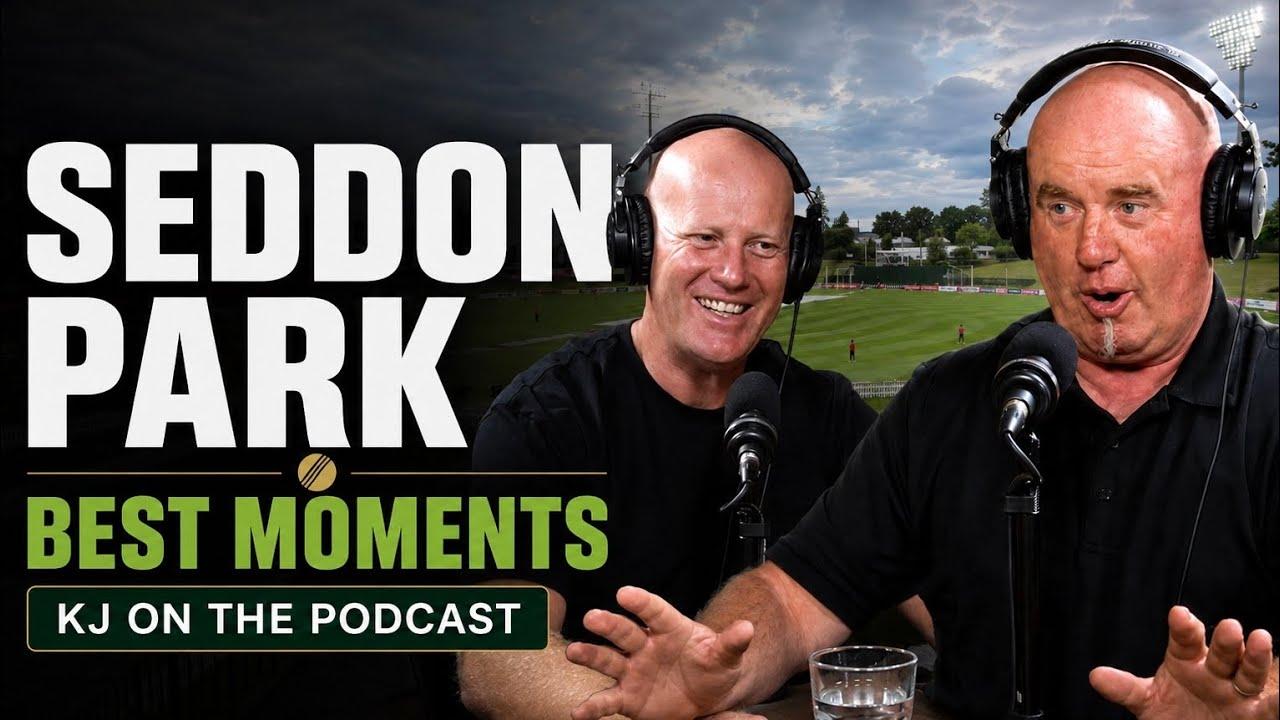
Karl "KJ" Johnson: NZ Cricket's Greatest Moments at Seddon Park
Karl "KJ" Johnson ·
Cricket · · 1 hr 59 min
Former Black Caps captain Ken Rutherford made his test debut at 19 against the West Indies pace attack, scored 12 runs in his first seven innings, then played 56 tests, captained New Zealand and was part of the 1992 World Cup run. He tells Jason Davis and KJ the full story.
“I had zero expectation, so when I at the 11th hour got the call up, I just went, oh well, that's fine.”
Ken Rutherford
“Everyone wants to have a say instead of just letting people who are given the task to do stuff, do stuff.”
Ken Rutherford
Ken Rutherford is a former Black Caps captain who played 56 tests and 121 one-day internationals, and made his debut at 19 against the greatest fast bowling attack in cricket history. He tells the whole story to Jason Davis and KJ, who works with Ken in his day job, in just under two hours.
Ken grew up on Oxford Street in south Dunedin and was playing first-class cricket for Otago at 17, with a New Zealand under-19 tour of Perth behind him. He was named for the 1985 tour of the West Indies on the radio, at 19, and cried, though he is not sure whether it was pride or "what the hell have I just done". He was meant to be the reserve opener who played the tour games, but an injury to the other opener put him in the Test side.
The numbers were rough: 12 runs in his first seven innings. He says the smallest he ever felt on a cricket pitch was facing Michael Holding in a one-day game at Barbados, when the fourth ball hit him in the chest before he had picked up his bat. Malcolm Marshall, coming around the wicket from behind the umpire, was the quickest he faced.
The 7.30am knock on the door is a good one. After a night out in Barbados, Geoff Howarth told him he was playing because someone had turned an ankle. New Zealand were 23 for seven.
A month out from the tournament, Ken had been told by the convenor of selectors, Don Neely, that he would not be in the World Cup team. Then he got the call. With zero expectation, he says, he just had a crack, and ended up averaging 42.4. Australia were the defending champions and Eden Park was half empty when New Zealand beat them, and the run went on from there.
Ken is upfront that the famous tactics were partly luck. Mark Greatbatch opened because of an injury and Dipak Patel took the new ball because the quicks were struggling. He and Martin Crowe were the odd couple in the team, one a public bar man and the other more of a lounge bar man, but he says they got the best out of each other. The Pakistan semi-final, with Crowe injured and a young Inzamam-ul-Haq playing out of his skin, is the one that got away.
After being left out of a New Zealand squad in the mid-90s, Ken took up an offer from Transvaal and calls the five years there the best of his career, playing at the Wanderers in front of crowds of 25,000. He stayed about seven years in total, did TV and racing work, then coached Ireland for two seasons and moved into wagering with the New Zealand TAB.
As captain in 1994 he won the toss at the Wanderers on a damp morning with a changing room that wanted to bowl. He called heads, batted anyway and New Zealand reached about 400 and won, though the series finished 2-1. He also believes the third Test at Newlands should have been theirs.
There are plenty. Batting for a triple hundred at Scarborough, hungover, while Jeremy Coney slept through the middle session. A few quiet pints in a Swansea pub with John Wright while the game was on live television, followed by shuttle runs after the last ball. An Indian tour in 1988 with a home umpire who changed sides once the autographs were done. James Earl Jones stepping out of a lift in Joburg just after Ken had watched him in a movie. And Shane Warne at the SCG, who said nothing for the best part of an over and then told Ken that if he said nothing, he just got out anyway.
Ken says his son Hamish scoring 171 on debut against England was a far bigger moment than anything he did himself. On his time as CEO of Northern Districts Cricket he says it is the hardest job he has had, mostly because everyone wants a say and too little of the work is about cricket. He worries about test cricket, but his main point is simple: protect the kid turning up to the club at seven, and the top end looks after itself.
Ken was written off at 19, left out of the 1992 squad, and still came back to lead his country. As he puts it, the one thing he is proud of is that he did not give up.
KJ has his own stories in The Man Behind the Grass for the All Blacks, Black Caps & Chiefs, and NZ Cricket's Greatest Moments at Seddon Park is a good follow-up. More is on the Ken Rutherford guest page, and the rest of the cricket episodes are in NZ Cricket and Waikato Cricket Stories.
Generated from the audio, so expect the odd wrong word or name. Timestamps open that moment on YouTube.
0:00He's a mate, he's a good mate. I work with him in my day job. He's one of my heroes. One of New Zealand's cricket's most respected former players. The way your career started and to think where you got to, you've got to be so proud. Because we as a Kiwi are proud of Ken Rutherford. I think when I look back, I'll just finish all this maybe. The one thing I'm proud of is I didn't give up.
0:24Yeah. All right, welcome to ShedLife. We've got another great episode coming in at us. We're all about good people working hard. Everyone's welcome in the shed. We love to hear the stories, the highlights, good times, bad times, what's going on. But you've got your old mates here today, KJ and Jase. And then who have we got in the guest seat today, KJ?
0:47Look, nice to be here again with you, Jase, on the ShedLife podcast. The title of this one is The Man Behind the Cricketer. I'm very honoured to have him here today.
0:59He's a mate. He's a good mate. I work with him in my day job. But I'm also, he's one of my heroes. So welcome this morning, Ken Robert Rutherford. One of New Zealand's cricket's most respected former players and leaders. Oh, come on. A wee bit of intro here, Ken. You were born in Dunedin. You enjoyed a distinguished 10-year international career with the Black Caps.
1:28Well, that's the loose definition of the word. From 1985 to 1985, 1995. Representing New Zealand, 56 test matches and 121 day internationals. A talented topwater batsman. He scored more than 2,400 test runs and over 3,100 ODI runs. Earning the reputation for determination, resilience and fierce competitive spirit. Which we're going to touch on in this podcast, Jase. How's your AI thing going there?
1:54No, no. This is me. You're a hero of mine, Rudzi. You also had the honour of captain in New Zealand during the early 90s. You led the national side through a significant period in its development. Beyond international achievements, you had an amazing domestic career. A lot of runs. 14,000 first class runs. Just under, actually. Just under 14,000, KJ.
2:15What was that? 13,993, I think it was. Or 92. Did you run a couple of shorts on there? No, I wanted to get to 14,000, I remember. Did you? Yeah, and I thought, I'm not going to go another season just to get another eight or nine runs. Oh, true. Oh, that's... Oh, welcome, Erdin. I don't know if KJ's intro.
2:33Yeah, my intro. That's right. We might just hand over you if I can get home, eh? But no, what I will say, Rudzi, distinguished career, I have a memory of you that I'll never forget as a teenager. You and your grey nickels bat playing a shot to square leg with massive floppy grey hat. And you're wearing this, and I actually wore this today for you in honour of the World Cup.
2:59Special mention, thanks to the Centre Critic Club, Kent Curry, for the use of this. But, mate, it's an absolute pleasure to have you here today. I had to wear a wide-brimmed floppy cap to make sure my considerable beak didn't get sunburnt.
3:14KJ? I'm really... No, look... No, nice to be here. Nice to be here. It's great to have you here today. We're going to go through a lot of your life in bits and pieces, but I do want to start, if you don't mind. Actually, I'm just going to let you know, too, I have spoken to a few people that have given me a few stories.
3:31Okay, that's all right. Yeah, I'll look forward to those. But you were born on the 26th of October, 1965. It's interesting. It's my father's birthday, the 26th of October. I'll never forget that. You played first 11 in Dunedin, and your debut first-class game was at age 17 years old.
3:56Mate, what was it like as a youngster to play 17 to be playing first-class cricket? Well, that's pretty massive... Yeah, I was really lucky. My brother Ian played 10 years for Otago. So I kind of grew up. I was eight years younger than Ian, and I used to go to trainings with the Otago team back in those days.
4:19You know, Warren Lees was captain. Guys like Bruce Blair, Stu McCullum, Stephen Bok, Peter Hills, John Wilson, Kevin Burns, Richard Hoskin. Big Bro and all those sorts of guys. So I got to know them quite well before I made my debut. But you're 17. Yeah, but I didn't really think about that too much. I'd just come back from Perth, where with the New Zealand under-19 team, we competed in that Kookaburra Shield.
4:41Oh, yeah. Each state side had an under-19 team. I mean, I was the same age group as Tom Murdy. I think Mark Waugh, Steve Waugh, Ian Healy, Craig McDermott, they all played. Tony Dottamade, Mike Dilletta. Can I just stop you there? Mm-hmm. These names that you just rattled off, these guys aren't just some average cricketers, right? No.
4:59They went okay. So we did okay over there. I got 100 against the ACT. It was really hot in Perth, I remember that. I remember there was a pub out at Cottesloe called the OBH, the Ocean Beach Hotel. It went really good too for a young fella. You would have gone to the pub. I think I was underage.
5:12You wouldn't have gone to the pub, would you? I think I did. So I did pretty well in that tournament, got back, and I think Otago weren't really in the reckoning for Shell Trophy honors. That year, so they must have thought, well, we'll give the young fella Rutherford a bit of a crack last game of the season against Auckland at Carersbrook.
5:29Wow. Just prior to the start, so your upbringing school-wise, you obviously played first 11 at a young age as well. I played first 11 for Kings before I actually started school, third form. Yeah, they were short the week before school started, started February. So your brother obviously had played for them? Yeah, he'd come through, but he'd left by then.
5:48And my other brother, Neil, he played a bit of cricket, a lot of soccer and loved the horses. So he was also ahead of me. So I got the call-up from a mate of mine when I was about 13 years of age, I guess. Hadn't started third form and played Port Chalmers. I remember I played at Logan Park against the Port Chalmers first team, all men.
6:06Yeah. I think about an hour and a half and got about 20. I thought, this is great. I remember I, because he always had to wear longs. But of course, I'd come from primary school, we were short. So I said to my mother, you've got to go and point at this pair of longs. But the only one was this old pair of Yens, and the Yens was a bit bigger than me.
6:21And I couldn't wear those. I mean, crikey, it was like Laurel Hardy. And Oliver Hardy or whatever. And so I wore these sort of these off-yellow corduroys, which I used to go out in the tower with down the Opno. You know, to the big daddy's hamburger joint and stuff like that back in the day. But, and trying to get a thigh pad down these very tight trousers was a bit amusing.
6:42But the guy who I played against, a guy called Graeme Carr, who used to win and play his football with at Dunedin City. He played National League football in Dunedin City for quite a while. Very good soccer player. And so I always remember GC was bowling pretty flat out. And I was this young 12 and a half, 13-year-old trying to get a few runs.
6:58Wow. And what about mum and dad? You know, talk about your upbringing from a young fellow then. Well, the old man, he was a Scotch guard in the Second World War. They actually eloped from Aberdeen and Scotland back in about 1950.
7:13He couldn't get work. It was a great irony, I suppose, after the Second World War that the UK was probably worse off than Germany, wasn't it? All this money was being thrown at Germany to rebuild Germany and nothing happened to the UK. So he couldn't find work as an apprentice plumber. Hopped on a boat with mum in Southampton.
7:33Every intention to get to Cape Town and Rob would get off there for a couple of weeks and stop there. Didn't like Cape Town. Went to Fremantle. Didn't like Fremantle. Went to Melbourne. Every intention to stop in Melbourne. Didn't like Melbourne. Ended up in Wellington. Had two weeks in Sea Toon and Wellington in this horrible tenement block where all the, you know, basically refugees from the UK used to go in those days.
7:56And actually said to the guy who ran the boating company, he said, we don't like Wellington either. Can we go back to Scotland? And I said, wow. And they said, no. Oh, you're stuck. You're done. Yeah. The old man couldn't get a job for about, I think, about six months in Wellington. And came up on the noticeable, well, jobs came up in those days apparently, where there was a job to build, as a plumber building the Belcluth Hospital in Otago.
8:21And so he had somebody new down in Dunedin. Stayed with them. I think he might have been his sister, actually. And commuted back in those days an hour there, an hour back from Belcluth every day as a plumber to that, about three or four years. And the old man never left Dunedin, actually. He never once went back to the UK.
8:39My mother did quite a few times. But he was, he said, no, we're here now. Knocked down back. And liked Dunedin or liked Belcluth. Loved Dunedin. Yeah, no. We lived out in South Dunedin. Same house in Oxford Street all our lives, really, from the day I was born. 213 Oxford Street. There you go. 209 Oxford Street. Brendan McCullum.
8:57What was that? Stewie and Jan. Oh, yes. Stewie and Jan and Nathan and Brendan lived there for a while. So, no, it was very working class, very pretty down-to-earth people. King's High School was just around the corner. Went to McKendra Intermediate leading into King's High School. And, yeah, yeah, nice upbringing. Wow, that's quite a great story. Yeah, that's, yeah, it's awesome.
9:16What were some of the things that just, obviously, they've been in the war. I think you mentioned that they weren't, were your parents? I read it. They either weren't able to travel together or they weren't able to come down to Dunedin together because they weren't married or they had to. Something a bit like that. Yeah. Because they ended up getting married in Dunedin.
9:37Oh, yeah. Yeah. You know, so those days of eloping, I mean, I've got two daughters now. I'd encourage them to elope or save me some money. But in those days, you can just imagine, you know. I don't know the true story, but I think there might have been a bit of family politics behind the scenes there. Right.
9:55Well, my sister might listen to this podcast. I keep it what I say. Oh, yeah. But it seems, there's so many good Kiwis now that came over. I know my grandparents came over on my mum's side anyway after the war, you know. Yeah. Just the same thing. It's just I'd had enough that was, you know, gone forward in the war, done all this thing, get back, no work.
10:13And you're like, oh, I know. What do we do now? Let's get on a boat. That's going to be South Africa or Australia or Canada or somewhere else in the Commonwealth.
10:20I wish you'd stayed in Cape Town there, my old man, I reckon. You love Cape Town. Oh, I love Cape Town. Yeah. I would have learned to play off the back foot a lot quicker than I did. Yeah. Good at that one. So what about then, so you obviously played cricket, but what about any other sports, you know?
10:32Yeah, football. No, I love my soccer. I still do now. I mean, of all the sports that I follow right now, soccer's, you know, football's my number one. So, you know, I watch a lot of football. Love the World Cup that's just been completed.
10:44But haven't you? So with that then, there's a little segue. How do you feel about your team finishing third in the EPL then? Manchester United. Correct. Yeah, very happy with them. They're on a bit of a comeback. The transfer market is pretty hot at the moment. Hoping we get a few other good players. But no, I really enjoy my football.
11:02And as a young fellow growing up in Dunedin, it was probably more number one than cricket, frankly. Yeah, and I wasn't bad. Had a good left foot. Same year as Michael McGarry, who played a lot of football for New Zealand. Yep. So when he was a Mosgill player and I was a Camisham player. So that was the big rivalry.
11:19Big rivalry. Big rivalry in schoolboy footy all the way through. And yeah, I enjoyed my football. But I got to the stage where cricket was starting to take over a bit more. And even in those days, you kind of had to have a bit of a choice. I'm interested in where this goes because it feels like at certain times there's pressure on players to make a choice.
11:39Were you pressured? No, not at all. Not in those days. There was, you know, you had the occasional winter cap for cricket when you were sort of 15, 16, 17. But in football, at that stage, I think I got to about 16 or 17 with my football and realised that I had to train a bit harder and, you know, had to tackle a bit harder.
11:57Yeah. It was easier playing cricket as a school kid against men than playing football as a school kid against men. And I was getting to that stage in my football where, you know, I was playing sort of Dunedin City, thirds into the second team, occasionally sitting on the bench. And all of a sudden you come up against some pretty sharp players, right, who would nail you if they gave you a chance.
12:18And I wasn't too keen at that stage on that. Yeah. A pregnant pause. I was just going to say, yeah, did you ever get the blues? It just stuck with me that you mentioned in the book. Oh, yeah. King's Heist. Yeah. Tell me about the book. What is the book?
12:35Anyway, one of 20,000. Yeah. Ken Rutherford, a hell of a way to make a living. I went to that photo shoot. I didn't have any clothes. I had to borrow my Chris Morams, who co-authored the book. I had to borrow his clothes.
12:47Yeah. And he bought it. I bought a bat and no clothes. And no shoes. And clearly I bought a brush. But anyway. It's pretty cool. That was a great book.
12:58Just that you were already playing for the Kings High at first 11 before you'd even made the school, but then they didn't give you the blue, you know. Yeah, that was my no. Because you were already in the men's team. I was playing for Dunedin Cricket Club, senior cricket. So even though I was playing into schools, they didn't give me the blues one year.
13:14But I don't think I was that annoyed about it. I think it was more my parents were, actually. Well, I remember old man being a bit of a stoic Scot, thought this isn't fair go. Yeah. Anyway. Gee, you read the book in some detail. I've forgotten about it. Yeah, that was good. And it's a signed one as well.
13:28It was a signed one. Maybe I'll get another signed one. There's so many gold stories in here. But just that, I don't know whether you want to go with it, KJ, but I just wanted to ask you is, you've got in here just the camaraderie of the Otago cricket team. And you've said here, normally team camaraderie was only present after a good performance.
13:52But with Otago, it was always, and I'll just read it out. But in terms of, bizarre was almost the norm. And then it was, one rule governed everybody through. You were only allowed to wear a jock strap and a cap when you're out in the bush. And bush behind town. So, what sort of team bonding and adventures were going on in the early 80s?
14:21Team bonding normally required a, you know, a jug or two of spades for a start of a 10. But I guess you've got to remember those days, you know, not 82-ish, 83-ish, around there, when you got together. Our first game was always around Boxing Day. That was our first game. Yeah. We used to, in those days, Otago still had a trial to pick their team.
14:40We used to all congregate at Alexander Monview Park. Oh, yeah. In the 80s, first week of December. And there'd literally be a problems versus possibles. Nice. And you kind of knew eight or nine players would be there or thereabouts, you know, in the team. But there was a few bolters would get 100. Like, I remember Kevin Burns got 100 one year when he first played for Otago.
15:00He got straight on the team. Now, if Burns hadn't got that 100, he wouldn't have been in the team. So the trials still had a – They were real. They were proper games where you could force your way in. So we'd get together on, you know, Christmas. I remember flying one day, Christmas Day, to Napier to play a one-day game on the 2016 Central Districts and had a Christmas lunch at the Tamatea Hotel in Napier, which had probably seen better days.
15:25And, you know, Horace McCauley, our manager, he'd give us our brown envelopes with our meal money in. You know, it was always $12 a day, $6, you know, $2 box, cornella, a pint, a pint. You weren't professional? Oh, of course not. That was it, $12 a day. That was your daily amount? That was your money, mate. That was your meal money.
15:46How much did you get? $12 a day, $2 box, cornella, a pint, a pint. That's brilliant. Yeah, that's the truth. That's true. That's the truth. So – But were you working? How did you survive? Oh, I was young then. I was a student. So I left school after sixth form and went into land revenue and did my – started BCom.
16:03So I took a couple of papers at the university. Like, in those days, you've got cadetships through government departments and banks and stuff like that. So I went through that for two or three years before I guess I went to the West Indies, didn't I? Yeah. But in those days, you know, you had guys who worked in freezing works.
16:20They were school teachers. They were, you know, Boccy ran a supermarket in Cavisham and Dunedin. You know, Stewie McCullum was on the road – oh, head of sports. That's right, he did too. He was a sports shop. He was on the road with Gunham War later on and stuff like that. So this was the guys taking their annual leave.
16:35So, you know, we talk about a culture of having a couple of jugs of space and having a punt and that. Well – You were on holiday. It was 100%. It was – this was something they – you know, they were absolutely on the field trying to win and trying to score runs and trying to take wickets and take catches.
16:51But as soon as the whistle was blown on the day, I mean, we're going to enjoy ourselves. Would you say, though, in comparison to today, that you guys enjoyed your team more than what people do these days? You know, because people are playing for money these days. It's different, isn't it? I don't think – is it better or worse?
17:10I just think it's different. You know, aspects of it are way better. I think – and we can talk about this in some detail later if you want to. But, you know, I think if you look at the way the game is these days and the athleticism of the players, you know, I can't imagine – all due respect to Chats, I can't imagine you and Chatfield taking the kind of boundary catches that the Trent Bolts of the Swill take where they acrobatically somersault over the boundary and miraculously, without touching the other side of the boundary rope, throw the ball back and dive and catch it in the field of play.
17:45I mean, I can't quite imagine Chats doing that. Yeah. But mind you, I can't imagine I could do that either, quite frankly. So I just think the game is different rather than better or worse. I think for sure the way the batters, batsmen, go about their work is on a different level to my day.
18:06Bowling, I'm not so sure, though. I think bowling-wise, particularly fast bowling, you know, the 80s and 90s were a period of international superiority in terms of the fast bowls. Yeah, well, which is interesting because I wouldn't mind heading down the internet, your international career. I know it's been talked about plenty, but it is something that I really just have learned more about is your debut.
18:28Can I just read something then? Okay. Yeah. I've been trying to forget about it the last 40 years. I know. All right then. So Otago and Wellington clashes were always dour matches. The main reason being a less than friendly relationship between Wellington's skipper Robert Vance and his counterpart Warren Lees. The match on the eve of the West Indies tour team being named was no exception.
18:57After suffering through a tedious three days, my mood was not helped by my second innings duck. I remember that. Caught it first slip off Evan Gray. Steve McGinnis caught it. Both sides gathered in a bar under the stand at the base and reserve for the team announcement.
19:13K.R. Rutherford, I heard. My mind, my body was numb. I had set this goal for myself as long as I could remember. Suddenly I had achieved it. At 19, I was in the same team as Richard Hadley, Jeremy Coney, Ian Smith, John Wright, and all the names I'd imagine playing alongside for my country.
19:34How was that? Yeah, it was pretty. I don't know if I was crying because I was proud or happy to be in the team or crying because I thought, what the hell? Yeah. What the hell have I just done?
19:46Probably on reflection, probably more the latter. Yeah. Because the Westernies are pretty darn good side in those days. But, yeah, look, I think I was no different to any Kiwi or anyone around the world. You love playing a sport. You want to aspire to achieve the highest possible honours. And playing for New Zealand is still, I believe, the highest possible honour for an international cricketer or sportsman to want to achieve.
20:12So I think it was a mixture of emotions, really. I mean, in those days, you did just listen on the radio. Yeah. Everyone knew after that round of Shell Trophy games that at 7 o'clock was going to be announced on the national radio station. Who were the selectors? Who was? That's a good question. Frank Cameron would have been convener.
20:29Don Neely and probably Bruce Taylor. Yeah. I'm thinking. So it's announced over the radio, the team. Yeah. And I did. What was it like for the rest of the Otago players to hear your name? Oh. Probably pretty cool. Yeah. I think Leezy probably said something like, probably the same as me. Oh, my God. What have you done?
20:47But all the others. No, it was, you know, a mixture of surprise and, you know, incredible, how the hell do you do that kind of stuff. Because, I mean, I hadn't really had that much of a season. I played about eight first-class games up until that point. Mm-hmm. You know, I only got 100. That was at Eden Park No. 2 against Auckland who were weak because the beige brigade were over in Australia playing a one-day series.
21:11So, likes to Sneddon and all those guys weren't in there. The Auckland team. Treby got me a wide one early on and a guy called Steve Adams dropped at third slip. So, if he'd taken that catch, I wouldn't have been picked on that side because I hadn't scored the volume of runs. Wow. But Frank got hold of me shortly after that team was selected.
21:27Frank Cameron and said, look, you're going over there as the third opener, reserve batter. Yeah. And we don't expect you to play A-Test. You might play a one-day or something like that, but you're going to play all the other games. Because in those days you played games between the big games. Touring games, right? Touring games. We were over there about two and a half months.
21:48And, you know, you said you're going to play all those games and just get experience because we see you in two or three years' time being part of our top six. But things didn't go quite well. Things weren't like what Frank said, right? Well, I got 100 in the lead-up game to the first test at St Kitts.
22:06Wow. Yeah, against Corny Wilde. I think it was six. Right. Yeah, sitting in the game. And Ronnie Hart, who was the guy they kind of earmarked to open with Righty in the test, he got whacked on the foot badly, a Yorker. And he could hardly walk. And then I got 100. So, you know, I remember coming back to the dressing room afterwards.
22:26It was the last day of the game. And the righty sort of said, well, again, what have you done? I said, what do you mean? I thought you might say, well done, Mahunder. He said, no, no. You're going to be opening with me in the test. Yeah. And that was pretty much what happened. Can I talk through what happened from there?
22:42Well, I got the old double wash on the first test. You got run out without facing the ball on the second innings. So, you're playing against Malcolm Marshall.
22:54Joel Garner. Michael Holden. I didn't get to face Holden that often, though. I was normally up by then. So, I'm just going to talk you through your first seven innings. And I know it might be reinventing a nightmare, so I apologise for that there, Rudsey. But, Nort in the first innings. Nort without facing the ball in the second.
23:14In the second test, you got four, I believe, in edge through slips, is it? Yeah, my first run was a test cricket. Perfect. What on? Garner between second and third slip. There you go. And that was our next ball.
23:26You got a duck in the next innings of that game? No, no, no, no. We only played one inning. We got 500, though. I got 500. Right. Kroger won 88 and Richard Richardson won 88. Okay, so then in the third test. I'm a first test wicket. I don't know. Larry Garth. I didn't have you down as a ball.
23:42I'm just talking about it. Larry Garth. So then in the third test, you got a duck and two. And then in the fourth test, one and five. So from your seven first innings as an international test player, you've scored 12 runs. Yeah, statistically, it doesn't help. Mentally, mate. I applaud you because you've come back after that and become a superstar.
24:03But how the hell did you get through that period? Because as a 19-year-old, it must have been pretty bloody tough on you, mate. Oh, it probably was. Yeah, but in those days, you know, social media wasn't around, thank God, because I would have copped it one night. Yeah.
24:19Yeah, look, I don't dwell on it. You know, obviously, it was tough, clearly. I mean, after that second test at Guyana, you know, Frank had come up to me. Because Frank Cameron came up on the tour and Geoff Howarth was captain. And they both sort of said, look, you're not going to play, obviously, the last two tests.
24:35And I recall we were staying in this lovely golf resort in Barbados, and it was called the Rockley Resort. And we had these sort of self-contained apartments. I was rooming with Coney, Chatfield. It might have been just those two, actually. And I wasn't playing the Barbados test, so I might have gone out the night before. I had a couple of beers.
24:54Might have. Would have been might have. Might have. Barbados isn't a bad place. We just had a game in Guyana, and that's not such a flash place. So it was pretty, you know, I had a few. And 7.30 in the morning of the test, Geoff Howarth knocks on the door, and he says, Rudd, you're playing.
25:12And I went, are you serious? He said, yeah, Kienzee's, Lance Kienzee's, he's turned his ankle overnight. Pardon? Yeah. Of the dartboard? And he said, basically, we've got no one else to play. Because, you know, and he said, you'll be batting six. And, you know, good luck.
25:32Oh, shit. And I don't think I'd even taken my gear down to the ground for warm-up, you know, for the practice for the previous two days. And it was a very odd test match there, because I think we were 23 for seven batting first. Oh, shit. Yeah. So I was one of the seven, obviously. Yeah. It happened quite quickly.
25:51But I remember we drove out of the resort, the golf resort, on the way to the ground that morning on our bus. And Kienzee wasn't on the bus, but he was playing the seventh hole in his middle of the field, having a seven iron into the seventh ring. And Johnny Brace would turn me and say, oh, how are Kienzee's ankles going?
26:10True story. Yeah. But anyway, we were 23 for seven. We didn't, you know, we got bowled out pretty quickly, I seem to recall. But anyway, that was a really quick, we don't see a wicked barbate us, actually. But yeah, no, then I played Jamaica, because once again, we were kind of running out of players. And in those days, you didn't have, I mean, you've got to marvel at the depth New Zealand cricket's got right now.
26:31Yeah. I mean, they've basically got 40 players who played for the LACAPs last 12 months. In those days, New Zealand cricket would have only had, you had your superstars, Hadley and those guys. But the rest of us just tried really, really hard. And it was probably only about up to 15 or 16 of us, you know, to make a whole squad.
26:48How many of you guys were on tour then? I'm not, I think I'm going to name more than 15. Yeah, so. Yeah, I mean, I stand to be corrected. AI can tell us probably, but yeah, I'm just trying to think of it. So it was righty hearty and I at the top of the order. Then you had Jeff Crowe there.
27:04I'm not sure he was actually. Ah, he was. No, definitely was. Martin, Jeff, Coney. And then you've got Bracewall and all these guys. Derek Sterling was there.
27:14Ian Smith. Bockey, Smilly, Stockley was there. And Braces, Pedals, Chats. Lance. Yeah. For his golf clubs. For his golf clubs, yeah. Well, he had a great fellow, Kiernsey. I learned a lot from Lance on that tour. I remember with him the first test at Port of Spain. Yeah, just to say, sorry, as a 19-year-old, you're with these, you see these guys as superstars, right?
27:36But how were they with you? Were they mentoring you? How did that all work back then? I think, again, because my brother Ian had played a lot and it was a bit unlucky not to play with New Zealand, probably. Yeah, they had a respect for him, I suppose, having played first-class cricket against him for a few years and I'd come in and, you know, I'd met Righty a few times socially and sort of knew him and, you know, got on well and still getting on well with him.
28:01And, you know, I sort of knew the guys anyway. Like Braces had been down at Otago, so playing with my brother and I knew him pretty well. So I really hadn't made those, you know, relationships, started those relationships and, you know, Martin and I played against each other in a few under-22 tournaments and the like and been in a couple of those age group sides, so I kind of knew him too.
28:23So I think that all helped. And, I mean, it was a funny environment though. When I look back and I think it was worse in 86 actually when Coney took over as captain, I think the environment was always a bit like a county team in a way back in the old days where County Cricket was very much about the old English.
28:42You're a professional and that's your career. That's what you do for a job and, you know, you're a bit selfish in the way you went about things. There was definitely a bit of that in 85, a little bit, but it was worse than 86 actually. I should say. There was very much an attitude in 86 with some of the senior players and led from the top with Coney and Turner that, you know, if we keep Richard happy and Martin happy, the rest of you guys can just chip in and we'll do our best.
29:07And it kind of worked to be fair because we won that series. So I'm not necessarily saying that as a criticism. So back then, how many management travelled with the team there? So Frank, we never had a coach. Frank Cameron was there. No coach? No. No, no, no. Sure, no. We had a, Frank was the convener of selectors and he came aboard as like the cricket manager, I think he called himself, or cricket director.
29:29So he, him and Jeff ran the team, Jeff Howarth. And I mean, I look back and I don't, I don't think I was any worse off. Well, clearly my results weren't flash, but I think I had the support that I needed to, for all I needed really. I don't think, by having necessarily a coach as they might have today, it probably would have helped to some extent.
29:53But in those days, as I just said before, you're expected to be very self-sufficient in the way you went about your life, your critting life. So, um, a training, what did that look like? Like, you know, two days ago? I just go to the nets and you might do a couple of laps and you might have a few high changers up in the air and a few catches and then a few slip catches.
30:12I mean, nothing too different probably they do today, but, but just less framework around it. You know, less kind of structure. And run by the captain, from what I'm hearing. So Jeff Howarth? Yeah, more so, more so. I don't even think, we might have had a physio. I know in some of those England tours, we kind of occasionally had a physio for half the tour that they changed.
30:29What about Mark Palmer? Did he get involved with that? Plums only came in, I reckon, I don't think he was there in 86 in England.
30:36I've got a feeling he started off around 87 when we toured Australia. I'm pretty sure he was on that tour. So I'd play cricket with Plums. He was on that Kookaburra Shield, New Zealand 19 team. He was on that team. So I knew Plums pretty, pretty well from that. So yeah, he was part of the team set up for a good six or seven years after that.
30:55What about, you know, like these days, the players are sponsored left, right and centre. Do you guys have your own sponsors or? No, not, I mean, obviously bad sponsors. I mean, I was with Newbury for a wee while then. And righty got me the deal with Gray Knuckles from about 86 onwards. And I was with Gray Knuckles very happily until I went to South Africa and did a deal on ping golf clubs with the Gunner Moore supplier in Joburg and turned to Gunner Moore then.
31:22Because Gray Knuckles weren't a big thing in South Africa actually. But yeah, not really. I mean, more laterally in my career, I got a Mazda car from the local Mazda dealer in Dunedin when I was sort of captain of New Zealand and things like that. But no, there wasn't much going on there. Certainly very different look. Oh, yeah.
31:41Robert Harrison, one of the mates from the lads chat. What was it like facing the great West Indies attack? You know, you've come from Shell Trophy in New Zealand.
31:51It was hard, yeah. I mean, a couple of the worst, the worst I ever felt, the smallest I've ever felt on a cricket pitch was facing Holding in a one day game at Barbados. We bowl me the first three deliveries, short as she outside off stump, and I just sort of, you know, let them go through to the keeper.
32:10And then the fourth delivery, without any noticeable change in action, hit me in the chest before I picked my bat up. And I just thought, oh my God. You know, this is probably a bit of a step up from Albion versus North East Valley at Tonga or Logan Park. That's right. So, and that was probably when I thought, oh my goodness, this is a step beyond it.
32:31But, yeah, no, look, it was hard work, obviously. And, you know, in those days you never had the bounce of restrictions either. They could bowl six out of six to you if they wanted to. And Marshall, if he couldn't get you out, he'd start off trying to get you out pretty much routine. But then you'd quickly go around the wicker and just bomb you, you know.
32:51And that was hard, yeah, because that's quite unusual, you know, to have a guy like Malcolm. And the thing about Malcolm, when he came around the wicker, you never saw him because he used to come on a bit of an angle. And so he'd be behind the umpire. And the last minute you'd see him and he'd be like this whiz and then from around the wicker at your body.
33:09That was hard work. Probably hard if like sort of righty being a left-hander, to be fair. Who was the quickest you ever faced? I think Malcolm was probably the quickest. I mean, people often ask that question, you know. And I've faced Donald and I've faced Akram and Eunice and all those guys. On their day, they're all bloody quick.
33:26And when you're slightly off, everything's a bit quicker. You're not quite in sync yourself. Because obviously Donald, he was real quick, you know. And I've faced spells of Akram and Eunice when they just felt really quick. But probably someone like a marshal or a holding was probably the quickest. Was there a lot of sledging in those days?
33:48Or were you a sledger? Yeah, I don't know if I'm a sledger. I mean, I think people get carried away with what a sledge is and sledge isn't. I mean, it should never over, you know, the lines of abuse. You know, occasionally I must admit every now and again you get a bit pissed off with someone, you might give them a bit extra.
34:05But, you know, but the West Indies sledging, nah. Yeah. England, not really. The Aussies were always the gold standard. But most of their stuff, they're warning those guys, it was more clever than outright abuse. Occasionally you'd go and do abuse. So it was quite funny, right? It was quite odd. Yeah, funny. I mean, Merv was great. Because Merv would spit in the ground and mumble things under his breath and stuff.
34:30But after a while you just kind of expected it. So it didn't really do anything to you. It was, you know, people often ask these questions. Steve Waugh was very good because he was a gully. Oh, you're true. He'd walk across the park from gully to gully and between overs. And often if you're broadcasting the game, there's ad breaks between overs, isn't there?
34:51So nothing gets picked up. But that's when he'd have a crack. You know, so you'd be there between, you know, having a chat to your partner between overs and Steve will pass and say something. Invariably. I guess no stump mics. I couldn't hear it all. You'd get away with it, right? All that sort of stuff, yeah. But I mean, I was never, oh, I used to, you know, Arjuna ran the Tonga.
35:12I had a bit of a running battle. But I mean, it was all, you know, it was on the field sort of stuff. That's awesome. Did the teams get together after matches? Aussies and us did. Yeah. And the Poms in those days. Yeah, we had a couple of great sessions with the Aussies afterwards. Yeah. They were all good fellas.
35:31And often, you know, we used to go to places like Sharjah and that. Oh, yeah. Yeah, we used to go to these tournaments where you'd be over there for about three, three and a half weeks and play about four games. And I remember one tour, you know, the Aussies were there as well. And we got to know those guys pretty well.
35:45And, you know, I was living in Australia the last five years. You know, you see AB every now and again in Brisbane and some of the other guys, Ian Healy and those fellas. So, Mark Waugh. So, it's good to keep up, you know, to know that those guys, you know, over the years are still people that you can send a text to and, in Mark's case, get a tip or a whatever.
36:02Yeah. And just sort of keep those contacts pretty strong. Yeah, nice. Just staying with the West Indies a little bit. What was it like? I just wanted to ask, but is the 80s, what were the grounds like? What was the, you've got down here, it was like a carnival atmosphere. Your music was going. The herb was wafting across the fair, you know.
36:24A bit like playing districts back in the day. Yeah. Before you came and cleaned up, set in the park, eh, Joe? Yeah, that's right. Yeah.
36:35That's a really good question. I mean, there's two tours as a kid growing up in Dunedin that I remember listening to on the radio. Growing up. And one was a 72 tour, New Zealand to the West Indies. Awesome. Listening on the radio, Alan Richards, I think it was, the commentator. And, you know, some of the scenes, I remember reading the old DB Cricket Annual back in the day.
36:53Go and get that one. And you read that and you look at some of the black and white pictures of the crowds in those days for those three or four test batches. You know, Turner and Joe put 387 on one day. I think in Guyana.
37:06So those are sort of the things I had at the back of my mind when we went there. And they were like that. Yeah, they were like that. You know, ramshackle grounds, Port of Spain, ramshackle. And you have got, you know, members, local Trinidadian sitting outside the ground on trees watching the game or on the roof or, you know, just all having their rum punch and getting slaughtered by the end of the day.
37:30It was a hell of a great atmosphere, you know. And likewise, Guyana, Barbados. Barbados in those days were a real quick wicket, you know. And there was a real sense when Malcolm and Joel were both from Barbados as well. So there was a real following there. And the crowds were, you know, with one day cricket not, you know, being as big as, obviously, no T20.
37:49Test cricket was still the kind of panacea for, even for those guys in the Caribbean. So the crowds were huge and they knew their cricket. You know, there's no doubt about that. Yeah, reggae. A lot of reggae on the... Yeah. Bob Marley. Yeah, but also we really, every country was so different. Yeah. Guyana was impoverished. I mean, years later, having toured India and Sri Lanka and Pakistan, you probably look back and say, out of all those countries that you tour, you know, the perception of someone like Pakistan was probably hard work to tour.
38:24But Guyana was real hard work, actually. Wasn't a lot happening there. Yeah. But then your Barbados, where it's quite a big touristy place in Jamaica as well. Yeah. Before you take it, I just wanted to ask, because I saw it in here. I might have found it. It is the Carrow's book. What was it like, the Carrow's book, from the changing sheds to the Scarfies?
38:47And you had down here, like when New Zealand had playoff and you guys had joined them for the pub crawl back to Castle Street. Yeah. But what was the grounds like? And I think it's just for some of the... Really love it for me, but, you know, some of the young people listening is just like what Carrow's book was like in some of these iconic grounds and what you could get away with, let's be blunt.
39:12Well, that's right. And the fans and the... Well, if the showers worked, you were probably lucky. But our dressing room, Otago's dressing room at Carrow's, well, we had two rooms, I remember. So you had the Southlanders and me in one room. Then you had Leesy and Boccy and a few others in the other room. It was quite segregated, frankly.
39:29Oh, yeah. And there was holes in the wall from probably where I'd thrown my bat a few times over the years. And then you had this big, massive area where you used to have like a rugby, like a scrum machine for before you used to go to the rugby field. It was like sawdust down there and stuff like this.
39:44And you walk out from this narrow gap out into Carresbrook. And what people don't remember is about Carresbrook, it's quite narrow ground. So the actual wicket block, I reckon there's only about three wickets that Keith Campbell was the groundsman in those days that Keith could have used. And that would be right, you know. And grass nets, I mean, forget about that.
40:01They used to have the occasional one down at Hillside by the railway standing there. But that was only for an international. So Targa never had grass nets. But also Carresbrook, the signers used to have these concrete things used to stick out. I don't know what they're there for, but like some Brendan Brace used to have a hell of a damage just trying to stop a four and go crash into these concrete things used to stick out.
40:24So, no, it was unique, Carresbrook. It was unique. It was in the terraces there, you know, for an ODI, we used to get chock. You know, the stories about the Scarfies bringing their couches from Castle Street and the like. They're true stories. And then after the game, burn them. Yeah, and they weren't going back on those. And, you know, the pub crawl back into the university there.
40:44The glue pot, the old Kensington on the corner. Then you have the Oval back in the day, Oval Tavern. Then you have the Southern.
40:52And then you'd have George's, which would be called something else. Carnarvon Station, which would be the Prince of Wales. And if you wanted to go up Stafford Street, you'd go to the Provincial and the Empire and the Rugby. Those are all the pubs there. I shouldn't know that, should I? And the Wayne's Hotel. And then you get into the City Hotel near the Octagon.
41:07And then all the way down through, you know, Branson's and Victoria. And, yeah. That's a serious crawl. The Robbie Burns and Robbie. Robbie Burns, yeah. London Lounge, the Old Old Arms used to be called. And, you know, those are my youth. Yeah. How good. Great memories. How good, eh? Can we go to the... We haven't gone very far.
41:28We are. We've only gone to 1985. You've got a great story to do. We're loving it. We're loving it, Rudsey. Got to take you now to the 92 World Cup. Mm-hmm. This was a pivotal time, I guess, for not only yourself, but for New Zealand cricket as well. So, selected in the team. Again, you've got superstars, Martin Crowe and, you know, Ian Smith and these guys.
41:49New Zealand, you were struggling as a team leading into this tournament. Opening game, New Zealand-Australia. Martin Crowe gets 100. You guys away. Mark, great plays. You, though, for this whole tournament, you averaged, and I had it here, it was 42.4, Rudsey. Mm-hmm. Do you know Kane Williamson's ODI average is 48? So, back then, 42 would be, that's way up there, right?
42:16Because scores of 200 were winning ODI cricket back then. Mm-hmm. But you weren't, I don't know, you weren't highlighted as this absolute superstar, but you were an absolute rock. Is that how you felt in your role in the team? Mm-hmm.
42:32So, I think you have to go back to before that World Cup. So, we played a four-game series against England leading up to that World Cup. Got pantsed. Badly. Yes. So, first two, what they did was they picked a team for the first two of those ODIs against England. You know, I wasn't in it.
42:54And I'd been told by Don Neely, who was the Cavaliers of Selectors at the time, that I wouldn't be playing at the World Cup. Wow. Mm-hmm. So, I'd, you know, and that's fine. I mean, that's cool. You know. So, and this was literally a month before the World Cup. And I was playing for Otago and doing okay for Otago.
43:09I remember getting 80-odd at Petonia Rick against Wellington in the game and better pretty well. But I was having a few beers at home one Sunday afternoon after the guys got beaten in the second ODI.
43:24And Neely rang me up and said, oh, you're in the team. I said, well, what team? Because you told me a few weeks ago I wasn't in any team. I said, no, no, no. No, you're in the team to play the third and fourth ODIs. Oh. And I said, oh, really? He said, yeah. And you're probably in the World Cup team too as well.
43:41And I went, oh, really, Don? Oh. And he said, yeah. He said, oh, well, thanks very much. I said, I'll see you. I'll see you there. Yeah. So I wasn't even in the reckoning. I think that kind of helped in a way because it kind of, my expectation weighed none. Yeah. I had zero expectation. So when I, at the 11th hour, got the call up, I just went, oh, well, you know, that's fine.
44:04We'll see if I, well, first of all, see if I play. And if I do play, I'll just, you know, have a bit of a crack. And I didn't really do that well against England, those two ODIs, but play that game against Australia, Eden Park. Eden Park. A lot of people think about, we really went in that World Cup with nothing.
44:24People expecting absolutely nothing. We were almost embarrassingly bad, frankly. England thrashed us on those four ODIs. So Eden Park for that game was half empty. Yeah. People would think what a great day it was and a great, you know, atmosphere. Well, it wasn't really. You know, no one's expecting us to win because Australia were the World Cup champs at the time, having won the previous one in 87 India.
44:48And, you know, they had Marsh, Boone, I think Dean Jones, where he might have been. Jones who played? Mark Waugh, Tom Moody played, Steve Waugh.
44:58He was, He was may not have been there actually then. He was their keeper, I was trying to think. But they had a really good side, an experienced ODI side who'd been playing quite well.
45:08So we weren't expecting to win. And then we beat them and just got on the roll. I think the next game we play here in Hamilton against Sri Lanka. Might have. I got a few against them.
45:18Went down to Napier, played Zimbabwe. Then Batchie, righty got injured. Batchie came in and smashed the South Africans at Eden Park. And then smashed the West Indians at Eden Park. And, well, we went about seven or eight unbeaten, didn't we, before we played Pakistan at Lancaster Park. And got beaten by them. And then obviously got beaten in the semi-final.
45:34Righty got injured. Port of Hemi, I think. So did Rod Latham open or did Paddy open? Yeah, Rod was opening, I think, anyway. Oh, right. So Mark Greatbatch then opened. Yeah, Rod was opening with Wrighty in that Australia game, I'm pretty sure. And three was Jonesy, then Martin, then myself. And then probably someone like Chris Harris, I think, was it six?
45:55Harry definitely played that. Chris Kiernes. Kiernes, he played that game. Kevin Larson. Larson, that's right. Yeah. The old dibbly-dobblies. Yeah, no pace on the ball, which was quite well highlighted. And for our pitchers, perfect. Then also, too, to have Dipak Patel open the bowling board. This was just a new revelation, right? Yeah. So a lot's been made of that.
46:16I don't want to undermine Lee's and Crowe's tactical acumen. But I think both was a bit of a fluke. The fact that Batch opened the batting was through injury. And he was the batting reserve. And with Jones, Crowe, myself going well in the engine room, the feeling was don't change those. So actually, if you're going to get in the team, you're actually going to have to go up the order.
46:37And by the way, your best chance of getting runs on the top of the order is to go hard. Yeah. So I think the tactical side of things was kind of forced upon the senior management of the team in terms of the way we go about it. And it worked. So that's great. And with Dipak, I understand that Danny and a few of the other guys who'd taken the new ball were really struggling to get it right, to get it going in the right area.
47:01Chris as well. So I think in Leesy had used Bocce opening the bowling quite a bit for Otarga in one-day cricket. So I think he probably got a bit of a lead from that and thought, well, we'll give Dipak an over. See how he goes and give him another over. I think it was against South Africa the first game where we tried that.
47:20And the likes of Kepler and a few of the South Africans couldn't hit him off the block. So it worked. Strong personalities in the team, right? Mm. Mark Crowe, Chris Cairns. How did all those relationships work in amongst the team? Yeah, Cairns at that stage, he was like this prodigious talent, so personality-wise strong. But, you know, he kind of knew he was still a youngster coming through, if you know what I mean.
47:49But, yeah, obviously, I think Lees' input into that, into controlling the tempo of the team off the field, was probably pretty good. He could sort of understand different people in their different ways and had that sort of knack of getting things done with everyone across the board. But, no, you're right. Smithy's strong personality as well and other guys, righty.
48:13So. Gavin Larson, I spoke to, he had a few stories, which some of them we can't put across in this podcast. But he did share, he said the personalities, like he put you and Martin and he saw you as like a big bot of space, the working class, you know, and Martin Crowe as this bottle of Chardonnay.
48:38Yeah. Would that be a good way that you saw this? Yeah. And yet you guys battered. So well together, right? Yeah. I mean, a lot of people sort of said that around that time, there was some newspaper articles about the two of us and how we did things differently. I mean, one article was, you know, Martin's more likely to go to the lounge bar and I'm more likely to go to the public bar.
48:57Yeah. Well, you've got down there, he's Italian suits, you're a jeans and a t-shirt. Yeah. Yeah, it was. Quarter-oids. Did it feel like that amongst the team though? I mean, I don't know. I mean, I have to ask, well, Gavin said that, so I guess I must have. But I mean, I certainly had a great deal of respect for Crowe.
49:16Yeah. I like to think he had some respect for me. Yeah, totally. So, I mean, it was a relationship all about getting the best out of each other and getting the best out of our team. And, you know, during that series in particular, we did. Yeah. And certainly, you know, when I captained the side, you know, Crowe was struggling with his knee largely.
49:37I never once felt that he was a negative influence when I was captain. I felt he was certainly on the same page as I, not necessarily completely at times, but he never let that affect the relationship that him and I had. He strongly would, you know, voice opinions, particularly around the Tour de Sarraga and the Tour de England before that in around 94.
50:00But I always felt that those opinions were constructive and respectful. Captaining the team for you in honour? For me in honour? Oh, shit, yeah. Probably didn't expect it one, really. I mean, I never really had any designs on it, frankly. But I'd kept on sides coming through and always felt I had a bit of a knack on the field.
50:20I saw Nashie for a few beers recently. He said, Rudd, you were by far the best on the field, Captain, I ever had, but you're by far the worst off the field.
50:28I don't know what he means by that. It's an elaborate. Yeah. But anyway, I mean, yeah. No, it was not. And that 92 World Cup, it was a special time. Yeah, I think there was a certain amount of good fortune the way things turned out in the end, but probably ill fortune the way right at the end it finished, just the way Crowe's injury and the fact that Pakistan played out of their shoes in that last afternoon.
50:58Inzamal Huck, was that him? Yeah, Inzamal Carmic. So he was a guy new on the scene, I think, wasn't he? Yeah, he was, yeah. So we didn't know much about him, and he just, I think, got 50-odd or 30-odd balls, which in those days was unheard of. Correct. Yeah, we got about, what, 250, 260, batting first. That's a great score.
51:14At Eden Park in those days, that's like, I remember saying probably wrongly to Latham at half time, you know, do we've got this? Do we book our tickets? Oh, you're rude. Yeah, that was always that effect. Probably wasn't quite that. Yeah. But it did feel that. I think there was probably a bit of that in the team as a whole, and complacency, maybe not to that extent, but a sense that, crikey dick, if we blow this, we're really blowing it, really, because this is a winning score.
51:42Jase, you shared a story about the memories of the World Cup for you, mate. Yeah, so I was at primary school, just the end of primary school, and it was the first time that I can remember that a sport, maybe the Commonwealth Games, actually, you know, I was at the 1990 Commonwealth Games, but, you know, the 92 Cricket World Cup, it just became on the scene, and it was just everything that's in.
52:05Everybody was talking about it. Everybody became a fan. And even now, I mean, what are we, like, 26, 34 years later, and it's still, like, talked about as one of the iconic cricketing moments. Yeah, the cricketing shirt, it's the Beige Brigade, the 92 Cup. What was it like just being out amongst the people and the fans? It was huge.
52:29No, it was huge. I mean, it really was. I mean, after that, Auckland won. It was huge. Yeah. It was a good time. Did you celebrate every match? Absolutely. Massively? Flat out. Great. Yeah, flat out. How good. Yeah, the captain cooked heaven, Dunedin. Oh, yeah. I was living in Dunedin, so I'd be very careful, but the captain cooked heaven, you know, but everywhere you went, the sense of, you know, the country being right behind you and, you know, riding that wave, that unexpected wave.
53:00Yeah. There was certainly that sense. It was enormous. I mean, when we played, you know, that semifinal was, that crowd was enormous, wasn't it? Yeah. You know, and even we played, I mean, that half hour when Betch came and smashed Donald, Snelly, Brian McMillan. Yeah. And I think Tushis Bosch might have played that game. Just, I think he hit 80 or Snelly into the stand roof at Eden Park.
53:29And then, you know, just that watching that, that was just like a pinch yourself moment. Yeah. Because everyone in the viewing area is kind of giving themselves high fives. I was like, where's this coming from? Because it's the same player who batted for like, what, a day and a half at Perth. Perth, yeah. And saved it. For about three runs.
53:48Yeah. And, you know, he was that guy who could, I mean, clearly he's had a remarkable impact on a number of, you know, important moments in New Zealand cricket history, really. Do you still catch up with you guys? Still catch last Friday, yeah. As a team? Like, you know, all of us? No, no, no, no. I don't know if we have had a lot.
54:07I've been overseas quite a bit, so I don't know if I have had that many, you know, kind of celebrations or not. But quite a few people are dotted around the world now. Yeah. So, you then get an opportunity to go and play cricket in South Africa. Mm. These days, it's so easy to get in touch with people around the world.
54:24Mm. How did, how did you end up over there? Well, you know, talk us through what. Yeah, Ali, so Ali Barker, who was the supremo of South Africa cricket, you know, he, he, he's a big trunce old cricket man from Johannesburg. And they'd had a couple of seasons, you know, very, very rich history and great, great size of the past and hadn't been going that flash.
54:45And he contacted me around sort of March, April, start of 1995 or 1996 or whatever. A letter, a phone call, how was it? A phone call to who I wrote in my book, actually, Chris Warrams. And at that stage, I was still in the mix for New Zealand. I hadn't been given the Don't Come Monday, which was soon to get.
55:06You knew this? About Ali. No, that you was. No, not at that stage. No, no, no. Turner had said to me that I wouldn't be captain as part of the New Zealand. Because he'd come in as the, you know, change after what had happened, you know, with Jeff Howard and what went on and that Centennial Series and et cetera.
55:25And turns out, I'd met him with turns very briefly at Carersbrook. He said, look, just let you know you won't be captain. I said, OK. Now, no indication I wouldn't be in the squad. But then about a couple months later, he left me out of the squad. So I thought, well, I might take Ali up on that offer now.
55:38So it happened really, really quickly, actually. And honestly, the best five years of my career, you know, in terms of, and look, it's a step down for international cricket. You know, it's still first class cricket. But, you know, it was very, very strong in those days. You still had really good pros at all the association, provincial teams around, so they would get great sides.
55:56And the infrastructure after a part I finished was really, really strong. And their cricket was really strong. And, I mean, my first game against the province in Cape Town and Newlands, their team was Gary Kirsten, I think, played. Jacques Callis played. John Cummins, who played for us. They've got Brian McMillan, Craig McMatthews, Dave Rundle, Paul Kirsten, the keeper.
56:18You know, they had a pretty good side for the official side. Oh, Desmond Haynes was their pro. So, yes, all the pros, good pros. Alden Baptiste was at Eastern Province. Malcolm was at, Malcolm Marshall was at Natal.
56:31You know, so it was, Franklin Stevenson was at Orange Free State. So it was just a really good time. We'd been to South Africa too, just after apartheid. Mandela had come in in 91, 92. They had their first elections. And it was just a really cool place to be and, you know, to be a part of a really big provincial association, to play as your home ground being the Wanderers.
56:55Yeah, wow. Yeah. Which was just an amazing ground, nice, fast, bouncy track, and, you know, there's no excuses. And in those days, we'd play a day-night game, particularly against those other good teams, like North Transville or Natal or France. Sold out, you know, Friday night game. So in what sort of crowd would that be sold out? 25,000 in Congress or something.
57:16And most of them baying for our blood. Yeah. You know, Capitanians or Durbanites living in Joburg in the commercial world, they all come along to support the opposition. So we were kind of, wherever we went, we were a hated team, which was great, you know.
57:32Could you have played for South Africa? No. I really played Test Group for South Africa. So there was that, when I wanted to change country and stuff. No, I really enjoyed that experience. It was great. So you had five years with them? Yeah, I lived there for about seven in total. I stayed there for a couple of years after I finished playing.
57:47And did what? Well, I got involved in cricket, off the field, sort of cricket manager at Hau Teng. Well, it became Hau Teng. Hau Teng. Oh, yeah.
57:57And did a lot of media. I was doing a lot of radio. Not radio. Well, I did do a bit of radio, actually. A lot of TV work and racing over there. A little bit in cricket. So the local competition was broadcast on TV. So I'd be a bit of commentary for that. Oh, yeah. A lot of stuff.
58:15I'm also in the racing side of things, like the on-course presentation work and things like that. And this is where you've, because obviously your career, you've been in racing for quite a number of years. Is this how this started for you? Yeah, pretty much. I'd always had an interest, obviously. So, you know, Nisbo, Grant Nisbo, actually, the guy who gave me a call when I was on Ireland, actually coaching the Irish team.
58:35And he said, look, if you're not that well about coaching. You've also coached a national team. Yeah, I coached Ireland for a while. Yeah. And Nisbo gave me a call when I was somewhere and just said, look, there's a job going to the tab in Petoni and Wellington if you're keen to do something else. I thought, well, why not?
58:54When did you coach the Irish team? A couple of years, when I finished playing. So I did six months in Joaburg after I finished playing and then six months in Ireland, two seasons. How do you get a gig like that? Ali Barker again. Just rings you. Ali Barker. Ali, you say how high, right? No, Ali just said that I was looking for a coach and wasn't interested.
59:12I said, oh, yeah, give it a go. But when I look back, it was too soon after I finished playing. And I think you see a lot of coaches where they finish playing. Yeah. You need to have that sort of distinction, I think, because the game's not the same as when you played it. Speaking of coaches, I'm going to take it back because I'm going to do it.
59:29Love the book. Billy Ibadala. Oh, yeah, Billy Ibadala. Billy just passed away about this time last year. Good age, though, to be fair. Yeah, well, that would make sense based on that he was coaching. Yeah. But what was it? You've talked him up multiple times through the book. So what sort of style and how did he coach cricket and how that might maybe apply to people?
59:52Because a lot of people will listen to this, they're coaching the kids. Yeah. Oh, very basic. Back to the basics. You know, really strong and basics. Foundations and things like that. And, you know, Billy played test matches for Parker Starr back in the 50s and 60s. He played a long time for Warwickshire County Cricket and through a very successful time for Warwickshire in the 60s.
1:00:14And I think he was coming to Otago in the off-season to play a bit of club cricket and to coach. He ended up living and staying in Dineen, liked it. So he was gone. And he literally, mate, Jacey, I was at McEnter Intermediate School and he turned up to take a development, you know, like a development officer session.
1:00:35Yeah, nice. Didn't know much about me other than Ian was my brother. Mm-hmm. And after about one session, he said, you've got to come to my advanced training camp. Oh. One of these advanced training sessions at Warwickshire Park. So I used to ride my Relay 20 from Southampton Eden. Right. There you are back with my cricket gear over my back about three times a week.
1:00:53Yeah. And, no, he was very influential and coached differently to your traditional Kiwi coaches. You know, he was, if you were cutting and hooking and sweeping, he was happy with that. Yeah. If I did that, later on, if Turner saw you do that, he was like, what the hell are you doing? And you got that one down the ground, you know.
1:01:09But Billy was, he coached differently, but very much around strong foundations, you know, keep your feet going and stuff like that. And I see it these days, actually.
1:01:19You know, players don't move their feet a lot these days, and I get it. But I think if they move their feet a bit more, they'll probably have a bit of results. But that's the old funny-duddy of me. Yeah.
1:01:31I'll just put it out there, that bomb, that damn bomb in Sri Lanka. We had two bombs. Yeah. 87 and 92. Yeah. Talk to us. Can you just talk about what it was like touring the subcontinent? I mean, you've got one in here. I don't know if I want it with a great batch. Oh, yeah. I have to say nodgy.
1:01:51That's shit here. That shit here is appropriate, too. Yeah. That definitely is. Yeah. Maybe just a few of the stories. Yeah, India. I mean, we toured India in 87 for the World Cup, and we went back for 88, and they had a test series there, which was, you know, we played three tests, plus all the warm-up games.
1:02:09And then we played about seven or eight one days afterwards. So we were there for about three months. Yeah. It was back in the 80s. It was hard yakka. I'm always saying that. We had a few train trips, actually, between matches. Yeah. Overnight train trips. There's obviously no Facebook. There's no Instagram. So was it like a postcard home situation?
1:02:26Yeah. I'm not joking. It was. Yeah. I'd send my mother a postcard home once a week. Yeah, absolutely. Yeah. That's exactly what it was. I remember one year I got home before the postcard. Oh, it hurt. But no, it was a really interesting time then. I mean, when you look back and you tell some of the stories from it, you go, no, that can't have happened.
1:02:47Yeah, because you guys are doing your own laundry. Yeah. Well, we've started this place called the Hotel Banjar in Hyderabad. And there was this little, what they called it, lake, but it was like a muddy puddle. Yeah. But it had these boulders on the side of the lake. And that's where they used to lay the laundry down.
1:03:04So you put the laundry in there to wash it. Then you go to practice at like 10.30 and you see all the, you know. But you get the bag back into your room and, you know, you'd end up with stockleys. Oh, yeah. Or you'd end up with chancers. Or you'd end up with panels. And so you'd end up in the team room at night time.
1:03:19Right, where's your... Swapping them out. So you learn to put K-R-R. Yeah, no, it was hard. It was at the end of the tour, you were so happy to be on that plane. Yeah. Out of there. And inevitably the first stop is Singapore on the way home. And the first thing you do is go straight to McDonald's at Singapore Airport.
1:03:40Yeah. And have a milkshake. Because there's no milk. There's no, you know. I was going to say, did sickness. Oh, yeah, absolutely. Like that test match in Bangalore where I think Connie had retired. He was doing the commentary. He had to come on and fuelled. Oh, did he? Yeah. Ken Nicholson, the erstwhile TVNZ reporter. He was over there reporting he had to come out in the fuel.
1:03:59I got really crook. But we had rest days in those test matches. So the night of the third night of the test, we used to go and have a few beers and no one got the rest day to recover. And a few of us, well, all of us got sick that night. Righty was first down. And we sort of taken the mickey out of him saying, come on, get up.
1:04:14You know, he'll be right. And then by the morning, probably three-quarter of the team were down. I was particularly bad. And, yeah, I was running with Batchi. And I remember hurdling this sort of sideboard by our beds. And he had his number ones, you know, his blazer and tie and white shirt. And I hurdled it. And a bit of spray.
1:04:33Eked out. Unbeknown to me, in the middle of the night, as I went to the toilet, and it was coming out of both ends. Sorry to everyone who's listening to this, but it is a true story. And Batchi woke up in the morning, and all could hear was, what the hell?
1:04:50Sort of extra dry cleaning work had to go in there. But, no, it was hard case. You know, it was some great stories. I mean, one story was, in those days, there was no neutral umpies. So it was homegrown umpies. Yeah. So, 88, India. You can imagine. Yeah. So our last game before the first test in, well, at Bangalore, actually, we played at a place called Rajcott.
1:05:13Yep. So we arrive in Rajcott, and the hotel is, like, half-built. So there's no elevator. You know, the stairs, there's four or five floors, and you've got to walk up. The stairs haven't got, like, a hand row as you walk up. So as you're walking up, if you lose your balance, you're straight down to the lobby. You know, there's like a big metre gap as you're walking up the stairs.
1:05:33And I'm rooming with Jonesy, and Jonesy at times could be an interesting tourist whose patients could be tested at times. They walk into our room, and literally there's a couple of single bunk beds with mattresses of, you know, like you go camping on. Yeah. And he goes to the toilet or the so-called bathroom. The toilet was pretty much a hole in the ground.
1:05:52It was just a hose that came out the side. Oh, yeah. The old hose. Water for everything you require. Yeah. Shower, basin, toilet work. Yeah. This was just his hose. And he came out, and he said, well, water, water, bloody hell. It was bloody funny. So anyway, so the game started late because they couldn't fit all our bags on the plane because it was a small plane.
1:06:12So it was supposed to, the plane, the baggage truck was supposed to get there like the next day. But it ended up getting there two days. So we're late starting the game. But meanwhile, they had this guy called Reporter. You go and look at him. It was a guy called FD Reporter, I think it was, who had the strongest glasses you've ever seen from an umpire.
1:06:31Yeah. And you thought, well, it's not a good start, really. You can't see. But he was an absolute sycophant for pedals. Was he? Absolutely. And we started late this day. So it started like two o'clock in the afternoon. So the morning was what Richard and this guy, Reporter, the umpire, who's trying to get a test match in Bangalore because he's voted by us.
1:06:51You know, we have a son. So he's got, literally he's got a whole big box of albums and, you know, what do you call it, those books, you know, with pedals, photos, and almanacs. All this, and Richard spends like, literally, I'm surprised he didn't charge him actually knowing pedals, but signing all these books and everything else, you know.
1:07:14So we're thinking, well, we're half a chance here when the game starts, you know. And sure enough, we bowl first. Can I have a look at it? I think pedals got about three or four LBWs. You've got like seven or eight wickets pedals. Yeah. I caught one at a short leg or something, I'm pretty sure. And he got nowhere near it.
1:07:29But I mean, literally, we just, we had to start our appeal and the fingers up. What was it? Mr. Reporter. So, of course, when we come to analyse the umpires, because we played another couple of warm-up games, so we had about six umpires to choose from. Mr. Reporter was at the top of the list. You know, he's our man, Mr. Reporter.
1:07:46I mean, by the end of that game in Rashcott, he's shaking everyone's hands and giving pedals a cuddle. Well, we get to Bagdell, of course, and he's changed ship. You know, he's now batting for the other team, so to speak. Yeah, so every time there was a half an appeal, you're out in New Zealand. Bit of a funny story.
1:08:04Oh, amazing how the stuff went on, hey? Yeah. Like, this is great. Yeah, it was good. And we won the test, of course, in Mumbai, Bombay in those days, and then got beaten. Was it Wankhead Stadium? Yeah, amazing ground. Massive, wasn't it? Pedals bought unbelievable that test, the second test. Some of the highlights, Sir Richard Hadley, or Pedals, like, you got to be with him.
1:08:25I saw it in Howard, find it, but, you know, when he got, like, 300 wickets, 400 wickets. Yeah, at Lancaster Park, he got a milestone there. Then in that test of Bangalore, he got Aaron Lull out by Cougs at third slip, didn't he? Yeah. I was a point. Yeah. Oh, look, he was just an unbelievable cricketer, and every time he bowled the ball, you thought it was going to be a wicket, you know?
1:08:45You used to shit yourself early in the slips, Tim, because every time, you just thought, yeah, something's going to be happening, you know? But when you think about the, you know, New Zealand cricket in those days, as I mentioned before, it was probably all about Richard and Martin, and, yeah, Jeremy was a good player, all really good players, obviously, but it was really about Martin and Richard, and the scrutiny that went on them domestically was huge, but when we toured England and Australia and the other West Indies, they got targeted, you know?
1:09:16So, you know, when Richard was batting against Marshall and holding these guys, they were trying to hurt him, frankly, because they can get Richard injured, you know? So, no, the fact that he was able to have such a long, distinguished career and perform what he did, I mean, it was a pretty special time just to be in his midst.
1:09:34Who would be the best player you've ever played with, and who would be the best player you've ever played against? Batsman Crowe, definitely, playing with. Yeah. And another guy I always mention is Daryl Cullinan, I played a season or two with him at Transvale, and he was a hell of a great player, I mean, really. I mean, well documented, he had a bit of an issue with Warnie, and quite a few of us did, quite frankly, Warnie could bowl a bit.
1:09:58But a player, you know, anyone to bat for your life against fast bowling, I'll tell you what, you wouldn't go far past DJ Cullinan. He was a hell of a player against fast bowling. You know, I used to watch him play off the back foot and just go, crikey, you know, how good is that? You know, he was a really, really good player and underrated, I think.
1:10:19But Javon Miendad was the other guy I mentioned. Miendad was a really good player. Technique that you would not at all copy. He had his own way of going about things, but a really good player and a hard guy to play against. A bit annoying, you know, really, yeah, really annoying. But just had so much talent and a real gunslinger, real fighter and border.
1:10:42You know, you can't go past AB. When you got AB out, you felt like you got two wickets out of football for your one. He's just an outstanding player. Was he a real thinker of the game?
1:10:53Yeah, yeah, absolutely. Oh, absolutely. Definitely a thinker of the game. But just an absolute, the guy you wanted in the trenches, bar no one else. I mean, you wanted him in the trenches with you. And I think when he first captained the Australian side, they were going through a bit of a low ebb and sort of looking to rebuild after those rebuild tours to South Africa and sort of early to mid-80s.
1:11:17So there was quite a bit of division in Australian cricket at that time. And he, I don't know if he did it through his, what he said, but he certainly did it through his actions. The way he went out there and batted and, you know, took on the West Indies at that time. We were a strong side.
1:11:31And, you know, we were a pretty good side. And, you know, he took on paddles and others in England. And I think they won the ashes around sort of the late 80s, didn't they? And got on a river roll from there. And that whole new group of Australian young cricketers at the time, Mark Taylor, Mark Waugh, Steve Waugh, Healy, all those guys, McDermott, they started to come through.
1:11:50Yeah, well. A couple, James Murray, another mate, shouting out. He had one, though. So everyone asks about the great bowlers you faced, but who was your favourite bowler to face? Or is there a couple that you actually looked forward to face? Who I love to face. Yeah, who did you love to face? See, that's a good.
1:12:05Probably any off spinner, actually. Right arm off spinner. I didn't mind, apart from early, probably. But he wasn't really off spinner, was he? I don't know.
1:12:14You don't say that. I didn't mind facing off spinners, particularly in one-day cricket, because the odds are against them. You only have five players on the leg side. So, yeah. I can't think of too many off spinners who were that good, really. I mean, Tim Mayer was a hell of a good off spinner. Obviously, Brace's debate went okay, you know.
1:12:31More than okay. But, yeah. I will think about that, actually. Because there were a couple. I remember a guy, Gary Gilder, one time played for Natal. One bad, actually. I didn't mind facing him for some reason. I used to run in and try and bloody ball real fast. But he was quite quick. But he wasn't always that accurate.
1:12:50So, yeah. I didn't mind facing him. But, yeah. I'll be careful when you're saying these things. Because it could come back to haunt you. I might see him in a bar in Durban at some time in the future. He might have a crack. Yeah, you might have to buy him a beer. Yeah.
1:13:02Muzzle also wanted to know, but this is a bit one. Who was the toughest Kiwi bowler to face in the nets? Jeff Ellert. Oh, God. Lefty. I used to hate facing him in the nets. Because he was a lefty? I used to turn up at Lancaster Park just with his bloody sneakers or his bowling boots and look around his guts quite frankly.
1:13:19Sorry, Jeff. And he'd just be there waiting in the background at Lancaster Park just to bowl. And this was before he was playing for Canterbury even, I think. I think he was just playing club cricket in Crossbridge. And he was a bit of a late starter, I think. Yeah, he was, yeah. GA. Yeah. And honestly, I think he would have had 100 test weekends before he got one, frankly, in the nets.
1:13:40He was a hell of a net bowler. Well, why? I know he's a bestie, but he used to run in with a new ball. And in those days, KJ, frankly, the nets weren't that flat. For sure. And the groundsman, that wasn't the priority. Yeah. Although, I've got to say, out the back of Lancaster Park, they were probably as good as you'd get.
1:13:56Yeah, they were good at it. Because they were proper pitchers, weren't they, for club cricket and the like. Yeah, yeah. Oh, he would just run in and he'd, you know, I think the coaches might have had a word to him too and say, right. Stir these boys up a bit, eh? These boys might have had a few beers last night.
1:14:09You'd better get done for them. Yeah, yeah. He was hard, yeah. But you've got to be honest. In those days, you turn up at Eden Park, the extra extent of the Basin for a Test match, you wouldn't go in the nets. They were terrible. Those nets at Eden Park, number two, they were seriously bad, you know. And even, I mean, I've been playing Test of Newlands, Cape Town.
1:14:31Those nets were awful. And even turning up later on to play for, when I was playing for Tronson, you just had throwdowns because the nets were so bad. But these days, obviously, the standards were a lot higher in terms of the overall, you know, what a ground staff had to provide for a match. Yeah. I want to ask this question because I know your son pretty well.
1:14:50So, your son, Hamish, obviously a very good cricket as well. Was it more pride for you that he played for New Zealand in his debut, he got 171 against England at University of Overland in Dunedin? Was that a bigger pride moment for you than it was actually playing yourself? Absolutely. I mean, I don't, you know, I'm fairly, you know, I don't think I achieved that much, frankly.
1:15:19I mean, you guys might differ in your opinion. I don't feel like that. I do. But when he got his 171 against the Punks, oh, shit, that was huge. Amazing, eh? Have your son played for the country? It was actually, it was huge not just for me but for the whole family, you know. Yeah. I mean, it's obviously a special moment.
1:15:40It's pretty cool. And, you know, we've got sons and stuff and you want them to go out there and do well. But to play for your country and against England who, you know, are a decent cricket side. Yeah, that broad, Anderson and Fulton, I think. Yeah. Monty Penis are. Yeah, cool, eh? No, look, he did really well.
1:15:56He played a lot of county cricket as well. I think he played for about five different counties. So I think it's great that, you know, he had a career, you know.
1:16:05Not all us who start the game or a sport and we get to a certain level can maintain a level for a long period of time. And he showed that he could.
1:16:13Best things I ever saw him play was that Mount Manganui got 100 against India Ray for New Zealand. Oh, yeah. And Mohamed Sarraj and a few of those other Indian players who are playing now, they were playing. And he did it really, really well that day. So, no, look, really proud of what he's done and I've got three other children and they've all done pretty good too.
1:16:31Yeah, no, Tom, Catlin and Holly. Yeah. They're all going good. Yeah. Very cool, mate. Yeah. Love it. I guess too, you know, like he's also followed in your footsie a little bit around a bit of commentating. Yeah, he goes, they tell me he goes, okay, I've sort of, yeah, I've heard of him. He goes, fine. Yeah. He knows the game.
1:16:51He sees the game a bit differently than I do, which is great. Yeah. You know, we talk about it sometimes and, you know, you see my views as more Neanderthal dinosaur than, you know, Elon Musk-ish. Does he tell you that? He would say he's more the Elon Musk. Well, he doesn't have to tell me that. I'll get that drift.
1:17:12Yeah. No, he goes good. And look, he's going down another road now career-wise, but I know that if he decided to come back into cricket that the game would be lucky to have him because he's got a heck of a lot to offer. Yeah. Nice.
1:17:28Your career did go into the media world, but also into the horse racing world. Mm. I want to hear more about how that happened and then, you know, and the roles that you've had over the past few years. Yeah, well, sort of chopped around a bit more laterally, but, you know, I always enjoyed my horse racing. Obviously, it was kind of my out when I was playing cricket.
1:17:47You know, the stories about the best bets in the back pocket and that. Yeah. I won't say they're not true. I'll say they are. Yep. But it was kind of always, you know, I've talked to Mark Waugh about this as well, it was, you know, just kind of, everything's so encompassing when you're touring and playing and, you know, you need something else to do.
1:18:05Mm-hmm. And that was kind of what I did, you know. So that was just to get away from it. Get away from it all, just to empty out the brain, I suppose. Yeah. The good thing about, you know, horse racing is actually, believe it or not, when you're reading form and stuff, your brain's pretty active, actually. Yeah.
1:18:21You're reading numbers and, you know, you're calculating and stats and when it became a bookie as well and football and rugby and cricket and all these other different sports when you're setting prices. Back in the days when bookies did that, they don't do it anymore. But, you know, these days bookmaking is very much a technology industry rather than a bookmaking, pure wagering industry.
1:18:42But a craft, right? Yeah, no, craft, 100% correct. You know, I learned a lot when I first started at the CAB and Petonia around the odd setting and stuff like that. From who? Oh, from a very good guy, a guy called Kevin Remind, who was a football bookie at the time. And he could just talk your way through a game, whatever it might be, and one of the key things you're looking at in terms of home advantage and team news and how that transfers to a price for probability around teams winning the game.
1:19:09So would you set your own odds in the TAB? Back in those days we did, absolutely. Absolutely. I mean, Mark Stafford, he's pretty well known these days, Stafford, isn't he? Yeah.
1:19:18You know, we would have a meeting once the reviews were done from around a Super Rugby, for example, on a weekend. Monday they'd have a review as a rugby kind of group and a few others. And then on Tuesday morning everyone would put their prices in. So in those days the New Zealand TAB were the first ones out for rugby prices for the next week coming.
1:19:38I want to take it back to an old one then. Oh, jeez. Should I just read it from the book, eh? It's had a B.
1:19:47So the host side batted much of the first day and it stumps Edgar and Franklin had safely negotiated a tricky period before the close of play. So this is New Zealand versus Brian Closer's 11. It was, however, Willie Watson's 21st birthday. Yes. And naturally a rather large celebration was planned for that night and studiously carried out. An in-depth tour of Scarborough's night spots was conducted and it's fair to say that everyone partook to excess.
1:20:19Watson's coming of age was celebrated in an exhaustive manner. The second day of the match dawned hellishly sunny. Our normal warm-up routines vanished as everyone sought the sanctity of the dressing room and a place to lie down. A quick jog to the middle, a few throwdowns and a dozen cups of tea was my preparation. Shortly into the first session, Edgar nicked a ball to slips and was out for one with a score of 15.
1:20:45The activities of the previous evening were certainly being felt. My head ached like never before and my body was sore. Well, leading off of that, how did you then, what happens next? I tried to play the games for the next five years under similar preparation and didn't go so well.
1:21:06I remember I nicked one early on. I think I just landed short of boycott. It was a first slip and I was kind of pretty keen to get off, frankly. I hit one through the covers early and I was just on a bit of a roll from there. It was a big night the night before, to be fair.
1:21:19I remember leaving the house bar in the hotel and scarring at four in the morning. Flaming Galliano? Flaming Galliano, as they were. I seem to recall very senior members of the New Zealand team at the time partaking.
1:21:33So, look, in those days it was a first-class game, but it probably shouldn't have been, to be fair. It was a festival game. Yeah. Although they had some good bowlers. Franklin Stevenson, Roddy Silk was a Western Indian, played for Barbados, good bowler. Dilip Doshi, the Indian spinner, he played. Chris Owe was probably a bit past it. Collis King had been with us most of the night, so he was.
1:21:53Yeah. Collis played a lot like that. But, oh no, look, I got a few off the middle. I got 100 before lunch. And I think the funniest yarn from that is that Coney had had a pretty large night too. He had a bit of lunch and slept the whole middle session. And he got woken by the applause as I came in at tea time on 301.
1:22:15And Roddy was slapping me on the back and said, Rods, well done, hell of a nothing. What have you done? This is unbelievable. And woke Coney up and Coney said, Rods, are you still betting? He said, you must be on about 170 by now. I said, I'm on 300, Captain. And I said, oh, yeah, righty, ha, ha, ha.
1:22:31And I said, look at the scoreboard. And he did. He went, oh, the hell. What the hell's going on there? Yeah, that was the funniest part. But, yeah, that was just, yeah, yeah, hard case. Yeah. Right, yards. You did share a story with me a little while ago.
1:22:44Correct me if I'm wrong. You were playing somewhere. I don't know where it was, but you got out early and you shot off down at the pub. Swansea with a variety. Tell me more about that. Yeah, we played a three-day game, Coney game 86 against Morgan and Swansea. Like, both, we opened the batting, both got out early.
1:22:59I'll get out to correct Thomas from memory. Called down leg side and righty knew Swansea pretty well. He said, Rods, let's go for a bit of a walk before lunch down the bay. It's actually quite nice. We had Garfield Sabers who died last week. That's where he got his six sixes. And went for a wander. And the boys started the second session.
1:23:17Crow, Jeff, and Jeff Crow and Coney were getting a few. And walked past this pub. It was right outside the Swansea City Football Stadium. I always remember that. And they had the TV on Welsh TV. The game was being televised live. And we walked in to get the score report. And Roddy said, well, should we just have a quick beer?
1:23:35And he said, oh, yeah, you're the senior player. I was only 20. And so I think we had four or five. And then ended up in the middle of Swansea having some fish and chips outside. New Zealand track suits having another pint. And got back about five at night. And I think turns might have smelt a bit of alcohol on us.
1:23:52Had the whole team out there doing shuttle runs after the last ball. Yeah. True story. Couldn't do it these days, could you? No. Great yarn time, mate. Great memories, too. There was another one in here. I won't find it or read it. But I'll ask you about it. You guys are in Wellington. The rain radar saying rain, rain, rain.
1:24:09Otago. Was it Otago? Played pub golf. Yeah. Was that the one? Yeah. We played pub golf on the back of the forecast. Yeah. They turned up next day with a bright sunny day. Yeah. But I had it with the umpire. The covers clearly hadn't worked. Yeah. We managed to get that game cooled off. Oh, well. Well played.
1:24:28Yeah. Well played. There was another time in Wellington, actually, where you might be thinking of Boccy who grabbed the minivan. We did a bit of pub golf here in Wellington, too. Yeah. No. Things you did in those days. These people listening to this will give you the wrong impression about me. No. It's a great impression. Yeah. Wow.
1:24:43It's a different era. It's good times. The Wanderers test, though. So you're captaining South Africa. So what was that like, the first test over there, 94? Yeah. Look, we'd come from England where we probably hadn't played that well. Yeah. And the side, you know, we had some, probably just going through that sort of transitional period. We had a few younger players there, a few older players there.
1:25:10And no real expectation, to be fair. I think if the bookies were setting odds in that game, South Africa would have been considerable favourites. They had a pretty good side. Cronje was captain. Bob Warmore just coming in as coach. AD didn't play that game. He was injured. But they still had a reasonable bowling attack. I think Matthew Snell.
1:25:26Just trying to think who else played for them that game. But anyway, the funny thing about that was a toss, because it had been rainy the day before, so the pitch would be under the covers. And the morning was still cloudy and a bit murky. And all the importance where you're going to bowl first. But Jimmy Cook, who I knew, and a real stalwart of Transville cricket, great player, played for Somerset, great record.
1:25:51I talked to him about the pitch, and he said, look, he's never seen a drier pitch before they put the covers on. He had seen it. And he says, there were cracks in it. He said, look, I know what the weather looks like. But he said, you know, 99 times out of 10, he would be batting first on this.
1:26:04Yeah. But he understands about the weather. And literally, as I was walking out with Hunsy to toss, the sun peeked through the clouds, honestly. It was seriously like that. And the coin went up, and I caught heads. And it came down heads.
1:26:20And even then, as I was in front of Trevor Quirk, the SABC interviewer, I was still going, oh, God. Oh, I don't know what I'm going to do. Everyone that's changing, saying, we're bowling. Bowling. I'm pretty much the only one who wants to bat here. And even I don't think that's a good idea. I went, oh, we'll bat.
1:26:40And Hunsy's smile. Yeah. Straight away, he's gone, Christ, what's going on here? You know. And we were very lucky that first session. You know, we played and missed, played and missed, played and missed. Flemm got a few, but he was probably lucky to get a few. Darren Murray, I think, might have even been around for a while.
1:26:58Yeah. Good can't have. We were only one down at lunch, I think. There might have been two down. Crowey got a few. I got a few in the afternoon. Tom, I think, might have got a few. We got, I think, down the order, Dooley got a couple.
1:27:11Matthew Hart might even got a couple. We got, somehow got a 400, amazingly. And you just see the pitch. It was a nice sunny weather now. The pitch, you just see it was starting to shine, starting to happen. Yeah. And really, it was, yeah, we just needed the weather to play ball, and we were home, James, and that.
1:27:27And I think they had to get about 250, 260 in the last day and a half, and they were never going to get those. Well, Dooley bowled a ball to Jonty, and off a length, it went over the keeper's head, three or four bounces into the size green behind, off a crack. So, as you know, in these wickets, KJ, it's not the one that does something that gets you.
1:27:48It's the one that doesn't do it. Yeah. It's the back of your mind. Yeah. And that was a classic workout for that. And we got a couple of reasonable umpire decisions. Guy Ian Robinson, who was the Zimbabwean umpire, he probably had a bit of a shock and probably favoured us more than South Africa. But, no, great, great test.
1:28:03We celebrated pretty hard of that one. Yeah. Probably a bit too much, to be fair. That's what Nashie said. He was a very good on-the-field captain. Correct. Yeah. But, no, that was a really, really good performance there. And I think that whole series, you know, I don't necessarily want to get into what happened in that tour. But you can, if you like.
1:28:20But the third test at Newlands, we should have won that test. Yeah. We absolutely should have won that test. And I don't want to criticise umpires, but they had a shocker. You know, and um, yeah, we had Hunsey out on 14, clear edge to the keeper.
1:28:36And it's the last bullet over off Morrison, and Danny refused to get his cap in a short C-suit. I had to ambel over to Barry Lamson and get it, and Barry said, I'm sorry, Ken, I think I got that one wrong. Oh, dear. It was 30 seconds after he said not out. And I'm going, probably not good.
1:28:50Not to tell me that. Good point to tell me that right now. Yeah. Um, so then that, and you look back, you know, that would have changed the whole game, you know. And even, I even backed us. I think they only, they needed to get 150, 160 on the last day. And even if that was 220, 230, I reckon we would have won that.
1:29:08So it's just those small margins, because it was turning a bit, and it was a bit up and down, and it's sooner the hour attack, it's bowling straight. I reckon we would have won that test. But, um, and then you come back, having won a series in Saravagia 2-1. Yeah. And all the other stuff gets, it's not a headline.
1:29:25Yeah, for sure. Yeah. So it was infamous talk. Mm. You don't want to talk about it? Oh, look, I think it's been blown out of proportion, to be frank, you know. Yeah. Just, when I read the book, and just look at it, it just seemed so far out of proportion. Yeah. And it was such a, what are you possibly doing?
1:29:46Yeah. From a New Zealand cricket perspective. Yeah. Because I also, so I come in as a primary school kid, cricket world count. Ooh. Yeah. Love it. And then you're like, then you guys come in through, and just like being dragged in front of like homes. Yeah. Like, yeah. And even then, I'm like, 14 and I was like, it didn't seem like that big a deal.
1:30:07And like, well, if anyone doesn't know, some of the boys smoked a joint at a vineyard, you know, and along these lines, but then it just gets, what was it? It's more that it was New Zealand, you know, hey, legal, shouldn't do it, whatever. You know, naughty.
1:30:23Politics. It's a wrap over the knuckles. But it's a wrap up, hey boys. And that's pretty much, that was a disappointment, I think, to, to, my only comment was it was kind of sorted out on tour. Yeah. Yeah, yeah. That was the way it was sorted out. In house, right? In house. Yeah, yeah. And I was pretty shocked when we got back and it was made public.
1:30:41It sort of speaks sometimes though, and you might want to say, it's a bit of a weird thing in puritanical New Zealand, whether it is just being too hard on strange little misdemeanors. I sort of see it. I'll come across boys that are kicked out of school for, you know, something tiny and then huge things that are just like swept under the carpet.
1:31:01It's... I totally agree with you. That's just what it struck to me. It's just like, why is this... It's amazing what makes news these days, isn't it? Yeah. To some extent, this was amazing in those days how it was kind of made a big... Which is a great segue into your role these days. Oh, yeah. Your administration, as the CEO of Northern Districts Cricket, how tough is that?
1:31:23Bloody tough. Why? Hardest job I've ever had. Is it? Absolutely. Without a doubt. Absolutely the hardest job I've ever had. I've had a few. Can't look at my CV. Yeah.
1:31:34It's hard yakka. Yeah. I think one of the issues I've been really surprised with is, along what you're saying, is how we seem to want to continually have a say in a lot of stuff where you don't really need to have a say. Yeah. And I think... I don't know. I've lived five years in Australia. I think Australia, being a bit bigger country, you're allowed to go and do your job easier.
1:32:05The levels of governance are a bit more streamlined and stuff like that. Over here, I just find that, particularly in cricket, I think at any level, actually. New Zealand cricket level, MA level, DA level, probably even down to clubs and schools. Everyone wants to have a say. Instead of just letting people who are given the task to do stuff, do stuff.
1:32:24Can I ask them... The point I make about that is when I say that it hasn't been an enjoyable time, it's not about cricket. Cricket's almost like it's the last thing. The last thing. Yeah. It's all this other stuff. Yeah, yeah. It's like when you... I think about when I took on the job, I was so looking forward to actually reconnecting cricket people with going to Seton Park and watching a game of cricket.
1:32:47Well, that's kind of the last thing I get to do, you know. And that's been a real disappointment for me. What about then where cricket is at right now? Do you see the day where a player won't play for his country, but is going to go and play franchise cricket? I think it's happening now. And I don't think you can begrudge that.
1:33:07I think the pathways through from being a junior cricketer to being an international cricketer or a franchise cricketer now is kind of... Let's just call that top echelon a professional cricketer, whether that's international cricket or a franchise cricketer or something else. It's just being a professional cricketer. And I don't see there's any problem with that, quite frankly.
1:33:32So the fern on the chest? I sometimes talk to some of our younger players at Seton Park coming through and sort of ask the question, do you still want to play for New Zealand? And the answer is always yes, which is what you want to hear. I think the allure and the pull of playing for your country is still the overwhelming allure.
1:33:53But I think there's certainly that money. Let's just be honest. I mean, the professional game in cricket now pays well. So you can't begrudge a person who's a man or woman cricketer who's very good at, say, T20 cricket to only concentrate on that. That's absolutely spot on. Nice. As a cricket fan yourself, this is for Maza, James Murray.
1:34:16So what are some of your favourite memories watching the Black Caps since you finished playing up? Oh, shit. My favourite sporting memory is Grant Elliott hitting that six-off day. Dale Steyn at Eddard Park. That's hard to beat. Yeah. Were you there? Where were you? I was absolutely there. I was at, when Dale was running into bowl, I was at mid-on, long-on.
1:34:37Yeah. And the TS hit it to mid-wicket, didn't he? So that was a hell of a moment. I think I might have had a couple of beers during the day, but I still recall it pretty well. And that was a great moment. But I mean, the 2019 World Cup final at Lawrence, the obvious ones are moments I think for any ex-cricketer of any note really gets pretty barred up about.
1:35:03But thank you, Grant Elliott or the hairy jaff. What are just the thoughts on the beige brigade and the ACC and that sort of... Oh, I absolutely love it. Yeah, that's great. You know, what it does for cricket. That whole brand is outstanding. You know, it's terrific. And probably hasn't been built on enough. One of my great regrets, I was thinking about this the other day actually, is you think back to when the beige started in the sort of early 80s, I think it was.
1:35:30New Zealand, before it settled on its now current colours, went through all these different iterations like that. Yeah. You know, we even had a white one when we played, I think Pakistan in 88 or 89. A teal? Wasn't there a little teal? That was after me. I think Jeff Ellett might have played with that. Yeah, correct. But I mean, even when I played, you know, when we toured overseas, say to Saragor or India or Pakistan or Sharjah, we always got given a different style.
1:35:52Yeah. I wish I'd kept one shirt from all those. Because I reckon there would have been a dozen, which could have adorned this pub here. You know what I mean? And it would have been just great. But I didn't keep, apart from my one 317 bat, my grey knuckles, I haven't kept bugger or anything else.
1:36:08So, I just want to ask for, because I think this has been missed out. I've been doing, I chat a lot with Waikathu Rugby and we hang with those boys. But is, well, the ACC and the Beige Brigade and then just cricket is fun. It seems to be missing out from the fan experience of the people that actually follow it along.
1:36:26But if you're a CEO of Northern Districts and that, but how do you encourage and go, okay, who's actually going to want to come along and watch cricket and enjoy it? It's just like. Yeah, it's a good question, isn't it? Just to have an enjoyable three hours, which you could teach when you game a cricket. Yeah, and just saying, hey, maybe the guys that are going to enjoy that are actually a group of lads, maybe a group of ladies, but more honestly, a group of lads that are going to want to enjoy some beers and enjoy a punt, enjoy a dart behind it, you know?
1:36:51Yeah, it's almost like. Because it's almost like it's not allowed. It's taken that puritanical 94. And if people want to do that, you know, the security guards are too readily available to quell any fun. Yeah, well, I think they had 92, you know, all the crowds running on and, you know, there's not a high vis in sight.
1:37:09Where would you stand with the old two-y catch of the match or what it was? Oh, that's awesome. Like, that was, it's those things. Yeah. Because I'm a general sports fan. I like all sports. I'm following all things. Busy with kids, business, everything. But those things will often raise up the attention. It's, yeah, the two-y catch a million.
1:37:28I was doing a bit of commentary around that time. I mean, honestly, when the ball went in the crowd, you did cross your fingers in case someone gets seriously injured, quite frankly. But I didn't, if you sort of had one section of the crowd sectioned off just for that, that was probably not a bad way to do it.
1:37:43But they kind of squashed it straight away, didn't they? But it's an interesting one, that one. It's, you know, I go to sporting events, you know, I went to the basketball somewhere recently and you almost didn't watch the basketball because there's so much music going on. And it took away from the main reason you're going, which is to watch the basketball.
1:38:01So it's getting that balance right, I think. Even from the T20 now, some of the music that blares out at every possible opportunity is almost too much. So I think we've got to be careful we don't get away from the main reason we're getting going and watch is to watch, you know, in our case, batters score runs and bowlers bowl well and some great catches to be taken.
1:38:18We don't want to be overcome or overwhelmed by all the other stuff that's going on around. But you're right, to really drive that fun aspect is something we should be looking to do. There's no doubt about that. It gets harder to have, you know, like I think of the little junior coming through. He wants to be able to see, you know, a Tim Seifert play, you know, because they're superstars.
1:38:38But, you know, now with so much cricket on around the world, we're not getting to see our heroes. And it's no different with Waikato Rugby. You know, you want to see all blacks play at that level, right? That's going to be less and less. Yeah. And look, we don't know whether NZ20s, you know, we know it's going to happen.
1:38:54We're hopeful it's going to happen in January 2027. If you ask me what the latest is, I can't actually give you an update because I don't know myself.
1:39:02But that might be the opportunity, you know, in that kind of competition to, you know, with four or five overseas players coming of some repute, local players from the Black Caps playing with some really good domestic players. You know, that opportunity to connect with the local communities around the country might be there. Yeah. I will say another thing, you know, the connection that our current domestic players and international players have with the community, I think, is not good enough.
1:39:29I wonder how restrictive some of the rules are around, you know, getting into those sort of promotional opportunities in the community through the CPAR. And I look at other sports who seem to do it at the downside better, you know, with the connection to community visits, school visits and something happening before a big game in the garden place in the middle of Hamilton, that sort of stuff.
1:39:51I think other sports do it at the downside better than cricket do. I think often, I think cricketers later on in their careers wake up to the fact that they need to start to develop a bit of a network for later on in life. But often it can be too late. I think there's an opportunity there earlier on to really have that connection between the community and a better players, you know, more supportive perhaps of the CBA than currently it is.
1:40:14Yeah. Nice point. Again, I'm going to get into trouble. No, that's a good point. No, it's the same. I hear it from the rugby as well. And it's encouraging them, encouraging people to go out there and have a bit of personality. You know, get them followed and it's not, not to poppy them and take them down because that's where people are seeing it now.
1:40:30I wanted to ask this one, Matt Pulsford, what's the funniest sledge you've ever heard on the cricket field? Oh, look, the one, the only, some of them, as I say, a lot of people ask me that and it's kind of the moment that you're in. And when you tell a story about what Warnie might have said or something, it's actually not that funny, but it was kind of at the time.
1:40:52So you actually see it on YouTube, I hit a ball back to Warnie at SCG, full toss, low full toss. Yeah. And he catches it and I'm clearly out. Yeah. But ODI about 1994, I think it is. Mark Warbring's that all the time. And they're still shitty about it. AB did too, actually.
1:41:09But Warnie in his attempt to catch the ball has gone in front of the umpire. True. And he's caught it and I'm out. Yeah. But I thought, oh, I'm not sure if it's a bump ball or not. So I thought, oh, I'll hang around and let the umpire's mate. And so the umpire at the bowlers in hadn't really seen it.
1:41:27I couldn't see it. So he's gone square leg. Oh, yeah. Yeah. I think Steve Randall, that notable upstanding citizen from Tasmania was one of the umpires. I don't know who the other one was. But the square leg guy went, you know. Not sure. And you couldn't refer to technology because there pretty much wasn't any. But they were replaying it on the big screen of the SCG.
1:41:44And the whole crowd has given it to me. Yeah. And the Aussies sort of congregated looking at the big screen going, Rudds, what the hell?
1:41:51I thought it was a bump ball at the umpires. That was when, well, you know, we're not allowed to leave the big screen, you know. So in that sort of 30 seconds from everyone getting back into their spots on facing Warren next ball, sorry. About two balls later. So Warren has said nothing to me in this whole time.
1:42:08Meanwhile, Steve Ward has given it to me. Healy has given it to me. AB has given it to me. Mark Ward has given it to me from cover. And I said, mate, I thought you were a mate of mine. He said, I was up until about 30 seconds ago, mate. And Warren has given it to me this whole time.
1:42:20I said, nothing. It was about an over later. I've got a single out to backwards point. All past Warren. I said, shit, mate, you're a bit unlucky there. I said, I thought you might have had a bit of a crack at me too. And he said, well, Rudds, I don't know if I give it to you. It makes you try harder.
1:42:34He said, normally if I say nothing, you just get out anyway, mate. True story. Well, that one about the, was the Mars Barrow on the pitch, which Healy said, David Boone or Kouis Fenter, who I played against for free state. Yeah. Yeah, quite a round chap. Real good guy. Yeah. Well, the ball was, he wouldn't get out of his crease to warn you, would he?
1:42:57Use his feet. And Healy said something about what? He put a Mars Barrow on. Put a Mars Barrow on length. And someone said, oh, you have to be quick, because Booney will get it for you.
1:43:08That's quite a good idea. I was looking at a bit of highlight too. Yeah, Booney with his massive moustache and the yellow at the 92. But what was he like? Great guy. He's a terrific guy. He spoke at a function. He did. Yeah, a few years ago. Yeah. Good golfer. Yeah. Great match referee. Yeah. But he is slow start to his career, and he became a real good player later on.
1:43:30Yeah. Real good player. Played pedals really well. Hey, just a couple of things. I've done a little bit of homework on you. Oh, yeah.
1:43:39You saw a James Bond movie many years ago, Red October? Hunt for Red October. That's a Tom Clancy movie, actually. Sean Connery. And would you have met anybody out there? Oh, I should have. Who told you that story? Tell me about that. No, it wasn't a Hunt for Red October. It was another one of those Tom Clancy.
1:43:59Oh, what the hell was it? Oh, come to me. But anyway, who told you that story? James Earl Jones. You met him in the lift. Is that right? Yeah, I did. Yeah. So it was the day before one of my rituals was I used to go and watch a movie before a big game. And it was done in the Santon Sun in Joburg before that Wanderers Test we talked about.
1:44:20Oh, yeah. Patriot Games was a movie. Oh, yes. Patriot Games. I think Harrison Ford might have been. But right at the end, the Admiral was James Earl Jones. And he turned out to be the baddie right at the end. And so I watched the movie. Oh, yeah. Good movie. Got the escalators. Up the escalators. And he had to go to this other part of the shopping mall to get up to the hotel part and waiting for the lift.
1:44:43And out walks James Earl Jones from the lift. Unbelievable. I said, mate, you just bloody died before. He said, oh, did you see your movie? I said, yeah, mate, a good movie. He said, oh, imagine. You enjoyed it, mate. Bloody hard case. That's unbelievable. Yeah. Watch the movie. Then he walks out of the lift. Nice. Yeah. True story of that.
1:45:02Yeah. There you go. Have done my homework, can you? Who told you that? I've got a little bit more on you. Okay. You have a little health thing you do every morning.
1:45:12Tell me about that. What? About lemons. Who the hell told you that? Sure. I froze normal lemons. I've got a good lemon tree at home, so I throw them in the freezer. Yeah. Squeeze two lemons every morning. Every morning. Haven't had a cold this winter yet. There you go. Yeah, I guarantee I'll get cold tomorrow. There's a tip for our listeners, eh?
1:45:29Yeah. Two lemons. What's I saying? I'm a bit healthy. I was a bit worried. Not every morning. It was terrible. Yeah, good, eh? Yeah. Shit. I'm good, eh? Yeah.
1:45:45Talking averages in that, and then we got KJ to bring it along, and I thought it would be worth, is you've discussed the difference in bats. So they're the same weight, but KJ's going to pass them across. But I don't know what era this one is of KJ's. Maybe a little bit older, as we can judge them.
1:46:07I've got a couple of grey nickels. But what has been, because, yeah, we talk about the scores. We talk about averages and that. But how has it changed, and what have you seen from it in terms of the batting? Oh, yeah, look, technology has helped. I mean, it's not all about technology, but this first one here, I reckon, is probably about the late 60s, early 70s, I'd say.
1:46:26Yeah. The scoop was around the early 80s when that came in. This one here is more latterly, isn't it? Correct. Probably about now. Oh, you know, the way the bats are these days with the weight, I mean, this one would be around 2.8, I suppose. Around 2.7, 2.8. I always used around about 2.10, but the 2.10s these days, you know, they're massive.
1:46:46Yeah. You look at the edge on it, eh? Well, some of them are even bigger than that. These new ones, I saw the other day, one of the players had them in the nets. I mean, the edge is even bigger now. Some of those SG bats or whatever they call India.
1:47:02No, they're just incredible bats these days. And also with the, I don't know if I sound like a bitter and twisted old ex-player these days, but the boundaries are pretty, I was watching a 100 game the other day from Lords. Shit, the boundary mid-wicket there was broadened. I think to myself, why are they bringing that in? I don't know, it was small anyway.
1:47:19You know, so it does make a bit of a difference. But, I mean, the spectacle for the punter is pretty good to watch when there's more going out of the ground than starting in, I suppose. That's why, like, when I talked about your averages at the World Cup, like, you know what I mean, back then the scores were a lot lower, right?
1:47:34And you're averaging 42, and I mean, that was a, hey. Yeah, a bit of that, maybe, I don't know. But I'll tell you, the other thing I looked at the other day was when Sir Gary passed away, and I watched some of the old YouTube clips of him. Go and look at this one, particularly when you've got that 250-odd, I think the MCG, against the rest of the world in the early 70s.
1:47:55And I think Gary O'Keefe, and I think Terry Jenner might have been around the park. And go and have a look, there's a couple of still shots there. You can see the width of his bat that he's using. And it's just incredible, you know.
1:48:06And the big difference, I think, you know, for punters watching this is that the middle is so big these days. Yeah. You can actually... Well, a mishit's still going. Correct. You can get it wrong, and it still goes somewhere a long way. Whereas with some of these older bats, unless you get it right smack in the middle, you know, it's not going very far, you know.
1:48:26But no, it's good for them, isn't it? You know, but these bats retailed out for your club cricketers and that. I mean, goodness gracious me, it's probably... They're probably a higher price than a good golf driver, aren't they? Yeah, you're right, yeah. Which is a shame, really, because the sport's becoming bloody expensive.
1:48:44Cricket's always had that kind of, I dare say, elite kind of tag to it, with some. Never with me, but... Yeah, by having the gear at that sort of price, it just sort of reinforces that, you know, you do need to have a bit of money to play the game these days, which is a bit sad. It is a bit sad, really.
1:49:03Was that not the case, or was it different? Because, so, when you would have been a kid and coming up, because I saw that even when my kids played, and we played a lot of hockey, and then you realise, oh, you can actually, if you take two equal kids, and then you give one a $600 stick, and one's playing with a $20 wooden stick, it's like you're getting twice the power, you know, like literally, and it will be the same with a cricket bat these days, is you can actually pay for performance, you know.
1:49:27Yeah, I think you're right. The better bats are better bats. Better off. Yeah. They do cost more for a reason, you know. It's funny, I was talking about this to someone the other day, it might have been Hamish, but I used to have a 210, Gray Knuckles knew what my, you know, style was, power spot, whatever, and often they would turn up, we'd get two or three, I'd only get two or three for a season normally, but they'd turn up, they'd look exactly the same, identical, but they'd always pick up different.
1:49:54You know, there's always, and maybe that's just me, but it was just always something, well, that's not quite right, you know, but it's exactly the same bat, but when you go, honestly, these days, when I see these bats, or, you know, you get, they might get half a dozen leaves at the start of the season, they all just pick up the same.
1:50:09The same. They do. You know, it might just be me, but I remember I used to get a couple of bats from a bat maker in Port Elizabeth when I was playing in Joburg, and bloody good bat. And I got one as a bit of a prototype, because all the, Neil McKenzie and Cullin and a few of those guys were using these bats from this bat maker.
1:50:29So I thought I'd get one and put kind of more stickers on it, just give it a go. What a bat. I was announced, you know, just fell in love with that bat. So after one season, I gave it back to, at least the nets and everything, and the bowling machine, and every game, just use that one bat all season.
1:50:42Yeah. I used to reverberate around the dressing room every now and again, and still come up back for air, you know, I love that bat. And I sent it back to him after the season, I said, you better fix it up, it's got a few dints, and the middle's a bit stuffed, and edges and that. And he came back, and I said, mate, make another one just like it.
1:51:01And he did, he sent it back. I was paying for them. And the other one just didn't, it was, everything was the same, but just never quite, you know. It's like your favourite pair of socks, isn't it? Yeah. Like when I finished with Transville, my last day, and McKenzie and Andrew Horne, if he was lining up to take that other bat off me, yeah.
1:51:19Yeah. Bloody good bat. Rudsey, if you had the power to change one thing in cricket, what would it be? Right now? Right now. Well, I guess along the lines of what I said before, really, you know, I think, I think we make the sport a bit complicated from an administration and governance perspective. I guess the other thing we can't lose sight of, KJ, Jace, is the fact that we all started somewhere in the game.
1:51:47And that was, in my case, turning up to the Elway and Crick Club when I was about seven. Yeah. You know, going through registration, you pay your, probably your five bucks in those days. And, you know, you're told to pull your white socks up. Yeah. And you got your, you're so excited because the first time you've worn your, your white shorts.
1:52:04Yeah. Your, your, your mother's ironed your white shirt and you get put into a group and you start hitting a few half volleys and, you know, we can't lose sight of that. That's where we all started. Yeah. Nice. And that's still important. And I think sometimes we do. And I think it's, we tend to focus as administrators and as governors in our sport, a lot on what happens at the top end.
1:52:25But in many ways, that's not as important as what's happened down here. And we've got to be very, we're talking about the price of gear before. We've got to be very careful that as administrators and as governors that came, we don't lose sight of that, that huge underbelly that deserves our full respect and our full scrutiny. Because we lose that in 10 to 15 to 20 years time, you won't have the top end, will you?
1:52:46Yeah. No, 100%. Yeah, man. I think that's it. It's just too easy to forget. We've got to support the kids that are playing it and the changing dynamics of the kids that are coming through. Yeah. And the other thing about specific to coaching for a moment, and I think we are losing by the side of this, is there are fundamentals to the game, you know?
1:53:09And I think, you know, the way, for example, bad is bad these days, that's fine. But there still is some parts of the game where you can't, lose sight of the importance of, say, for example, footwork, balance, you know, things like that. And I think at the moment, through T20, you know,
1:53:26we don't, we'll be careful, we don't train more baseball players compared to, you know, when I talk about Daryl Callinan, and I talk about Martin Crowe, and the reason why they're two very fine players, you used to be a craft. They were great practitioners of a craft. Yep. And it's called batting technique. Yeah. I don't think these days there's enough emphasis put on that craft.
1:53:52You know, even, there seems to be like a cookie cutter approach to batting these days. Techniques seem very, very similar. And that's the nature of T20. Unless you, you know, open your shoulder up and your leg up, you can't bang it over mid-wicket. Good luck. You've got to be able to do that. But we can't all be about that.
1:54:05There's got to be a bit more, I don't know, more craft to it. Do you think there's a fear that test cricket will diminish? Oh, I don't see how it can survive, frankly, in some countries. I mean, talk about your England, Australia, New Zealand. I mean, South Africa won the test championship a couple of years ago. They didn't play a test match at home last summer, did they?
1:54:29Have they played any tests in the last 12 months? They've probably played two or three, I'm not sure. But I don't think there's any doubt that the pressure at a very, very top part of the game, the ICC, is to make more money. And that doesn't necessarily translate to playing more test matches, does it? At the very least, the form of the game is under pressure.
1:54:51But it's heartening to see England, there's still crowds turning up over there. We're all looking forward to what will be a really good series in Australia at the end of the year. Amazing. With New Zealand going there. And maybe that's what we have to get our head around, is maybe test cricket becomes more of a niche part of the game than what it has been in the past.
1:55:11Do I think that's a good thing? Probably not. But we've got to be careful that, you know, I can't be thinking in the 80s and the 90s, it's what we're about now, you know, and that's the environment we're in now. Is it worth investing more into cricket to play more test cricket? You've got to look at it and you've probably got to say, no, it's not because the commercial activity in the game is just heading one way.
1:55:35Chase, mate, what a chance it's been. Yeah, so many good stories. Okay, no worries. So this is just anything for the Northern Districts, the upcoming season.
1:55:47Oh, look, we've got some outstanding, well, they all are outstanding people involved in the organisation from a cricket perspective and right across it, really. As KJs, we've had a lot of change in the last 12 months and we're in a really, really good spot in terms of having square pegs and square holes and that kind of thing.
1:56:07We're so fortunate in BJ Watling, Peter Boran, Daniel Flynn to have not just people who are very good at what they do in terms of high performance coaching, but are so invested in Northern Districts. That's important. They really... Just good people, mate. They just like ND, they like what ND is about, they like that little, the fact that in the 80s and the 70s there's a waft of cannabis coming from the ND dressing room.
1:56:33I never said that. But no, they're just good guys, you know, and going down to Antoine Dev, such much rain work, I don't get myself in trouble, not talking about everyone here, but we've just got a really good bunch of people who invested in the association, the organisation, and we just, and the players who are under these people, who are working with these people, they love it.
1:57:00The culture, I don't like using the music culture actually, but the values of the place and the behaviours around the place are really strong and it starts at the top and BJ and those guys are setting great examples. you know, where they all head in their own careers will be really interesting to me. I mean, if they start ND for 20 years, I'll be disappointed because there's, there's, there's more for them ahead in the, in the game of cricket than, than staying here.
1:57:26Awesome. Like it. Awesome. It's been a great career. It's been inspirational. I, so many of the dudes I've spoken to have been like Ken Rutherford. Ken Rutherford. Very good. Yeah. 100%. One of my mates, Chris Harris. Oh yeah. Not like, you know, Chris Harris seems to be a lot, but, he was just, right. Whoa. He was my hero growing up.
1:57:47Really? So. You just told me that. Yeah. It's, yeah, I think it's been a great thing. And I think for like a working class Kiwi is just going about and just battling away and then dealing with it. And I was watching some of the interviews. It is just, you know, so straight up with all the interviewers. He needs a bit of work.
1:58:06Oh, we've done this. We've had this. It's just a refreshing. I've probably said a few too many straight things today. It'd be for you to get yourself in trouble. But, I think when I look back, you know, I'll just finish all this maybe. I mean, the one thing I'm proud of was I didn't give up. Yeah. I think I saw that in the book and it was this moment, maybe you went and looked at the ocean or you would win and you'd had the tough start, but you just thought, I'm just going to keep pushing and keep moving forward, which I think is awesome.
1:58:33Mate, you're an absolute legend, but you're a good bastard. That's what I love about you the most. The way your career started and to think where you got to, I mean, you've got to be so proud because we as a Kiwi are proud of Ken Rutherford. And I love the fact, you know, Hamish and your family and you love your wife, Gail, who's been very good to me as well.
1:58:56But yeah, but those things, mate, it's been an honor. Like I said at the start, you're a mate and it's really cool just to hear your story because it's an absolute unique story and one that most Kiwis love about you, mate, that you're just a good bugger and a good Kiwi bugger. So thank you so much for your time.
1:59:13It's been an absolute pleasure. Ken Rutherford. Thank you. Cheers, guys. Cheers, guys. Thanks very much. Appreciate it. Thank you. Thank you, KJ. Thanks, team.
The week's episode, Sport, Garage and subscriber deals, free. What's in it
Karl "KJ" Johnson ·