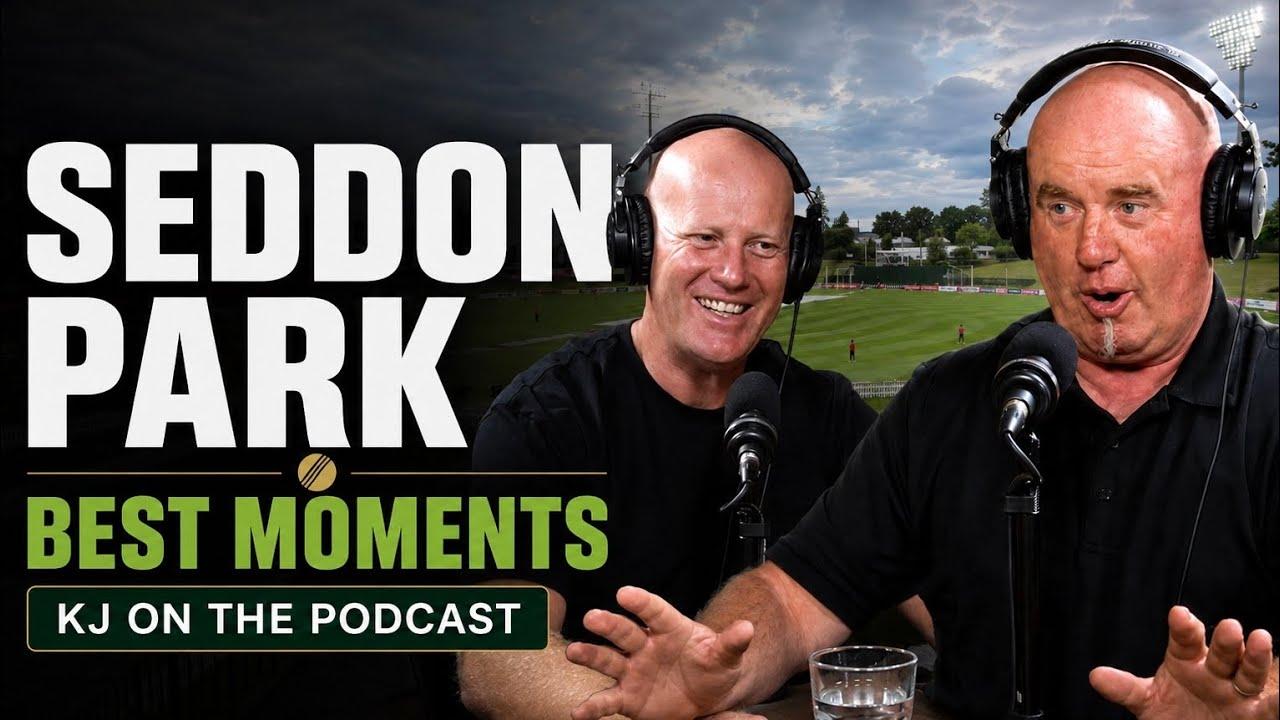
Karl "KJ" Johnson: NZ Cricket's Greatest Moments at Seddon Park
Karl "KJ" Johnson ·
Community, Cricket · · 1 hr 56 min
Karl "KJ" Johnson, turf manager at Seddon Park and FMG Stadium Waikato, tells Jason Davis about working with the All Blacks, losing and winning back international cricket, building grounds in Dubai, the Masters at Augusta and 25 years as a volunteer firefighter.
“I have to be honest, I've never prepared a pitch in my life.”
Karl "KJ" Johnson
“The best thing I could do is put Seddon Park and the stadium back on the map and show that Hamilton's got some pretty special venues.”
Karl "KJ" Johnson
Karl "KJ" Johnson is the turf manager at Seddon Park and FMG Stadium Waikato, the Hamilton grounds that host BLACKCAPS cricket, All Blacks tests and Super Rugby. In just under two hours at the Shedquarters bar he tells Jason Davis how a kid from Waimate who left school at sixteen ended up in charge of two international playing surfaces, with detours through the All Blacks, Dubai, the Masters and 25 years on the fire brigade.
KJ was born in Waimate, raised by his mum, and moved to Christchurch at nine or ten. He played cricket for Canterbury, left school at sixteen and started a greenkeeping apprenticeship at Shirley Golf Course in 1987. When the club could not afford to keep two newly qualified staff he was let go, which he now calls the best thing that happened to him. At nineteen he was head greenkeeper at Akaroa Golf Club, then he ran the nine holes at Lincoln for about five years.
Then John Reid from New Zealand Cricket rang about the turf manager job at the High Performance Centre in Lincoln. KJ told the panel he had never prepared a pitch in his life, and they said they would sort that out. He started in 1998 and his first big match was South Africa against New Zealand A, with Hansie Cronje, Shaun Pollock and Allan Donald.
In 2003 he took the job looking after what was then Westpac Park and Waikato Stadium, and gave Hamilton three years. He did not like it at first. Within about 18 months the city lost international cricket, because the outfield drainage, the pitch and the practice facilities were not up to New Zealand Cricket's standards. KJ remembers sitting at the council meeting while councillors voted on money for the ground and thinking they were voting on his career. Radio Sport was hard on him and people stopped him in the supermarket to tell him to sort the pitch out.
New Zealand Cricket chief executive Martin Snedden told him not to run from it. The reward came in 2007, when Australia played a Chappell-Hadlee match at Seddon Park. Matthew Hayden made 185 not out, Australia reached 345 or 346, and New Zealand were 41 for four with people leaving the ground. Craig McMillan got a hundred, Brendan McCullum made 80-odd, and New Zealand won. Rachel, now his wife, had just cancelled her flight to Scotland, and Stephen Fleming and McCullum let her into the changing room.
Gilbert Enoka asked KJ to join the All Blacks in Samoa in 2015, and he was surprised by how little the team behaved like his idea of them. After the Apia test they drank fruit juice, and on the flight home they spread out among the other passengers. Before the Rugby World Cup in France he tested the venues for the team, checking drainage, hardness and even which size of stud they could use. Wales have trained in Hamilton too, bringing their own gear to test the turf.
The cricketers, he says, need more from him than the rugby players do, because a pitch shapes how a cricket team plays. He also tells how the Chiefs shifted their training to Ruakura, the culture Dave Rennie built around whanau, and the jersey swirls that mark the waterways the players come from.
In 2013 KJ spent 12 months in Dubai for Emirates, building cricket grounds at a desert complex that also had seven rugby grounds. It was 53 degrees in July, and the grass was couch watered with recycled water. Rachel was 28 weeks pregnant with their son Toby when he left. Before COVID he went through four interviews for the Sydney Cricket Ground turf manager role. After an All Blacks test in Hamilton, Steve Hansen told TV that KJ was the best groundsman in the world, which he happily used as a reference. The SCG appointed internally.
KJ gave a signed All Blacks jersey to a visiting John Deere man, who later invited him to Augusta. A knee operation meant he missed the first invitation, and he says he would never have got around the hills. He loved that there were no phones, so people talked, and he met a man at his 63rd Masters. He spent his first day studying the turf, from the vacuum system that sucks water through the profile to the tunnels that keep deliveries out of sight.
KJ joined the fire brigade in Akaroa, moved to Lincoln, and has now served for 25 years. The brigade trains weekly and attends about 150 calls a year. He is a driver and senior firefighter, and says the pager means everything else stops. The same attitude runs through his turf crew, who work seven days a week because the turf does not know it is Christmas Day.
He also commentates with Graeme "Minty" Mead, belongs to a monthly mates' group called Shed 22, and runs lawn brand Keeper's Way.
KJ also turns up on the Waikato Sheds channel. When the Waikato Sheds crew decided they wanted a bar of their own, the first stop was KJ's shed, home of the Shed 22 mates' group, and KJ's first call was to Daryl Hadley of Good George, which turned the day into a full tour of the Hamilton brewery. That bar was built and is now the ShedLife NZ Studio, the room this podcast is recorded in. The whole story is in our Good George backyard bar article.
If you want the cricket side, the Seddon Park episode covers the greatest moments there, and Ken Rutherford talks about batting for New Zealand. The FMG Stadium Waikato guide covers game day, KJ's guest page collects his appearances, and Minty Mead's episode goes into the commentary side.
Generated from the audio, so expect the odd wrong word or name. Timestamps open that moment on YouTube.
0:00Alright, well, ShedLife, welcome to episode two. We are lucky today. We have the man, KJ. Thank you for coming on. Number two? Number two. That's pretty awesome, mate. Pretty awesome. So, quick intro for you before you start. Husband, father, volunteer fireman, turf manager, radio commentator, MC, all-around great guy and everybody's mate, KJ. Anyway, just before we got on here, you were talking about how you were on the All Blacks tour over to Samoa.
0:31Yeah, it was interesting to travel and to stay with the All Blacks. I did some work up in Apea, at Apea Stadium, and the All Blacks played Manus Tamaa in 2015, heading into the World Cup. And one of the things that really surprised me, Jason, was I had this impression of what the All Blacks would be like, you know, in a hotel and staying with them and stuff like that.
0:52And what blew me away was, so after the game, I thought they'd be on the beers and I'm in for this. I'm in for a good time. And we've heard about All Blacks back in the heyday. So, back to the hotel. Actually, sorry, we went back to the Parliament House and they did a cap. Those who got their first caps got a cap presentation, which was really cool to be part of. And I had a beer and I saw the boys all having fruit juice. I thought, oh, that's pretty cool. That's them just doing their thing. And I thought, once we get back to the hotel, she'll be into it.
1:22Yeah, yeah. And got back to the hotel and Sonny Bill's here and, you know, Richie McCaw and all those guys, they're all drinking fruit juice. I was like, this isn't what I thought was going down. But because we were travelling home the next day, they take their travel and making sure they're in a good state because it was going into a World Cup.
1:41Yeah. The next day, though, we travelled by bus to the airport. Yeah. We didn't go into the airport itself. We were actually on a little house on the edge of the runway. Getting onto the plane, here's me thinking, up the stairs, all the All Blacks are going left, right? Yeah. And KJ's going right. No, they all went right and they were spread out right throughout the whole plane. So, they actually sat amongst the punters, I guess.
2:06Yeah. It blew me away. I thought they'd be all up the front of the nose. But no, just the way they engage and the people. So, I come away from that little gig and so impressed by All Blacks and it certainly wasn't what I was expecting. Right. And so, dealing with the All Blacks and I've been working my way through the book Gilbert Inokin's Unstoppable and it's just pretty phenomenal.
2:30Yeah. The culture and then, yeah, the intensity I can imagine leading up until that 2015 World Cup, you know, become the team of the decade.
2:40When did you first get an opportunity to work in with the All Blacks? Like, when would it have been the first test match or match where you'd have been involved? I moved to Hamilton in 2003 and I think in 2004 was my first All Black game.
2:55Gilbert Inokin you talked about. Yeah. He is an absolutely amazing man. I know him pretty well and just the stuff that he's done. He worked with New Zealand Cricket when I worked for New Zealand Cricket and he had a thing called BTB. Yeah. Which was better than before. Oh, nice. Which, when you think about it, is so powerful in its own right. But that was used for New Zealand Cricket and Gilbert's thing with the All Blacks was no dickheads.
3:18Yeah. And that's kind of, you've heard the saying, you know, there's been used a lot. But, yeah, my first involvement, I've done quite a bit of work for them over the years, was we were in Dubai in 2013, 2014 for 12 months. Came home and we had the Cricket World Cup 2015. But the All Blacks were playing, I think we might have played South Africa. And anyway, Gilbert was with the team and he said to me, he goes, KJ, we need to go to Samoa. Would you be keen in coming and giving us a hand?
3:50I was like, yeah. So, that's, yeah. I mean, that's just pretty much how it started and got a really good relationship with them and you've been really fortunate over the years. Yeah. And have you seen, yeah, just an evolution in the way that they go about the game, you know, and treat the game? Yeah, I have. I mean, what I have probably noticed and something that's probably pretty public now is the amount of people involved.
4:12Yeah. So, you get a busload of All Black players, you get a busload of pretty much support staff that come with them as well. So, it is quite a big logistics and stuff that go with the team.
4:24Even with the coaching stuff, there's more and more of them. So, yeah, their demands on us are pretty high. Their expectations of what they want from the, not only the match pitch, but more importantly, the training pitch. They want to be able to train like what they're going to get. Oh, really? Yeah. So, the expectations are certainly going up.
4:41Mm-hmm. Yeah, 0.1 percenters. Yeah. And where would that feed back into the structure? So, like what sort of, obviously, you've got head coach, you've got forwards, backs, you've got like mentals, you know. Right. So, in that gig, I was dealing with the manager, Darren Shand. Mm-hmm. He was the guy who just reached out for me and then I'd give him the information and he would flick it down through the coaching staff or whoever the train is or whoever they needed.
5:37Because even, I've had Wales train with us here in Hamilton and they brought turf equipment, bits and pieces that they could test the turf themselves. They actually adjusted their training depending on the condition of the turf, which, you know, again, you go back to those 0.1 percenters. Yeah. But they're the difference in the, I guess, in the world of rugby. And you see that a lot of our countries are catching up.
6:00Oh, massively. You know, so, yeah. So, they're the little things that they need to be, I guess, focusing on and helping out to make a difference. Yeah, man. Well, we'll get into some of it because I've been impressed. It's been pretty good for the All Blacks lately. I feel like we're, you know, back and doing well. Yeah.
6:15Because it felt like at a moment that they were, you know, the rest of the world was going to catch us and are they going to overtake us? Are our glory days behind us? But I feel like our glory days are still amongst, we're still amongst the glory days. They were led by a good can-tab, eh? Yeah.
6:28That's it. But before we get into some of those cool stories, like, where is it, you know, can-tab, there you go. What a segue. So, where are you from and how did you end up in the mighty Waikato? I'm actually from a little place called Waimati. Now, a lot of people won't even know where that is. And I was, yeah, I was raised by, my mum and dad split up on a seven, so I was raised by my mum.
6:54And then she moved us to Christchurch when I was about nine or ten, did my schooling in Christchurch. Then when I left school, I left school, it was funny, I was in a boys' school, in a boys' Catholic school. Yeah. We integrated with the girls' school next door. Yeah. I lasted one term, mate. There was like 24 girls and us, I don't know, five or six guys in our class, so I only went to cricket to eat my lunch and play, I only went to school to eat my lunch and play cricket.
7:20So, anyway, then I went and did apprenticeship at the Shirley Golf Course as a grand keeper back in 1987. But let's just wind it back. Further. What was it like? No, but just, how was it going? So, small rural town and then going into Christchurch? Yeah, it was pretty tough because obviously my mum, you know, solo mum, we didn't know anybody.
7:41So, I got straight into playing cricket at the local club. My mum, she used to do the scoring. The local club, give them a shout out. Yeah, I was actually trying to think who it was back then. Lancaster Park Cricket Club. Yeah, nice. Yeah, yeah, which was based obviously at Lancaster Park in the day. So, that's, yeah, Lancaster Park Cricket Club, which is no longer there where it originally was, but they play somewhere else.
8:05So, mum was a scorer. I went to school. I played golf. I played badminton. I played crickets. Yeah. All those normal things. I wasn't very big. I played rugby when I was a little fella, but then when I went to secondary school, went to a lot of the Samoan boys were a lot bigger than me. Yeah, yeah.
8:23That's it. That's cool. And then, so sports was what got there and built the friendship groups down there? Yeah, 100%, yeah. My dad still lived in Waimati, so I'd go down there in the holidays and that's, his parents owned an orchard, which is really ironical already, that we're sitting here at an orchard today. Yeah. But, um, I had an apple orchard and my dad worked at the freezing works. I'd go and stay with them in the holidays and, and I learned to drive an old Austin A30 around the, in the orchard and up and down the apple tree lines.
8:58Nice. He had a motorbike, all those sort of things. The old man brought me a horse, which was, I ended up by being allergic to horses, so that didn't, didn't last too long, but, um. Was it on the way to the freezing works when he got a deal? No, it ended up by going to a campground somewhere, I think, so, in Glenavie, a little place in Glenavie, so. Yeah, so that's, uh, yeah, so I went to stay with them in the holidays and then, yeah, but Christchurch was where I did my secondary schooling.
9:22Yeah. Uh, again, played golf, badminton, cricket. Played cricket for Canterbury, played badminton for Canterbury. Nice. And I did it right in the golf, so, yeah. So just going through the age grade? Yeah, pretty much, yeah, yeah. And that's, I guess, what I love. Like batting, bowling, or just a classic? Uh, I was, uh, all, I was an opening bat, uh, bowled a bit as well. My first ever game, I actually played with Chris Kenz.
9:45Oh, really? And, um, we're on the West Coast, but I actually got hit in the head, innit, by being in a hospital. So I was opening the batting, I was on, I don't know, 30-odd or something, and got one in the Swede. But, yeah, Kenzie was in the back of the bus playing a bit of talking heads on the old cassette.
10:00The boom box. The boom box, yeah. That was it, so, yeah. Nice. And so, then what, 15, 16, done with school? Yeah, 16, done with school. School C. Yeah, nice. Yeah, got that. Um, and then one term in the sixth form, and then opportunity came to, to go, and I was playing a lot of golf. Yeah. And I, there was an apprenticeship advertised in the Christchurch Press newspaper at the Shirley Golf Course, which Shirley was one of the top clubs.
10:31Yeah. And I, I loved my golf. I had an upbringing of an orchard, so kind of the outside life, so it sort of fitted. So I applied for it. I actually missed out on it. Oh, really? Um, and the guy that's the current superintendent there, Mark Lawson, was the, he, he got the job as, as the apprenticeship. But a couple weeks later, the boss, Murray Palmer, rang me and said, oh, we've just had one of the other guys leave.
10:53And there's another apprenticeship going, if you'd be keen. So, yeah, I said, yeah, I'd love to. So I started and, yeah. And I mean, I'm so fortunate that I got an opportunity with Murray and he. And so do they still apprentice through? Yeah, they still is. Yeah, I've got an apprentice at work. Excellent. Yeah, it's cool actually.
11:08They have a trade certificate. And, you know, Kiwis are well known all around the world. So, you know, if you get your apprenticeship and trade certificate, you can travel the world. So, yeah. And how long was the apprenticeship there? It was about three, three and a half years. We had to do a block course every year. We had exams to pass, diaries to do, and on-job stuff as well.
11:27So, yeah. And then I actually lost my job then again after that. Because there was two of us, we were going to come out of our apprenticeship at the same time. And the golf club then couldn't afford to pay two qualified guys. So they said, why have you got to go? And it was unfortunate to me. But to be honest, it was actually the best thing that ever happened.
11:48Yeah, one door closes, another one opened there. Yeah, well, it made me kind of go, whoa, what do I really want to do? Yeah. So they'd given us plenty of notice. So I had about three months notice.
11:58I went and did a bartending course because I thought. Well, I could get a job anywhere. Yeah, well, I could get a journey. Yeah, 100%. You get a job, at least I've got a job, right? Yeah. I'm a bit of coin. I was still living at home with my mum and my sister. But I needed to have something to fall back on.
12:14But I was very fortunate. The Akaroa Golf Club advertised for a head greenkeeper. And I didn't even know where Akaroa was. I had an earring in my ear. And I used to wear a bit of jewelry. And I'm heading over to this farming community. So the earring was pulled out. And I had a suit and tie on.
12:32And it was successful. So as 19-year-old, I became the head greenkeeper at the Akaroa Golf Club, which is, I don't know if you've been to Akaroa, but it is a beautiful place. Beautiful spot. I'm just trying to work it backwards. My old man, my grandfather. I think it was my great-grandfather was the mayor of Akaroa. Really? Yeah, that's it.
12:53The Davises came out on one of those original five ships to Christchurch. So there's a little bit of canned air flowing around the Davises. I knew there was some in you, eh? I knew you liked the Crusaders.
13:04My competitive side can't resist a little bit of Crusaders. Absolutely. Yeah, no, beautiful spot. The closest the French came to colonizing us. Yeah, correct. I lived on Rue, Bulgaria, was the name of the road that I lived on. And obviously it was Rue for road in France. I never lived from home. So moving to Akaroa, I had to flat with another guy.
13:25And all of a sudden I'm having to cook, clean. And so, yeah, so it was certainly a bit of a whirlwind difference or change for me. But, yeah. So 19, head greenkeeper.
13:37Played, I don't know, again, played cricket, rugby, basketball. Actually played netball. Got amongst the community straight away because I didn't know anybody. And I thought, well, I've got to get out and about.
13:50Yeah, got 100 over there for the Akaroa Cricket Club in a game down there on the main street in Akaroa. Played a lot of golf as well. Yeah, I was a reasonable golfer. I got down to, you know, five or six handicaps. I played all right back then.
14:05Yeah, just had a good time. We'd go back to Christchurch at most weekends to see my mates and catch up and hit the nightlife. And so what was it? If you're the head greenkeeper, was it just yourself then running it? It was. I had a part-timer and a couple of volunteers, but it was pretty much me, yeah.
14:21So I kind of, it's like doing an apprenticeship again. Like when you're an apprentice, the boss tells you everything to do, right? Yeah. When you're shoved in the seat of the boss. Yeah. I really, I learned a lot about myself and, you know, and that you actually make decisions isn't easy in business or in life and stuff.
14:38So, but I'm really fortunate. The golf club was very supportive and made some changes and improved the place. And then, yeah, so I got good support from the committee at the time. And then I only stayed there about two, two and a half years because the golf course superintendent or the head greenkeeper job at the Lincoln Golf Club came up.
14:59Nice. Back into town. Only nine holes, but a really good nine holes. So I moved back there. And I did join up in the, as a volunteer firefighter in Akaroa. So I did some competition firefighting, which was awesome. Met lots of people through that. Had a good time socially. Yeah. And then moved to Akaroa, I moved to Lincoln and, again, transferred into the Lincoln Volunteer Fire Brigade and took over the superintendent's job at the Lincoln Golf Club.
15:28Nice. How long were you there for? I was there for about five years. Again, we're only nine holes, but it was a really busy little place because it was pretty good condition and we did some stuff, which was pretty cool.
15:41Busy with the fire brigade, busy playing golf, all those sort of things. I then got a phone call from John Reid, who worked for New Zealand Cricket. Now, I was a bit of a cricket tragic, so the phone rings. G'day, G'day Carl. It's John Reid, New Zealand Cricket. How am I?
15:56Bloody John Reid. G'day John. And anyway, he said, look, I want to have a bit of a chat about some potential work up here at the High Performance Centre in Lincoln. Would you come and have a chat? So, yeah, no problem. So, I've turned up. There was Chris Doig, who was the CEO, who was a world-renowned opera singer.
16:14Dale Hadley, so the brother of Richard, but Dale played for New Zealand as well. And John Reid. I'm like, holy hannah. It's a big fish here. Yeah. Fortunately, they took a bit of a punt, and I became the turf manager at the High Performance Centre for New Zealand Cricket. So, that's where the Black Caps train, and where their coaches are, and they're all based on that.
16:35And so, had you started looking after any cricket grounds at this point? Yeah. Had I looked after any? Yeah. No, I hadn't. So, this is straight for me. This is taking the punt. Yeah. Dale actually said to me, he goes, you know, Carl, tell us about your cricket pitchers, you know, preparation experience. And I said, oh, Mr. Hadley, I have to be honest, I've never prepared a pitch in my life.
16:56And Crystal goes, that's all right, we'll sort that out for you. So, Chris was just such a positive fan, you know, he was just, he'd just make things happen. So, yeah. So, they gave me some, obviously, a bit of training and bits and pieces, and I got alongside a few other guys.
17:11And John Reid was, he was pretty much, he loved the ground side of it. So, he was my boss. Yeah. So, the first couple of cricket pitchers weren't great, to be fair. Mm-hmm. But just going back, as I've had it, and for people might, saying it with France, what, was there a voice in your head when you got offered something like that that was like, hey, maybe this is too much for you, KJ, you shouldn't do it, or you were just, you were going to go in for it straight away?
17:37And what do you think got, what did you show them, you think, looking back, that they said, we're going to take a punt on this young guy? It was obvious, you know, they must have seen something. Yeah, good question.
17:50I'd done all right. I'd won a couple of awards as a golf course greenkeeper. So, the turf-grown side of things was pretty much the same. The preparation of a pitch was obviously different. But I think, you know, I lived locally. They kind of obviously done a bit of homework on me as well. And I was young, and I felt, you know, I'd been at the Lincoln Golf Club for five years.
18:11I was probably due to perhaps go somewhere else or do something else. And the fact that I was still in the turf industry, and I love my cricket, so I was kind of like, you know, what, yeah, this is perfect. So, no, there was nothing that sort of, no alarm bells that did go off. Yeah. I was pretty excited.
18:27And to be employed by New Zealand cricket was, it was kind of cool, you know. So, yeah, no, I got really excited about it. And I kind of saw potential for more opportunities with cricket than I did at golf, you know, like, you know, which is, as it's worked out, I've had some amazing opportunities through the fact of looking after, you know, cricket and rugby stadium.
18:48So, that was probably a bit of a change. I was a little bit of a black sheep in the turf industry. Going for golf was kind of the predominant in the turf industry, but to go down the cricket, there's not many of us that do what we do, so. No. Yeah. So, that was it, yeah. Interesting. And so, what are we looking at then, mid-90s, late-90s?
19:07That was, I went to New Zealand cricket in 98. Yeah. I had a Women's World Cup in 2000, which New Zealand beat Australia in the final, which was pretty cool. My first big game was South Africa played New Zealand A at Lincoln, and guys like Hansi Cronje, who's no longer with us, and Sean Pollock and Alan Donald, superstars of, like, South African cricket, that was my first big match.
19:36Yeah, the World Cup in 2000, and then 2002 was the under-19 men's. Did they put any pressure on you for the pitch, or what was it like? No, it was kind of the warm-up games for them before they played test matches. So, you know, they were pretty good, to be fair. They were pretty cool to deal with.
19:53I mean, again, these guys are childhood heroes. You know, I'm a cricket fan, so to see these guys, but to work with them, and they're coming to me asking information on pitch, you know, it was actually pretty cool. Yeah. This is a bit of a pinch-me moment, but yeah. Yeah, so, yeah, that's pretty cool, and I guess that's one of the things that I've had many years of working with sort of some quite high-profile teams and players, but they're no different to you and I, mate, eh?
20:18You know, they clean their teeth. Yeah. You know, they tie their shoes the same as you and I, so I just treat them as if they're a customer, right? You know, so I need to make sure that they get what they need or the information from me or whatever and produce a good pitch, and if they don't like me, bad luck.
20:34Yeah. It is what it is. That's awesome. And so, yeah, looking after the New Zealand, yeah, high performance there. And then what happened? So it was in 2003, the role came up up here in Hamilton. Yeah. To look after, it was known as Westpac Park then, was a cricket ground, and Waikato Stadium was FMG Stadium Waikato as it is now.
20:59So it was a dual role. Yeah. But I'll be honest, Hamilton didn't really… Wasn't a city of the future then? Wasn't a city for my future, what I didn't feel. Yeah. I was single. I didn't know anybody in Hamilton. But I was actually quite excited by having two venues. Mm-hmm. You know, like the Wellington have got a multi-venue, Eden Parks multi.
21:23I just like the idea of having a pure cricket ground. Yeah. And a pure rugby stadium. Mm-hmm. So I moved here, took the job.
21:33The only people I knew was Scott Styrus and Daryl Tuffy. So I actually lived with them initially until I got to my feet on the ground. So that was an interesting… Yeah. You know, Scotty was a bit of a hard case. And so, yes, I lived with those guys. I hated Hamilton, I'll be honest. I just… Why?
21:54I found it difficult to meet people. And I found it not as friendly as perhaps Christchurch was. So I gave myself three years, I said, if that's it. And then in the first, I don't know, 18 months, we lost international cricket. Mm-hmm. So I was front page for weeks on end and all terrible stuff, not great stuff.
22:16What, lost the match? We lost international cricket. We lost the status. Oh, yeah. Yeah, so we had to rebuild the ground. The ground needed work when I arrived. Yeah. But it was… Was that ICC or the New Zealand cricket? No, there was New Zealand. Well, there was a little bit of both, but it was more so from New Zealand cricket.
22:31You know, there needed to be expectations or standards met. Yeah. And we didn't meet a lot. You know, drainage of the outfield, the pitch performance, the practice facility was poor. So there was a whole lot of things. So within the first couple of years, council had to invest a lot of money into the place. Yeah. And I can remember going to a council meeting where it was being voted on.
22:54And, like, I'm sitting there going, they're voting on my career. Yeah. You know, like, I'm either going to be working at Wickles tomorrow or I'm continuing to do what I do.
23:03And that was… So that was a bit of a… That was a tough old time. Mm. Again, I was on my own. I'm a family, a mate from Crosshirts, but… Were you still playing sports? I can be in the fire brigade at this point. No, I wasn't at the time because when I moved here, I didn't think you could be a volunteer in the city.
23:17So I didn't… I just… So I actually put a hold on my career, you know, my volunteerism. So I wasn't doing that. I played a little bit of golf, but I was just busy working. Yeah. Like, I just really need… And lose cricket, I felt terrible. Yeah. I felt it was… I've let the city down. Little old ladies in the supermarket coming up to me and saying, you get that cricket pitch sorted, Sonny?
23:38And, you know, people on Radio Sport were just honing into me. It was… It was terrible. So… And I'm… I'm pretty much… I'm going, eh? Yeah. But three years in the… But what happened was with about, I don't know, probably a month ago before three years was up, I met Rachel. Mm-hmm. So in 2003, when I'm only going there for three years, we're now 2025.
24:01So it's been a pretty long three years. Yeah. No, it's nice. But going back to it, it must have been, how did you pull yourself out of the dumps or what made you going? So you've had a, I wouldn't say a golden run, but a pretty pleasant run, you know? You've left school, you've got the apprenticeship, you know, you miss out, but then they give it to you anyway.
24:21You know, like, you do it, you finish that role, but then you bump over to Akaroa. You know, that's a bit of fun. You're into Lincoln, then with no experience, you're suddenly doing the pitch at the New Zealand cricket high performance. So, you know, like, yeah, you're hitting a few sixes so far. Yeah. Then to suddenly turn up in Hamilton, new city, new, you know, New Island, you know, quite different, you know, quite far away.
24:44Yeah. How do you keep getting up, you know, get up and face that every day? I guess… I bagging it, you know, in radio sports, possibly the most brutal talk back then. Yeah, it was pretty tough to hear it and read it. And, you know, you talk about social media. There wasn't a lot of social media back then, but the newspaper was, you know, good stories don't sell papers, right?
25:07No. So, you know, it would be front page for a lot around, and it was all terrible stuff. And again, we're spending a lot of money, spending ratepayers money, so I felt… Absolutely. I actually felt I owed it to the city to get back and get it back to something that people can be proud of. So, I was probably driven by that.
25:23Yeah. And I wanted to prove that I was good enough, and I needed to prove myself I was good enough. Martin Sneddon, who was the CEO of New Zealand Cricket at the time, he actually said to me, KJ, he said, the best thing that you can do, mate, is… Because I was actually looking to get out. Yeah.
25:38Get away, and I just, you know, but I kind of… You know, without him saying it, he sort of pushed me down the lines. Don't run from it, KJ. You know, embrace it. Take on the challenge. He said, you're good enough. You'll get it back. So, it was probably Sned's little bit of a chat with him on the phone, and… Yeah.
25:56I mean, he was right, to be fair. Yeah, I mean, the best thing I could do is put… Mm-hmm. Set in Park and the stadium back on the map and show that Hamilton's got some pretty special venues. And, you know, that was in 2004, 2005, whenever it was. And, you know, since then, we've had a really long… Yeah.
26:15You know, we've had some great games. And we've been awarded some really big matches, which goes down to meeting expectations of New Zealand cricket and All Blacks and that sort of stuff. So, yeah. And then how was it also getting into the rugby venue at the same time? Yeah, no, that was… When did they rebuild you from, Jack?
26:29That was just before my time. So, it was pretty much brand new. Mm-hmm. I think Hamilton's made an amazing decision to build the venue like they did because there was… Originally, they were looking to build a multi-purpose, bigger venue at Claude Lens and have cricket and rugby. Oh, yeah. Well, I think the intimate size of FMG Stadium in Wakanda at 25,000 people and it's a rectangular field.
26:53So, you're so close to the… I mean, you guys… Absolutely. I mean, like, you just… I think the foresight of who made that decision there, shout out to that because, yeah, that was a… You know, you go back 25, 30 years ago, it was all about the, you know, the cake tin down in Wellington. Yep, totally. It was a purpose.
27:10Eden Park's the greatest, you know, the endless debate of whether it should or shouldn't. Yeah, yeah. But, yeah, and there's… Yeah, I love it with Waikata Rugby, watching that there. I'm a huge Warriors fan. So, you know, like, Mount Smart, go Media Stadium, you know, like it is. It's like, to watch rugby league, you want to be in a rectangular stadium.
27:28And it's funny, so, because my mother came up when I first moved here. The Crusaders played the Chiefs. And I got her some tickets and I said to her, I put her in the front row on the very, very end seat. I said, you sit there, I'll go and do my stuff. Once the game starts, we'll then go up and there'll be some spare seats up in the top where we'll be able to sit.
27:50And she goes, yeah, sounds great. So, anyway, did all that and then the game started. I went and grabbed her and she said, I ain't leaving. I said, what do you mean? I said, I can just about touch the players. I want to stay. So, we sat in what is probably the worst two seats in the venue and watched this game of footy.
28:07You know, like it was just for my mum's… Yeah, she loved it. And she said, I can nearly touch the players. So, yeah, we're pretty special with the… I think, was it the last All Blacks match there or am I thinking of… But, anyway, I could see the players in a moor and a bit of fisty and they're literally on the side, you know.
28:29A few kids there like, whoa, literally touch with the players. That's pretty cool, wasn't it? It's so cool. Yeah, so well done to Hamilton. So, what was it like taking on a… So, did you have much of a team down in Christchurch? You must have had to take on a team in a separate team or the same team looking after both grounds?
28:46In Christchurch or here? Yeah, well, did you go from much of a team in Christchurch? Oh, true. As in numbers, I had a small team, but we had three cricket grounds. So, we still had three small numbers. And we were more summer casuals than that. I moved up here and there was four or five of us when I first started.
29:01So, we were pretty small for what we were doing. I mean, back then we didn't have as many events as what we do now. There was real certain windows when rugby had stopped and then there was gaps and then cricket would start. Well, now that doesn't happen anymore. You know, they're overlapping and the introduction of super rugby.
29:19You know, we've got rugby and rugby league being played in February and even January when we had the sevens. Well, you know, so that's really… And cricket grounds go in full noise January, February, March. So, we're, you know, those times of the year is a real crazy. So, I've currently got 11 staff on team and that's three of them are summer casuals or fixed termers.
29:39So, we've certainly changed and we've changed our structure on that as well. And I've got two IC and a couple of team leaders and stuff. But we're seven days a week, you know, and the saying I have is that, you know, the turf doesn't know it's Christmas Day or whatever. So, yeah, we've traditionally… Well, of late we're starting to have a bit of cricket on Boxing Day.
29:59So, last year we're at Christmas Day. So, this year we're at Christmas Day because the turf… Turf don't know it's Christmas Day, right? So, yeah. To the farmers. Cows don't know. Yeah, no different 100% to farmers, yeah. So, a big shout out to the guys that do work in the team because, to be honest, my name gets bandied around a lot, as you know.
30:17And it's the boys that do the hard mahi and, you know, they're just so committed. And I've got superstars working for me. So, yeah, really lucky, mate. Awesome. So, first big games. What are the big games that stood out to you early on at both events? Probably one of the highlights is Australia played New Zealand in a Chapel Hadley at Seddon Park.
30:43Yeah. Our first international game of cricket back to Seddon after being taken off for a couple of seasons was Sri Lanka played the Blackcaps in a one-dayer. Unfortunately, there was the tsunami in Sri Lanka. So, Sri Lanka never toured. So, that game was off the tables. They played a warm-up game. And then the next one, Sri Lanka came back the following year.
31:08And it was actually Billy Bowden's 100th international game. So, it was a big hoo-ha about Billy. They had the toss, so that counts as a game. It actually rained after the toss, so we never got a ball bowled. So, my first game back was a rain out. So, I'm like, oh, God. The next one's Australia playing New Zealand.
31:27Yeah. Which, you know, there's a fair bit of pressure on. And we hadn't played for a couple of years in international cricket. They played in Wellington. The Blackcaps won easily. They went to Eden Park. This was back in 2007.
31:42Mm-hmm. And New Zealand – oh, sorry. Australia made 330 or something. It was back then was a massive total. Yeah, huge. New Zealand chased it down. So, I'm going, this is a worst-case scenario because they're coming to us a couple of days later. They've just scored 1,000 runs up there. Yeah. You know, like, oh, this is just – I'm feeling it.
32:02Yes. It was a stinking hot day. The place was chocker. There was like 10,000 people in the venue. It was cool. It was hot.
32:10Matthew Hayden for Australia opened the bat. He got 185 not out. He broke his toe. Australia scored 345 or 346. Mm-hmm. New Zealand were 41 for four. Yeah. And people were leaving. They're going home because it's all over. Craig McMillan got 100.
32:31Brendan McCullum, the current England coach, he got 80-odd. Peter Fulton got – he got a few. He was playing. And New Zealand won the game. It was like unbelievable. It was a world record. There was a whole lot of records broken.
32:47So, that's probably one that stands out. I'd only just met Rach. She actually was living in Scotland at the time and was heading back to Scotland. The day before the game, she came down and security – she had to get in through security. She'd come out to the middle and she had said, I've just cancelled my flights to Scotland.
33:05I'm like, went in. This is all right. So, then to have that game the next – that night. So, she came to the game as well. She was with me. I get a call from Scott Styrus to – he said, KJ, bring your boys over to the shed. Yeah. Quite ironic. Shed. Bring some beers over. Yeah. And they had a rule no females in the change room because it's kind of – it's their space.
33:29Yeah. I was like, anyway, get over there. I give the old – Brendan McCullum comes to the door. Get in there, KJ. Get your boys in. Took some beers in. And then I said, hey, beers, I've got Rach with me. He's gone, oh, shit. Hang on a minute. He yells out, hey, Flem. Stephen Flem. Has it arrived?
33:43KJ brings Rach in. And they're like, yeah, yeah, get her in here. All of a sudden, she's in there. The boys are in their undies. There's cigars. There's champagne. It was – it's one of those moments that, you know, money could never buy. I know. And really pretty special and I'll never forget it. And, you know, people say, what's the most memorable match?
34:03Yeah. I always say that one, but for the fact that Rach said she just canceled a flight. Yeah. That's so cool. Yeah. So you – I say that's testament. You rode out the lows with the little old ladies saying, get out of our city, KJ. I imagine you're a bit of a back-slapping hero. I was just saying – After that one.
34:23It was quite nice just to be able to show – Yeah. And again, just the people who had backed us and supported us and to be honest, the counsellors who had, you know, decided to invest money into the venue, just show that we were good enough and, you know, we've had some amazing games that have been played out for many, many years.
34:41And do you think that – I'll just ask this. This is a bit of a side one, but I just have made us an observation, you're a cantab that's come to the mighty Waikato, I'm an Aucklander that's come to the mighty Waikato, is they just seem to invest into the future a lot more here. Like, I know it's certainly for me going down to Auckland, but it's very cool, they're very proud of the region.
35:02I think – I mean, if you have a look at the growth of Hamilton in the last five years, you know, a huge amount of people wanting to move here, houses being built, that sort of thing.
35:12I think my boss, my big boss, Sean Murray, here's a good explanation of what Hamilton is about. He said it's about the – it's about our venues, because you think people don't come to Hamilton for the mountain, for the beach, for the lake. They come here for events. Yeah. You think of Mystery Creek with the field days.
35:31Absolutely. You think of an all-black game at FMG starting Waikato. You think of Claudelands with, you know, numerous conferences, netball, basketball. Balloons. Concerts, those sort of things. Set and park for the cricket. Mm-hmm. So, you kind of go – he always says, what would Hamilton look like without the venues? And you kind of go, that's a really good question.
35:53Yeah. Or a good thing to think about. I'm like, yeah. So, again, that's why we love putting on events, because people come and have a good time. Yeah, and I think also, too, what surprised me is Hamilton's actually got a lot of stuff that people don't know about. You know, like, look at the lake. Right in the middle of the city.
36:10It's beautiful, right? You know? And the river running. Yeah, I love how they're opening the theatre up to the river. The theatre's amazing. The walkways up and down the river. The golf courses with, you know, Taiiki is a really special place. So, there's a whole lot of little hidden gems. We're so close to everywhere. Waitomo. Yeah. You know, the mountain.
36:31Oh, the – yeah, you think about sport in our region. Our region, Cambridge was cycling. Yeah. Rowing. All those sort of things. You know, the Chiefs. Yeah. You know, what they bring to – yeah. And one of the things, I mean, I love being a can-tab and I love giving you guys a racket. But people, massive Chiefs and Wakatau rugby, you know, they're bred, you know, red, yellow and black, right.
36:55And just the rivalry is – I mean, I love giving it to them. Yeah. I love stirring people up. And I've lost a lot of coffees over the years. Yeah. I've won a few of late. But – so, yeah, no, I think we're really fortunate. Hamilton's certainly grown on me. And again, I came here, Jason, for three years.
37:11Yeah. And I'm still here. So what does that mean? Right. 20 years now? 22 years. It did have 12 months in Dubai. Yeah. Had a sabbatical. Well, it was employed by Emirates to build some cricket grounds up there at a venue in the desert. So, yeah, so pretty much I've been here since 2003. Awesome. And so let's talk chiefs.
37:36How are, you know, memorable coaches, players? What's it been like being involved in that environment? Because you have possibly the most behind the scenes look at really what's going on and what goes into a high performance? Because it's a bit different. Or maybe, you know, like super rugby, obviously it's a club and you get some that follow it through.
37:55But it's a bit different from the traditional coming up through the age grades. And, you know, you were either bringing in a whole lot of provinces together, players, or you're building a team every year. How does it look from there? Interesting. When I first started, the chiefs were based at the stadium with us and Waikato Rugby also.
38:16So they worked kind of together. Then when they kind of had a split and because of the V8s coming to the city, there used to be a field next to Mill Street, which was where they were trained. Oh, yeah. The V8s, that's the home straight or the grandstands. Yeah. So they lost the field. So we had to look after them somewhere else.
38:36Anyway, the chiefs decided to move off site and they went and moved to Waikora. One of the things that I saw was the difference that added to their culture when they moved. They seemed so much more connected and the place where they were wasn't flashed. They had to do a lot of work to it and they did it all themselves.
38:59And guys like Dave Rennie, one of the coaches, he installed the culture around their whanau and little things. And I've been fortunate enough to, I was involved with an induction of the brand new players when they come to the stadium. And man, it blew me away, the history of the place that I didn't know about. So it was an old pass site.
39:23All the Maori carbines all have a connection to their whanau. Even the chiefs jersey with the swirls on it, that is the waterways from where the players have come from. Wow, excellent. Honestly, for a middle-aged Pakiha South Islander, I just got blown away by the history of the area. And I didn't know anything about it. So that's probably something that I've seen introduced into the chiefs, I guess, their whole franchise.
39:56And everything now is the connections they bring. So the players bring a bottle of water from where they're from and they mix it all together when they come. Oh, that stuff. Yeah, that's very powerful. Oh my God. Yeah, man. It blew me away. So yeah, so that's probably something I have seen.
40:12Yeah, Clayton McMillan was straight up and down, good to deal with. We have a lot to do with probably more the manager and stuff around, because I look after their training ground for them.
40:23Again, they're a customer, so we try and look after them. But we are part of the players. They're all great. I mean, they're no different to you, like I said, right? You know, they'll say g'day. I've probably got a closer connection to the cricketers than I do the rugby players. Because from their point of view, the cricketers probably need more from me than the rugby players do.
40:44Yeah, they do. So rugby players, as long as there's some posts and some white lines, they'll go and play anywhere. With cricket, the pitch becomes an important part of their team selection, how they might play, all those sort of things. So yeah, so probably slightly closer to the cricketers. But I've got some really good mates.
41:02Play a bit of golf with Damien McKenzie and Brad Weber in the day and all those sort of things. What do you think about his try on the weekend? Yeah, amazing, eh? Yeah. I know. Because he's such, he's little. He's tiny. Yeah. Like when you see him up close and there's some monsters that he's having to take on and he's just so super strong for the size he is.
41:26Yeah, the heart and the monster. Another good South Islander, though, eh? Yeah. Oh, beautiful. Yeah, I thought the same. Watching Cruden play this year as well, you know, it was just like, man, you're so tough. Yeah, they are. I mean, obviously, been around a long time and I guess his body's so used to the knocks and that.
41:45But as you get older, you know, you know yourself how it gets harder to recover. So I don't know how those guys do it. But they're just there. You see it. You see them adding value with their young players and, you know, teaching them the, you know, around the game and looking to, I guess, pass on their experiences.
42:04So you kind of see the value in having those mentors within the team. So you leave a super long as another one. You know, a couple of old legends running around there. But, yeah, what they bring to the team environment is pretty amazing, eh? Yeah, I think it's awesome. Anything from the guys, like, any highlights or things that you'd have seen when you were watching the game from, like, that era when Sonny Bill, Williams came along, Liam Meeson.
42:27I mean, some legends that have been coming through the Chiefs jersey over time. But those title runs. Yeah. And, again, I think I heart back to what Dave Rennie did with the culture on the team. You know, two years in a row they made finals. And, yeah, they won it two years, sorry. But guys like Liam Meeson, man, he is just, he oozes Chiefs, right?
42:49Yeah. He can just see what the Chiefs, he is what I see is what a Chief is all about. Yeah. Fit, strong. Yeah. Gets on, you know, no, I don't know, no fuss type sense. You know, he is one fit man. Yeah. I'll give you the tip. And Sonny was the same, again, a superstar around people. People, he attracted people wherever he went.
43:11Mm-hmm. Whether it was on the rugby field, two or three defenders, or whether it's walking down the street. Yeah. You know, he just, he was just. You had this level of charisma. Oh, yeah. It's just phenomenal. Sort of that mana when he walked in the room, eh? You just kind of, there's something about him. So, yeah, I mean, yeah, again, I wasn't really, really close to him.
43:30But, yeah, close enough to be able to have a bit of a chat and all those sort of things. But the guys like Liam Meeson have just been around forever and, you know, yeah, fit as hell.
43:40Yeah. Just discipline, eh? Yeah, 100%. 100%. I'm really close with guys like Ross Taylor and Tim Southey. Yeah. Tim Seifert, those guys. So, yeah, Ross Taylor's been really a great friend to me and his family as well and my family. So, went up with him when we were in Dubai. He was playing IPL. Went over and stayed with him in India when he was playing for Delhi and went to an IPL game.
44:06What was Dubai-like? I see it on the news. I've never been. It's, yeah. Yeah. Dubai is certainly the opposite to living in New Zealand. Yeah.
44:20We went up there. What year was it? Take us together. 2013. Yeah. It was a. So, we won the World Cup in New Zealand. Yeah. You must have had a few matches there. Yeah, I had three. The All Blacks played Japan. Was that when we beat them 87? Yeah, yeah. That was our first game for us. And then I think we had Samoa played Wales.
44:41Wales. Mm-hmm. And then I think we had Wales. We had two Wales games. I think they might have played Fiji or something. So, yeah. So, that was pretty cool. Moved up to Dubai. It was a 12-month contract just to rebuild some cricket grounds for them. Mm-hmm.
44:57It was actually funny because my boss at the time, Sean Murray, I actually sort of said to him, I look, there's a. I've got a job interview in Dubai. And I'll be honest. I said to Rachel, I'm going to apply for this job. I don't want to go to Dubai. But I've never been, if I got an interview and got a trip up to Dubai, that'd be pretty cool.
45:14Yeah. And anyway, I ended up by getting the job. So, I went to Sean. I sort of said, oh, look, I've been offered a job. I don't want to take it. And he goes, you should take it. He goes, what do you mean? He said, it's only 12 months. I'm like, yeah. He said, I'll keep the job open and opportunity for some of your guys to step up while you're away.
45:33Yes. And he said, you'll learn heaps. And I'm like, oh. So, anyway. So, we moved up. Rachel was 28 weeks pregnant with Toby, our young fella. Yeah. When I went up. So, she wasn't able to travel. So, I moved up on my own. Luckily, employed by Emirates. I come backwards and forth a number of times and then come back for the birth.
45:51When he was old enough, I think it was nine weeks to get his passport, photos. We then all moved back up and we stayed up there for, yeah. They probably stayed for six or seven months.
46:03They came home because it gets hot. Yeah. How hot? The hottest. Because hotter in New Zealand is like 22 degrees. In July, I was outside working on the cricket grounds. It was 53 degrees. 53. Damn. And we weren't allowed to wear shorts. We were in trousers. It was pretty hot. And I came back the next day and it was minus two back here in Hamilton.
46:31Nice fog. So, it was a big old change. I can remember going, pretty much got home. We went straight to Fiji to a wedding and I was in like shorts and a sweatshirt. And it's like 23, 24 degrees. Everyone's going, KJ, what are you doing? I just come from 53. Yeah. 23 is really freezing. So, yeah. No, Dubai was.
46:51Was it a burning sun or a burning heat over there? No, it's not. No, it's not like this. It's not like more like getting baked slowly and another. There's always a bit of a breeze, obviously, off the – where the grounds were locked off, we were about 45 minutes out from Dubai itself. So, we were right out in the desert.
47:07So, there's camels running around the outside. It's pretty cool. There's always a bit of a breeze out there. Dubai was – oh, look, it's pretty cool. There's a lot to do. It's just a busy, busy place. Yeah. We had two young fellows. Yeah. You're not – We're not part of them. Yeah, 25-year-old KJ. No. We're taking more advantage of Dubai than your own father to KJ.
47:30Yeah, yeah. So, it was more around the work opportunity. And Rach was lucky. She was on parental leave with Toby. So, the timing worked out perfect for us as a family. So, we kind of thought – we treated it as a bit of a holiday, like being away. But it was pretty tough on Rach. Yeah, yeah. Be away from your own families and the race.
47:51So, yeah, but it was really cool. We met some really amazing people. And I did a little job out of there in Kuwait. Went over and did some work at a soccer ground. Yeah, went to India and caught up with Roscoe and played a bit of golf up there. Yeah, but it was certainly – rebuilding the grounds is the reason I went there, so I focused on it.
48:10So, they had the grounds, but you were – It was where the – yeah, it was where the Dubai Rugby Sevens is held. So, there was seven rugby grounds and there were three cricket grounds I had to build because there's a lot of Indians and Pakistanis that live in Dubai, so they love their cricket. So, yeah. So, local clubs would be playing.
48:30Local clubs, yeah. They had a couple of World Cups. We had New Zealand play the West Indies in an under-19 game, which was really special for me while I was there. Yeah, that's great. Grant Bradburn was a coach. I knew a lot of the players. Dick Pat Patel was with them. So, it was really cool. I actually – when they first arrived, I met with them and I gave them a bit of insight of Dubai, the things that you don't want to do because really strict up there.
48:57The rules like if you do not drink or drive because you're put in jail, all those sort of things, just things you don't do. And then there's some things that you probably should do as well. So, yeah. But it was cool. Yeah. So, that's when I – then I sort of – it gave me the exposure of being able to go and do stuff away.
49:13And that's when I think the All Blacks, that's when Gilbert and then when I got back, said, oh, do you want to go to Samoa? So, that opened up some opportunities for me by doing what I did. So, yeah. Yeah. Yeah, saying yes to things. Yeah. Burns and all. Just how do you keep the grass alive at 53 degrees?
49:29It's hard. You know, like it's a high-level irrigation system. Yeah, there was irrigation. We had water that got pumped out from the city. It was recycled water. Yeah. So, we had big master storage tanks and overnight it would get pumped to us and then we'd use it. I had one guy. All he did was just check irrigation all the time because there were obviously seven rugby grounds and three cricket grounds and if they had no water, we were in trouble.
49:55It's all couch, so it's all warm season grasses. So, busy, busy venue. Lots of rugby, football. There was a netball there. It was a pretty cool facility. It was owned by Emirates. So, that was – Yeah, nice. I was the first time Emirates had ever employed a turf manager. So, I didn't fit into the box of a pilot of an A380.
50:19So, yeah, so that was new for them as well, but yeah. And were they just looking at it from a business perspective? Hey, if we have more events by and large, better stadiums, more people are going to jump on the planes and fly to Dubai? Yeah, and also a lot of the pilots were expats. So, they wanted somewhere where they could play their rugby, play their football or play cricket or their kids.
50:41So, there was lots of, you know, coaching opportunities and all that sort of thing. So, I guess it's all about – Emirates were all family orientated. So, a part of it, I think, was about ensuring that the people, when they're not flying aircraft, they're having a good time because if you didn't enjoy Dubai, you're going to be gone, right?
50:57So, yeah, but it was – lots of expats. So, English, lots of Aussies, South Africans. So, we met – all of our friends we met. We met by Zach playing rugby up there, really, on a Friday morning, which was the first day of the weekend. We'd all go out there and the kids would run around and, yeah.
51:17So, I started doing a little bit of coaching up there and we'd go and have breakfast. What was Zach playing for? Five? He was – no, he was only about two and a half at the time. Yeah, he was a little – It was a little tech, right? Poor that. Yeah, they started – yeah, they did. Yeah, they didn't play games.
51:31They did some drills and skills. I remember the first day he went, he loved it. Then the second time he went back, he went to Ababara Lane, breaking tears and screaming matches and we're like, Zach, Zach, he's on top of it. Yeah. Right, it's like – yeah. Oh, that's cool. And so, you get back and, yeah, cricket is set in part.
51:59Yeah. What's it been like, some of those four or five-day tests, you know, like how does it change? Obviously, there's a pressure on you guys to deliver it or on the players. Yeah, massive pressure.
52:15You know, you think about an Indian team with Sash and Tendalka playing all those guys, the amount of people that are watching, you know, and the cricket pitch is 20 metres long by 3 metres. It's 60 square metres. Yeah. That's the most over-talked about bit of real estate in New Zealand at the time. Absolutely.
52:33Overscrutalised. Test matches are tough because there's 36 and a half hours of commentators having to say something. Yes. So, quite often, the pitch gets talked about. Yes. So, if it's going well, it's cool. But it's a flipping long five days if… If they decide to. Yeah. So, that's always… Test matches, from my point of view, are the ultimate.
53:01Yeah. Because not only are the players tested, I'm tested or we're tested around how good our pitch can last five days. You know, the tactics change as the wicket wears. It dries out. It spins. All those sort of things. What's it going to do? You know, it's, again, so much talk about it. So, yeah. So, where one day they turn up, they play.
53:21The next day they're gone. Yeah. When they come for test match, they're here for, you know, they might be three or four days before the start of the game. They're here for a long period in our city. Yeah. You know, yeah, so that's sort of really important that they come and have a good experience. And that's where we probably got a close relationship to the players because they're around us for a lot longer.
53:42That makes sense. Yeah. That makes perfect sense. Yeah. And so, what have been some of the highlight players and matches that you've been coming across over the years there? Yeah. Oh, look, guys like Stephen Fleming have been, he's been amazing. He's played a bit of golf with him. Brendan McCullum, who, you know, lives here in Matamata, which is amazing to think that he's coaching the English cricket team, but basically in Matamata.
54:06I mean, he's always been a great guy. He's always been a real positive go-getter as we kind of see him. Yeah. And the way he coaches, the way he played the game. Again, Ross Taylor's a really good mate.
54:17Tim Seifert and Tim Southie live here, again, locally, which is really cool. You know, they've got young families as well. So, yeah, just, yeah, those. Simon Dool, you know, over the years have been pretty close to Doolie. He's now living in Dubai himself, actually, in England. So, yeah, Ian Smith's been amazing. I mean, yeah, so I've been really lucky in the people I've got to meet throughout the years.
54:42You know, Steve Hansen, Steve Chu, who was the CEO of New Zealand Rugby, again, formed a really good relationship with him. And, you know, he's been a referee for me. I'll share a story, which I haven't shared this very often. Yeah. I'll probably get myself in trouble.
55:00No one's watching. No one's listening. No, you're right. But the Sydney Cricket Ground, their turf manager role came up. It was just before COVID. So, what's that, four or five years ago. Yeah. I applied for the job. Yeah. And I said to Rachel, I'm going to have a crack. Yeah. They're not going to take on a Kiwi turf manager.
55:18It's an Aussie icon stadium. They're going to have an Aussie guy. So, anyway, Steve Chu was one of my referees from New Zealand Rugby. Applied. Got a first interview. Did that. Got a second telephone interview. And Rach kept saying, what if you get the job? What are we going to do? I'm like, I ain't getting the job.
55:38Yeah. Don't worry. Well, I'm not getting the job. So, we don't even need to think about it. Oh, you sweet. So, all of a sudden, get a third interview. Yeah. So, sitting in this bar, having a wee drink, talking about it. It's like, oh, what if I just won't get the job? Rach, they're going to take an Aussie.
55:52Next one, get a fourth interview, which was fly her over as well. Look at schools. You know, look at housing. Like, oh. This is getting a bit awkward now, is it? But anyway, so flew over for the interview. Sorry, they won't give you to.
56:10Sorry, we flew on the Monday. On the Saturday, the All Blacks had played Tonga here in a day game before they went to the World Cup in Japan. Yeah. So, Steve Hansen, the All Black coach, come up to me. And he's a good mate for Steve too, who was my referee.
56:25And Shag or Steve Hansen goes, KJ, S-E-G, eh? That's pretty run, cool, isn't it? You know? I'm like, yeah, no, no, no. I said, I won't get away. He goes, I said, oh, Shag, you couldn't do me a favour, could you? He goes, yeah, what do you need? He said, oh, a little mention somewhere would go down an absolute treat.
56:44He goes, yeah, yeah, yeah, no problem. I said, I'll tell you what we'll do, KJ. I'll get Kieran Reid. We'll get him to say something. I said, no, no, no, no, no, no. Don't make it look like it's a set-up. Like, you know, no. He said, yeah, yeah, come and see me Saturday morning, mate. I was like, oh, I didn't want that to be, you know.
56:57So anyway, so I left it. But the game's starting to go live on TV. My phone lights up. Yeah. And Steve, Ian Smith had interviewed Steve Hansen when they got off the bus. And Smithy goes, oh, how's the week been here in Hamilton? And Shag goes, oh, look, it's been a great week. You know, the weather's been terrible.
57:18But KJ would be the best groundsman in the world. He's done an awesome job with the facilities. So anyway, I'm in this fourth interview. And they said to him, have you got any questions? I said, I've got a few questions. I've also got something. What am I showing you? And they're like, oh. I said, what's that? And I said, oh, I had the All Blacks play in the weekend.
57:37And the head coach and the guy goes, Steve Hansen. I went, yeah, yeah, yeah. You know, oh, he's a legend. And I went, play. And he went, that's a pretty decent reference, isn't it? Yeah. But so that's a bit of a funny moment. I haven't really shared that publicly. So don't tell anybody. No worries. But you were quite funny, eh?
57:56Again, the connections that have been fortunate to form over the years. So what happened in the end, though? Obviously, you're still here and not at the SCJ. So they decided they actually were going to internally appoint. Yep. And to be honest, it was probably the best thing that happened to us because COVID hit within, what, even been a week.
58:17So we would have been potentially living in Sydney, which you know was hit really hard with COVID. But we live lifestyle in Pukitaha. Yeah. Where COVID for, you know, Zach and Toby were riding motorbikes around. Yeah. We had the school next door. We were like, they were just having a great time during COVID. So, yeah, we probably dodged a bit of a bullet.
58:39But the SCG is an amazing venue. So it would have been the new rugby stadium as well. But, yeah, so that's a bit of a funny old story with, yeah. Yeah, that's pretty awesome. And so when it comes along, does it have me, I said, look, I've got to watch with cricket. How have you, like, we've seen the professionalism of rugby, but how has it changed with the IPL?
59:03And, like, what's, like, how have you watched it all just sort of go? And what do you think of it going forward? And, you know, like the 2020 versus test matches versus IPL versus Rebel Leagues? It's happened so fast. All the franchise cricket, there's a huge amount of cricket all around the world now. So, you know, some of the players, you know, they potentially won't ever play for New Zealand, but they'll play all around the world playing for different tournaments.
59:32And, you know, Canada's going, America's going, South Africa, Pakistan. Yeah. India, Dubai's got a league, you know, so there's just West Indies. Yeah. They've all got franchise cricket. So they're owned by, you know, business guys, you know, like the Mumbai Indians will own a team in the South African League. Ah, okay. So, like, internationally. Yeah. And then they move their players around.
59:59Yeah, totally. So they'll own a team or involve with the Big Bash all of a sudden. So you might get hired to go and play for them, but you're going to be in Australia in, you know, January for Big Bash. You're going to be in India in April for IPL. You're going to be in Pakistan and, you know, whatever it will be.
1:00:17So that's kind of, you can kind of see it starting to evolve. And, you know, interesting, you know, when I grew up as cricket, you know, to play for your country was massive. I just wonder whether it's not as big now, you know. Well, it's tough because you've still got to make a living and it is interesting how they do it.
1:00:34I mean, I've just sort of, the professionalism, like the current Warriors owners structure and how they've got their age groups coming through, but the New South Wales Cup where they just absolutely smash it. It was so good to watch those guys, but they were such a level of professionalism that could feed into the Warriors. And I was like, when are they going to have a Super League team?
1:00:53You know? When do you give a pathway out for some of the players that might have had a few? You've got somebody else coming through. You've got a bit of a salary cap issue going on here. And you're like, hey, well, why don't we just swing you into our other team playing into it? Yeah. I was surprised with the wide kids of rugby as the amount of those guys that were going and playing in the American rugby.
1:01:11So, you know, like they're switching, you know, like there's so many, I don't know, Matt Farmer, you know, like it's been known for Kiwis to go and play that sort of lower grade or, you know, senior club type level for England, you know, Italy, France and that. But it's, yeah, all over the world. They're just poaching and meeting the players.
1:01:30It's interesting you say around, you know, young players and I was fortunate to do some commentating with Minty or Graham Mead for New Zealand rugby in the last couple of years, streaming under 18, New Zealand under 18, New Zealand Maori team. And the amount of scouts from league that were there watching. Oh, yeah. Oh, yeah, blows your way.
1:01:53You know, they're getting them when they're really young, right? Even younger than under 18s. And a lot of those players were signing deals and played for the country and then they go and sign up for NRL. So there's obviously, you know, league's on a bit of a massive up really, isn't it? You can see, I mean, you're obviously a league-y.
1:02:09Yeah, I'm a league-y. Yeah. League's on a tier. I mean, I think that rugby is probably, I think NPC going free to air next year will change it at that time. And I think if they do it right, the NPC is the gold in New Zealand. The NPC could be like the NRL. It could be an international product.
1:02:29You've got provinces. Everybody knows them. You've got a great history. It's behind it. Excellent product. In fact, sometimes some of the best rugbyers will watch it, you know? Like sometimes it's a lot of fun to watch a 24-34 game. This year's Bunny Cup. Yeah. The scoring was so close and there were so many games that had to go to extra time, which that's the ultimate, right, when you're putting a competition together.
1:02:53So you're right. Yeah, absolutely. I think virtually every game that we were winning for Waikato, it was coming down to the final few minutes. Yeah. You know, you're winning games, you're losing games. No one knew who was going to take out the comp. Yeah. Like it was cool. It was really cool to see. And I think being able to then attract that into a market, you know, with the free-to-air and a bit more social media, I think they might have to think about how they do it.
1:03:16I really get it with the black jersey and everything, but I think what league does that the union doesn't is let the players and encourage the players to promote themselves. Yeah. You know, absolutely promote themselves and then they connect with the, you know. Yeah. You're right. You're getting a connection with the player, don't you? Yeah. You want to go and see that player and not, yeah.
1:03:36And it's interesting because on an even lower level, you know, shout out to the kids, but like Jasmine and, like, they're watching and TikToks, Instagram, like,
1:03:45first 15 players have huge followings in New Zealand. So they're getting, you know, you're getting bigger crowds the first 15 matches, but then those players all have a following. And so you translate that to the next level. I need to get you involved. That's all. Sorry, I don't have anything. Oh, good. Cool. But it's the Swamp Foxes, you know.
1:04:04Yeah, yeah. In the Valley, you know. But why do they get such a following? You're going to catch up with all your mates at the ground. You're seeing it. You know the players. There's a link back into it. Yeah. So I think league is doing a huge amount of things right. But I think instead of worrying about that as a threat to union anymore, is they're actually really compatible or they're beneficial, like it's they can worry about Auckland FC or anything else.
1:04:28But because league fans watch Union, unit fans watch league. They go on other days. If you're in a way, you can talk worries, you know. Yeah. But everyone's watching MPC and NRL. There's no, no, I don't watch that, mate. Yeah, yeah. I just wonder whether there should be, you know, like MPC rugby played every now and the week so that, you know, you turn TV on and it's on.
1:04:49Oh, yeah. If you knew you were turning on 7.30 every night and there's an MPC game. Yeah. And you can connect into it and you can see it. It's like that's it because the sports and white people, you don't know who's going to win. If you don't know the result, that's the most interesting thing. It's to watch a story and find out you don't know what the ending is.
1:05:06Yeah, yeah, yeah. Because it's not scripted, is it? Yeah, it's not scripted. You're not going to see it. So I think, yeah, sure, it's had its challenges. But I think it's got such a heritage of a product that they can easily do it.
1:05:18And then they can probably do a few things with, you know, getting into the crowds. But in terms of the actual viewership and the numbers, it's going to be there. Yeah, yeah. It's going to be very cool. I mean, interesting too because, you know, rugby's got to have changed with the times. You know, the times have probably sort of sat back.
1:05:34It's always been number one. Well, you know, other sports we've talked about have caught up, right? Oh, they've caught up. Look at the A-League. With the A-League and the Auckland FC, I've watched my two nephews massive. You know, one of them is big league. I was only sponsoring his team up until last year, Eli. Shout out, Eli.
1:05:49Nice, nice. And they've both moved over and they're playing football. And they just love the Auckland FC. Yeah. And it's like the hottest jersey you can get if you're a 10-year-old boy up in Auckland. It's an Auckland FC jersey. Do you think there's a part of it where you get connected to your team? Yes. You know, and there's like that rivalry.
1:06:08Yeah. It was a little bit like I'm tied up with Hamilton Marist here for rugby. And with old boys, you know, like there's this love-hate relationship. Like we give each other grief. We go out on the paddock and we, you know, we battle but come off it. You know, end the day we're there for rugby. But I just love that rivalry.
1:06:24And I stir it up. You know what I like. Yeah, absolutely. It's the Waikato or Chiefs Crusaders. And it's the same thing. Yeah. You just, I mean, yeah, I just, they're my team. It doesn't matter who they play, they're my team. Absolutely. Yeah, I think that's it. I think it's just been, I think they've just missed a bit of the, it was actually, what, you'll don't know.
1:06:44It was the World Cup when we pulled all the All Blacks out of the Super Rugby. Yeah. You know, and it really, I get it. The All Blacks are there. But we've got to, you've got to look after the, you know, you've got to look after everybody else. And I was saying, I actually said it to a few players, is obviously there's a pinnacle in the black jersey.
1:07:02But you've, whether it's be better every time, but also be happy with where you get to. And that's what it's like, if you only ever made the second 15, hey, that's cool. You know, if you make, you know, under 18s, that's cool. If you make Waikatoa Rugby, I think there's such an obsession with having to get the black jersey now that anything other than the black jersey haven't really made it.
1:07:24It's just ridiculous. Oh, no. It's really interesting, you talked about, you touched on Gilbert Anoka earlier. Yeah. Now, Gilbert Anoka's first thing around playing any sport is you need to have fun. Yeah. Make it fun. Make it enjoyable. Because if you go along, it's like your job. If you don't have fun at work. Yeah. We like doing a jail sentence, really, isn't it?
1:07:44Pretty much. So Bert was around. It doesn't matter whether you're an all-black or you're starting at your first year. You've got to enjoy it. And you can actually see in the environment. This year, the all-blacks played France. And we have them with us for the whole week leading, which is really cool. So we spend a lot of time with them.
1:08:00And you could just tell that everybody was actually really enjoying themselves. Yeah. And Razor's, I guess he's sort of, people either love him or they hate him, but he brings an energy that you can just see and feel it when, you know, like, I don't know. I don't know what it is, but it is something that just, even though you're pumped up just talking to the guy.
1:08:21Yeah. Because he's like, he's like, he's like, he drives a battery and he's just, you know, loves it. So, yeah, but again, Gilbert's thing, you've got to enjoy it. You've got to have fun, enjoy what you do. Yeah, you've got to have fun. You've got to do it. But, yeah, I think people have been too quick to write off rugby in New Zealand.
1:08:37I think that, you know, there's a changing dynamics. There's a changing way in the people playing it. And it's never going to go back to what it was with. Do you think that's a common thing with a lot of stuff in New Zealand now? Like, as we're, I guess you and I are getting older, the generations are different.
1:08:53If everything's, you know, on a device or it's instant like that, do you think we've, the generations we have changed around who we are or our expectations? Yeah, I think so. I think people have changed, but I think people are much more, I'll take music as an example and you compare this to sports. When I was, you know, you go back 25, 30 years, maybe now as you get older, and you only listen to one type of music.
1:09:20You might have been into grunge. You might have been into heavy metal. You know, and you actually made out like there was a difference between both of them. Or, you know, like no one was allowed to be into country. You know, like you might have been into gangster rap. You might have been into classics, and that might be songs from five years ago.
1:09:36Whereas you now take people because of Spotify, and they just like all the music. It's great. You're right. How many young people love country music? They love country music. They love, Jazzy will love Fleetwood Mac, Taylor Swift, you know, like all of these great things. And so I think the sports have got to realize that, yeah, back in the day you could get was like, no, I'm rugby.
1:09:54I'll never watch, you know, league. Or I'm league. Yeah, yeah, yeah. I'm a cricket guy. I'm a basketballer. It's like, no, I'm a sports fan. You know, like I like sports entertainment. I say that to people as well. I'm like, oh, it was, but it's entertaining. You know, but I'll watch basketball. I'll go and watch break. You know, like if I had more time, just watch more games.
1:10:12So I think it's that people aren't as parochial as before, but they actually want it even, you know, they want it more. It's like you can be a, and you see little glimmers of it, but you can be a UFC fan and a rugby fan and a golf fan. You know, like it's actually way more common. If you take those guys, chances are they'll be all three, you know, like they'll play it and do it.
1:10:35And so, you know, cross pollinating it between the sports. Liam Ossopawonga is watching his on his Instagram and he's done it very well. Because he's just friends across all of it, you know. 100%. And it's better to be friends across all of it than just like, no, I only do this. Yeah, yeah. And I think it's a good point you make.
1:10:55And I guess too with technology now, right, you know, people are watching three different codes at one time, right? Oh, yeah. Well, that's it. We're joking at lunchtime. And we're out there, you know, sitting around. We've got the kids at work, you know, and they're old now. And my wife, Freda, and that. And we see a photo on it.
1:11:12And you're like, how many photos do we see on a five-minute scroll between three different platforms? You know, like so it's not one game. It's not one thing. And so I think, yeah, it's just changing it. And, you know, shout out to Waikato Rugby. It was pretty cool. We brought back the March pass this year. So we got involved.
1:11:28We sponsored and helped. You guys love that. You're in your element. And it was so cool to see you guys enjoying being at the footy, right? Being at the footy, seeing the kids. But what I also love is they opened it up to the league as well. So I know we had the Horeki Tigers there and that.
1:11:42And so, like, it's about playing sports. It's not really about the code. Yeah. And those boys loved it just as much as the rugby. Like, they actually don't see a year, an 11-year-old boy, like, they don't see any real difference between the Chiefs and the Warriors. They think they're both super cool. Yeah. You know, they were Chief or a Warrior.
1:11:58They're not having some sort of argument whether the scrums are better if you're pushing or not. Like, it's... Yeah. You make some really good points. I do. Yeah, awesome. But, yeah, so I think it'll be, you know, people will keep playing. It'll be fun. And it'll just change it up. And then it's... In terms of what the kids should be playing, it doesn't matter if less kids play rugby as long as more kids are playing sports.
1:12:18Oh. If they're playing hockey, if they're playing soccer, if they're playing cheerleading, dance, whatever, you know, as long as they're getting active and playing with their friends. Yeah.
1:12:27It'll still go through. And we've got so many performance academies and we've got so many kids that want to do it and can make it a career that we're not going to run out of all that, you know. And there's more choices for people these days. Yeah, young kids. Yeah. So just let them go. Yeah. Play a sport or play sports.
1:12:42Play sports. Have some fun and whatever you like, perhaps you'd go on. But I think, too, I mean, I've coached a bit of rugby, junior rugby over the years. Yeah. And I see pressure from parents. Oh, absolutely. And I'm like, oh, it's just like, you know, they want Johnny. Johnny's going to be an all-black no matter. And Johnny doesn't like playing rugby, right?
1:12:58He doesn't. You can see he doesn't want to be there. So kind of, yeah, it's really interesting how it has changed from when you and I were kids. I think that's it. And I think that's it. You can be a huge passionate fan without having to force it on to somebody else. And really interesting, my boys just started getting into golf.
1:13:18Yeah, yeah. And I've played golf, but we'd go out and we'd have a hit now and again. But it's been TikTok and the internet that's gotten them into it. All their mates are playing and it's become trendy. And Zach's now looking up on TikTok, you know, these golfers and he's talking to me about stuff. I'm going, how are you doing that?
1:13:35He goes, oh, TikTok. I'm like, you know. Yeah, it's amazing. Yeah, golf. I mean, I've seen it at Hauraki Golf Club and the amount of kids that will play golf now and do it. And it's the same again. And I liked it. You know, Jack, him, him and his mates are great. And I'm like, certainly beats just, if you go catch up with your mates for beers, better off doing it on a golf course than just doing it.
1:13:53You know, just doing nothing. So I think. But when I played though, when I was like Zach's age, it was a little bit like, oh, you're a golfer. You know, you're a softy. I'm like, interesting. Actually, you know why. I think there's a theory I have on it. Because I was like, why do I not like, I didn't particularly like golf.
1:14:11We played a little bit of it. I didn't get much of a chance to it. Happy Gilmore. Oh, yeah. I actually think because of that. True. And you are a product of what you see and repeat. And, you know, bless it. It's a hilarious movie. But it gave me and all the dudes I knew that were into that music.
1:14:31It was like, nah, that's what golfers are. And cool guys go out there, smash the ball. And so everyone tries to happy Gilmore. But it didn't promote it. And because it was in the latest movie came out. And I was like, I was trying to re-examine in my head. It's like, why do you have this thing where you don't particularly think golf's very cool, where everybody else likes it and do it?
1:14:50I don't mind it. I play it. I'll go and do the odd round. And I was like, I wonder if that, when I would have been like, you know, 14, 15 or something, and that came out and it just stuck in the back of the psyche.
1:15:02And there was another movie, Caddy Shack. Do you remember that one? Yeah. And the green kid's name was Carl. There you go. Oh, yeah.
1:15:10But it's interesting. But, yeah, bring a trip of a lifetime. I heard that you can't even – how did you get into Augusta this year? Oh, yeah. That was a bit of a once-in-a-lifetime opportunity. It's actually – I've given away two signed All Black jerseys. So the All Blacks have given me a bit of stuff over the years.
1:15:29And this one I gave to a guy who worked for John Deere. He'd been in with John Deere for a very, very long time. Anyway, he came out to New Zealand. I'd never met him. He wanted to come and have a look at what I do. So I had an All Black game being played, and I said, come out a couple of days earlier.
1:15:45I'll take you to the game. I'll talk to him to the game. He wanted to go and buy an All Black jersey, and he went down. There's a queue for him, buddy. Yeah. For Miles. But I had this jersey for him anyway. So anyway, I said, mate, come out for dinner on Sunday night. We'll catch up. So I gave him this All Black jersey.
1:16:00You'd think I'd given him a sheep station, right? He just – he'd never seen rugby live, but he knew the All Black brand. He knew the haka. Yeah. So anyway, we become really close friends. And then he got made redundant from John Deere, and he'd reached out to Vento Wee. But anyway, he was – he texts me, and he's got a photo of him outside Augusta.
1:16:20And he goes, guess where I am? And I went, you wanker. And I said, what are you doing there? He goes, oh, my mate's got a couple of tickets. And I go along with him every now and again. I was like, what? Your mate's got a ticket to the Masters? And he goes, yeah. Yeah. And cheekily, I went, oh, I'm sure he'd love to have an outgoing Kiwi turf manager.
1:16:41Let's pop over and join you. And he goes, I'll ask him. And within 10 minutes, he came back. He said, yeah, come over. You've got a ticket. And I went, you're taking the purse. And he goes, no, no, no, no. He said, if you can get yourself here, there's a ticket sitting for you. And I've gone, you're kidding.
1:16:56So anyway, so we're lined up. I said, you're on. So the next year I was ready to go play, she had a knee operation. My surgeon, who's a golfer, wouldn't let me go. I said, mate, you're a golfer. This is Augusta. I've got one opportunity to go. I'm going here. KJ, one, you can't fly. Two, you won't get around Augusta.
1:17:18So I was like, no, I said to Rach, no, I'm going to go. I'm going against the doctor's advice. But anyway, I took his advice and I went back to him and said, well. Rach didn't agree with you.
1:17:31He went on. So I went back to him and said, oh, look, unfortunately, my knee's not good enough to travel. Yeah. You know, I'm going to have to turn it down. And they said, that's okay. What about next year? And I was like, yeah, for real. I went, yeah, yeah. So, yeah, so I managed to go. And I'm so lucky I didn't go that first time.
1:17:48Augusta is so, so steep. Yeah. I would not have got around. And, yeah, so, yeah, so once, so pretty much by being a cheeky Kiwi. Yeah, yeah. And an all-black jersey is what got me to Augusta. And, you know, you're talking about it being a bucket list item. It certainly was. Mm-hmm. But it is just an amazingly special place.
1:18:11And some of the reasons why, they won't allow cell phones or cameras into the place. Yeah. Which was the best thing out because. So do they take, like, do you put them into, like, one of those bags? No, you go through. You don't even take it with you. It's just not. You leave in the car. Yeah. You walk through an x-ray.
1:18:28It's working. Yeah. And I had someone else's ticket. Yeah. They'd take the ticket off you if you caught. And I was frightened to do anything wrong. Yeah. I ain't even trying to push it. Yeah. So, but what I loved about the no cameras, no cell phones was people talk to each other. Yeah, I bet. Like, that's a revelation, eh?
1:18:47You know, so. And a story that I had was on day three of the tournament, Rory and Justin Rose, obviously, you know, they were batting with each other, pretty tight, pretty awesome. Rory was coming up the second. It's a par five. And we went and stood around the back of the green. We're standing there. And this really elderly gentleman just said, oh, sir, can I go past you?
1:19:08He's got a seat. I was going to sit in front of him. He said, yeah, no problem, sir. And I looked at him. And he was of an age. And I said, oh, sir, how many of these have you been to? He goes, this is my 63rd. And I went, pardon? It's my 63rd in a row. I went, you're kidding us.
1:19:28Nah. And I said, tell me about the first time. His mother had bought him a ticket. They lived down the road 63 years ago. And so he's been every year. And he was as excited as I was. But anyway, I said, oh, what is your name, sir? My name is Billy. Billy, lovely to meet you. This is 63.
1:19:43That's amazing. He goes, KJ, how many have you been to? I said, oh, this is my second day. But yeah, we were both really excited. Even little things like visiting the toilets is something that I'll never forget.
1:19:59Hughes line up there. And there's a guy going, g'day, mate. You're on the front nine. You're on the back nine. And I was like, from New Zealand, not sure what you mean. He goes, you're standing up. You're sitting down. I'm standing up. You're on the front nine. You go down this way. Which was quite cool. And then I found out later that if you need to play nine holes on the back nine, they have somebody who wipes the seat before you go in for everybody.
1:20:28Like, the level of detail. Like, this is, and there is a lot of people on the golf course. So, yeah, you're on the front nine. You're on the back nine, boy. I said, I'm not front nine. You're on the front nine. So, yeah, food was, yeah, no, just cool. So, got to see up close, the person I probably want to see was a guy called Zach Johnson, which is the namesake of my son.
1:20:49And he is actually, Zach Johnson, the golfer, is actually sponsored by John Deere. So, there's a real cool connection. So, managed to see him, and he shot six under on one of the days. He nearly holed out on the 16th. So, you buy a seat, and when you get in, and then you can race out in the morning and put your seat in any position you want.
1:21:09You put your name in the back of it, and nobody sits in your seat. Yeah, okay. So, the first day that we're there, we went to 13, another par five. And I sat there, because the guy that I was with, he goes, this is tradition for us. He said, no problem. So, we did that. On the next day, he said, where do you want to sit, KJ?
1:21:26I said, I want to sit beside the 16th green, which is the par three over the water. We got the early, got right up front row, right side of the green. Like, honestly, A spot. So, we left our seat there, went off, had breakfast, saw some of the golf, and then went back and watched Justin Rose and Rory and Zach and all of the profile players that went through there.
1:21:50John Rahm, all those guys. So, to see all these superstars, like, it was unreal. Yeah. And then after, I actually flew to Florida, and I stayed with Jeff Crowe. So, Martin Crowe's brother. I'm good mates with Jeff, or Chopper. And he's a bit of a foodie. So, he, I stayed with him for four or five days. We played a bit of golf.
1:22:08What's he doing in Florida? He works for the ICC, the Industrial Cricket Council. So, he's actually a match referee. Because his job can be anywhere in the world, he just flies in and out. He's married to a woman, American woman. He's got two sons. They're 18-year-old sons on a plus five handicap. Damn. So, he stands on the first tee.
1:22:26He's had five shots already. Yeah. His 16-year-old son's on a plus 2.5. So, yeah, they're pretty decent golfers. But we went and had lunch. So, Chopper's all about food. One of the days, we went to Tiger Woods' restaurant for lunch. So, like, living the dream, really. Yeah. But, no, Jeff Crowe's, yeah, he's been good to our family and always comes out home when he's here in Hamilton for cricket and stuff.
1:22:50So, yeah, really lucky. Yeah, man. So, that was anything that you'd have, what was the level of greenkeeping going on at Augusta? Like, what did you see there that you could, is there anything that you'd bring back or you're like. The place, there's just not a blade of grass out of place. It was a massive, massive site.
1:23:06How many staff would they have right now? There was, like, about 150 staff. There was a Kiwi working on the, who I knew from, he's actually from Akaroa, from when I lived over there. So, you caught up with Sam and he was looking after, was he looking after, I think, like 14. His job during the tournament was to look after the 14th green and he was just there if anything happened and there were eight bunkers and stuff.
1:23:37So, he watched a lot of golf. Caught up with him. But, again, no cell phones. So, you kind of, you need to just go, hey, I'll meet you at 2 o'clock beside the big tree beside the 14th. So, yeah, so that.
1:23:49The first day we were there, the guy I was with, he goes, what do you want to do? I said, I actually want to walk every hole. And so, we went to the first green and the first golf that come down was Bubba Watson. So, I've gone, oh my God, this guy's an absolute superstar. He's the first person I've seen.
1:24:08We walked the whole golf course and my knee wouldn't have handled it if I had gone the year before. It's steep, undulating. Greens are tough. I just, but I walked that first day down, looking down. Yeah. And my mate's going, what are you doing? I'm just looking at the turf because I'm just blown away. Whereas, he's watching the golf.
1:24:29I took more interest in the turf. The next day, I took a lot of interest in the golf because Zach Johnson went well. But, mate, the place is just, they had a lot of rain the first day we were there, the night prior. But they have a big vacuum suction system that you could hear it sucking the water through the whole profile.
1:24:49So, nothing was, you wouldn't know there was any rain. So, it's sort of like they've got a level of, like. Underneath it, there's just a massive vacuum and it sucks all the moisture out of it. There's actually a tunnel system under the ground because what you don't see is a truck coming in and dropping off more sandwiches or delivering more beers.
1:25:05Everything's done underneath it. Underground. Yeah, everything's underground. So, you imagine there's like tens of thousands of people on the golf course where you all want to buy a sandwich, you all want to buy a beer, but you never see a delivery. No. And they never run out. But, the pro shop was something like, I don't know, they make like, I'm going to say, I did know the numbers.
1:25:30It's millions and millions of US dollars every hour. And it's open for seven days for like 12 hours. They make in, but yeah. People putting it in bags or just like going and buying it and then immediately shipping at home. You can do that so they can organise it for you. They can say, where do you live?
1:25:48And it just gets sent. Yeah. Everything's so super. Yeah, Augusta. Yeah. Amazing. What I did want to do is the guy that gave me the ticket, I wanted to have a game of golf with him. So, we went the next day and had a game of golf with him. And I gave him some other stuff. And he loves the haka now.
1:26:09So, because of me, he'd started looking the haka. Yeah. And he now loves the haka. So, he wants to come to New Zealand. And I gave him a bit of kit and bits and pieces. He said to me when I left, he goes, KJ, you've got a ticket for life to Augusta. So, yeah. Pretty cool. Damn, that is very cool.
1:26:26Yeah. Pretty lucky, eh? Yeah, yeah. Real lucky. That's awesome. Oh, well. Good things. Good people. Good people look after good people, right? Yeah. That's what you think.
1:26:35Speaking of good people, there's a thing on it, but we want to talk about it. 25 years this year, Volunteer Fire Brigade. As I would say, living rurally. And shout out to the Ngātiya Fire Brigade. Awesome people. They looked after Frida in a car crash four or five years ago. Four years ago, first on the scene. So, just absolute everyday heroes.
1:26:57But what got you into the Volunteer Fire Brigade? And, like, how's that been? Like, that's a journey, like, and amongst everything else, you know? Husband, father, two boys, Seton Park, FNG Stadium.
1:27:13Yeah, it's one of those things. Like, you know, people say everyone's busy. And I actually don't. I hate hearing people say that. Because, like, if you're not busy, you've been left behind, right? You know? Yeah. So, I don't know. What got me into it was when I was in Akaroa. It was probably the guys I was playing a bit of rugby with and playing a bit of cricket.
1:27:30And they were all in it. And I can remember my first night going down there. And I thought I'd go down and have a look. Yeah. The prop for the New Zealand rugby fire service team was up the hose tower. I had to go up and get them down. That was the first thing I ever did. Like, oh, my God.
1:27:46Yeah, but. Firemen's carrying them. Yeah, pretty much. Get them down. Oh, no, I've loved it. It's like another family. Like, we're pretty close, all of us.
1:27:55Yeah. Done 25 years. And I've got a gold star coming up, which is a celebration for – it was only 4% of volunteers actually reached the gold star. So, I don't know. I just love doing my bit. Love giving back to the community. And, yeah. And so, what will that involve? If people are hearing and going, what does it involve, like, being a volunteer fireman?
1:28:13Being a volunteer? Yep. So, we train once a week. Yeah. We have courses that we go and do, you know, things like driver courses, like that sort of thing, basic firemanship, pump operating, all sorts of things. So, there's lots of skills that I've been, obviously, learning over and developing over the years. Fire calls, obviously, and we probably have about 150 calls a year, but our numbers are going up.
1:28:39So, you know, it's turnouts. I'm really fortunate that my employer allowed me to turn out during the day if I can. Like, if we've got a game on, I can't, which is understandable. But so, they allow me to turn out during the day.
1:28:55Yeah. So, we're going to, obviously, you know, there's lots of things. We're going to car accidents, house fires, scrubbies, all those sort of things. So, we see a lot. Yeah. Ever rescued a kitten from a tree? Yeah, that's happened, yeah. There's a few of those. But I don't know. People say to me, why do you do it?
1:29:14I'm like, why wouldn't I do it? Yeah. I mean, yeah. 25 years, I'll probably start to think about what I do moving forward from now. But, again, Rach, Toby, Zach and Toby, they're the only – I've always done it. They've always known me as a firefighter. Yeah.
1:29:32They're a big supporter. Yeah. And the tough thing about it is that you can't schedule it in a diary. No. Yeah. So, that is one thing. But what it has taught me to be able to switch on and switch off, I don't think about fire again now. Yeah. But as soon as my pager goes – Game on.
1:29:47– everything else stops, and I'm then into firefighting mode, and I'm starting to think about things, and you get a little bit – so, yeah, I'm a driver. I'm a senior firefighter. You know, we go to all sorts of things. I've loved it. Yeah. 25 years, it's gone fast. Yeah. I can remember starting, and there were guys who had gold stars.
1:30:04I was like, oh, my God, these guys are legends. You know, they're 25 years. I'm like, I'll never get there. But it just seems like yesterday, so – Yeah. No, that's very cool. Well, thank you for your service.
1:30:17No problem. It is. I don't think – I think people rarely understand how much it is. I think you're right. And that's one of the challenges that we – like, I'm a volunteer in a city, so from a customer point of view, they just see a red truck turn up with guys and people in uniform, so we probably don't get the recognition as a volunteer in the city as you want.
1:30:38When I was at Lincoln, and particularly Akarawa, the community really loved us and what we did because they needed us. Oh, absolutely. If you need it in a true emergency, whether it's, you know, obviously car crashes or, you know, like a fire, obviously you're cool on it. But they're also trained. I mean, I'll shout out Brent Achenston and Adam Keane.
1:31:03They're in our hockey, the stick men team. But we were all in Ragland last year. Great fishing trip the night before. Joining some beers. We're down at the bowling club in the sun. You know, just bowling away. And we're there having a chat. And then this old lady that's there with her family just doing it. And then she just collapses, you know.
1:31:23I go, oh, no. What's going on? So the other boys. And before I knew it, you know, Brent and Adam had her in the recovery position, looked after everything. Suddenly they've got, like, defibs and all that. And she was all right. You know, it was like a sort of heat stroke type situation. But, yeah, in terms of two boys that, you know, should have been pretty dusty and having to enjoy it.
1:31:46The adrenaline shot seemed to just be, like, just completely. And as they weren't there, no one else knew, you know. Like, we'd have all been sort of like, oh, 111. Can you, you know, like the ambulance. Like, thank them. And St. John's are at a similar level. There's a lot of volunteers really, you know, for it. But, yeah, I think it's, yeah, a huge skill, you know.
1:32:05Yeah, and you kind of see when things happen like that, you know, emergency people run towards it. Yeah. A lot of other people will run away from it. Like what you talked about. And I'm one of those people, I can't drive. You know, if I see someone needing something, like a puncture or something, I always stop. Rachel's like, go on.
1:32:22She just knows it. I can't drive past them. Yeah. You know. But it's just, I'm just how I am. And you're right. And even as firefighters, I mean, I've been in Raglan and the siren's gone off and I've gone out to them saying, you guys need a hand or, no, no, we're all good. Whatever, sweet, there's no problems.
1:32:39And I've actually been to house fires in Miffin, in the Miffin Brigade. Yeah. I was down there and siren went off. Ended up by driving their tanker to this house fire, right, you know, because in the day we've just got to get some kit and some people there. The customer needs help. So they don't care who it is.
1:32:54Yeah. And it's a little bit like I talked about in the city. A red truck turns up, but they don't know whether they're paid or not paid. And I say to our people in our brigade, just because we're not paid doesn't mean we can't be professional. No. You know, so. Yeah. No, that's very cool. That's very well done.
1:33:11And then, so, we've gone a long way. We've talked Augusta. We've talked the rugby and cricket. But we're, I mean, not only that. You know, like, let's get us up. You've got commentary. You're down on the sideline for the Ranfilly Shield Challenge. You know, so how did that happen? So Graham Mead, or Minty Mead, who does the, does an amazing job as a commentator and he's very talented.
1:33:34Well, just him and I are pretty good mates. And then it just ended up by, I helped him out a couple of years ago and filled in, I think, for someone. And then we've just got a bit of a connection. So we actually do a radio show together on a Saturday morning. News Talk ZB here in the Waikato.
1:33:49So. So that's on the local News Talk ZB Waikato channel. Yeah, it is. Yeah. So he sort of got me involved and did a couple of games. And then he's like, oh, you do okay. And I'm like, I thought it was terrible. But yeah. But so it's just grown from that. So yeah. So we do Super Rugby.
1:34:06We do the Bunnings, well, NPC as well. I've done a few women's games. I really love it. Yeah. Like, I'm not great at it. And I looked at it and went, oh, that can't be that hard. But it is incredibly challenging. More than I ever thought so. We did some games for New Zealand rugby, live streamed them.
1:34:25Mm-hmm. And New Zealand under 18 team played, was it a Maori and there was a Samoan team. Mm-hmm. There's no Smith, Brown or Jones that play for Samoa. So all the names. So that's where it gets challenging. And I really want to do a good job. I want, you know, Sione's grandmother who might be still back in up here listening in or watching to make, you know, know that I've got her grandson's name correct.
1:34:59Yeah, that's really cool. So yeah, I do. I don't know. I just, I think about that when I'm doing it. I've made some terrible mistakes with it. And it's not as easy as what it looks. But I certainly do, we do a lot of prep. Yeah. Yeah, prepping it up for it would be okay. What can happen though, the teams can change or people come in who are not on the sheet or who's this fellow or whatever.
1:35:20And that's when it gets hard. But, you know, it's live sport. Yeah. You can't make it up. What's some of the moments that you'd have had commentary? Why don't you? Oh.
1:35:33Yeah, there was one. Steve Gordon and Exo Black and Minty were up the top. I was down. And there was Wakatau. It might have been Super Rugby. But whatever it was anyway. There was sort of try for one team. It was the Brumbies and Chiefs. Both teams were scoring try for try for try. And I'm like trying to run down.
1:35:50And Steve Gordon goes, oh, KJ, how are you getting on? I said, mate, I need a motorbike out of here. I can't give up with them. Because they were just like a game of 10. Yeah. And I'm trying to get down the other end to see the conversions. So that's sort of some funny moments. I did have a funny moment with Fabian Holland, who's sort of a new All Black, who's the lock.
1:36:09And my role at the end of the game is to get out and get a couple of interviews. Well, he's like seven foot, what he three or whatever he is. And I'm like on tippy toes holding his microphone. So, yeah, mate, how do you reckon he went today? And I'm like, I can only get the microphone up to him.
1:36:23And so that was always a bit of a funny moment. Yeah, just those little moments. He had been injured. And he came back for his very first game. He'd been out for like 12 months. And he played half a game. Anyway, I grabbed him. And I said, oh, how was that, mate? You know, you've been off for 12 months.
1:36:46You know, coming back to play for the Chiefs who you love. You know. And in that 12 months, you've also become a fail. For the first time, you got your little son.
1:36:55Started tearing up. Yeah. It was the coolest interview I've ever done. To see a rugby player, like, show emotion. Because a lot of them, it's sort of like it's quite robotic. It's the same stuff they tell you. But to see him. And he just said, oh, this is so amazing. My son's amazing. I'm just loving being a dad.
1:37:12You know, like, it was gold, eh? It is gold. Yeah. I think that's one of the things that I would be certainly looking for as a fan. And they would, it's time to move on from that old, hard and, you know, Kiwi way of that understated of not celebrating the try, not ever talking about, not showing any emotion.
1:37:33I think it's time for the rugby community. You know, a bit of emotions go. You know, Kieran Foran was playing his last test for the Kiwis. All the Fox League commentators, all the Aussies were like, oh, man, they're getting emotional watching him having the tears and that. It was pretty full noise. I think there's something going on there with the Samoa versus New Zealand and the power, the energy Samoa and Tonga are bringing in that.
1:37:58And they're just, it's cool. There's a recognition, I think, happening that, hey, the Pacifica doesn't take it. It's not taking away our game. It's not taking the game away. It's adding. Add into it. It's adding this deeper, much more powerful level to the game. It's just phenomenal. And if that means that, hey, there's going to be a lot of Pacifica kids playing in it, like.
1:38:23How good? Bring it on. 100%. I love it. You know. It's interesting to say, you know, like, you could be a rugby player. I know what you're going to tell me the answers are. But if you look at motor racing, like, I think motor racing do an amazing job. You're pretty much in the car, you know, like, and they've got people in the pit seeing what's happening.
1:38:40F1, you know, they're talking to the, you're hearing what the driver's telling, and they're dropping F-bombs and that. And they're talking, like, I think as a, as someone, I'm not a motorhead, but I am loving F1. And Rach, who's loving, we, the other day, I didn't get up and watch the All Blacks, but we got up and watched the qualifying of F1.
1:39:00Now, that says something, eh? Well, it's a connect, it's an emotional connection with the people. And I think that's where the big one rugby's got to get is accept that, hey, there's the jersey. We love it. But, you know, like, you've got to get people emotionally would connect with other humans. I think, I'm not entirely sure how they did it.
1:39:16That's how Auckland FC sort of did it. They didn't reinvent soccer or football. No, you're right. But they got a connection with it straight away into it.
1:39:25Speaking about the connection, you've got a bit of a ShedLife. How did shed 22 go on? Yeah. I know. Pukitaha. Yeah, yeah. We've got a wee thing. I have a wonderful shed on my property, which I'm really proud. I built it myself, which was the old Noble Shed, which is awesome. I've got a bar out there and we've got a group of 11 guys.
1:39:45We've been going for eight years now. Nice. So we meet on the first Friday of every month. Yeah. So there's 11 of us. Everybody hosts once a year and you bring a guest along. We've got honors boards, but we've got some jackets. So the jacket has to be older than 22 years or cost less than $22. Yeah.
1:40:02So the jackets, which are cool. And yeah, we've had some amazing guests. Probably one of recent which, Ian Foster joined us. Yeah. And Fozzie, obviously, again, lucky. Worked with him over the years. He'd heard about our blazers and stuff. So he actually brought his all black, he gave us an all black blazer, his all black blazer. I've gone, Fozzie, what are you doing?
1:40:29Yeah. He goes, I've got more than one. I don't need more than one. So he's actually represented a shed 22, his all black blazer, which is. Wicked. Yeah. That's it. Again, it's the connections to people, eh? But no, shed 22 is really a good bunch of blokes who have been there for each other at times when things have been tough or, you know, people going through tough times.
1:40:52So yeah, just a good connection. We have family night once a year. We just recently had that and fish and chips and the kids come and, you know, they had a bit of fun. But yeah, just a real good bunch of blokes who, similar ages, who most of them live around the area. Yeah, we look after each other and have a good time.
1:41:09Have a beer and have a good George beer as well. We've had brewers involved, so we're lucky in that sense. That's awesome. And then I've been saying about you do the emceeing. So I know you sort out the setting, you know, the setting cricket club. But is that something that you'll do for others? Yeah, yeah. I tell you, yeah.
1:41:25So how do you emcee? How did that get? I'm on a guy, Essential Talent is a company of the guy that's got a few speakers on his list and I'm on his list. And I'm actually doing a gig next week up in Auckland. I'm talking to 70 accountants, most of them based from Australia. So they want some sporting stories.
1:41:46So looking forward to that. Hall Chadwick. So that's going to be pretty cool. Yeah, just a bit of hosting in there. And I don't know. I mean, I enjoy being with people and I enjoy sharing stories. Done a bit of emceeing for St John's School as well and some sports awards. And I interviewed Ken Rutherford the other night and all that sort of thing.
1:42:06So again, I'm probably lucky I've got a few connections to get people. Yeah. Follow me. Yeah, Ross Taylor's been to Shed 22 as well. I forgot about that. Yeah, yeah. So no, we're pretty lucky. And I enjoy doing it. And it's probably a little bit of a continuation of the radio work that I'm doing. It's around being able to have a yarn and people not turn off.
1:42:25So hopefully people who have heard this obviously haven't turned off on the podcast. Yeah, I think that's it. There should be some follow-ons, some additional guests. Yeah.
1:42:34I think that's pretty awesome. It pretty much brings it us up. It's just a cool story. And I mean, that's how we originally got connected via Noble Sheds. You've done it. You've been a great brand ambassador for us for many years. And we've had a lot of fun. And you have seen some, I don't know. Give us a bit of, you know, give us a five minutes.
1:42:53Why not? If you just shout out. But in terms of the story of what you've seen in the wonderful world of Waikato Sheds. Well, it's funny. I reflected when I knew that I was coming out to do this today was how I met or how I got involved with Waikato Sheds and also Noble Sheds. So I went to Field Days and we bought some land out and, you know, lifestyle.
1:43:17And we were looking at a shed. And we went around Field Days. We looked at all the different companies. And just kept coming back to your guys' company and the products you had. But anyway, built the shed. And then I was in good George and a staff member who worked for the company, who no longer works here.
1:43:35He came up to me and he goes, and it sounded weird, but he goes, I've been a stalker of yours for years. He was a cricket tragic. Yeah. And he said, I've always wanted to meet you. So anyway, we met and we got on like a house on fire. And he said, why don't you come out and share the story around how you experienced your build?
1:43:55So I turned up here and I said, I don't want to come in and sort of share the good things and the not so good things. I said, why don't I come in and share a little bit about where I've been and what I've done? And he's gone, awesome. So I went in there and sort of shared a few stories around Dubai and India and all those sort of things.
1:44:12Anyway, we all got like a house on fire. And it was interesting. I asked the staff one question. I said, how many of you guys have built one of these? And went around the table. And there was only like one out of the six staff at the time. And they're like, oh, that's interesting. And I said, well, I've built one.
1:44:27You know, so in the end, they then come to me and said, oh, I'd be quite keen to get you involved somewhere. So I actually met with Brian. Yes. At a cafe down in Ruakura. And I'll never forget, he wanted the coffee that he had, had to be in a little tulip cup. And that is my very first impression of Brian was this little tulip cup he was drinking his coffee out of.
1:44:48But we had a bit of a chat. And he kind of, we got on really well. And my history with my dad was he had an orchard. So automatically, we had this connection around the orchard that was out here. So yeah. And then he kind of said, oh, what are the sort of things you can, you know, what are the things you want?
1:45:03So we went through a bit of a list and we sort of come up with bits and pieces that I could offer and that suited the company. And then, mate, honestly, I've just been so proud to be part of it and the growth in this place. You know, when I first came out here, it was an old, the old fruit store was what was the office.
1:45:22And she was pretty beaten up and tiny, you know, tiny. But to see it, the evolution of it. And even the stuff that we did when I first became the brand ambassador was filmed with an iPhone. And I'd have to clap and I could start my lines. And it was edited by Shane. And it was, we thought we were, we thought we were cream in the world with this stuff.
1:45:47And yet when you look at it now, you sort of go, oh, oh, oh. So yeah. So I've seen the company. And a little thing that I've been strong about is good people look after good people. You've got some amazing staff here. And Rachel and I feel privileged to be part of it. Little things like being invited to the Christmas dinner.
1:46:07Like, you know, like those were things. You guys do it so well. Got a really good friendship with, you know, Brian and his fan hour and stuff too. And even been to the batch, you know, which is pretty special to think. Yeah. But no, just the, and I've loved the people that I've brought to your business and people that have got the sheds and just they even know.
1:46:28And it's funny because a lot of people, I mean, obviously I've got the branding on my vehicle and people often say my relationship with, you know, how does it work. So it's pretty cool. So yeah, I've seen it come a long way in the 10 years. Yeah. So that's 10 years. And I've got an amazing shed. That's probably the key thing.
1:46:47And I built it. Yeah. I get pretty proud about that. Yeah. We need to do another visit out there. It's, yeah, it's very cool. It's a cool thing. It's a cool business. It's been founded by Brian and it's, yeah, good people doing good things. But final, keep his way.
1:47:06It's the brand. It's on the shirt. Like, it's our lawn out the front. How did that come about? And, yeah. Yeah. It came, I've always sort of helped people with advice for lawns and stuff and just, that's me. I like to help people. Because this came about just after COVID or sort of the COVID time? During, sort of during COVID.
1:47:27A mate of mine, Graham Blake owns a company called Pan Media and he was always big to me saying, KJ, you're a brand. Yeah. And I couldn't get my head around it. I was like, no, I'm not. I'm a grass cutter. I cut grass, right? He keeps saying, no, no, no, no. You've got a brand. People know you.
1:47:42They know KJ. And I was like, oh. And it felt awkward to call me or myself a brand. After a bit of time, I kind of went, oh, maybe there is a brand there. So, anyway, he said, look, I've got this, I want to start up this little business. And he goes, yeah, all good. So, anyway, we started putting some names together and what things meant a lot to me and things like tradition and craftsmanship and stuff.
1:48:11So, he came up with some names and I had some names. I had KJ's whatever and KJ's this. And he went, no, no, no. You don't want KJ. And I'm like, where are you? You're telling me I'm a brand. Now you don't want my name in the bunny thing. He goes, think about Nike. Who owns Nike? I said, I don't know.
1:48:29He said, I rest my point. Yeah. So, he said, you want it where the likes of Mitre 10 or Bunnings want to come in and buy it off you. And I'm like, no, yeah, maybe I do. So, you know. So, anyway, so he came up with the name Keeper's Way and I liked it. I loved it. It has something different about it.
1:48:47Ian Smith launched it for me. So, yeah. So, it's a sell some seed, product, equipment on and do a bit of consulting in my spare time, which can be challenging. But, well, I've just loved, you know, that I've sort of had companies or brands that I've helped out over the years. It's actually really cool. I own my own brand.
1:49:09Yeah, that's very cool. And that's been, I've learned so much. My accountant's been amazing. And I'm a grass cutter who now gets excited by some numbers because I didn't understand what they meant. I've learned a lot around business and you'll probably laugh, you know, just the cost just to be, even have a business. Oh, yeah. You know?
1:49:29So, yeah. It's been awesome. Everything's done in the shed. I've packed lots of bags of seed and fertilizer and whatnot and got a bit of equipment and, yeah. And so, for somebody that might be listening and watching and thinking, hey, I wouldn't mind a side hustle. What would you sort of give the advice on being able to do it?
1:49:48And how do you approach it with your employer? Yeah. What I did do right from the get-go is I told them, you know, I checked in that they're okay doing it. So, the deal with, my job is my priority. Yes. It's no different what I do with you guys. They know I do it and I've been really honest because I can't, again, I do have a bit of profile and I know that.
1:50:10So, I can't sneak in or sneak out or go, you know, do stuff overseas. I do a bit of consulting with it overseas. Yeah. I've done Japan and India and all those sort of things. So, I've been lucky in that sense. So, yeah. So, my advice would be talk to your employer. Yeah. I pick a lot of people's brains.
1:50:28I'm like a sponge around you. I see what you guys do in your marketing space and it's interesting in my Keeper's Way space, if I do some social media posts, it creates sales. Yeah. It's really amazing because I haven't had to do that in my career. Like, my role, I spend money. Yeah. I don't bring money in.
1:50:50So, it's already new around that. So, yeah. And just even having customers who, you know, like to make sure they're happy. And so, yeah. So, it's been a bit of a massive development for me. But, again, I'm probably most proudest is that I've got my own brand. That's probably something I really enjoy. Yeah. That's it. I think it can't be understated honesty, you know.
1:51:15If you tell the truth, you don't need to remember your lies or something. I always go on with. And that doesn't mean that you don't get things wrong every now and again. You know that. But it just makes life so much easier.
1:51:27Yeah. And in terms of it, if – so, what would – is Keepers Way just for, like, super rich people in Dubai? Or, like, who – No. I mean, it's – I set it up to help people. Yeah. I mean, it's interesting if you think of our vintage. Or a lot of people now are into doing things at home.
1:51:47And I think COVID's been a part of it. You know, people want to have a good lawn. Yes. They want to cook a bit of meat as slow as you possibly can on a barbecue. Yeah. They want to be able to make or enjoy a craft beer. They want to have a shed. Yeah. You know, they want to have lifestyles.
1:52:02So, all the things that are really trendy, and one of them, obviously, people love having a good lawn. Yeah. So, I just love passing on the knowledge or the IP that I have and giving the products. And what I do do, the products that I sell, I use myself. So, they get me with the products as well.
1:52:20And, yeah. We've got an epic lawn. So, it's lawn seed, fur, all of that stuff that you'd need. Keepersway.co.nz. So, where did you use your inside connections? How did you find the lawn seed? How did that go about?
1:52:36It's just, again, through my connections here, through work and that. And I'm lucky I've got a company here in New Zealand who have been around forever. I get product off them. Yeah. I use your products at work as well. So, PG Writes and Turf, which is a brand that I can remember my grandfather talking about them too.
1:52:56So, there's, again, there's a connection back to my childhood. So, I remember that. Yeah. I can remember my grandfather mowing his lawns and the pride he used to take. So, that's – Yeah. I sort of go back to those days and those where it all started for me. It's a very Kiwi thing. It's a little side note, but it was an article I read about an immigration advisor talking to people that were looking to move to New Zealand.
1:53:20And what could you expect Kiwis to be like? And then, you know, they said a lot of the things. One of the things they said is be prepared to be mowing lawn. You know, Kiwis spend a lot of time mowing their lawns on the weekend. And a lot of people are like, what do you mean mowing lawns?
1:53:37They come – because we don't realize how lucky we are. They come from a world of apartments, you know, townhouses, all of these things. And so, the concept of having your own lawn to look after is often something that was reserved for the aristocracy or the super rich. So, it plays into that Kiwi thing. And I don't know what is embedded into the DNA, but when you look at a freshly mowed lawn, you're like, oh, damn.
1:54:01It's pride, isn't it? Yeah. It's great. It's funny you say that. I mean, we probably take for granted that, you know, the quarter-only section that we have or the lifestyle that we live in.
1:54:11A couple of things. I mean, when we were in Dubai, we had the opportunity to stay over there. Emirates wanted us to stay. But we actually appreciated New Zealand more for when we – you know, because we didn't realize what we actually had. And even the story I told about the SCG, it was – they talked about where we lived.
1:54:30And I said that we live in a lifestyle. And I showed them a photo and they went, wow. And I can remember the HR lady going, oh, so you must have a big drive to get to your job. I said, oh. Oh, she says, it takes me 15 minutes to get to work in the morning. She goes, into the city?
1:54:47She said, yeah, yeah, yeah. She's like, oh. And I said, if the traffic's really terrible, it says it takes me 16 minutes. I don't think it helped me in getting the job at the SCG because they saw where we lived as being pretty special. So, yeah. Oh, I think that's it. It's probably a great place to wrap it up.
1:55:06But I think lately Kiwis have really lost touch with how lucky we are to live in this country and just how good it is. And so just stop and say, hey, nothing's ever perfect and never will be. But, damn, it's still – I wouldn't live anywhere. It's such a great country. It's so many cool things and it's such a great place regardless of cost of how it is to enjoy.
1:55:28We are lucky. Yeah. And I think you're right. We do probably take it for granted. And I guess we're not great at sort of celebrating or actually stopping and actually probably enjoying what we have. Yeah. You know, and that's probably something that I'm very, very guilty of. And a big shout out to my wife, Rachel, who does a huge amount for our family.
1:55:47And Zach and Toby because the things we've talked about that I've done, I guess the other ones that, you know, potentially – Fire Brigade, you know, like, again, sitting, having a birthday dinner and the pager goes. Well, you know, so a big shout out to them. I do love them to – the moon are back and really lucky.
1:56:05They give me the opportunities to do what I do. They're part of it though, you know, like, I don't do anything without them. And, you know, that works. But, yeah. But thanks, team. I love you. Awesome. All right. Thanks, KJ, brother. Awesome, mate. Love your week. Awesome.
The week's episode, Sport, Garage and subscriber deals, free. What's in it
Karl "KJ" Johnson ·
Leana de Bruin ·