Rugby · · 4 hr 54 min
Dwayne Sweeney: Pulled Out of Class at 17, Then Ian Foster Gave Him a Waikato Debut
Waikato centurion Dwayne Sweeney tells Jason Davis about being pulled out of a maths class at 17 for Ian Foster's call, kicking John Mitchell in the head, Titch's sevens training, NZ Māori, the 2009 Morrinsville title and chasing marlin.
Play audio here
Best bits
“There’s no such thing as luck. You make your own luck.”
Dwayne Sweeney
“For me it's high performance culture, you don't have to be friends, you just have to respect each other for what you can do.”
Dwayne Sweeney
In this episode
- 00:00Cold open on being cut in Japan
- 03:23Pulled from maths class for Foster's call
- 11:12First day in the Waikato changing room
- 18:19Dad's line: make your own luck
- 42:24Boarding house, rowing and respect
- 1:05:35Kicking John Mitchell in the head
- 1:11:21Warren Gatland and learning to fail
- 1:21:14Gordon Tietjens and sevens training
About this episode
Dwayne Sweeney is a Waikato rugby centurion from Morrinsville, best known for making his Waikato debut at 17 while still at Hamilton Boys' High. Over close to five hours with Jason Davis he walks through the lot: 103 games for Waikato, 143 for Morrinsville Sports, Super Rugby with the Chiefs, NZ Sevens, NZ Māori, six seasons in Japan, and now coaching Chiefs Manawa.
A Waikato rugby debut at 17
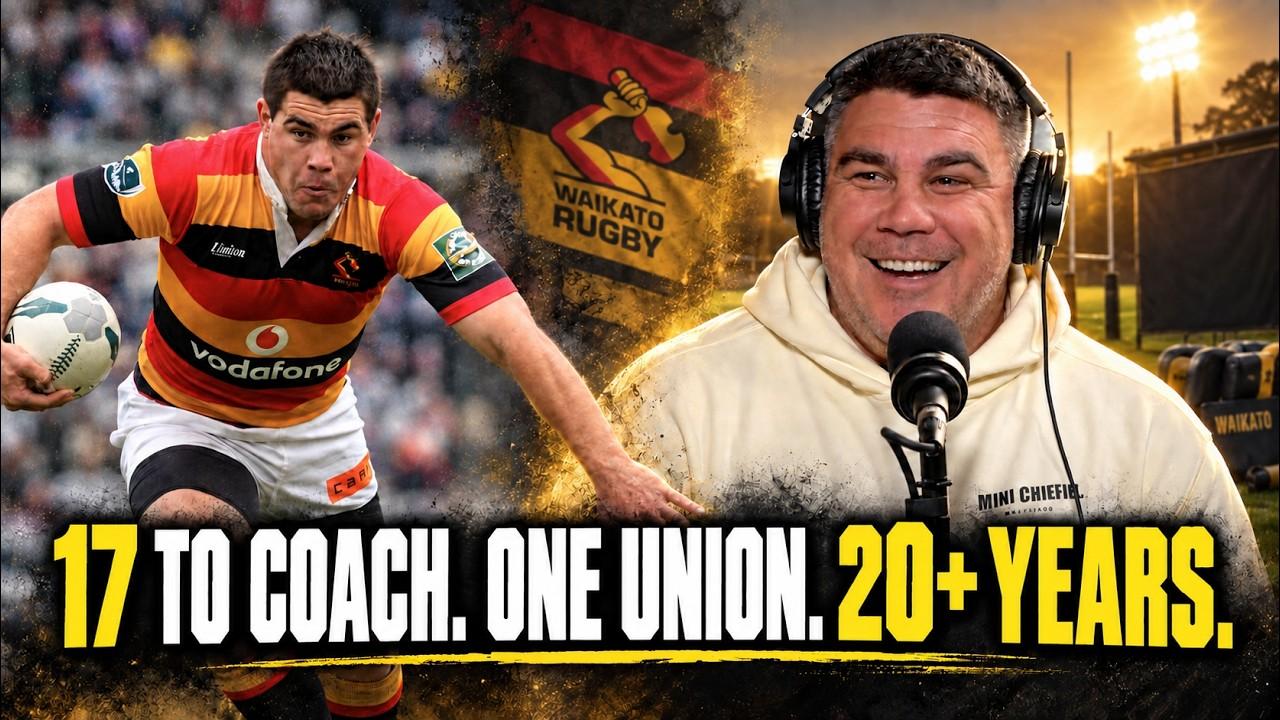
In 2002 Dwayne was sitting in a maths class when a note sent him to the principal's office, where he was handed a number to ring. Ian Foster picked up, asked if he could have the rest of the week off school, and told him to meet at the stadium and train with the Waikato side. Two sevens players were away at the Commonwealth Games, which left a spot in the outside backs, and the coaches took a punt on a schoolboy. He debuted that Friday against Hawke's Bay in the number 21 jersey, five years after he wore the same number for Waikato primary schools.
He made a try-saving tackle in his twenty minutes, but he reckons the first tackle at live training earlier in the week mattered more. If it had gone wrong, he says, his whole career might look different. On the Saturday he was back playing first 15 for Hamilton Boys' High and scored all 28 points in a win over Tauranga Boys. His dad's line about making your own luck took years to sink in.
John Mitchell, Warren Gatland and learning to fail
By 2004 he was 19 and trying to earn a contract under John Mitchell. At a wet night training he hit the best left-foot kick of his life straight into Mitch's forehead while the coach was writing on his paper. He was sent home, told he was useless in front of the group, and didn't play a game for Waikato that year.
Warren Gatland arrived in 2005 and saw the problem straight away: Dwayne was too scared to fail. Gatland made him try things he couldn't get right, and it turned out he was good under pressure. That year he made the NZ Colts side for the under 21 World Cup in Argentina, which finished third, and he was named in the tournament's World 15.
Titch, sevens and the 2006 title
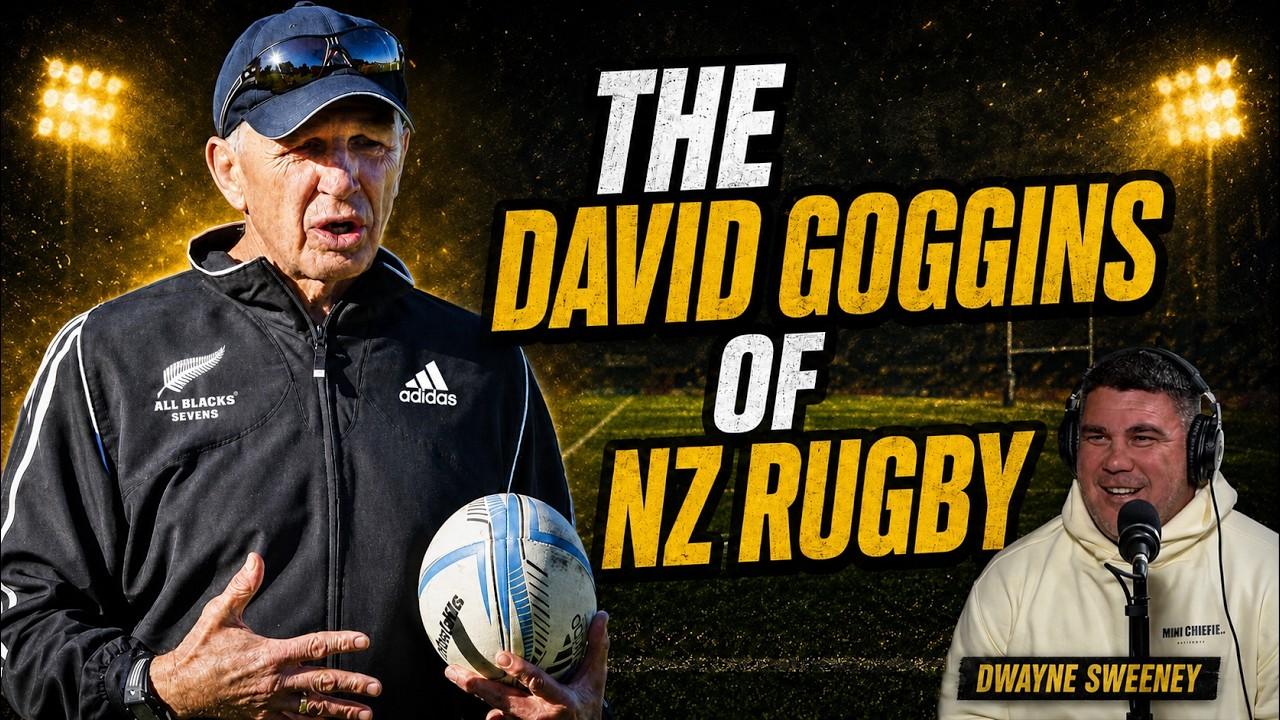
In 2006 he joined the NZ Sevens under Gordon Tietjens. He describes the training in detail: a beep test and a phosphate decrement test, then a game called death, played until players were cramping on the grass and only three were still moving. In Singapore the ball bag stayed behind at the hotel and the team ran for two hours without a ball. The rule was that kicking is for karate. He ran out at the Wellington Sevens on debut alongside DJ Forbes and Corey Jane, and watched William Ryder score after the hooter in a Fiji semi-final.
Back in Waikato that year, Gatland's side won the NPC. The plan was simple: keep the ball in play for forty minutes, be bigger than the opposition, and kick long and in rather than out. A Chiefs contract followed, and in 2007 he debuted against the Brumbies in Hamilton, dropping a ball cold with 90 seconds left, then helped run a Morrinsville midfield scrum move against the Bulls at Loftus Versfeld.
Māori All Blacks and a two-day pepeha
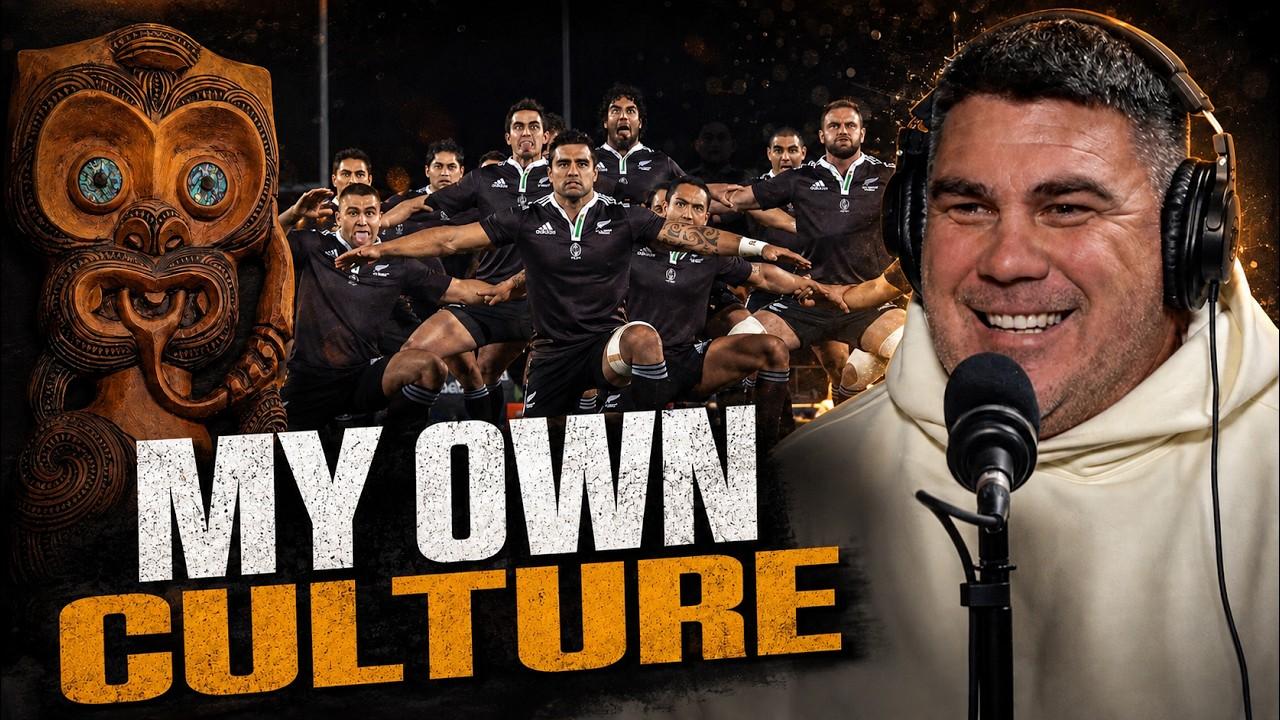
His mum is Māori but he didn't grow up with the culture. When he was picked for the Māori All Blacks, the kaumātua rang and told him to present his pepeha when he arrived, and he had two days to learn it, leaning on an aunty and uncle. He explains the nightly kapa haka and why it is the only New Zealand team bound by blood. In 2010, the centenary year, the side beat Ireland and England, and he describes the Ireland game in Rotorua as the best he ever played. That told him he could play test rugby.
Morrinsville Sports and the 2009 title
Hamilton clubs offered him good money out of school. He took free lunches from Old Boys, Fraser Tech and Marist and signed with Morrinsville anyway, in a team that lost by 50 and 60 points. It took 14 years to earn the 60-game blazer, and 143 games in all.
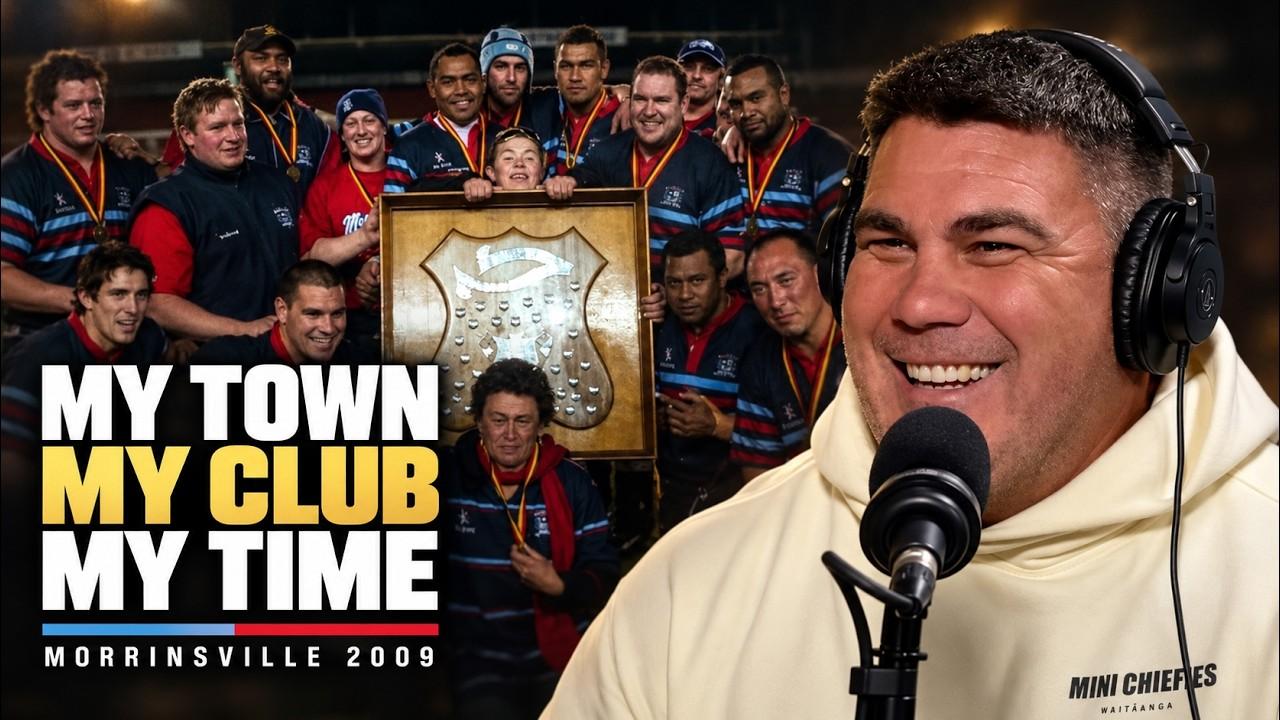
In 2009 the club won its last three games to make the semi-finals. That night the coach died suddenly. Dwayne played for Waikato on the Friday, then asked to play the semi against Old Boys, started and scored the opening try. Morrinsville won, and Dwayne came on in the final, kicked a penalty and a drop goal, and calls it the greatest game he ever played.
Japan, home and coaching
After 2010 he went to Japan for six seasons, starting at Kyuden Voltex in Fukuoka. When he was let go, he decided on the walk to his car to come home and be a Waikato centurion, taking a big pay cut. He captained the province in 2017, 2018 and 2019 and reached 100 games after a seven-year gap.
Coaching started with Waikato women's sevens, then three years as Waikato attack coach, then Chiefs Manawa. Away from rugby he built Mini Chiefie while still in Japan, caught his first marlin on his third trip, and now shares what he has learned on his own podcast.
If you want more of Dwayne, the Dwayne Sweeney guest page lists every appearance, My Town, My Club, My Time tells the 2009 story on its own, and the Waikato Rugby guide covers the Mooloos and the club scene.
Questions people ask
Who is Dwayne Sweeney?
Which teams did Dwayne Sweeney play for?
What happened in Morrinsville's 2009 season?
How did Dwayne Sweeney get his Waikato debut?
What does Dwayne Sweeney do now?
Mentioned in this episode
Transcript
Generated from the audio, so expect the odd wrong word or name. Timestamps open that moment on YouTube.
0:00I think because I've always been internally motivated and I think that's a really, you know, talking to the people that I've been able to speak to with my podcast as well, is a lot of people that are, you know, are good or successful at whatever it is they choose to do, they're always internally driven to be better themselves, not to be better than anybody else. I didn't want to be number one. I didn't want to be the best. That's not what drives my mentality.
0:25What drives my mentality is being good at something and learning it and the process of it, like I'm a real process driven person. So I found out I wasn't going to be contracted. I walked outside, I rang my dad and it was a shock. It was a big shock because I kind of thought the team I was at, I would end up taking over as an assistant coach because I was kind of playing coaching at the time.
0:51And the big boss had always spoken to me. He had actually taken, my dad had come over and months prior to that, he'd taken us out for dinner and he was saying, you know, like your son will be here for a long time and all this. And then, you know, within four months I was gone. And I remember walking outside, ringing dad and we're both like shocked and he was just like, oh shit. He goes, oh, I didn't expect that after the bloody dinner we had and what we'd spoken about. And I was like, oh, well, it is what it is. It's a business. And then he's like, what are you going to do? And I was like, I'm going to come home and I'm going to be a centurion for Waikiru.
1:23So I really struggled with, you know, around that time as well, when I got sprayed of making mistakes, I didn't want to make mistakes. I didn't want to go out there and fail. So, you know, to be sprayed like that at that point in time when all I was worried about was getting things right was really hard to deal with.
Read the full transcript · about 256 min
1:44Warren Gatlin coming, he recognized that in me and he, the way that he, you know, kind of coached me and spoke to me and observed me was just like, man, you're too scared to fail. Like he goes, you, you've got to, so he forced me to, he would make me at training. He'd be like, oh, when we do this, Drew, I want you to do this. And I'm just like, but I'll never be able to get it right. And he's like, exactly.
2:07All right. Welcome to ShedLife. We're all about the stories of good people working hard. Everyone's welcome in the shed. This one's pretty awesome. We've got Sweeney, Dwayne Sweeney. I saw him follow the channel after putting out one of the reels. So I reached out and said, hey, bro, would you like to come on the podcast? He said, dead keen. I was like, keen as he's got his own podcast, Reel Tales with Sweeney.
2:32So it's going to be shared across both. So you might be seeing this on his podcast. Probably the only dude in the professional era of rugby to play 100, weighs about 143 games for Moransville Sports, which is awesome. We're going to talk about the title run in 2009. 103 games for Waikato rugby. Centurion, the latest Centurion. Who knows? Possibly the only one. Maybe Mitch Jacobson will get it. But 2019, 69 games for the Chiefs.
3:05Six seasons in Japan. New Zealand Maori. Sevens. Thames Valley. Up the Swamp Foxes. Massive into fishing. Ultimate Fishing TV appears. Fathers. Hunting. All around good guy. Lots of stories. We're going to be getting into it. But welcome aboard, Sweeney. Awesome. Thank you. Let's just start with this one because this makes my mind hurt.
3:29You're 17 years old, Hamilton Boys High School, playing for the first 15 and this is 2002. And Ian Foster decides that he needs you to make a debut for Waikato rugby. How does a 17 year old that's only playing high school rugby end up there? Give us a story. Yeah. Oh, first of all, thanks for the intro. Yeah, it's pretty humbling, I suppose, sitting here and thinking that a chubby kid from Morrinsville achieved all of those things.
4:02So, yeah, but I guess going back to that moment as a 17 year old, yeah, I guess the story in itself is quite interesting. And the fact that I was sitting in mass, not doing a lot, you know, sort of my last year of high school, I was, you know, I'd already sort of, I suppose, qualified for what I wanted to do post high school, which was I wanted to go to Wintech and study sports science.
4:28Nice. My sixth form cert had got me in. So, yeah, I was kind of ticking the box in terms of turning up so that I could play rugby for the first 15. So, yeah, I was actually in mass and I got a note to go to the principal's office. And as you could imagine, I wasn't at school for school so much at that stage.
4:47So I was actually thinking I was in trouble. Was it the first time that you'd had a note to go to the principal's office? Yeah, yeah. Yeah. To go to the principal's office. Yes. I've been to the dean's office a few times and the deputy principal's a few times as well. But in terms of, yeah, the actual principal, they're going to Susan Hassel's office was, you know, pretty daunting.
5:11And, yeah, I remember just walking across from from mass block and it's, you know, sort of on the far side of the school, too. So it was a decent walk and I was like, oh, man, like trying to think of every excuse of like where I could have been, what I wasn't at. And I sort of walked in there and Barb Clark, you know, pretty special woman, was the manager of the first 15 for a long time.
5:32She was a receptionist and she had a big grin on her face when I walked in and I was like, oh, that's a bit odd. Yeah. And so I sat down and was waiting and then Susan came out, well, Mrs. Hassel, and said, oh, you can come in my office. So I went in there and she handed me a piece of paper and said, oh, you have to ring this number.
5:50And I was like, okay. So I used the school phone and rang the number and it was like, hello, Ian Foster speaking. And I was like, whoa. Whoa. Yeah. And he's like, how are you? And I said, oh, hi, it's Dwayne Sweeney speaking. You know, good habit that dad taught me is always answer the phone with your full name.
6:08So and he's like, oh, hey, Dwayne, how are you? Yeah, no, good. Thank you. And a little bit of small chat. And then he asked what I was, you know, if I could get the day off school.
6:17So I was like, oh, hang on a minute. So I asked Mrs. Hassel and unbeknownst to me, they'd already had a conversation. So she knew exactly what was coming. And so did obviously Mrs. Clark or Barbara, who was at reception as well, because they had obviously talked about it. So that's what the big grin was all about.
6:35And then, yeah, I said, so I asked and she's like, yep, yep, that's fine. I was like, yep, I can get the afternoon off. And he goes, oh, what about the rest of the week? And then I was like, oh, I can have the rest of the week off. And she's like, yep, that's fine. He goes, okay, cool.
6:49I need you to come down to Wakata Stadium. Meet me there at 12 o'clock or whatever it was. He goes, I'll just meet you at the front, just on the steps, outside, come around to gate five. I was like, okay. And then he's like, yeah, and you're going to train with the Wakata NPC team and you're going to make your debut on Friday against Hawks Bay.
7:09And I just like, I can't explain the feeling like being a proud, you know, Mulu supporter from, I don't know. I couldn't even tell you when I started supporting the team. It was, rugby's been a big part of my life.
7:24Dad played, you know, for Tens Valley when I was younger. So, yeah, for me it was a bit of a surreal moment and quite a numb feeling. And, yeah, sitting here now, what are we, 24 years on? Yeah. But I can, it's like I'm still there. Like it's that vivid in my mind. So, yeah, it was a pretty, pretty amazing moment, I guess.
7:51And really cool to share it with, you know, my principal at school and with, you know, Mrs. Clark as well, being my first 15 manager. It was my third year in the first 15 at that stage. So, I'd formed a really strong, you know, sort of bonding relationship with her too. So, yeah, to, I suppose, to break into tears and to, you know, hug your principal was a pretty kind of surreal moment.
8:16And then to ring mum and dad and fill them in, you know, on that kind of news was pretty special. Yeah. Yeah, they must have been stoked, mum and dad. Yeah, it's actually really quite a cool story in the aspect of the game itself. So, the first time I ever represented Waikato was Waikato Primary Schools in 1997.
8:36So, my last year of intermediate. Oh, yeah. So, you used to have the Roland Mills Tournament or Grinshield. I played for Morinzal and then made Roland Mills, which there's a city and a country team. The Rangers was the country team. So, I played for Waikato Rangers with Richard Kahui, Brendan Leonard, Ella de Maumont was in that team too.
8:55So, yeah, pretty good under 13 team. And then we, I made Waikato Primary Schools out of that. So, they would pick a team which was the best of Waikato Rangers and Waikato Rovers, which was the city team. And we played Hawke's Bay and Hawke's Bay at McLean Park and I wore number 21. Yeah. So, it was 1997.
9:17And mum took a photo of me before running onto the field. And then five years later, as a 17-year-old, yeah, she got a photo and I wore number 21. Again. Yeah. Again, ran onto the field and, you know, like in the Waikato team. So, it was a pretty fast, I suppose, transition from a 13-year-old kid to a 17-year-old, I would still say kid.
9:41I definitely wasn't a man, but yeah, playing for Waikato. Two runs, when were you able to tell all the rest of the boys in the first 15 that you were going to be playing for Waikato? Like, did you have to tell them you were going to be missing their game on Saturday? And then what was it like going in and for all the moolus, all the men, how did they welcome and, like, what did they think about you turning up?
10:06Yeah. Well, in terms of my teammates, I can't even really remember because back then, like, cell phones had only just sort of come out. Maybe like an Architell text machine. Yeah. They were playing Snake on Nokia. Yeah, it was like 20 cents a text or something. So, I was like, I didn't have enough money to text all of my teammates.
10:24And not all of us had phones either. So, yeah, I can't really remember too much about how I told my teammates, but I actually played first 15 on the Saturday. So, that's another story. We'll get to that part of the story because, obviously, the game was on Friday. But, yeah, I suppose turning up to training and meeting Fozzy outside on the stairs and, yeah, just being, yeah, again, numb.
10:49And he was, like, somebody that I really idolized as a kid. Grew up watching the Mooloo's of the 90s of, you know, Warren Gatlin, John Mitchell, Dwayne Monkley, who I'm actually named after as well, which is pretty cool.
11:03Yeah. So, I suppose meeting him, being really kind of in awe of, you know, what was kind of happening and then walking into the changing room. And I remember I was the first one in there. Yeah. And the first person that came and sat beside me was a guy called Regan King. And he was also, it was his first day, like, head.
11:25Okay, okay. Because it was the first assembly day of the team, of the official squad. Yeah. And the whole reason that I was called in was Roger Randall and Bruce Rahan were both selected for New Zealand Sevens to go to the Commonwealth Games in Manchester in 2002, where they won a gold medal. So, yeah, those two players were unavailable.
11:45So, that left the spot open for an outside back. So, they took a punt on this 17-year-old from Hamilton Boys High School. And I remember sitting there and then Regan King walked in and he was like, kind of looked at me and didn't recognize me. Yeah. And he was obviously playing for Hotapu. Yeah. And he'd had a really breakout season that year and obviously went on to become an All Black 2 in that same year, went on the India tour.
12:08But he hadn't debuted yet either. So, he sat beside me and he's like, oh, hey, bro. Regs. And I was like, hey, it's Sweenes. And he's like, oh, yeah. Who do you play for? I hadn't seen you before. And I was like, oh, Hamilton Boys. And then he was like, oh, do you play like Colts or something?
12:23And then because he thought I meant Hamilton Old Boys. And I was like, oh, no, Hamilton Boys High. And he's like, oh, are you still at school? And I was like, yeah. And then he's like, wow, you must be mean. And that was my kind of like opening line. And then, you know, guys like John O' Gibbs walked in and, you know, Dion Muir was the captain.
12:42Reece dug in. And, yeah, it was pretty amazing seeing these, you know, men walk in that I've been, you know, turning up, you know, the year before with my cowbell in the green zone and, you know, really getting into. It was the first year of the stadium as well in 2002. So, I didn't actually get to play on the stadium because we played Hawke's Bay down in Hawke's Bay for my debut.
13:06But I did sit on the bench one of the games later in the season, but didn't get on. And, yeah, just as a sort of backup injury cover. But, yeah, it was pretty unreal, like, watching all those guys walk in and then go out to training. And I think that was probably the most daunting thing of the whole week was that first training.
13:25Because I didn't, like, you know, we train at first 15. And it was back then I'd never been in a gym or anything. So, we went out to training and it was like, you know, training in 2002 was very different than, you know, 2026. There was no GPSs. There was no contact load monitoring. It was like full noise.
13:47It was like a game. Probably more intense than a game, to be fair. More intense than any game I'd ever played in, that's for sure. And, you know, there was live contact drills and, you know, even just, I remember just warming up and doing passing waves. I'd never been so scared in my life to, like, catch and pass the ball.
14:06Especially when you're catching it, you know, off guys like Todd Miller. And you're passing to Keith Lowen and David Hill and these guys that you, you know, had been watching on TV. So, it was a pretty daunting experience going into that changing room. And Isaac Boss was in the team then and, in all honesty, like, him and Regan were amazing for me in those first couple of years.
14:27They really made me feel welcome. And I think for Bossy, he's just a great man. Like, you know, I'm stoked that Hotepu won this year under his leadership. And Jackson's done a great job with that team the last couple of years. And he's a good mate of mine as well and played a lot of rugby with both of those two.
14:43So, yeah, it's really cool to see their successes. But Bossy was just a really good, I suppose, you know, like, big brother for me, really, being in that environment. He might have been the next youngest player, I think, in the squad as well at that point in time. So, yeah, it was really, he was super helpful for, you know, making me feel welcome and helping build my confidence and stuff around training.
15:08So, yeah. What was it like, I just want to ask, what was it like the first sort of contact, whether it was in the game or in training, like, the difference of going from first 15 to provincial rugby, which was it. At this point, for some people that might be listening, it's just, it's still absolutely huge in New Zealand.
15:27Like, this is, yeah, what was that like, the other first tackles? Yeah. I actually surprised myself, in all honesty, because I didn't think I could do it. Like, I remember standing there watching this drill go live, and I was like, it was like a ball carry kind of three on three drill. Yeah. So, no hiding. Like, there's no, you know, you can't play 20 minutes and not make a tackle or not clean a ruck.
15:53It's like, you get thrown the ball and you've got to run it, like, at three guys. And I remember the first time I went in, I was actually on the defense side, and I was in the middle. So, that's like, you're going to make the tackle, basically.
16:06And I can't remember who it was, but it was one of the forwards that was getting the ball. And I remember just thinking, okay, well, this is it, dude. Like, sink or swim, basically. And I just remember, like, actually shocking myself that I made the tackle. And I did. It was a good tackle. And I was just, like, thankful it was on my right side, because I'm a lot better on my right shoulder.
16:27But, yeah, I just remember thinking, like, oh. And it's really, I think about that moment a little bit with a number of things across my career. Whereas, quite often when you get that, when you try something new, that first experience is everything. So, like, if you, if that had been, if that had gone bad, and I had been smoked or got injured, or my whole career is probably different, right?
16:53But the fact that I made that tackle, it just gave me this little bit of, like, oh, maybe you should be here. Or maybe you can be here. And I'm not saying that I made that tackle and went, yeah, I'm a wakido rugby player. But I think there was an element deep down that was, like, okay, well, that's, you've ticked one box.
17:10Like, it's in the back of your mind. You're, like, okay, well, yeah, I made that tackle. Because in the game itself, I ended up going on on the wing. And I hadn't played wing before, because I'd always been a center at high school and stuff. But I was quite fast.
17:26Yeah, I was actually Waikido Secondary School 200 meter champ the year prior. So, yeah, but anyway, I actually made a try-saving tackle. Like, and that was my, you know, kind of my one moment of the game, really. I played about 20 minutes, and I might have carried the ball once or twice. I could have scored a try, but Riggs dummied me.
17:47He scored anyway, but it would have been nice to score first touch. That would have been a hell of a day for me. But, yeah, but I just remember, yeah, I made a try-saving tackle. It was basically one-on-one. They'd made a big breakout, and I was coming across on cover and, yeah, made the try-saving tackle about five minutes short of the line, and he lost the ball.
18:05So, yeah, I think, you know, if you think about, you know, small moments playing a part in that, probably that first tackle with that training was, yeah, a big part in that. But was there a mindset that you'd develop when you're younger or going into it that you would tell us, I had a guy, Kenny Short on here, or some BMX, and he was all about mantras, which I thought, like, was there any mantra or anything that you would say to get yourself in the zone to perform so that when you could do that, like?
18:33Yeah, it was actually something that my dad used to say to me all the time, and I never really got it, but I used to say it to myself. Yeah. And, you know, I got it in time. I understood it in time, but he always used to say, there's no such thing as luck, you make your own luck.
18:47Ah, nice. And, because I always remembered it, like, I would go off to a game or whatever. Yeah. Mum would always be like, good luck, and then Dad would be like, no such thing as luck, make your own luck. Yeah. And I'd be like, oh, okay, I'll walk out the door and away I go. Yeah. And I never really understood what he meant, and then you put yourself in situations and you make teams and pressure goes up.
19:10And you have different scenarios and you have different coaches and different things that they say. And, you know, the bounce of the ball. It's, you know, there's another, you know, people talk about, you know, you get the bounce of the ball if you work hard and all those sorts of things. And they all started to stack up for me.
19:27And I'm like, oh, man, that's just what Dad's always said to me. And, you know, it was probably, I'd maybe been in the professional environment a couple of years before I really understood what that meant. But, yeah, that was, there's a big one I carried, you know, kind of through life. Yeah. Still to this day now. You know, I go fishing and people say, oh, you're lucky you caught a marlin.
19:48There's like no such thing as luck. Yeah. You make your own luck. So, yeah, that's probably the big one for me. Yeah, I like that one. Yeah, I always, I heard a couple around that. I always think, it's on a haul, though. There's some great sayings on local rural country halls, but the harder you work, the luckier you get.
20:07It's that sort of, the more shots you take, the more likely you are to get in. But it's just like, the more work you do, the more it's going to be, and then just preparation for it. But, yeah. Yeah. Yeah, that's cool. I think it is, it's interesting what can get instilled in someone's head and what's worthwhile.
20:25I think that's also worthwhile, I don't know. Anybody that's got the ability to influence young kids or something, it might not make sense to them right now. But the more that you can get positive stuff stuck into their head or these sort of mantras, is it can just be going and playing on background loop and then helping out just like that situation then.
20:43And it could be years before people even really understand how powerful a positive background loop mantra is, let alone the, oh, you know, we're unlucky or good things never happen to us. You know, like that sort of stuff. It's like, no. Yeah. Well, it's quite interesting, right? Like it can go one way or the other. Yeah. You can easily get stuck in a rut too.
21:03Like I think, you know, in life in general, you can ride the ups and you can ride the downs. Yeah. But it's, you know, having something that you can kind of go back to really helps with that. And for me, that one saying that my dad started, well, I don't know, I was probably eight, maybe. I don't know when he first said it to me.
21:21It was just so normal for me to hear. Yeah. So he might've said it to me from when I was bloody five and I went out and pretended to play rugby because I was shit scared of the ball. But yeah, like I even think about that a little bit because obviously he said that to me the day before I debuted.
21:37And then the very next day, I actually ended up playing first of Dean. So we bused back from Hawke's Bay and yeah, I played first of Dean that next day. So going from playing professional and back to your, I suppose, question that started, how did I tell my teammates? I actually still turned up and played on the Saturday and we played Tauranga Boys at Hamilton Boys and it was a traditional game.
22:00We played for the Don Clark boot, who's a, you know, famous Moransville man. Yeah. And that's the trophy that we played for and we won that day. And I think we won, might've been 28, 20 or something like that, but I scored all 28 points. So yeah, it was a, it was a pretty good day. As you could imagine, I was riding a bit of a high from, you know, the week that I'd had and I was feeling super confident to go out there and play against people my own age and younger.
22:28Uh, cause obviously first of Dean is a variance of ages, but yeah, it was, um, there was a pretty cool day to be able to have the week that I had, but then also ground myself and well, Hey, you're still a first of Dean rugby player. And I don't necessarily think my teammates saw it that way. I remember a bunch of different comments coming at different times or coming back to me through other people.
22:52Like, Oh, he's arrogant. He's cocky. Oh, he thinks he's the man now. But I definitely did not think I was the man. Like I thought I was the biggest pretender, um, at the school. Like, honestly, like, uh, even though I'd played three years of first of Dean, I was the vice captain of the first of Dean for my last two years.
23:09I didn't think I was the man. Um, I ended up obviously, I made, uh, New Zealand secondary schools that year too. Yeah. And for our school, that was big. Like Hamilton boys high school was definitely not the rugby powerhouse it is now. Um, and I think I might've been the first player for 53 years that had played New Zealand secondary schools.
23:32It was a long time. Yeah. And I think they've had a player every year since. Um, yeah. So it's been a pretty impressive change, like in the school and Nigel Hotham came the year after and, and rugby looks a lot different there now than what it did when I was there. Yeah. No, it's, um, I think it's a theme that'll keep coming across is backing it up, you know, playing for some, you know, Waikato and then the first 15 the next day.
23:59There's some good stories that I'm sure we'll tell. But let's take it back to the beginning. We'd grow up. What was, um, family like just to give people a bit of a, a rounded edge of it. Um, I just thought I'd drop it on is to is we're talking about the peaks and valleys of life. As I always said to myself, two things, um, it'll all work out in the end and the best is sort of yet to come, but I've just, no matter what's going on in life, I've always, and you know, when stuff's really bad.
24:28Cause I think, and this, I think you could speak to it, but the higher, the highs, the lower the lights, it just seems to be the way of life. So such as, you know, which I accept that, but it's, so it's just like, it'll work out in the end. It'll work out in the end when, and then you're just like, okay, just keep pushing through.
24:43Yeah. Um, but where'd it, where'd it begin? Um, yeah. So I'm, I'm the oldest of four boys. So yeah. Shout out. Yeah. So I grew up in Morrinsville, um, obviously small town, probably 15 minutes east of us where we sit here now in the shed. But, um, yeah, I grew up in Morrinsville, um, yeah, oldest of, of four boys.
25:06So as you could imagine, like rugby was a pretty big past time in our house, but all sports were honestly, like there wasn't a sport that was available that I didn't do, or I didn't try, or I didn't, you know, put my hand up for. Um, and it's quite interesting. It's my son's fifth, uh, sorry, my son's birthday today is 11.
25:25Yeah. Um, and actually like a bit of a family tradition that's been passed down from my dad is we draw pictures in the cards. And my dad always did that for us. Um, and he still does. And he, you know, he thinks he's pretty funny. Like he is funny. I want to don't really admit that to him, but he is.
25:40And he, um, he writes little, you know, he draws little sticks figures of like things that we do. So quite often my card will have, you know, me fishing and there'll be speech bubbles of like, oh, he's not out fishing again. And those sorts of comments and like my, I look at my son's card that I drew for him last night and he's, I've drawn a, you know, like a basketball court and he's playing basketball and then netball court.
26:03Cause he plays netball as well. And then rugby field cause he plays rugby and then there's long jump and high jump and everything. And that's just like, he's so just like I was as a kid, like just all in, like whatever it is, he'll give it a go. So, um, and that was me, like I was just active.
26:19I wanted to do things. I loved rugby. I loved cricket. Like those are my two main sports. But if there was anything, you know, that had an element of, I guess, activeness or competition, like I was all about it. So yeah, growing up for me, I was obviously heavily in my rugby and then heavily into my cricket in the summer.
26:39But yeah, like I said, if there was any sport available or anything I could have a go at, then yeah, I would. And yeah, mum and dad were both, you know, pretty active, um, yeah, growing up. Like my mum was a really good swimmer through high school and stuff. So that was another thing that I did and I hated it, but it instilled good discipline and, um, and fitness as well.
27:02So yeah, that was something that, you know, was pushed by mum and then, you know, obviously dad was, was a, um, keen rugby player and had played for Tins Valley and he was still actively playing as well as coaching. And I don't know how he did it, eh? Cause he, he coached all of us, like all four of us.
27:18And I don't even, yeah, I can't even, I can't think back to a time where he wasn't at a training for any four of us. And I'm just like, how did that work? Cause we're all training on the same days. We're all playing on the same days. And obviously as we got older, there wasn't many games that I played even through my professional career that my mum and dad or mum or dad weren't there for.
27:40And I just don't know how they did it. Like we didn't have, um, you know, like dad worked really hard. Um, but it's not like we had heaps of money growing up. So I'm like, how did they afford all this travel? And I know they remortgaged the house to go to Argentina when I went to the under 21 world cup, um, and taught my brothers to share that experience.
28:01But yeah, I suppose they were always really awesome. Um, and the fact that they just provided opportunity, um, you know, for the four of us and I benefited hugely from that. And then, yeah, so I went through Morin's primary, Morin's intermediate. And then I went across the Hamilton boys high school. Um, and yeah, I remember I really wanted to go to Hamilton boys high because of the opportunity that it presented.
28:30I remember thinking that as a 13 year old boy, I really wanted opportunity. I wanted to have a crack. I wanted to have a go at whatever like it was. And at that time it was my rugby and my cricket. And it's not like Hamilton boys high were a rugby powerhouse back then either. Like my three years of first of thing.
28:49Yeah. Um, I hate admitting this, but we never won the Waikato competition. So St. Paul's won those three years. We drew in my first year. We drew the final, but we, we actually didn't win. So for, you know, like for me, it's not like I went there to this big dominant school. It was a competitive school regionally, like, but not nationally at all.
29:12Like the super eight competition, maybe the best we finished might've been fifth in the whole three years that I played. So yeah, it was just more the opportunity to test myself, to be in a bigger school, to, you know, challenge myself to, to be better. And I just saw it as like an opportunity and mom and dad always kind of instilled that competitiveness in us.
29:34Um, and that's quite funny, but I don't really call myself competitive. Like, and those that know me well probably will understand that, but it's quite weird for a professional athlete not to be competitive, but I'm not that kind of person. And in all honesty, like I actually shy away from particular things because I don't, I don't want the necessarily the, the pressure of having to be good at it.
30:04If that makes sense, like if I'm going to do something, I, I have, I, in my own mind, I have to be good at it. So I'm not a, I wouldn't say I'm a very good handyman because I expect professional standards. So like, you know, like looking in this bar here, like this is how I would love my bar, but I would never, ever try and do this myself because it would take me years to, to learn, to get it right.
30:28So yeah, I suppose for me growing up, like mom and dad instilled that competitiveness, but it wasn't probably something that I, you know, really had. And then going into a big school like Hamilton Boys High School and that kind of transition, um, yeah, it kind of, it kind of helped that. Like it pushed me, it made me compete harder to, to be able to play, to make the top teams and all that kind of stuff.
30:52Because I think if I had stayed at Morinzel College with my mates, um, I definitely wouldn't be where I am because I didn't necessarily, um, probably have that real drive at that age to do it myself. And it would have just been too easy to be the number, you know, to be at the top if you weren't surrounded by other guys that were also sort of just rising you up together.
31:16Yeah. And I think for me, like one really important thing that, you know, you, you think a guy that debuted at 17 years old has probably always been the best. Um, but I wasn't man, like even in Morinzel, like I was not the best rugby player in my teams. I was. Who was the best rugby players in the teams when you were growing up?
31:37Carlos Simons was really good. Yeah. He was the man. He was very good. Tough, fast, all of the things. Allard was good. Allard was very good. Um, so Allard. Allard de Maumont. Yeah. Yeah. So, um, yeah. So he's in Morinsville. Yeah. So I, and that's quite an interesting story. He wasn't, his dad's a rural bank manager and he came, moved to town from Hamilton.
31:58But I, I would win athletics day at school until Allard turned up. And I remember Allard turned up and I think I might've tried to bribe him with my lunch money when we were like 10 or something, you know, I was just like, oh, just let me win. Cause I hadn't lost. I don't want to lose. And then, yeah. But, um, yeah.
32:13He turned up and, you know, he was better than me. He was faster. Um, you know, I never won, you know, like I was to that point, I was probably, you know, one of the top in the school. But then from there I didn't win anymore. Um, and then, yeah, even like all through boys high. So when that happened though, when you stopped winning, did you stop competing or did you just try to still chase him down?
32:36Well, I tried to bribe him for my lunch money that first time, but no, I, I kept competing and I kept trying, but I was just like, it wasn't, um, yeah, it didn't come easy for me. Yeah. But it didn't also crush your spirit, you know, cause I've seen some guys and kids in particular is they go from being number one, someone else comes on the scene and then they quit.
32:55Yeah. And they don't want to do it. That didn't. Nah, that didn't happen for me. Um, and I think because I've always been internally motivated and I think that's a really, you know, talking to the people that I've been able to speak to, um, with my podcast as well is a lot of people that are, you know, are good or successful at whatever it is they choose to do.
33:17They're always internally driven to be better themselves, not to be better than anybody else. And I think that was the thing for me. I didn't want to be number one. I didn't want to be the best. That's not what drives my mentality. Um, what drives my mentality is being good at something and learning it and the process of it. Like I'm a real process driven person. So yeah, like going, I suppose, across into Hamilton boys high school, it was a process.
33:46It was like, okay, I want to play for this team. How do I be the best that I can be to play for that team? Um, or to have that opportunity or to, yeah. Yeah. Can I, I think that, yeah, motivation is often over talked about or people assume that people are really motivated and they wake up is we're often disciplined and the discipline is what gets you through all the time.
34:10I just wanted to ask though, is what club was your old man playing for and how did you go for Thames Valley? Cause being in Thames Valley myself is sometimes you get the old Morinsville. So was he Morinsville sports and then he'd go and play Thames Valley or was he one of the Thames Valley clubs? Nah. So I was actually, I was born when my first year of my life, I'd lived in Te Aroha.
34:34So dad was based in Te Aroha. Dad played for Waiho. So yeah, he played it. He played, I think he might've played Colts for Kirione in Morinsville, um, which was my junior rugby club. Yeah. Yeah. I played for Kirione, um, growing up and then yeah, dad played for Waiho. So when, when I was born and what I remember of dad playing was he was playing for Waiho for their thirds because they didn't train.
34:58Like, so he could coach us growing up and he could continue to play. And, um, they were, they, and I just, they were like superstars to me. Like these guys that I grew up idolizing, like there's, and it's really funny now because I see they're all my dad's friends, you know? So, but I remember what I used to think of them when I was a kid and I was just like, I thought that guy was like an all black, like, you know, oh, it's so funny.
35:24Um, but yeah, it's, but that's cool. You know, like for me, they were like real life superheroes. Like I was like, man, I want to be like them one day. Imagine being able to play for Waiho thirds, like that would be amazing. But that was just, you know, what it was like. But yeah, dad always played, you know, while all of my memories, he played for Waiho. Um, obviously I had played for Thins Valley prior to me being born.
35:48Um, and it was me coming along that changed a lot of that for dad. Um, he got really busy with work as well and he put a lot of time into his career and yeah. Yeah. And then, but he still played. So was he, he started NZ farming livestock? Yeah. New Zealand farmers livestock. So yeah, he originally used to work for a company called, um, Aldous Pastoral, but that's what I remember as a kid.
36:13And they got bought out and, um, he didn't want to go work for the other company. So he branched out and started Wakata Farmers, which was a off branch of Tadnaki Farmers. And then yeah, from there, um, I went to a point of allied, allied finance, bought the livestock division and it was allied farmers. And then yeah, dad ended up taking the company over, rebranded it to New Zealand farmers livestock and sold it or maybe about 18 months ago now, but he's still involved in the company and still hold shares and still actually works.
36:46He's actually working more now than he did when he, when he was running the company. But, um, yeah, it's, it's been a big part of my upbringing to that rural life and, um, always grew up in town, which was really funny, but it was, it was kind of like a real farm kid. I remember even like a bit of a funny story, but going into the Northern regions, um, secondary schools, which back then you played, um, you know, like Waikato secondary schools.
37:13And then from there you make Northern regions and then into New Zealand schools. And then Northern regions was like, you used to have an A and a B team and then there'd be central, then southern, and you'd play in a quad tournament. And then they picked the New Zealand secondary schools side out of that. And I was the only, uh, non Auckland player in the back line of the Northern regions team.
37:34And I remember going up there and I was the novelty of the, of the team because I'd milked a cow. Like they were like, Oh my God, like, have you milked a cow before? Is that actually a real thing? So they're all obviously city kids. So I was kind of like this farm boy, but little did they know, like I did milk cows and that's what I did.
37:51Like, um, you know, for pocket money and stuff in the summer holidays, but I grew up in town. I was like a townie. So, yeah, but I always had a, you know, I guess a large rural element of life because of dad and his job. And I remember just tripping around in the car with them and the school holidays and, um, you know, talking to farmers and talking about rugby and yeah, that always, you know, that'd be the first question.
38:12Oh, you play rugby boy. Like, yeah, yeah, yeah. I do. What position do you play? Yeah. And then a way we go from there. And then, yeah, they obviously, um, you know, sort of probably followed along in my career as well. And dad jokes that he, you know, got a few herd deals over the line because I had a good performance on the weekend.
38:30So yeah, it would have been a good icebreaker. Good chat. Yeah. I think all farmers are into rugby hunting and fishing. Yeah. Pretty much. Yeah. In some sort of order. Yeah. Some sort of order. Um, you know, they are, they definitely are. Um, awesome. All right. So any other, anything else from the Hamilton boys era? Yeah. And then switches into Waikato.
38:56Yeah. I think like sort of through high school, like probably going back to what I mentioned in and around. What was the training regime like? Oh, just Tuesday, Thursday. Yeah. Exactly. Like. So yeah, mine was like nineties, but that was it. Yeah. It's like, I hear about what is now. And I'm like, Tuesday, Thursday. Yeah. So that.
39:20It's not even that, not even that long hours. It's just like tackle practice passing. Yeah. That was about it. And that was, that was literally. Yeah. Not at all. And if you wanted to get fit, you did that in your own time. Yeah. I just, yeah, I was always up in the morning, you know, going for a run before school or running on the days off after school.
39:41And it was all just road running. Like that was what I knew. There was no such thing as gym or there was gyms, but I didn't know how to go to a gym and train. Where did that come from? Cause that is one of those key ones is most boys. I certainly wasn't, weren't road running. They weren't, was that from the swimming?
39:57Was that the parents put that into it and that sort of discipline, like how did that discipline, like, Hey, you've got to do that? Yeah. I think that was, that was just dad. Yeah. Like he was always fit. Yeah. And that was what, um, he kind of modeled, right? Like growing up, dad was fit. I remember it was quite interesting cause we, I had a race running race with my boys over summer.
40:19Yeah. Um, and for a number of years I've never raced them, like obviously since I finished playing professionally cause I've seen so many middle aged men like do their hammies and think I still got it. And then, so when we had the kid races and stuff like that, I was always like, nah, nah, I'm not doing it.
40:35And then we got to a point the other day and I'd actually been doing a bit of training and stuff again. So I was confident that I wasn't going to do a hamstring. Um, so I actually raced them on the lawn and, and smoked them. And which I was, you know, again, they're like, well, Cooper's soon to be 13 and Mason's 11 today.
40:52So, you know, I should beat them still. Um, but I remember I was the only kid at my intermediate that couldn't beat his dad in the running race and it bugged me, man. Like, and I don't think I beat dad. And I think even the first time I might've beaten him, he might've let me as well, but he would, he never, he wasn't that dad either.
41:12Like he, he was like, nah, if you want to win, you gotta like earn it. You know, um, it's not like he would, um, feel sorry for me and, and let me win. And, but I do think he might've let me have that first one, but I might've been 15 by that stage. And remember, like I played professionally two years later.
41:29So yeah, that's it. You're a 200 meter champ. Yeah. So he, he modeled, um, that really well for me growing up. Like, yeah, I just, I vividly remember him coming home from work and putting his running shoes on and going for a run. And then, um, you know, he talked a lot about fitness levels and when he coached us, that was a lot of what, you know, he instilled in us.
41:50I remember vividly he'd make us run up and down the field and make us hold our hands above our head. Oh man. If you haven't done it, like it's horrible. Like it is the worst thing ever. And if your hands dropped below your ears, like we'd all start again. And he would like, man, we would run up and down that field for, it felt like hours.
42:12Um, but yeah, that was, you know, probably one thing he really modeled into us was that kind of hard work. If you want to get somewhere, like you've got to be fit, like you've got to work hard for it. So yeah, I think for me and going across the boys high, and this is one thing I did really want to talk about too, was probably in that middle part of it, like kind of around my fifth form year, I made first 15.
42:35Um, it all happened kind of quite quickly. I matured quite a lot. Like I got quite big in terms of like my physical stature, you know, pretty quickly from sort of like fourth form to fifth form. I was like, I look like a man. Yeah. Um, and it's not that I was like huge, but I was big enough to play first 15 and I could, I was athletic and it was, you know, had a good base of fitness because that's what, you know, dad had instilled.
43:02But then I probably got a bit lazy with it and a bit complacent cause it kind of came. And I think, you know, probably because it kind of came easy. Um, and I, me and dad started clashing like quite a bit. Um, like I suppose most teenage boys probably clash with their dad at some point, but yeah, it got, yeah, pretty bad.
43:22Um, to the point where it was like basically leave home or, and I actually suggested going to boarding school. Um, cause I was just like, and I was, and I knew, um, I was like, I was like, I was like, I was like, I knew like, I knew I wasn't, I'd lost that kind of spark in myself as well.
43:38And I, I could, it was a bit of a crossroads and I was like 15 at the time. And I remember halfway through fifth form, um, I went into the boarding house at Hamilton Boys. Um, and it was a bit of a, you know, not many kids did that. Like they either started in the hostel and then maybe dipped out or, um, you know, not many went in late.
43:58Yeah. I remember going into the hostel and it was the best thing for me because it, it kind of pulled all my focus back in again. Like it definitely strengthened my relationship with dad, like, because I got more motivated and back into my sports and I started rowing and you know, like all that kind of stuff. And, and because I didn't want to just sit around in the hostel, I wanted to do stuff.
44:22So that active kid in me came out again. Um, so yeah, if there was anything on a weeknight that we could play the volleyball, water polo, anything to get out of prep or study, like we, we just jumped into it. Um, so I kind of used the sport as a bit of a, an outlet to, to, I suppose, refocus myself.
44:42And yeah. And then rowing was huge. Like I wrote in my last year at Hamilton boys high, Glenn Ross was the, had come back to the school. And, um, yeah, it was actually the crew. I ended up rowing in Marty eight as a novice. There was four novice and we, I think we finished fourth or fifth. Wow.
45:01And the Marty final, which was huge. And we rode a boat that were, that had won Marty in 1987. The last time I, when the boys had won it. So we're racing all these boats that were made of carbon fiber and all this sort of stuff. And we had this old wooden boat. Um, but I was a, I was a, it was a pretty special time like, um, and it actually really taught me how to train hard.
45:23But, um, man, I, I thought I was fit. I thought I knew how to push myself. But if you have never rode, like, if you really want to test yourself, get in a boat and go and, you know, row with a, and build up a base and then get yourself to, you'll be at 250 meters and you're like, I feel like I'm going to die.
45:43And then you've got 1750 meters to go and you can't stop. Um, yeah, but it was, that was a big kind of form. I, I think those, that kind of two and a half years or two years that I spent in the hostel, um, really actually, and then getting into rowing for that one season really was a catalyst to, to me having or getting into, you know, professional sport.
46:08Yeah, no, that's awesome. Can I just ask, I've had, my daughter rode for a few years and I got involved helping out. Um, it was a little bit because I grew up in Auckland. There was a bit of rowing, but it was pretty, I don't know, not elitist. Not elitist. Well, it was a bit elitist, but it was also, it just wasn't common, you know, like it wasn't as big as it is in the Waikato.
46:29And then coming down here and seeing my daughter get involved at Horeca Plains College and then doing it and then going along and seeing all the schools and speaking to do and dudettes that have done it. Is I just think it's a bit of the secret sauce of the Waikato is that because with rowing, you've got to get in time.
46:46You've got to train hard regardless of whether you like the person or not, you know, like what's going on. There's nowhere to hide. There's nothing like that sort of row of shame if you're going down or if the other boats are chasing you and pass you by. But it's just the dedication that it does. And I think it just, it just seems to have something about the Waikato is people like, hey, you don't have to all be best friends, but we've all got to work together.
47:11Yeah. And we can be competitive, but it's just like, you're also really competing with yourself. Yeah. I think that's like, you know, having a professional career that I've had, that has been a really, it's probably the most unspoken about rule really is that you don't have to get on to perform. Like, I think there's this bit of a misconception that, you know, like people talk about culture, right?
47:41And I'm heavy in that in the moment in terms of coaching and women's sport. Yeah. And that is, you know, the famous Wayne Smith line of girls, like boys need to play good to feel good, but girls need to feel good to play good. And that, that kind of sits on that culture side of things, like in terms of how he uses that.
47:59But for me, it's like high performance culture, you don't have to be friends, you just have to respect each other for what you can do. Yeah. And that's, that's probably what I learned from rowing. Like, and you form, you form a, I guess what you would call a loose form of friendship out of respect over time. Yeah.
48:19Because like those eight boys that we put in that rowing boat together, we are so different. Yeah. But still to this day, there's not one of those boys that I wouldn't, that I would walk past in the street. Like I would always stop and give them my time because of what we went through collectively together. Um, and it's, and we're so different, like in terms of like even our backgrounds in sport, you know, I was the rugby jock.
48:47Basically I was the first 15 vice captain and stuff when I jumped into the boat. So, and you think about high school in New Zealand, like first 15, you're kind of like the, yeah, like the, what you would call the cool kids, I suppose. So like, and they're a couple of them played rugby, but they weren't, you know, maybe second 15 players.
49:09And then a couple of them played, or one of them played soccer. Another one was like, wasn't, didn't, didn't do any other sport, you know, it was like rowing was his thing. And, um, he was deputy head boy and, you know, like that, it was just, we're all so different, but we found a common interest in like basically wanting to row the boat faster and wanting to collectively be better.
49:31Um, and yeah, it was, it was awesome. And it was, and it taught me a lot about that too. And understanding that, well, you don't necessarily have to be best friends, but I respect what you can do and I will give what I can to help us in the same sense. Yeah. And that's super, it is super powerful.
49:52Um, actually it's a lesson that people could take on as if you can respect others and you put in that hard work and the discipline is you don't all have to be mates. Like I say something that it's not necessarily popular. It's a family owned business. I've worked in other businesses and lots of things, but I'm like, we're not family.
50:09There's a reason we all come here. It's because we're paid, you know, everyone's gets paid that this isn't negative. I'm just like, let's be honest. This is the reason we turned up. Otherwise you'd actually be with your real family, ideally all your mates or somebody else. Yeah. But it's just being a little bit more upfront as I don't know whether it's worldwide or definitely New Zealanders.
50:29It's an assumption that you've got to be best friends and we've got to do this. And if we don't get on, then it won't work out. And that's not necessarily true at all. It's like, Hey, if we can respect each other and we'll actually make it stronger. Cause then you've got differing, you can have differing point of views, differing personalities, but like, let's just respect each other and then put in the work and then we'll succeed.
50:50Yeah. I think that's, um, I really think that that's the secret too. And that's what professional sport teaches you. Like being, well, I'm incredibly lucky that professional sport formed me. Yeah. Like I was like, I was a 17 year old kid when I went into it. So all of my life lessons have come in a professional environment of pressure.
51:15Like there's nothing like, or, you know, back then running out in front of 25,000 people at Waikato Stadium. Yeah. And I think that's, you know, I've been under that performance pressure of like, you make a mistake, everyone's going to know about it. Mm-hmm. You go, you know, you have a poor game. Like I remember vividly going into, um, you know, the supermarket on a Sunday and having some, you know, 60, 70 year old grandma come out and go, Oh, you played like shit last night.
51:38And it's like, yeah, she's right. You know? Yeah. And, but it's like, you can't hide from that. And if you, you know, you could have a poor day here at work, you know, with the sales or sheds or whatever. But you're not going to go to the supermarket and have someone come up to you and go, Oh, you did a shit job today.
51:54Yeah. And it's like, well, you know, you could probably say that to everybody, right? Yeah. Because everybody has bad days, but you just don't. Yeah. But I suppose being in that limelight, um, that was, you know, part of the lessons that I had to learn and understand. Mm-hmm. And I think, you know, that professional space of what are we here for?
52:15Yeah. And then basically, cause it, it basically comes down to, do believe in the vision of, you know, what is it that you're here to achieve? Yeah. Like, is it to sell sheds? Is it to, you know, provide a income and a stable job for your family? Whatever it is that you're, what spins your wheels. Yeah. You got to understand what that is for you.
52:35Mm-hmm. And it's easy to then, if you keep referring back to that, okay, what am I here for? It's for this. Yeah. Am I meeting those needs? Yes. Okay, cool. Keep moving forward. Am I not meeting those needs? Okay. Why? Why am I not? Why do I not feel like this works? And maybe it's a dynamic thing.
52:52Maybe it's just like, oh, I don't have the motivation to sell sheds. Maybe I should look at selling something else. Mm-hmm. Maybe this team is, I don't believe in the direction that this team is going, all right, so maybe I look at, I transfer. Do I look at playing for somebody else? And for me, it was really easy because I was super fortunate and it's something that I talk a lot about.
53:13I was so lucky that I played rugby for teams that I loved. Yeah. Like, I grew up wanting to be a Mulu and that was my identity. So I didn't have to move for opportunity because I got that at 17 years old. And then it was up to me to keep fighting to stay there. Mm-hmm. But I never got to a point where, you know, I had to move elsewhere for opportunity.
53:35I had forged that in a place that I loved playing and didn't have to move away from family, didn't have to do all those things until I chose to in terms of going overseas. But yeah, being able to play for the Chiefs and for Waikato for my professional career while I was in New Zealand was like, you know, so it was easy for me because I was passionate about that.
53:56But if my journey had been different and I had to go and play for the Blues, like I grew up hating the Blues. Like all the swear words that get thrown at the TV when I was a kid about them, like, oh, that would have been a very different scenario to sit in and be there and go, okay, what am I here for?
54:12Yeah. I don't believe in this jersey, if it makes sense, but maybe it's the people. Yeah. Maybe it's the coach. Maybe it's the captain. Maybe it's like the teammate next to me, I actually really like and respect him. So like, that's what I'll gravitate towards. And that's what will keep me motivated to be here. And I think there's a lot of misconception that people say, oh, I do it for the jersey.
54:35And it's probably, it's something I definitely have said in times in my career. But when you go through it and you come out the other side, it's never about the jersey. It's like, yeah, it could be like in white t-shirt. Like it wouldn't matter what it is that you put on. It's the people that you do it with.
54:52And that's the most important thing. Yeah. That's so powerful. It's so honest as well. Cause you hear it so much about, oh, we're doing it for the jersey. We're doing it for all the players that had gone before. And I sometimes look at it and sometimes especially culturally and how the changing culture of rugby and sports. Like, is that really true?
55:13Cause you look like you, like, I'm not having a go at them, but I'm like, when someone's saying that, whether it's, yeah, it's cool. Cause yeah. But then there's definitely elements of that. Like, like I said it there. I was lucky that I got to play my professional career for teams that I believed in, grew up following.
55:33So that's different. I feel. So the jersey did made something to me because of the people that wore it before me, not because of what the jersey is itself, what the jersey stands for. It was the people and what they stood for. Yeah. And that's the thing that you learn in time or I learned in time. Yeah.
55:50It was like, but I was blinded by loyalty for a long time. Like I took some pretty shitty contracts at times where I could have got more money, but, and ultimately it's a business, right? So they know that, oh, well fuck, Zuin's ain't going to play for anyone else. Cause he loves this place. Yeah. He'll sign it.
56:06Like he doesn't want to play for anyone else. He's got no motivation to. And I didn't. Yeah. And like, ultimately money didn't motivate me either. So I, it wasn't about making as much money as I could. Like I set myself a goal. Yeah. When I started playing, I remember a guy, Wayne Allmond, it was, I was in the chief development team, my first year out of school.
56:27Yeah. And we're going to a game and he was in the chiefs, um, big multi fella, play for the bay, kept in the Bay Plenty. And he was like, tough, like pig hunter, good man. Awesome man. And I remember sitting by him on the bus and he goes, oh, what do you want out of rugby swings? And I was like, oh, I don't know.
56:43I want to be an all black. And he goes, nah, but what do you want out of rugby? It's a job now. So what do you mean? He goes, well, you get paid. Like, you know, this is your career. Like, you know, if you're a builder, do you want to have a building company one day or do you want to just work for people?
56:57Like you got to think about it different. And I remember being, you know, 18 or whatever I was at the time. Like all I want out of rugby is I just want a freehold house. That was his thing. He was like, if I can get that out of my rugby career, I'll be happy. And I remember in that moment I adopted the exact same thing.
57:15So I was like, okay, well, if I can finish my playing career and I've got a freehold house then, because the way he explained it to me is like, if you don't have a mortgage sitting over top of you, then, you know, you're working for a lifestyle rather than working to pay off debt and to, and the stress of like chasing another job or trying to have a bigger income because your mortgage is too big or whatever.
57:36And you can just work for a lifestyle versus, you know, you can go hunting and you can do these things. And I just remember sitting there and being so like, yeah, actually, like that sounds good. And then literally I just adopted it. And, and that was my whole thing. So when I finished playing, you know, I got to the point that I got to in Japan and I was finishing with one team and I had some opportunities to go to others and would have made some good money, like a lot more money than, you know, I was making back in New Zealand to come home.
58:08But I remember thinking at the time was okay, what am I working for now? Because the love of the game was not like in Japan, it's different. Like I was there for money. That was what I went for and experience to live in a different country, experience a different culture. But I've done that for six years. And it wasn't somewhere I wanted to stay for the rest of my life.
58:30So I was like, well, I ultimately want to go home on the boys to be schooled in New Zealand. I want them to have a Kiwi upbringing. What am I going to stay for now? Because I've got a boat. I've got a house. Nice. Yeah. My boats little, but well, maybe I'll get a bigger boat. Yeah. And I'm like, oh, they need a bigger boat.
58:48No. So I was like, I want to love. I want to play for a team that I love again. So that was my decision. So I walked out of that meeting and then within, I found out I wasn't going to be contracted. I walked outside. I rang my dad. Yeah. And it was a shock. It was a big shock because I kind of thought the team I was at, I would end up taking over as an assistant coach because I was kind of playing coaching at the time.
59:17And the big boss had always spoken to me. He had actually taken, my dad had come over and months prior to that, he'd taken us out for dinner. And he was saying, you know, like your son will be here for a long time and all this. And then, you know, within four months I was gone. And I was like, oh, okay.
59:33And I remember walking outside ringing dad and we're both like shocked. And he was just like, oh shit. He goes, oh, I didn't expect that after the bloody dinner we had and what we'd spoken And I was like, oh, well, it is what it is. It's a business. And then he's like, what are you going to do?
59:48And I was like, I'm going to come home and I'm going to be a centurion for Waikiru. And that was like, I'd made that decision from walking from the office to my car, which took, I don't know, two minutes. Yeah. And I was just like, nah, that's what I want to do. Like, cause you know, I've weighed up all of those things.
1:00:03And then I had some contract offers come through for some other clubs. And my agent was like, what are you doing? You idiot. Like you're going to cost me a lot of commission if you go home. But yeah, I came home and that was the best decision I made to come back and probably, you know, coming back in and I'd never been a captain, you know, before.
1:00:23So coming back in and captaining Waikiru for 2017, 18 and 19. Yeah. Becoming a centurion. You know, all that came with that was, you know, it was a pretty awesome, you know, sort of time of my life, I suppose, that came out of what most people would call probably a like hardship or like, not hardship because that's the wrong thing, but feeling like your career is over at a professional, you know, sort of kind of standpoint.
1:00:50And then being at a real crossroads of what do I do? And, you know, just as a, I don't really like talking about, you know, sort of money. But if you think about, I was in Japan and, you know, making well north of like $250,000 a year. Yeah. After tax to come back and pay for $40,000 before tax.
1:01:11Yeah. So that's an example of what I was willing to do to come home. And like I said, from that conversation that I had with Wayne Ormond in 2003. Yeah. Yeah, that was, you know, a big catalyst. So you set it off though. So because of that conversation with Wayne in 2003, so 14 years, you've got the freehold, you've settled that I don't need to chase a bigger boat every year.
1:01:34No. And I deal in a world of people that are endlessly chasing the next biggest toy. Yeah. That you could go for the lifestyle and, you know. Yep. Yeah. It's awesome. But let's go back to what happened after high school, New Zealand secondary schools, Colts. Yeah. It was a pretty. NZ7s I want to talk about. Yeah. It was a pretty rapid like kind of five years, especially from, you know, like 2002 to 2007.
1:02:02Yeah. Everything happened fast, like real fast. I pretty much ticked every box that you could tick in that time, apart from being in All Black. Yeah. The only box I didn't tick in New Zealand. So yeah, 2002, obviously made my debut. Then I left school, signed with the Wakataw Academy for $2,000 a year. Ooh. But it was a pretty, pretty cool intake of players that year.
1:02:30Yeah. So like. Who lives in there? Yeah. I think Ahui, Ala De Melmontsch. Mark Bergman was in there. Mike Delaney was in that group. He was like a year or two older than us, but. Yeah. He was involved in that space. Yeah. But our trainer, Nick Gill. Mm-hmm. Yeah. So pretty, you know, I think a lot about that in terms of, a lot of us had really long careers.
1:02:55Mm-hmm. And I really put that down to that we had, that we, cause that was when the academy first started like officially. Mm-hmm. Like, so we would train three gym sessions a week and then our normal club trainings. But when club training wasn't on, we'd do two, two to three running sessions as well or conditioning Yeah. Or rugby blocks or whatever.
1:03:16Yeah. Through that period of time. So, you know, the old 5am starts and that kind of stuff. Yeah. And driving across in the fog from Morrinsville. Yeah. You know, all that kind of thing. And then trying to balance that with study and then a little bit of part time work cause you needed, you know, needed some more money or whatever it was.
1:03:34So, yeah, that was, it was a pretty cool in the fact that, that group, we all actually kind of ticked all those boxes together. Mm-hmm. So I was, I'd obviously already played for Wakataw, but then those other boys came in. Toby Lim was another one that was in that group. Yeah. So yeah, we're all the same age.
1:03:53So we played Waikare under 16s together. Well, some of us started at Roller Mills together and then under 16s and secondary schools. Yeah. So that kind of, that kind of group we kind of carried through. I started to play a bit of provincial sevens and stuff as well. You know, I grew up watching Christian Cullen and Jonah Lomu and, you know, Roger Randall and Bruce Rayhanna and that all plays sevens when Hong Kong was the one kind of tournament that we saw on TV.
1:04:22Yeah. But I just remember Christian Cullen scoring that try from the end goal, you know, like breaking out and, well, actually he didn't score it. Waesaki Masarewa actually did and I ended up playing club rugby with him and he's a big part of the story that'll come in and around my sevens. But yeah, like from there, went into the academy, was kind of in and around the NPC squad.
1:04:48Didn't officially get contracted until 2004. Okay. Yeah. So like 2000, no, 2005, I think actually. 2003 and four, I played a bunch of games, but generally called in as like, yeah, so I was playing in the development side and then we'd get called up and. And so would they just give you a bonus for the game? Yeah.
1:05:13Back then you'd just get, I can't remember what it was, like 1200 bucks for the week. I think it was if you went in and trained for the week and then made the game day 23. So yeah, there was some weeks I went in and trained, but didn't make the game day 23. So you didn't get paid.
1:05:25Yeah. But that's just what it was. Yeah. So yeah, played a few games and around then got my first official contract. Nah, it must've been 2004, I think, cause John Mitchell was the coach. Um, it's quite an interesting story with that one that I'll share, but I remember the old, um, rugby park number two. Yeah. Used to be out on the roadside there.
1:05:47It's like a bit of a park now. Yeah. So there used to be a training field and that's used to be where we trained and it was like a winter's night must've been like July before, just before NPC had started. So it was like kind of those preseason trainings. Mm-hmm. We're training at night time and we're doing this kicking drill and it was like a, the midfielders had to catch from a pass and do a left footed wipers spiral down and try and land it in the box.
1:06:11Mitch was real big on, um, creating like games and point scoring systems. And that was kind of how he coached. Mm-hmm. And he'd obviously just come back from being the all blacks coach. Yeah. Um, and then, yeah, so we're doing this drill and I was having a shocker. Like I couldn't hit the side of a barn. They were going sideways backwards.
1:06:30It's like wet, raining, windy. Yeah. And I, I was just, it was terrible. Yeah. And I just got in a bit downward spiral and a rut and it was just going no good. Then I just hit out of nowhere, this pearler. And I'm just like, probably to this day, probably the best left foot kick I've ever kicked in my life.
1:06:48And I remember looking up and just watching this perfect spiral fly through the air. And I'm just like, man, and it's right at the box and I'm like, oh, this is wicked. Like, how good is this? And then I was just was, it was like the whole thing in slow motion. And then I looked down to see like, you know, watch where it was going to land.
1:07:05And I was like, oh shit. And Mitch was standing behind the box, but cause it was raining. He always used to ride on his refill. Yeah. And he had his like head down and he had this like perfect shiny ball dome and the lights and at nighttime. And he's trying to ride on his paper under his jacket.
1:07:22Yeah. And I'm just like, oh shit. And I was like, oh, it's a, you know, I remember for a split spec and thinking, oh, he's behind the box. It's fine. It's never going to make it there. And I kind of looked at it and I was like, holy shit, that's going to go over. So I yelled heads.
1:07:34And as I yelled at, he looked up and it hit him flush. Flush in the forehead. Like, and paper went everywhere. And I felt like I was about that big. I was like, oh my God. I just couldn't believe it had happened. I was just, I was obviously in a bit of a hole cause I'd been so bad and he was watching and I was just like, he'll be like, what is this guy up to?
1:08:01And then I just do that out of nowhere. And he, I've never, ever been sprayed like by a coach like that in my life. And he, yeah, he actually sent me home from training. He was like pretty, it got pretty heated. Like he was like, there was so many swear words that came out and he stormed down the field cause he was like, who the fuck did that?
1:08:24And then they all just went and I'm standing there like, oh, sorry. Like, and then yeah, he just let me have it in front of everybody and told you, you know, basically it was like, if you weren't such a useless rugby player, it never would have happened. And in my head I'm thinking like, that's the best kick I could have ever kicked in my life.
1:08:40Like, but obviously it just got him in the rage moment. And Mitchell was pretty good at that. He used to get pretty angry sometimes. So yeah, I remember he actually sent me from training and then I went to walk off and then the boys were like, bro, don't go. Like he's just overreacted. So I kind of like just stood back in the drill and kind of hid behind the boys and stayed there.
1:09:01And then he like sought me out and was like, what are you doing? I told you to walk off home. So I was like, oh, okay. So I actually went, so I actually had to leave. So yeah, it actually led to, you know, I guess the kind of flow on effect of that was like, I was pretty, pretty down about things.
1:09:18I was still a kid. Like I was 19 at the time. So yeah, I was not in, yeah, I wasn't in a very good mental state after that. Like, you know, being told by coach that you're useless in front of everybody. And in that kind of context, it's quite hard. And you look back on it now and you can laugh at it.
1:09:36Cause you're like, oh man, that was actually the best kick I could have ever kicked. But in that context, you don't think like that. You know, I was thinking I was useless and all the things that he had said, because I had so many insecurities as a, somebody that I still didn't believe I was good enough to be in that environment.
1:09:52You know, so yeah, that was a pretty, pretty interesting sort of moment. And I didn't play a game that year. So 2004 was the only year of my Wakatul career that I didn't step foot onto the field officially. I played in preseason and I sat on the bench once, but he didn't put me on. But it was actually a really cool year.
1:10:13And the fact that in the development team, I really kind of really established myself and had some really, there was some cool players that come and played for us. So Regan King was coming back from injury. So he played a bunch of games in there. Brendan Leonard, obviously we were both together at Morinsel Sports. And we were, you know, both in that team together.
1:10:34So our friendship and bond, you know, really strengthened through that period of time. Because we spent a lot more time together and went away on trips and all that kind of stuff. And Roger Randall was coming back from injury too. And yeah, he played as well. So having, you know, guys like Regan King had been in All Black two years prior and Roger Randall had also been in All Black and around that team for a sustained period of time.
1:10:59And, you know, their good training habits and their just kind of, them instilling that confidence in you that you are good as well. Like playing alongside them and then being like, oh, bro, he had a mean game today. It's like, oh, really? Like, yeah. So it was actually quite a, even though it was probably a hard year, I look back at it now and think, oh man, that actually probably really shaped me to do what I did just moving forward.
1:11:23And then 2005, Warren Gatlin came. Can I just ask, with that John Mitchell spray, does that affect how you coach now or do you go forward? Did you like? Yeah, definitely. I think being a coach now, there's a lot of things that you carry from how you were coached. And I'm so lucky in the fact of who I've been coached by.
1:11:45So, you know, like Ian Foster was my first Waikato coach. And then I went to John Mitchell, then to Warren Gatlin. You know, I had Dave Rennie, Wayne Smith. Yeah, Vern Cotter, Joe Smith. Like, yeah, I've had a lot of really good coaches. Yeah, just a powerhouse. Yeah, just a powerhouse of international coaches. And then, you know, John O'Gibbs, Clayton McMillan.
1:12:10Like, yeah, Roger Randall. Some really, really good coaches in my time as a player. So, yeah, there's a, and we'll get to that probably when we talk about me transitioning to coaching. But, yeah, that, that kind of, that spray, yeah, definitely is not something that I do. Like, in terms of, I never, as a coach, you can demand and, and there's, there's definitely elements when I will raise my voice or I will demand something of it.
1:12:40But it's always in a sense of, it's always, in my mind, it always has to be directed at the team. And it always has to be directed around effort. Because you can't, skill's uncontrollable. Skill's skill. It happens, like mistakes happen. Like, and if you want your players to perform at an elite level, they've got to be willing to make mistakes.
1:13:00Yeah. Because if you're not, like, and that's probably something we'll talk about shortly. Like, I really struggled with that. Like, I hate, I had, I was a perfectionist. They had to be perfect. Like, I talked about, I could never build this shed because it would need to be to the standard and I don't have the skills to do that.
1:13:15So I would, you know, either have to get to a point to pay somebody to do it, or it would take me five years to master it before I even started it. Because that's what I would expect. So I really struggled with, you know, around that time as well, when I got sprayed of making mistakes, I didn't want to make mistakes.
1:13:36I didn't want to go out there and fail. So, you know, to be sprayed like that at that point in time when all I was worried about was getting things right was really hard to deal with. But then, you know, I suppose jumping forward into the next year of 2005 and Warren Gatlin coming, he recognized that in me.
1:13:54And he, the way that he, you know, kind of coached me and spoke to me and observed me was just like, man, you're too scared to fail. Like, he goes, you, you've got to, so he forced me to, he would make me at training. He'd be like, Oh, when we do this draw, I want you to do it like this.
1:14:11And I'm just like, but I'll never be able to get it right. And he's like, exactly. But it was the best thing though, because I learned to fail. I learned to be okay with it, but I also learned to try things under pressure. And then what I actually highlighted was that I was really good under pressure. Like I was really good at giving that last pass with no time and because of all of that time I'd spent on my skills leading to that point, I was ready for that push.
1:14:38So it was really probably just good timing of somebody to show a bit of belief in me, someone to challenge me the right way. And it really kind of set me on a pretty good trajectory. And then yeah, made New Zealand Colts that year in 2005 and Brendan Leonard, Toby Lynn, Richard Kahui, all in the same team.
1:14:58So it was pretty cool. And like I said earlier in the podcast, like mum and dad, you know, remortgaged the house and took my brothers over and came to Argentina for the four weeks or five weeks of the tournament. Um, which is really cool family memory that we have of, you know, some of the, um, you know, stuff we got up to over there.
1:15:17And my brother came to the end of, um, world cup party and got real hammered. Yeah. Pretty much had alcohol poisoning and spent like two days puddled around the toilet cause he was so sick. But, you know, and that's something that we laugh about now, but Was he on the Argentinian reds? I don't even know what it was.
1:15:34I'm pretty sure he got his drink spike day. He was pretty hammered. And I just remember, yeah, getting, um, we, I took, we put him in a taxi and I took him back to mum and dad's accommodation cause we're staying at a different hotel. And I remember going there and I walked them up and they were on a second floor.
1:15:51Yeah. And it was just like an outside balcony, the rail. And I remember walking up, knocking on the door and I just sort of like, I was pretty much carrying him up there and he could barely stand up. So I was just sort of like lent him on the rail and I like turn around, knock on the door and then dad opens the door and I was like, Oh, and then he was like, what?
1:16:13I just remember his face just dropping. I turned around and Paul's standing on the rail, like just standing on that, like with his pants down, like peeing off. But I'm like, he couldn't even stand up. So I don't know one, how he got on the rail or how he was still there. So I turned around and actually tackled him off.
1:16:30He ended up peeing all over my arm and stuff, but that's, that's neither here nor there. But yeah, I was, um, yeah, it was a pretty wild scenario to kind of be in. And dad was just like shook his head and looked at me. He's like, what did you do? And I was like, I didn't do it.
1:16:45Yeah. But, um, yeah, I ended up taking the brunt of, of that, um, I suppose, experience. Yeah. He was a pretty crook boy for a couple of days, but yeah, that was a bit of, we kind of segued off the there a bit, but, um, yeah. How'd the team go on Argentina? We got third. So yeah, we beat France for third and fourth.
1:17:05We lost to South Africa in the semifinal, um, by, or I want to say like maybe three or four points. Randy Ellis was our halfback. We had a, it was really interesting cause that team was really good with a number of all blacks in it. But the, the team the year before was stacked like Luke McEldis, the Ben Aatinga, you know, Stephen Donald, Piri Wepu.
1:17:27Um, I can't remember. Oh, Jose Gier was in there, but he was in ours as well. Um, yeah, but they were, Jerome Kaino. Yeah, they were, they were mean. And I remember a lot of them were playing super rugby already. So when our team got selected, we were like, Oh, we're the shit team, you know? And, but then you go through the list of guys in our team.
1:17:48Like we have been Franks and, um, Jeremy Thrusch was one of the locks. Toby was obviously one of the other ones, Isaac Ross as well. Um, Liam Messam, Andy Ellis, Stephen Brett, um, Richard Kahui, Jose Gier. Like, yeah, it was a pretty good team, like really good team. But at that point in time, we just hadn't established ourselves like the team the year prior had.
1:18:12So yeah, we lost to South Africa. Andy Ellis actually got dragged down like, oh, I want to say a meter short of the line to win the game. Um, and then we, I think we might've got held up over the line or something that ended the game and we ended up losing. Um, but that South African team was really good.
1:18:28Mornay Stain and Wonyar Olafia and yeah, a lot of guys that played a lot of test rugby as well. And we actually formed some pretty cool, you know, friendships and stuff. So Ruan Pina was like a, you know, really good halfback first five that's played a lot of rugby for the Sharks. Um, and we became really good mates on that tour just through meeting each other in the lobby of the hotel.
1:18:51So were you guys all in the same hotel? We were, yeah, we were in the same hotel as South Africa. Oh, that's cool. Yeah. So, um, and was there another team there? I think there might've been three teams like in our hotel, but I just remember the South Africans were in our hotel. So obviously when we drew each other in the semi-finals, it was a bit of an interesting, you know, sort of, yeah, four or five days leading into that game where we were like schedule, training schedules were training.
1:19:16So we were changing. So we weren't like crossing paths and it was, yeah, it was pretty interesting, but it was a pretty cool, um, like really cool experience to go to a world cup and to, you know, to, to lose it was hard because New Zealand had been so dominant at that point, you know? Yeah. So going into that team and expecting to, you know, everyone expecting that we should win it because we're New Zealand, um, and the team, you know, the years prior had been so good.
1:19:47Yeah. It was quite hard to, I suppose, not win, but pretty proud that, you know, like I even look at the French team that we played and so many of those guys played test rugby and, um, you know, some of the names that you see come back up. Um, I actually made the world 15 off that rugby world cup too.
1:20:06So that was quite cool. I've got the, got the newspaper article at home where they had the tournament team at the end and number 12, Dwayne Sweeney. So yeah, it was pretty cool. Um, you know, pretty cool, I suppose, milestone to be able to tick off at that point in time, um, of my career. Yeah. Then sort of came back and, um, that was, you know, obviously off the back of that went into Warren Gatlin's era was with Waikato and a lot of change in 2005, a new defensive system.
1:20:35And yeah, it was really interesting cause our results weren't the greatest, but he was building and he was trying to really establish, you know, his way of, um, playing the game with a, a team that had, you know, a lot of established players, but a really good core of young guys coming through. And he really empowered us young guys to have the opportunity to play and also, um, feel confident in doing so.
1:21:01Like he was the first coach that probably really gave all of us our, our proper shot in terms of giving us starts, giving us decent amount of game time. Um, so yeah, that was, that was a pretty cool year. And then the year 2006, um, yeah, made New Zealand sevens, um, under Gordon Titchens and. So he's always been just like this legend of Gordon Titchens, the sevens training.
1:21:29Sevens training. There's nothing tougher. There's nothing harder than sevens training. No. Is that true? That is the truest form of true. It could be like, Oh my God. Like I, it's really funny now because like, obviously I coach and there's in around the professional era and all the players are GPS that training and they have all these arguments with trainers about training load and all the players are running too much or they're not running enough or whatever.
1:21:56Man, if there was GPS is on us when Titch was our coach, like they would have broken. Like there's the numbers wouldn't have gone high enough. Like it was crazy. And some of the sessions that I had done, like talk about a test and mental resilience. And if I hadn't have had that experience of my rowing, there's no way I could have put myself to that position.
1:22:19But there's elements of feeling like I'd felt in races and then you just find a way to finish it. And I, I talked about this the other day with a mate and we're talking about, you know, hard trainings that you've done or training sessions. And especially once you, you're not in the team environment and you're doing it on your own.
1:22:37And I just remember like, man, imagine how many times you've told yourself, oh, you can't do it. Like you can't do another rep. Like, bro, just like fake a hemi injury. Like, oh, your car, I reckon you should just stop. Like, just do one more and then just stop. Like, and just be like, I just can't do it anymore or whatever.
1:22:54Like the amount of times you must have told yourself that, but then you just go, oh, fuck it. I'll do it anyway. Yeah. Like pretty much live there for a year of my life with Titch, you know, like some of those sessions were crazy and I'll, I'll give the, a couple of examples, but like one. So 2006 was the Commonwealth Games year in Melbourne.
1:23:18So they, what sort of happened was the super rugby teams, a player from each team could drop back into the squad. So I was in the contracted squad. I'd made the contracted squad for the first time. Yeah. My debut tournament was Wellington. That was a pretty cool experience. My roommate was a Masio Valance, who was like the, you know, one of the greatest to have ever played.
1:23:46And it was his last tournament before he was off to Japan. So yeah, that was a, it was a really cool kind of introduction, you know, playing Wellington sevens when it was pumping, like tickets sold out in three minutes or whatever it was. And yeah, just that whole vibe and atmosphere of it all was wild. Um, yeah.
1:24:08What was it like running out to the Wellington sevens? Cause it's just, it's, it's probably one of the saddest things that was missing from New Zealand rugby landscape. Yeah. It really is. And I think like when I went there, um, to the sevens, like I remember just watching it on TV and you're just like, wow. Wow. But actually going there and I'd never been before as a fan.
1:24:33So I'd never been to it. I'd only watched it on TV, but then going there for the first time as a player. And I went back years and years later as a, as a spectator, as a fan. Um, and I didn't actually realize how the stadium's not full all the time because of the whole concourse. Yeah. Basically the parties out on the concourse or during the day everyone's, you know, mingling and stuff.
1:25:01So when I turned up, I was just like, Oh, where is everybody? Like we kind of did a bit of a field walk and a bit of a look around and kind of stuff. And I was like, man, there's not many people here. And then I remember going out for warmup and there still wasn't that many people.
1:25:15And I was just like, Oh man, I thought this was like going to be pumping. Like, and I was like, Oh, okay. Well it is what it is. You know, whatever. Go back in the sheds. And then, um, like back in black for ACDC was our run out song. So whenever that song came on, it was the queue for the crowd to be like, Holy shit, New Zealand are coming.
1:25:35And I didn't realize that the stand just floods because everybody's on the concourse. They hear that song come on and everyone's like, Oh shit, we've got to get out there. New Zealand are going to play. And then I remember standing in the tunnel and literally it's like a swarm of ants, like seeing people like down in the distance.
1:25:51Cause obviously the cake, you run out in that one corner. And I remember just standing in the tunnel waiting for run out and the other game still. Like had just finished or something. And the song comes on and you just see the stand swarming with people. And I remember just standing and going, Oh my God. And then like literally like walking up to the edge of the field, like with the team and then just looking and just seeing the whole place packed.
1:26:14And it's just pumping. Everyone's jumping and the sounds, you know, like the songs, you know, it's a good song too. So yeah. And then just running out there and just being like looking around like, Oh my God, I can't believe I'm here. You know, like as a 21 year old or whatever. Yeah. I was at the time, but yeah, it was a pretty surreal experience and pretty awesome to, you know, sort of run out there.
1:26:37And, um, obviously on debut, but on debut of guys like DJ Forbes as well, who obviously became, you know, DJ became one of all the, you know, probably the greatest captain in terms of the amount of time he spent in that team and the amount of titles that they won. And, um, yeah, it was, it was pretty, Corey Jane also was in that team.
1:26:57Yeah. And he, he was a cool character. Yeah. He's a bit kind of, but different, eh? Like I, that's what I like about rugby is there's so many different differences in personalities. Yeah. And I was very much like the, probably like a bit of a goody to choose in a way of like, just do everything you can to, you know, to be disciplined and to show that you want to be here.
1:27:21Country rugby. Yeah. Where he was a bit more, he had a bit of swag about him and a bit of like, almost like just a bit of air or not, I wouldn't say arrogance, but just confidence. Like he was really confident in himself. He was confident to be different. Like he didn't give a shit that he had long hair.
1:27:36Like it wasn't a cool thing to have long hair, but he made it cool because he was Corey Jane, you know, like that's kind of what I, and I, I kind of like, you know, you just kind of pick things up from people as you go through. And I just, what I liked about him is there's no occasion was too big.
1:27:51It was like the bigger it got, the better he got. Yeah. And that was like one thing I kind of, yeah, like a rock star and he really embraced it. And that was probably one thing I'd like really kind of idolized in him. And then I kind of took a little bit with me too. It was like, well actually, yeah, fuck it.
1:28:07Like, let's go. Like how cool is this? Instead of being like, oh my God, it's Hong Kong sevens. And there's like 70,000 people out there. It's like, yeah, how cool is this? Like we're about to go out there and let's show them how good we are. Like that whole kind of change in persona. And that was kind of led off one person, you know, like he would, that's the way he was.
1:28:25Yeah. So we were like, oh yeah, sweet. And then they kind of built confidence in others around. So yeah, it was a pretty cool experience. Obviously Wellington and they've been with, you know, those guys and playing alongside them. Any highlights from that tournament that stick out from the camp? Um, well, probably that we didn't win. Like, so yeah, like obviously I, it was a pretty rough kind of introduction for me.
1:28:50Cause like 20 or the year prior, we didn't win the 21 world cup. Yeah. Then also in 2006 was the first year that New Zealand sevens didn't win the world series. So for me, like that was like, it's hard not to take that personally, you know, when you're in those teams. And, but I look at the players that I played with and it's like, it was just not our time.
1:29:11Like, because the, everyone was like, oh, the New Zealand sevens team sucks. But then it's like, it's a DJ Forbes, Corey Jane, like Orlando Soakai, um, like all on debut, you know, like, and just Ed Cocker, like guys that went on to be greats of New Zealand sevens and you know, all black rugby. Yeah. And you're just like, oh, like, but you know, hindsight's a wonderful thing, you know, but you, you kind of have that doubt then when, you know, when you're in it and you don't get the results, you're like, oh man, like I just, yeah, maybe we're the problem or maybe I'm the problem.
1:29:45Yeah. But then you kind of look back on it and go, well, actually it just wasn't our time or that team was really good in that moment or they were, you know, or look at what they went on to do and look at the guys that you played with and what they achieved. So yeah, I think probably that, that we didn't win, but watching William Ryder for the first time, oh my God.
1:30:04And when I say watch him, like I played against him, but we were watching him, like he was incredible. Like him and, um, Waisali Sarevi were just, I'd never seen anything like it in real life in terms of the way that they could just beat defenders and just how much time they had. And yeah, just incredible. I remember we had Fiji in the semifinal and we had William Ryder like pinned, like we had this awesome defensive set.
1:30:29We were just marching them back and I was like, sweet, we've got this game one, you know? Yeah. Cause we were up, we'd scored to get in the lead. Um, and we had them under all sorts of pressure. They were dropping the ball and they're going backwards and we're like, sweet as William Ryder gets the ball, got him trapped on the sidelines, like four of us around him.
1:30:46Not one of us touched him. He got out of there and then ended up scoring and winning the game like after the hooter. And it's just like, how, how did he get out? And you watch the footage back and you're like, oh, like I don't even, to this day, I still don't know how we didn't get him.
1:31:00It's not like all of us can't tackle, like we could tackle, we just couldn't tackle him. Um, so yeah, that, that's probably like a highlight for the wrong reasons. But yeah, I think just the, the whole occasion was pretty cool. And, um, there's, you, you kind of, when you, when you fall into moments like that, there's almost like out of body experiences that almost happen.
1:31:23And I remember just like my very first like involvement in the game, we scored a try. Well, I did, I was the kicker. So we scored pretty much really early. And then I had a conversion like right on the touchline and I remember just hitting it and I couldn't even feel the ball hit my foot. And I was just like, oh my God, where is that gone?
1:31:41I looked up straight down the middle, you know, so I think I kicked four from four in that game or six from six or something and three or four from the sideline. So it was just like, you know, as a individual like moment, being able to have some pretty cool, um, success around, you know, one element of the game was, was a pretty cool, um, kind of experience that I remember.
1:32:04Um, but yeah, then going back to, I suppose the training side of things. And I spoke about the, um, Commonwealth games being a thing. So what actually happened was those boys dropped back into the squad, which actually pushed me out of the squad. So I was a non-traveling reserve for the Commonwealth games. Um, I actually got called into the Chiefs as injury cover in the training camp week.
1:32:29So I was really excited, obviously that I was going to get an opportunity, maybe get an opportunity to play for the Chiefs. So I went in and trained with them and that was cool. And, um, you know, Sam Toitapo was at the Chiefs at the time who was like, I really liked him as a player. So, and he's an awesome dude.
1:32:46So that was cool to, you know, meet him and train alongside him and stuff. And then camp. So because I was a non-traveling reserve, Titch released me to go across. Doug Howlett ended up pulling his hamstring at training. So I was the only back that was on standby. That was the non-traveling reserve. So we had one back, one forward.
1:33:08Um, so I was like, oh, like found out that Doug had pulled his hammy. So I'm like, holy shit, I'm going to go to the Commonwealth games. But then I didn't get released to go across to training the next day because I was still in contention to play for the Chiefs on the Saturday. Um, and just how all the contracting stuff worked, it's kind of was what it was.
1:33:27But then because I didn't go across to training, Titch took Orlando Soakai, an extra forward. It was the forward non-traveling reserve. And he just put an extra forward into the squad. Yeah. Um, so it was a bit of a like hard luck kind of moment that I didn't end up there. But it is what it is. And, you know, what will be will be.
1:33:46Yeah. And that there's nothing you could really do. There's nothing I could have done about it. Um, it would have been nice to have gone because they won a gold medal. Yeah. And it was the only thing we won all year. So, you know, again, going back to feeling like you're the problem. Yeah.
1:34:01But, um, off the back of that, we trained in Rotorua. And we normally always trained at the Mount, but we trained at Rotorua. And we were getting ready for the Hong Kong Sevens. So, they come off winning the gold medal. And that, you know, was obviously an awesome high. All of my teammates had, you know, had gone.
1:34:25Um, and they'd won and that was cool. And then we go into this camp. It must have been a week or two after. And I remember the first day of camp, Titch is like, oh, when I was a player. Because that's when he played, he was super fit. And that was his thing, you know. So, that's why he coached that way.
1:34:42And then, um, he was like, oh, I used to do this run in the Redwoods. And it was 3Ks or whatever. And he could do it in whatever time it was. It was fast. Yeah. And he's like, that's when I knew I was fit. If I could hit this time, it was sweet. And then back then, the way camps worked, the first day was always fitness testing.
1:34:59So, you would turn up and you would do, you'd always do a beep test. And then the phosphate decrement test. And you'd do them back to back. So, you'd do the beep test first. You'd run in two groups. So, one group, half of the group would go first. Yeah. And then you'd rest. And then the other half would do theirs.
1:35:15Then from there, you'd go into the phosphate decrement and the same thing. And the phosphate decrement's a 40-meter sprint on 30-second turnaround. But it's through timed lights. So, you do your speed testing first to see how fast you are. Yeah. And then you've got to run your first rep within 90% of your speed time. So, basically, so you can't bluff it.
1:35:37So, you don't go in there and go, oh, yeah, I ran 40 meters in 5.6 seconds when you can run it in 4.9. Yeah.
1:35:45And they measure your drop-off. So, it actually doesn't sound that hard, 10, 40-meter sprints, like, and going every 30 seconds. But, man, when you do it and you're doing it through timed lights, it is the worst, probably, in all honesty, probably the worst fitness test I've ever done in my life. Because, you know, like, you do a yo-yo or you do a beep test and that's hard.
1:36:07And you do a bronco and that kind of stuff. But it's that real high end, like, it feels like your throat's bleeding. Like, it's so incredibly tough. And you've just done a beep test as well. So, yeah, we do that. And then we went back recovery. And then he was like, oh, we've got field training in the afternoon.
1:36:28So, he's like, oh, I used to do this run in the woods. Like, we'll go and do that. So, off we go down to the red woods and we do this run. And then we obviously have got this time that he used to hit. And we're all New Zealand Sevens players, so you better be able to hit it.
1:36:42So, away we go. We do this run and it's fast, like, proper fast. So, just for an example, at that point in time, like, I've never been so fit in my life. But we used to do, for the trials, when you're trying to make the squad, you do 1K time trials and you do them on 10 minutes.
1:37:05So, whatever you do, you do the first one. Say it takes you four minutes. You've got six minutes rest and then you do the next one. And you do three. So, you do three 1K time trials. I averaged 3.01 for my three. So, that's how fit I was at the time. And I was fourth. I wasn't even top.
1:37:24So, I think the Tanido let him, oh, no, he wasn't in the team that year. I'm trying to remember who it was. Somebody averaged 256. Wow. That was the, you know, across the three. Yeah. So, really, we're fit, like, proper fit. And we go and do this run and we literally just make it in time, basically. Like, a few didn't.
1:37:47Yeah. So, we get there, do it, whatever. And then he goes on to tell us, well, this is what I used to do back in the day. And I'd rest for 10 minutes. And then I'd try and beat my time on the weekend. And we're just like, what? Like, we've been, like, we've done the yo-yo, like a beep test this morning and the phosphate decrement.
1:38:04We've just emptied it as hard as we could go. Yeah. And he's like, all right, you've got 10 minutes recovery. And then we're going again. You're going to run back to the vans. And we're just like, oh, okay. So, anyway, run back to the vans. Try and beat the time. And, you know, some do, some don't, whatever.
1:38:22Then we get in the vans. And then we go down to the stadium in Rotorua. And then we train for, like, oh, I want to say probably an hour and a half.
1:38:33And Titch always had this game called death. And, like, it is literally that. It's like you die for as long as you play it. And it's basically sevens, seven on seven. And there's no kicking because kicking's for karate. That's what he used to always say. So, whenever you have the ball, you don't kick it away. That was the one big thing with Titche.
1:38:56You never kick, like, kickings for karate. No chip kicks. No nothing. Like, hold on to the ball. Yeah. The ball was everything. And to be honest, it is. Like, in sevens, possession is key. Like, yeah, defending sucks. You burn a lot of energy on D. You can use the ball well and attack. Like, it saves you. So, yeah, there was method towards madness.
1:39:16But we played death. And I remember at one point in time, I was cramping. Because we were all cramping. Because we'd done. We'd been. It wasn't a flat run. We were in the bush. Like, running and jumping over tree stumps and all sorts of stuff. So, we were doing this training. And it was, like, intense. And we played death.
1:39:37I don't know how long for. But a long time. And at one point, I remember I was just down on the ground with cramp on my calves. And I remember, like, sitting up and looking. And there was three people playing. So, out of the 14 that were out there, there was only three. Two from one team. One from the other.
1:39:54Everyone else was on the ground with cramp. And he would just. So, how it worked is you'd just play. And then he would just yell turnover. And if you had the ball, you just had to put it down. The other team would get it and just go the other way. So, it basically created, like, just constant movement.
1:40:09Because he could dictate things. Even now and then, he'd let you score. And then go back and reset to a kickoff and where you go. But if he just wanted to keep you running, he would just blow a whistle. Turnover. So, he'd make a runaway. And you'd be running to score. And you'd go, turn over. And you'd just put it down.
1:40:24The closest person run picks it up. Go. And then it's. So, it's just creating chaos the whole time and a lot of running. And he can dictate the whole thing, you know. So, yeah. I remember just looking up and seeing there was, like, two people. And then one. Like, you know, two on attack and one on D.
1:40:41Trying to stop these two. And then he'd just blow turnover. And that one person would get it. I remember lying on the ground. And then my team got the ball. Because we were the one on D. And he got it. And then he gets up and starts running. And he's, like, coming past. So, I get up to try and, like, join him.
1:40:57Take, like, two steps. Fall back over with cramp again. And then he yells turnover again. So, they get it. They come running. I remember getting up off the ground. Diving. Trying to make a touch. Because it was just touch. Yeah. Or sometimes it would be live contact. But a lot of the time it was just touch.
1:41:11Because, again, it kept us running. Where the contact would slow it down and whatever. So, he was just like, nah, you need to run more. Yeah. And I remember, like, diving. Same thing. Cramp. But he had this thing at the end of training. So, we played that game until basically there was nobody left. And then at the end of training, we'd always run 100 meters in pairs.
1:41:30That was his thing. So, you'd always finish training with a 100 meter sprint in pairs. So, you'd partner up. One corner. Run to the other corner. And that's where you'd wrap training up. Yeah. And he'd wait there. And I remember we were running down. And we, like, we're falling over because we're cramping. Like, it was just the shambles.
1:41:49And he's just in the corner. Biggest grin on his face. Like, just loving it. Because he's just like, I broke you. And that was his thing.
1:41:58And although he was a stickler and he was, like, really hard on fitness, it was, if you could empty the tank and you could keep going, like, that's all he cared about. So, he didn't, it wasn't so much about numbers and what you could achieve in terms of, like, oh, man, you ran a whatever on the beep test or the yo-yo test or whatever it was.
1:42:19Like, it didn't actually matter what you ran. But if he saw that you didn't quit regardless, like, then you were, he, you were his guy. So, like, it was, there's plenty of guys that, because there used to be this myth that if you don't hit 13 in the beep test, you don't play. I've seen plenty of guys not hit that.
1:42:37But they just had dogged determination and no quit in them. Like, Nigel Hunt was one of those guys. And he just, you know, really poor in fitness testing, but put him in a game scenario or any hard training, and he would just get up and go again. And he'd die. Like, he would be well out the back in the fitness, but he would never stop.
1:42:55And he had no quit. So, Titch was just like, oh, yeah, I'll play you, because you won't quit when he gets hard. And that's all he looked for, basically. He would look into your eyes and be like, are you going to quit? Are you going to stop? Yeah. So, that's, yeah, that's what it was like under him.
1:43:11And another scenario, we're in Singapore, and you always have one guy that's on ball duty for the week, and Lando was on ball duty, and he left the balls at the hotel. And we was like, I don't know, maybe a 45-minute bus ride to where we trained, and we got there and was like looking around for the ball bag, and we're like, where's the balls?
1:43:30And then Sox was like panicking, and we're like, oh, did you forget the balls? And he was like, no, no, no, they're under the bus. I was like, are you sure? Because we always used to make sure we put them in the bus so they were visible, because that was the thing, is like you do not forget the balls, because you know what's coming if you do.
1:43:46And he was like, no, I put them under the bus. And we're like, but we never do that. Like, why would you have done that? And he goes, no, no, I did. And then we look under the bus, no balls. And we're like scrambling around, and Titch hobbles out, because that was when he had his bad hips and knees and that too, so he used to hobble a lot.
1:44:01He kept hobbling down, and he's like looking around, he's like, oh, you didn't forget the balls, did you, boys? And then he's on the officer, it's like, oh, it's all right, I can get some fun. He's like, nah, nah, nah, nah. The boys don't need balls. Hey, you don't need balls, eh, boys? And we're just like, oh.
1:44:16And then he's like, all right, oh, well, you guys might as well start warming up. Do some passes. Oh, no, you can't. Oh, well. And then, yeah, he just thrashed us in like 40-degree heat for, yeah, probably an hour and a half, two hours, just no balls, so all we did was run. Like, yeah. And he also loved the crowd.
1:44:34Like, if people turned up, you know, to watch or observe, it was just like, yeah, just like, oh, yeah, watch my boys go, watch how fit they are, and it would just be ridiculous. Our sessions would be so hard. We just prayed that people didn't come watch, because if they did, like, it was just like, uh-oh, here we go.
1:44:52Like, he's going to show off how, you know, how hard we can run or how hard training can be. Yeah. But I remember in Singapore, too, like, going and doing some work with kids, like, just at a school, like, we did a school visit, and we ran skill rotations with them and whatever, and Titch had a group, and he made them do shuttles and down-ups.
1:45:10It's like, these kids are like seven or eight, like, just, like, trying to spark their interest in rugby. I mean, he's got them doing shuttles. I was just like, oh, at least he's consistent. Oh, yeah, man. He just seems like the David Goggins of New Zealand rugby. Yeah, yeah, yeah. And it was really funny, because you have formed, like, a love-hate relationship with him.
1:45:31Like, I really, like, you looked forward to tournaments, because they were easy compared to training. Yeah. And they were cool, man. The World Series back then was awesome. Like, we played in, you know, Hong Kong, and that's massive, obviously. And, you know, a place like Singapore, Paris, Twickenham. Like, yeah, it was all awesome as a, you know, like, as a young guy to be able to travel the world like that and to play in those places and big crowds and all of that.
1:45:59But, yeah, it was hard. It was so hard. Like, he was a real stickler for everything, so he controlled everything, what you ate. Like, he would check your plate before dinner.
1:46:13Yeah, and, like, he controlled what you wore everywhere. So everywhere we went, we were, like, in uniform. It was like we were in the military. So we were going on, I don't know, like a day off, and we would go, I don't know, somewhere for the day. It would be like, okay, you got these shorts, this shirt, those shoes, you know, this hat and that jumper.
1:46:33And that's all you could wear. So, like, yeah, it was intense, you know, kind of four weeks when you were with him. Do you know where he developed that sort of attitude of just such an intensity about it?
1:46:46Like what formed his desire to control everything? Nah, I don't really know because I'd never really probably spent enough time with him on a personal level to understand that and not because, like, I didn't want to, but it's probably just, like, when you're in that environment and you're a young guy, and I was only there for a year, I think it might have been a bit different if I'd been in the circuit for four or five years and, you know, like guys like DJ and that would know him a lot more on a personal level, I would think.
1:47:22But, and it's not that he wasn't personable, like it's not like he was just this arsehole, like he was an arsehole at training, but he was a good laugh in that as well, wasn't it? Yeah, yeah, yeah. He was a good, you know, he was good to sort of joke around with in that, but it took a little, I suppose when you're a young guy too and you're new in the team, like, you're quite worried about, you know, like his impersonation of you, so you probably hold yourself back a little bit too because you're kind of like, oh, I just don't want to put a foot wrong.
1:47:52Yeah. But no, I don't really know where it came from, but I suppose the proof was in the success he was having too at the time, like, like I said, we were the first team to not win the World Series, so that was hard to deal with, and it was also hard for him too because obviously they had always won.
1:48:11Yeah. And he's got this team, and we were good, don't get me wrong, like we had a good team, man, and we played great sevens, but the Fiji team at that time were just so good, and it didn't matter how the draw worked out, we found them on the way. Yeah. Always, like, they beat us in quarterfinals, they beat us in semis, like, you know, we'd be able to get to a point where they would drop a game and it was like, okay, sweet, we're not going to hit them in the quarters or a semi, and then we'd end up, like, you know, have a banana skin game that would get us,
1:48:40and it's like, oh, no, we've got to play Fiji in the semis now, like, and it was just like, it became almost like a bit of a mental block as well, that, yeah, it was just, it was quite hard to kind of, I suppose, deal with at the time, and they beat us, I don't know how many times in extra time, like last play and, yeah.
1:49:01Well, it's intriguing from a fan perspective with that, with the Fiji-New Zealand rivalry. Were they training at the same level for their fitness, or were they beating you guys on that natural flair and skill? Because obviously, well, not obviously, was Titch didn't have the choice of, and I'm not taking away, but the best rugby players available in New Zealand, you know, because you've got all the super rugby contracted guys and everything else, and so it's all super rugby, five teams are super rugby contracted guys, and then it's the sevens team.
1:49:31Yeah, yeah. Whereas, I'm not exactly sure what it would mean. With Fiji, at that point, there's no drawer or anything. It's a sort of pinnacle, unless you've been able to pick up a contract and go overseas. Yeah. I was like. But those contracts normally came out of their sevens performances. Yeah. Yeah, I think, like, we, it was almost like a rite of passage.
1:49:53If you were a really good loose forward or back in New Zealand rugby, you probably went through the sevens program at some point. Like, I think back to, you know, I list those guys off that I debuted with, and you go back to the years prior, like, guys like Jerome Kaino, he played, like, Liam Messam, Tamidi Allison, and these are just the years kind of, like, prior to me.
1:50:13But if you get, you know, Cullen, Lomu, like, all of them were all involved in sevens at some point. So it was, with the way New Zealand rugby was established, it set up, like, you got those guys for maybe one year before they made their super rugby jump, where it kind of went away from that because super rugby contracting became younger.
1:50:33So you kind of, and then now we don't have a national tournament anymore, so it's all a little bit different. But at that point in time, like, we were getting, yeah, not the top 150 because they were all in the super rugby teams, but it was that kind of the best of the rest. Yeah. And the guys that are about to be super rugby players within, and a lot of us were within that 12-month period, we all picked up super rugby contracts, and away we went in 2007.
1:51:04So, yeah. But what was really interesting that I found, we had two game plans, game plan one and game plan two. That's what Titch used to call it. And when we played Fiji, it was all about physicality. So every other team was keep the ball alive, stay out of contact. That was the way we played. Like, the ball will do the work.
1:51:25No kickings for karate. Like, hold on to it. Get it, hold on to it, and don't let it go, basically, and avoid contact. So we would go backwards to go forwards. We'd shift the ball. And we always had great athletes who, you know, like even that team that I'd talk about, my team, like Corey Jane, like, give him the ball some room and space and catch you later.
1:51:45Yeah, so, but when we played Fiji, and that's what kind of really suited me, because I've never been a player that has been, what I would say, like I've had enough speed, but never had enough speed for my speed to be a point of difference. So what my strength was, was my ability to break tackles, my work through contacts to keep the ball alive, all those sorts of things, create momentum and go forward and whatnot.
1:52:09And that was also my point of difference in sevens. Like, I could break a lot of tackles, like, had a good fend, and, you know, I was strong through contact, but I was never fit enough or fast enough to outrun everybody. So whenever we played Fiji, I actually played my best, because our game plan lent more to my strengths, which was to go through contact to, you know, step off my outside foot and punch through an inside weak shoulder, and because that was our mindset playing in those games.
1:52:38So quite often those would be my best games. But, yeah, it was quite interesting, because the Fijians were a lot bigger than us. They always were, but we had it over them in the contact area, and that's what, because they were so free-flowing and with their offload game and stuff, and when it got unstructured, that's, like, good night.
1:52:58Like, you're not containing them. Like, they will throw it around with one hand, they'll catch it with one hand, and that's what used to, like, amaze me, because we'd play them in this contact game, and we'd be really aggressive and stuff, and it would rattle them, and we would, you know, like, perform really, but they obviously had a really good team that year, and they still beat us in every game, but there were some of those games where we were by far the most dominant team, but they would get two or three opportunities from nothing, and they would just score these unbelievable tries.
1:53:31But, yeah, like, it was quite an interesting mindset going in, because I never, watching the games, I never viewed it that way, but then when you actually get in there, and it's like, okay, this is the way we play Fiji, and it's like, oh. And then you go back, and you look at old games and footage, and then you watch the team moving forward, and years go through, and you're like, oh, okay, yeah, like, it is, yeah, it's definitely a part of the team's DNA, you know, to play against Fiji that particular way, so, yeah, I think the Fijians were, like, yeah, they were incredible that year,
1:54:06and I think probably that year was probably maybe one of their first years that they really got their fitness right. Yeah, so we, our point of difference was our fitness over everybody, and we had, with that, we had great X Factor always, like, New Zealand rugby's always produced really good players, so Titch kind of always knew, oh, if I can just get them fit, it doesn't matter, because the, we did, our game plan, very simple, like, he's not a sevens mastermind, he's a mindset mastermind, so he knew how to make us deal with pressure, and deal with the hard, and just find a way to get up and go again,
1:54:43make another tackle, clean another ruck, be there in support, you know, that was what he taught us, it wasn't, like, it was really interesting, because watching the Rio Olympics, and seeing the moves that they were doing, and hearing them on the ref's comms, it's still the same plays that we did in 2006, it's all the same moves, so, the game, well, they weren't evolving the game, it was just the whole, it was his mentality that he taught, and his ability to push through the hard, was the point of difference for that period of time, and you, like, you hated him while you were in there,
1:55:18but, you know, ultimately, I look back on that, and go, oh, yeah, I learn a lot, like, in that 12 months, yeah. Yeah, it's pretty awesome, yeah, obviously, part of it was the sevens, but so many guys going through that, it's just forging New Zealand rugby, just like we talked about, like, New Zealand, or rowing, forging, into it, is that sort of going through the cauldron.
1:55:42So, you come back from that, is that the, what, Sirks, Warren Gatlin, so that's a big season for the NFL? Big season, yeah. By the Moolus. Yeah, it was an incredible, like, campaign, that 2006 team, so, like, you know, fielding a Test rugby starting line-up, you know, was, yeah, it's pretty surreal, and even looking at the bench, you know, and the careers the guys had on the bench, so, like, Ella DeMalmunch, you know, was on the bench, Toby Lynn, Liam Messam, Brendan Leonard, myself, Roy Kinikinilau, yeah, pretty incredible, you know, bench in terms of, those guys played a, like, well, all of us played really,
1:56:27you know, successful careers at a professional level, and then we were just on the reserve bench, so, yeah, like, a pretty, pretty awesome time, and I just remember there was, just the whole year, like, Getz just had this mindset of, like, we had this. Did he put that, did it, sorry, but did he put that team together, was that just a combination of just, a combination of just, amazing Waikato club rugby, and it was built to that, but, like, what led to that level of.
1:56:55Yeah, there was a few factors, like, there's a couple that, of guys that came into that mix, right, so Byron Callaha, obviously, was Otago Highlanders' man, and he actually came up to be part of the Chiefs, part of it back then was, if you were to play for, a Super Rugby franchise, if you wanted to be locked into that franchise, and not be in the draft, you had to play for one of the home provinces, so, obviously, Waikato Bay of Plenty counties, those teams benefited from the Chiefs wanting a particular player, because they had to come and play in that region to be secured, so, obviously,
1:57:37Byron being, you know, the Chiefs wanted him to come and be the halfback, that benefited Waikato rugby, and it just so happened that there was this really good halfback coming up through the grades, and Brendan Leonard, you know, so it was a good culmination of timing of having, you know, Byron there as the all-black halfback, and the Chiefs halfback, and the Waikato halfback, and then this young kid coming into his, you know, professional career, and about to, you know, kickstart his journey, and, you know, within 12 months he became an all-black, as well, so, and he went to the Rugby World Cup in 2007, and Brendan,
1:58:12so, yeah, it was a bit of a, you know, if I look at that group that they established in the academy, in 2002, like Richard Kahui, played a great part in that season, and he was outstanding, you know, that year, and then Toby Lynn, Ellard, myself, Brendan, like we were all products of that academy, those four years, you know, prior, another guy, Mark Berman as well, that played a, played a bit of a part in that campaign, in that season two, we all kind of came through, and, you know, we'd had four years, kind of in around those good training habits, and stuff, so, and we're not even the starters,
1:58:48right, so, we're just guys that are there to support, and play supporting acts, apart from Richie, Richie was starting, the rest of us were all on the bench, so, and then you've got guys above that, like, that have established super OB players, and have been playing, you know, 50 games for, for Waikato, at that point in time too, so, yeah, it was a pretty, pretty good roster, a pretty good culmination of, all of that coming together, Gats, the work he did in 2005, to expose us a bit more, in terms of Richie, and, yeah, Brendan, and myself, to really elevate us, and build our confidence,
1:59:22so that we were pushing those top guys, we weren't taking a back seat, so much anymore, so in 2006, it demanded a more, a higher standard, of the, guys to stay in their starting spot, because we were chomping at their heels, you know, for game time, as well, and Gats had fostered that environment, of healthy competition, and, providing opportunity, you know, for us to, to get out there and play, and, like, I featured in the game, day 23, every game that season, but, maybe only started three times, but, you know, I was in the, I was on the bench, the rest, and played, some games,
1:59:57you know, 10 minutes, some games 30, but, you know, like that, kind of throughout the year, like all of us, had kind of played those, kind of roles, and yeah, it was a pretty, pretty good team, it was all built on, like obviously our line speed, defense that he'd brought back, from the north, northern hemisphere, that he'd had great success, with, wasps, while he was up there, and it was just a way of defending, that hadn't come to New Zealand yet, so he taught us it, I think us younger guys, also adapted to that quicker, because we weren't established, in defensive systems, so, you know,
2:00:29the team benefited, from us learning that system, as well, and then, you know, the other boys, the older players, adapted to that too, it brought a real physical, edge to it, like Gats was, like man, the boys lifted some tin, like we had a big, team, like we did, I remember so many of our, all of our training, and even our conditioning, all had weights in it, like we're just doing, circuits, and all sorts of stuff, and we had a number 40, on our training jersey, sleep, so at that point in time, the average ball and play, of a game of NPC, was 33 to 35 minutes,
2:01:06or something, so he was like, well, we're going to average 40 minutes, ball and play, okay, and that's what we're going to do, and that's the way we're going to train, that's everything, and then, so whenever we play a team, they're going to come here, they're going to have to play, you know, seven to five minutes longer, than they've had to play all year, so, it might, they might get out to a start, or whatever, but they're going to have to live with us, because we're going to go to a level, that they haven't played at, so there was a lot of tactics, in that,
2:01:34like we never kicked the ball out, we kicked the ball long and in, and I remember vividly, like David Hill, and Beaver, just getting sprayed by commentators, for not kicking the ball, oh he's missed touch again, but little did they know, we were trying to miss touch, we were kicking the ball in, to keep it away from set piece, kick chase was everything, so we were putting a lot of energy, into our kick chase, a lot of training into that, when we'd have the ball, our forwards would just go around the corner, same way, and we'd go all the way to the touchline, and we would just,
2:02:03hold the ball for as long, as we possibly could, and if we were going to kick it, it didn't go out, and it went long, and we made sure that, they had to run back, to get on side, and we won that race, in terms of our kick chase, so it was a very simple model, and that we're just going to hold the ball, for a long period of time, we're going to keep it in play, so that they're going to fatigue, quicker than we will, and it just built this confidence in us, that late in the game, we could be down by 20, at half time,
2:02:28and it wouldn't matter, because we'd be like, sweet, they're going to, wheels are going to fall off, and then because we'd also established, this great bench group of players, that had started to become of age, and have a lot of confidence, in the way that they could play too, that we could really bring on, like a one-two punch, and bring a whole bunch of energy, into the tail end of the game, and yeah, it was awesome, it was a real wave, to kind of ride, as a young guy, you know, tuning up each week, and back then, all blacks played NPC, so that was cool,
2:03:00like having, you know, each week going out there, and competing against all blacks, and winning, and it was like, oh man, how cool was this, and yeah, I remember when we sold the final out, it sold out in like an hour, or something, and it was like, man, it was like a Justin Bieber concert, like it was pretty, pretty cool, and yeah, it was a wicked year, but super competitive year too, and then, I remember Jonah Gibbs, reminded me of that, because he was in that team, when he came back, and coached us in 2018, and he was like, that's what a lot of people forget,
2:03:34is like, that was a really good, high performance culture, but we weren't all mates, like there was scraps at training, and the intensity of it was there, because guys were competing, guys were like, wanted to play, guys didn't want to lose their spots, and then, so it was, yeah, there was a real edge about, what we did, but we all respected each other, for what we brought to the team, we're all, you know, you're never going to get, 30 guys, to get along, and to all be mates, there's always going to be, clashes and personalities, and, and all of that stuff, so, yeah, it was a pretty,
2:04:04pretty cool, campaign to be a part of, and, yeah, it was, kind of, I guess, the kind of kickstart for me, and, for all of us, that academy group, we actually all ended up, picking up super rugby contracts, with the Chiefs, that following year, so we all, made that chump, and change all together, so that was pretty choice, that's, I just asked two, one,
2:04:27what was Stephen Donald, the Mighty Beaver like, and what sort of tin, was getting thrown around, I've heard of this legend of, his name's come up multiple times, Ellard, yeah, so I think, from memory,
2:04:42well, I know that Ellard's benched 220 kilos, so, yeah, impressive, like, I remember, we, actually, it was the following year, so we had a first year of super rugby, and Ellard actually had to stop doing weights, because he was getting like, compartment syndrome in his forearms, because his muscles were going, too quick, and he was losing feeling in his fingers, and it was affecting his throwing, so, they stopped him pushing tin, like, and he didn't, like, you know, when I say pushing tin, he did like, weights, yeah, functionally, but not big tin, because his muscle mass, was going too big, so, I remember we went,
2:05:20on our Maori All Blacks tour, like, first time together, and we did a gym session, and all the boys had, obviously heard the myths, and the legends of Ellard, and anyway, we're going there, and we're doing, a gym workout, and I suck at bench press, like, I'm terrible, but then Ellard's like, loads it up, and he's like, oh, can you spot me, I turn around, he's got like 180 on there, and I was like, damn boy, I was like, oh, and he's like,
2:05:46I don't know, like second set, like only just, and I know that he hasn't, lifted weights for about, you know, sort of three or four months, because he, like in terms of like heavy, and he's like, nah, I'll be right, I'll get it up, and I was like, because if you can't, like I won't be able to lift that off you, and he's like, yeah, nah, I'll be right, and then he goes, and he does it, he does three, easy, and then it was just like, holy, and all the boys, then all started kind of looking around, and they're like, oh my god, so he puts 200 on it,
2:06:12and just does three, like it's nothing, like how I would push 100 kilos, you know, and that like in terms of, nah, probably not even that, it would have been like 80 kilos, that I would have pushed, but yeah, you just put, and then all the, everyone's just kind of jaws dropped to the ground, they're like, oh my god, like can't even squat that much, yeah, but yeah, no, it was pretty, pretty impressive, but even like around that time, there was a number of guys, that were pushing close to that 200 kilo mark, you know, like a lot of the type 5, were all up around,
2:06:41you know, kind of that 160 to 180, like kilo bench press, which is crazy, like yeah, it's big, big tin, but we did a lot of it, like we did a lot of weights, and a lot of running, was that something Warren Gatlin had brought back, or was it a different era, like coming from the north, yeah, it was definitely Warren, like yeah, Warren had kind of brought that in, and I actually really enjoyed that style of training too, it was quite, for me, it was, I got caught in this pretty ugly little cycle, the year, in 2006, around sevens, and because in between tournaments back then,
2:07:17used to, it wasn't centralized, so you would train on your own, for like four weeks, and then you go into camp for two weeks, and then you go on tour for two, so it was like this funny little cycle, that you used to go in, and you'd have to train remotely, on your own, but I got brought into the Chiefs, as like a wider training group player, so I would go and train with the Chiefs, they were trying to put weight on me, and then I'd go back to sevens, and Titch is like, nah, you need to lose weight, so I was in this like yo-yo,
2:07:42of going back and forward, and trying to like, put weight on, and then take it off, and yeah, it was, it was a hard balance, to get caught in the middle of, but yeah, like going into Super Rugby, the next year, like it was cool, we'd do all these like, kind of strong man sessions, and yeah, we'd do circuits, with weights out on the field, and we'd be lying on the grass, doing bench press in the sun, and yeah, it was, yeah, it was, it was quite a, it was a different way of training too, at the time, so it was, yeah, it was a bit of a novelty,
2:08:12and yeah, the boys got big, and our forward pack were huge, yeah, and the, but the thing with it though, is like, Gets needed us mobile as well, you know, for the game that we wanted to play, so it's like, it's not like we got big and slow, the boys just got big, and fit like, so we had to get used to, carrying that weight as well, so yeah, it was a, it was a pretty,
2:08:36it was really simple, way to look at it, you know, how I explained it to you, it's as simple, it's as complicated as it got, you know, keep the ball in play, we're going to run more than they're going to, be used to dealing with, and we're going to be bigger than them, and that's, yeah, that's what we did.
2:08:51Did you find that was a case, as you'd go through the different coaches, and over such a long career, that there was a level of simplicity, for the great coaches or something, because it seems to be, like, just a theme that's already come up with some of these, it's like, hey, they didn't have, like, these overtly complex ideas, they had a belief, this is how I'm going to do it, this is how I'm going to train the team, and then let the rugby unfold.
2:09:15Yeah, yeah, and I think that's like, that's something that I really try to adopt with my coaching too, there's no magic bullet, like, and that's something you probably learn in life, right, like, you think that there's this magic trick, and it's something I talk about a lot in fishing, so, with marlin fishing, everyone thinks there's a magic trick, like, what's the magic, what do you do, what's the secret, and it's like, there's no secret, it's a process and consistency, and it's, you know, into how you apply yourself into whatever it is that you do, right, so, yeah, with all of the coaches, what I've learned is just,
2:09:48it's probably more the consistency point, where they get themselves to a position, where they believe in what they're delivering, right, so, the way the game, they want the game to be played, they believe in it for their reasons, and they've done their homework to establish that, I guess, their identity around what, what style of rugby we're going to play, like, you know, and because Gats had seen, well, the team's averaged this amount of ball in play, so, if I can get my team to play at this amount of ball in play, which is higher, yeah, over time, these teams are going to struggle to keep up with that,
2:10:22and if I can make my team bigger, and stronger, while we keep that ball in, we're going to win the collision battle, because we're going to be heavier, we're going to be stronger, so, like, you know, he fully believed in that, he believed that he could get it there, through probably the conversations with Nick Gill, because, he was our trainer, so he's probably going, okay, can I get these boys like this, how would we do that, they go back and forth, they go, yep, we can do it, this is how we'll do it, this is how we'll train, these are the type of sessions that we need to do,
2:10:51okay, well, what I need to do from a rugby standpoint, to make sure we get enough rugby in, as well as the conditioning, and, that's that kind of balance, and then they get themselves to a point, where they believe in it, confident in it, and then they deliver on it, and they don't waver off it, so, 2005, if everyone remembers, like, everyone remembers 2006, 2005, we sucked, like, we actually did, we really struggled, because, Gats was trying to, change the team's mindset, and their mentality, and we're going against things, we've always been told, kick the ball out, now all of a sudden, you're telling us to kick it in,
2:11:24so we're going out there, and guys are like, still second guessing that, so they're still kicking it out, but then, did he fold and go, oh yeah, now, let's just kick the ball out, because, Hilley likes kicking the ball out, because he doesn't like the commentators, talking shit about him, you know, Beaver, and he's like, no, we're kicking the ball in, this is why, and then, you know, over time, that, we started to adopt that, started to believe in it more, started to see proof in it, and then, yeah, away, away you kind of go, and then, yeah, it's the same of all, like, Dave Rennie,
2:11:55you've heard the players, talking about it already, in the interviews, like, do the obvious, that is his big thing, like, if it's there, take it, and that's, that's all I remember, from being coached by Renns, is do the obvious, and do it fast, don't think, like, you see it go, and it was, it didn't matter where you were, what the scenario was, what the scoreboard told you, if there was space, you put the ball there, like, you go, whether that be a kick, whether you shift it, whatever, it was just do the obvious, yeah, and then, and you can hear it, in their interviews, like,
2:12:23I listen really intently, yeah, now, especially after, now that I am a coach too, you know, because, you kind of don't want, all your secrets to get out there, but they just do, yeah, and the way that the players talk, talked about being optimistic, and it's such a Ren's thing, you know, we're going to be optimistic, because we're going to play, don't you want to play, like, yeah, the space is there, why don't we just go, like, why did you exit there, like, this is five on three, why did you just shift it, yeah, and that's the way he spoke, so then you start to adopt that,
2:12:52and you, the way you train, what you do, the constant message that's there, you just kind of morph into it, and then you get out there, and you go, oh, three verse five, this, we go now, yeah, and you start doing it without thinking, yeah, but it is, like, I spoke the same about Titch, right, like, yeah, there was no rocket science, and what he did, he just made us mentally tough, and fit, like, and willing to just keep working, and kickings for karate, yeah, kickings for karate, yeah, it's one of my favourite lines, that one, yeah, that's awesome, lead us into, NZ Māori, the Chiefs,
2:13:29but also, how does Moransville, fit in there, because you must have been playing a few games, hit 143 games, as I did my sort of research, and I was like, man, there's some serious amount of rugby going on here, yeah, and what was the party like afterwards, the 2000, after 2006, yeah, when what is, yeah, oh, 2006, yeah, that party was, I remember, like, yeah,
2:13:54it was, we went all night, it was good, I remember just the main, I feel like the main street was closed, it was that, town was that, busy, like, it was awesome, like, the whole, kind of city got in behind it, well, the region got in behind it, right, and it was, MPC rugby was huge, at that point in time, I think professional rugby in general, was in a really good sweet spot, before that 2007 World Cup, yeah, it was, yeah, I reckon it was, that was the pinnacle, yeah, that 2007 super rugby season, was by far the, like, biggest profile tournament, that I played in,
2:14:33I think, like, because at that point in time, because the All Blacks, hadn't won, yeah, but they were just dominating world rugby, and through, you know, that, through that kind of period, post 2003 World Cup, yeah, like, you know, guys like Dan Carter, and all that were coming in, the Lions Tour in 2005, they were on fire, 2006, they were winning everything, going into 2007's, hot favourites for the World Cup, and, so like, that sort of 2007 super rugby season, at the start of that year, rugby was pumping, and, obviously, off, of the back of that, we had won the MPC in 2006, so, yeah,
2:15:11the party was great, like, yeah, we had a, we went to the bank, um, that was pretty, pretty awesome, and then from there, we actually went to Stephen Donald, and Richard Kahui's flat, um, over by, in behind the hilly, actually, they used to stay in a flat down there, and, we had the, the trophy went somewhere, I feel, we didn't,
2:15:34we didn't have it, and then one of the boys turned, oh, I think some of the boys that weren't drinking, maybe took it, yeah, because it was, everything was getting a bit out of hand, and, the party was pretty wild, and then, um, yeah, they turned, I remember they turned up the next day, and we were fading big time, I was like, we hadn't been to bed, and, we were all, you know, sitting around having a few beers, and, the trophy turned up at about 9.30, at the flat, and then that kick started, everyone gets, and we started pouring, you know, beer into it, and drinking out of it,
2:16:01then we ended up at the, east side tavern, and I remember I got to a point, and I was, done, I was just like, ah, I can't anymore, and, I remember ringing mum, and she drove over from Morrinsville, and I told her, I was like, park on the opposite side of Steel Park, like in Ham East there, because I was just like, don't try and come here, because there's no way I'll be able to leave, and I just remember, going, oh, I'm just going to go outside, like, for whatever reason, and then the boys probably realised, that he's going to try and leave, and I just remember,
2:16:31hightailing it across the park, and the boys were chasing me, and I just dived in the back seat of mum's car, and I was like, take me home, like, she's like, what? she goes, oh, do you want to go to your house? She's like, I was like, no, because I'll find me at my house, take me to yours, so I went, I must have just fallen asleep in the back of the car, and went back to mum and dad's house, and I don't know how long I slept for, but it was quite a while, but it was, yeah, it was an awesome, like, experience, and just,
2:16:56I think the culmination of all of that hard work, that goes into something like that, it's, it's really cool to celebrate that with your mates, and, yeah, it kind of, it led on for a couple of days, and that led into, obviously, Super Rugby Selection as well, which came the following, that week, it was actually Marty Holler's 30th, I think, and we went to his party, and, you know, we got invited, and, and as young fellas, it was like pretty, oh my God, going to Marty Holler's 30th, like, how cool is this?
2:17:24and, and we went along, and it was at Maris Club Rooms, which was, you know, a bit of a short walk from the boys flat, so we got dressed there, and wandered over, we didn't know it was a fancy dress party, so, we turned up, like, Richie, Beaver, myself, and Toby, like, the four of us, and it must have been Brendan as well, it must have been the five of us, and we were the only five, us in the band, who weren't dressed up, so it was, yeah, it was a little bit awkward, obviously, going in there, and because we were a bit younger, than every,
2:17:54you know, then the other guys, and the other guys was like, you know, even though we were teammates, it was still, that's Marty Holler, like, you know, and it was, it was, yeah, it was pretty cool. Oh, I can't actually remember, in, in all honesty, yeah, I feel like he was dressed up as Dracula, like, yeah, from memory, like, yeah, but I don't, yeah, I don't know what the, can't remember what the theme was, but we actually found out, we got the phone calls that day, yeah, before the Chiefs, Fozzy ring us, so, it actually became a bit of a tradition, on selection day, that we'd go and play golf,
2:18:28because we played golf that day, and we all got our phone calls, on the golf course, so we were out, at Horsham Downs, playing, playing golf, and yeah, the phones rang, and yeah, one by one, then, you know, all four of us were there, all five of us, Beaver was there, but Beaver was already in the team, but, you know, Richie, Toby, myself, and Brendan, we were all there playing golf, and one by one, our phones rang, and yeah, we all made it, so then it became a thing, every year, on a selection day, we would go play golf, yeah, and luckily enough, we all got the phone calls,
2:19:00each time, so it would have been a bit harder, it would have been a bit harder, if one of us didn't, but yeah, that was, it was pretty cool, I suppose, yeah, kind of weak really, like it was, yeah, it was pretty wild, but the other side of that too, is I was still contracted sevens player, in Dubai, in South Africa, where those tournaments, are played in December, December, November, like I remember what it was back then, but I actually had to go into camp, the team was in camp, that, on the Monday, after the NPC final, so Tichard rang, and said, oh, I'm going to give you and Corey,
2:19:37the week off, because you were in the final, so you just can come, no, the start of the week off, you can come on Thursday, whatever, and I remember thinking, I was just like, that's the last thing I want to do, is go back into, to sevens kind of thing, and obviously, if you make super rugby, you get the option to, opt out, of those final tournaments, or you can still go, if you negotiate with your super rugby coach, so like I could talk to Fozzie, and go, I really want to play, in Dubai, in South Africa, so I can do that as part of pre-season,
2:20:12but, I opted not to go, because, yeah, I was, very heavily, I saw my future in 15s, I love, although I love, the sevens environment, in terms of the tournaments, I found the balance, really hard, especially in the position I sat, of trying to put weight on, or, you know, get bigger in one camp, in the other, that was a real big mental toll, and, yeah, I didn't really like, some of Titch's methods, and like, he'd have me doing intervals, on the treadmill, after dinner, and all sorts of stuff like that, you know, which, in hindsight, is, was really good, for my mental resilience, but,
2:20:50you know, at the point in time, like, yeah, there was a, like, there was some pretty, dark moments, and, you know, I didn't, I'd kind of lost a bit of respect, as well, because, for me, and it's probably something that, sat consistent in my career, as I always felt like, I was judged, because of what I, looked like, and my body shape, so like, yeah, and I just found it, really odd, that people, and even general public, would comment on that, a lot, and, it was quite a hard thing, to deal with, as a young, you know, guy that's pretty insecure, about feeling like, you should be at that level,
2:21:26or not, to then, you know, people to say, oh, you should look like this, because you're, you know, oh, you look like a hooker, or whatever, and I was like, yeah, but what does it matter, and then, and that's one thing now, I'm really big on with my coaching, is like, I don't care, what my athletes, look like, but they're just purely judged, on performance, so like, for me, I was always in the chub club, or marshmallows, or, yeah, fat club, or whatever, would be, because my skin folds, would be high, in pre-season, and you'd have to do extra fitness, and all that kind of stuff,
2:21:57and that's just, what it was, you know, just body shaming 101, that's what I always used to give, Nick cool shit about, and Phil Healy, the trainers, but it was what it was, and that was, you know, that was the standard, and that was, what is it, was expected, but what really, what I really battled with, was like, through those years, I was like, you know, quite often in the top three, to five, in the conditioning, testing, every year, but I would still have to do, all this extra training, and I'm like, but I'm, my output, and my performance is, you're not judging it on that,
2:22:31you're purely judging on what I look like, with my shirt off, so I found that, quite a hard, mental balance, but then also like, obviously, I just sort of got myself, to a point where I went, oh, ultimately, I'm just doing some extra work, and it's good for me, so I kind of flipped my mindset on it, but it was hard to, kind of deal with, a little bit, well, not a little bit, like I'm pretty, and to this day, probably still really self-conscious, of the way I look, because of the judgment, that I faced, you know, sort of through my career, but yeah, it's just probably one of those,
2:23:06you know, like I'm sure everybody has, something like that, in their life, that they probably feel, I wish I was, you know, skinnier, I wish I was taller, or whatever it might be, but for me, it was just, I had to learn, that was something I had to learn, to deal with, and sort of balance out, so yeah, it's kind of that, you know, being at that point, that was sort of something, that lended to my decision making, around whether I went to tournaments, because I knew going in there, I was going to get flogged, and get told to strip weight, you know, for two tournaments,
2:23:40and I was like, oh, do I really want to do that, or should I focus on, what's going to be my next thing, which was super rugby, and get myself ready, for that competition, yeah, it's very important, it's good of you to say, I think, that's it, everybody has, different insecurities, you speak to different people, everyone gets anxious, about different things, to differing levels, and like, the worst thing that's happened to you, I say is the worst thing, that's happened to you, so everyone's got different, but it is good for people to hear, it's like, hey man, it'd be nice to look like this, or do this,
2:24:13or have this, is, it's just, across the board, and it doesn't matter, whether someone's achieved here, or there, it's, yeah, I think it's just one of those, probably everyone's going to face it, or it does face it, that eternal battle, to accept one as themselves, yeah, and it's really funny, because I was like, like, I'm comfortable to like, talk about it too, you know, because I'm like, I've come to terms with it now, like, if I, if you had talked anything about my body, when I was in it, like, you know, around that time, shit, I would have shut up, I would have closed off,
2:24:50and I would have avoided it, I would have, yeah, it was, but it's, you know, hindsight again, it's just like, oh man, why was I so worried about what other people thought, but ultimately, that is what it is, right, everybody's affected by what people think of you, and that's just, and it would be nice to say, oh, I don't give a, I don't give a shit about what people think of me, everybody cares, and if you're, if you say you don't, you're lying, yeah, so yeah, for me, I was like, I look back now, and I think about, you know, comments that people had said to me,
2:25:23or different scenarios that I was being in, and how it really affected me, and how I was really self-conscious, and worried about, and I see photos of myself, and I'm just like, oh my god, I had abs, and like, you know what I mean, and I'm just like, why was I, so pent up about, but it was, because people said things to me, at the wrong time, and, they just, you know, they didn't necessarily mean anything by it, or they might have, it doesn't, but again, it doesn't really matter, it was just, they got me at the wrong time, and it affected me, and how my emotional state was after,
2:26:00and you start thinking, I thought about when I was young, I used to think, well yeah, I was probably like, you know, like this, especially when I was like a teen, I thought I was like, was fat, and I was like, no, I might not have had like, the full eight pack abs, that I envisaged in my mind, but if I flexed, and looked the right way, I don't know what I mean, get the right lighting, yeah, get the right lighting, and that was also one of the things, is the right lighting, when you're translucent, like I am, but I say it to the teenagers,
2:26:32and people, and they're like, oh I don't want to get any photos, oh I really should, because, you're looking the best you'll ever look, you know, like it's, you'll get to my age, and you're like, you just don't care, because you're just like, an old bald dude, but it's just, I do try to say it for people, is take the photos, enjoy it, like it's, you look great, and the only person, that's being really self, the only person, that's being critical of you, are either genuinely, not worth listening to, because they're absolute dicks, and wounders, or it's just you, because everybody else, is like you're beautiful,
2:27:04you look awesome, I'm waiting, everybody else, is beating themselves up, in their own head, and thinking everybody else, is looking good, and it's, I don't know if it's, so much easy to say, but I think it's worth saying, that if you did it, I did it, it's so common, as if you, if you're thinking, and worrying about it, it is just normal, and you just gotta try, and give yourself a break, you know, I think that is the thing, yeah, and that's, that's it, like I think, you know, for me, I, I wasted so much, energy, and mental capacity, you know, for a period of time,
2:27:38where I should have just been, extremely proud of, my body, and what it was enabling me to do, if that makes sense, like literally, my body, professional, yeah, my body was the reason, I had a career, like, yeah, but I hate, you know, I was sitting in points, and moments of that, that, you know, time of like, hating the way that I, you know, was perceived, or looked, or whatever, which, you know, I look back now, and think, man, what a waste of like, just mental space, and energy, but I suppose, everything's different, right, and everybody has their, struggles with, whatever it might be, and like you say,
2:28:17every, every struggle is relevant too, like that's one thing that, I do know to be true, is that, it might, you know, the worst thing that's happened to you, like you say, is the worst thing that's happened to you, and who are you to say that, that's less than somebody else's, or more than somebody else's, because you don't know, like, nobody knows what anyone else is going through, so, yeah, I think that was, you know, I look back in, on that, and, and I'm very mindful of the way that, I language, you know, in and around stuff now, because of, you know, what I, I guess had to,
2:28:51sort of face, and, and what people would say, so I'm very mindful about how I, message particular things to my players, to my friends, to my kids, and, and stuff as well, so, yeah. That's good, I think it is, I mean, that's, that's the maturity, when you can have bad things happen to you, or it's things happen, whether it's bad, but it's just that,
2:29:11and if you can grow from it, and then you can improve it, that's, I don't know why, John Mitchell, your story's that nice, but you know, I hated that, when I was, like, when I was coach, not at the date level, I hated the dudes that would yell at me, you know, like, I would, I just wanted to please, I was just trying to, so hard to do what was right, it was very similar to how, you know, like, I just wouldn't, and then they'd abuse, and it just would crush me from the inside, so I always think, when I'm coaching the teams, actually like this year,
2:29:39coaching the girls hockey team, at HBC, it is like, if you're not making mistakes, you're not trying hard enough, I want to just see mistakes, it doesn't worry me, and I promised them at the start of the season, we haven't done it, it's like, I'm not going to yell, like, the only time when I get annoyed, is if I actually don't think you guys are, pushing it hard enough, it's just push it, make mistakes, if it goes out, it dribbles out, it's a game, we want to win, but it's also not that big a deal, no, it's like, we're here for fun, we're here to learn some lessons,
2:30:06but, no, I really like that, that's like a bit of a mantra, that I have with my coaching, is like, just, I just want players to play with no fear, like, I just, what's the worst thing that can happen, like, you make a mistake, who cares, like, the next, the most important moment is the next one, it's not the one that just was, like, and that's one thing, you know, I find with the girls, or coaching women, is, they are perfectionists, so I see a lot of myself in them, because that's what I was like, in those formative years, I was a pleaser, I just wanted,
2:30:38whatever the coach wants, like, I'll do, you know, but it's, yeah, like, I really encourage them to, I just, I just want to see you try, like, just get out there, and give it a go, and if you make mistakes, all it is, is a coaching point, and then we just, and the only thing you're ever going to get pulled up on, is repetitives, but, if it's repetitives, you're not getting pulled up on it, in a negative way, it's like, how can we fix it, how can we adapt it, how can we make, that better, like, that's all it is, it's not me going, you're not good enough,
2:31:10it's me going, how can I help you improve, like, and that's the bit that I find, it doesn't matter how many times you say that, it's, how it's received on the other side, is the, is the really hard bit to manage, so, trying to foster an environment, where, it's like, it's okay to fail, is actually a really hard thing to do, that's the bit I've found hardest as a coach, because everybody wants to please, you know, well, more people do than don't, yes, are wired that way to please, and to be able to give to, you know, the environment, or give to performance, or, or whatever,
2:31:48but, yeah, it's actually a really, that's the bit I find hardest, to, to really get across, is people to be okay, with making mistakes, and, it doesn't seem to matter, like, it takes quite a lot of time, to build that trust, that I'm not going to come down on, because you can say it all you want, right, but until you live through it, then they trust it, like, because they're still like, oh yeah, you're just saying that, you don't care if I make a mistake, but I make a mistake, and then, oh now I'm not playing, and it's like, yeah, but it's, the reason you might not be playing,
2:32:20is not necessarily, because you made that mistake, like, sometimes somebody, is just better than you, and that's professional sport, like, and, or any sport, or any job, like sometimes somebody else, outperforms you, and that's not a controllable, that you have, your controllable is, what was that error, how can we adapt, and, you know, make sure that that, you know, improves, and we can make that better, and that's the, that's that, like real coach, element, but yeah, it's getting the players to,
2:32:52I think, a lot with, the girls, is they put a lot of their worth, on selection, and that's the bit, that I really struggle with, because I'm like, you're all, worthy of being here, otherwise you wouldn't be in the squad, but sometimes, some of you just don't get to play, because somebody else, is performing really well, or the dynamic of the team, needs this, or, the opposition we're playing against, is going to create this, and, I think it's only really something, you can learn to deal with, when you do it for a period of time, like, because I was very much like that, you know,
2:33:22I put all of my worth on, whether I got selected, or I made a team, yeah, until you go through it, and then you realise, okay, well, okay, I didn't play that week, because of this, and then that, and then, yeah, and then you move, and adapt, and you make changes, and then you improve, and you're like, okay, yeah, nah, I see, like the, bigger picture, or the way forward, if it makes sense, oh, 100% it makes sense, there's a parallel to it, we're on a good tangent, definite tangent, but to being successful, over a long term, but if you ask, you're a man, and sales,
2:33:53it's like, you're just not going to get every sale, yeah, people are going to say no, and it's not a personal attack, it's just, you know, yeah, it's just business, or it's just this thing, it's, but yeah, being able to just accept, yeah, the things aren't always going to go your way, and then you just got to keep moving forward with it, yeah, do you find that, with, I suppose, this younger generation now, that they really struggle with that, in that era of sales, because I, I definitely find that, in high performance sport, as well, whether you'd say lucky or not, but I dropped out of uni,
2:34:28and then got into door-to-door sales, and I was one of the last of an era, of hardcore, door-to-door, commission only sales, was mainly business to business, but door-to-door, and got taught all these old school techniques, that you do, which was just how to relate to people, how to keep your attitude, and do all of these things, yeah, that doesn't happen, and it's, and there's a bit of that parenting style, people have either been just too soft, and they're like, you're absolutely wonderful dear, you're awesome, and then the flip side, is people can just be too hard, on it, but yeah, as people,
2:35:06yeah, just too used, or they expect, if they don't get selected, for something, or one of the first setback, is, oh, that's the end of the world, and they might not have seen, either the appearance, go through as much as before, I think that's where you get, that some of those amazing stories, of someone just comes from this terrible home, or terrible air, is they've just got super resilience, early on, they're like, oh no, you think this is bad?
2:35:33Yeah, you got no idea, yeah, it's funny how life can, put you in those positions, and it's funny though, you say that about like, you know, you get that first experience, or whatever, and then how that kind of goes, and flows, it goes back to, what I said in and around that first tackle, at that live training session, you know, and the fact that I executed that, was like, oh, okay, like, you know, and how that could have altered, and changed, if I just missed one tackle, in the wrong time, and life's like that in general, man, like, the amount of times I've, you know,
2:36:05even, like, we're no doubt, going to talk about it, but like, with marlin fishing, like, getting into that, and, you know, like, being able to, put a plan, and a process together, and, and create this, like, vision or story, of what you want it to look like, and then to go out, and have success early, that just changes your whole confidence, or your whole demeanor around it, yeah, versus, you know, like, you know, some people go 20, my neighbor went 28 years, without catching a marlin, so, yeah, so, I think it, with the young people, I know, is it's sort of gone a little bit,
2:36:41both ways, I find that there's some, so many examples of them, that they work harder, they do more, they're way more switched on, um, they've been able to take all of this stuff, and go, oh man, this is how I train, this is how I nutrition, this is how I should save my money, I should be putting money in, you know, can we save her, and you're like, man, I wish I was half as onto it, as you are, you know, like, I made way of, you know, I spent my 20s making dumb decisions, I wish I was listening to you, um, but then there's also probably,
2:37:13just like, there's ones now, that are probably, more extreme and better, than anybody I knew growing up, there's also probably a larger chunk of people, that are just like, completely reliant on like, oh no, I'm a little bit sick, or I'm a little bit sad, or I'm a little bit this, or that, I can't do anything, and you're like, missing what I would call, just the middle working class attitude, that I just grew up with, was like, you just turn up every day, you do your best, you know, sickness, non-existent, you know, like, um, you just go in there, you do it, if coach says you,
2:37:48you do it, you know, like, if your boss wants you to do that, you do it, you're lucky to have it, you know, like things, so, I found the middle road, is squeezed to, people pushing for the, extremely high performance, and then also expecting, uh, just a level of hand up, so. Yeah, yeah, good tangent, I enjoyed that.
2:38:08Yeah, um, let's bring it back, NZ Mole, what was it like going from MPC, and the sevens, into the super rugby world, you know, probably, heading through some pretty pinnacle, super rugby areas, this is South Africans, everyone, you know, still in there. Nah, it was, it was incredible, like, you know, like I talked about, professional rugby at that point in time, was, yeah, it was everything, you know, it was front page of the papers, it was on the news, it was, yeah, it was real kind of front and centre, especially with that World Cup coming up 2007, New Zealand were desperate, you know, the All Blacks were desperate to win another one,
2:38:47um, and, they were just dominating world rugby, we'd had the Lions here in 2005, and, like, Dan Carter went, here I am, like, you know, I'm him, and then, yeah, and then obviously he was just at the height of his powers through that period, um, as well, so, you know, Richie McCaw becomes the All Black captain, and he's, who he is, yeah, so, all of that kind of period to be kind of in there, and in that, and around that, like, yeah, super rugby was a big, big deal, um, and not to say that it isn't now, but it was just different, um, and it was,
2:39:24you know, there was less sports, um, back then, that had a real public, you know, I guess, kind of eye on it, as well, so, I just remember, like, if we played the Blues, if we played Crusaders, if we played the Hurricanes at home, it was a sellout, and, that's just the way it was, that was like, you know, I remember turning up, and there were 20,000 people there, like, each game, um, you might get, you might drop to 15,000, if it's like, one of the lesser, you know, sort of South African teams, that wasn't doing that well, you know, but if you, but if one of the teams turn up,
2:39:55like, I remember the Sharks, that might have been that year, they came, and they were going to be the first team, to clean sweep, all New Zealand, super teams, yeah, um, and we hadn't had a, great start to the competition, um, in 2007, so there was a big crowd for that, and they were all cocky, and like, yeah, we're gonna, you know, we're gonna be the first South African team, to do this, and then we put 50 on them, so it was like, yeah, um, you know, so that was a pretty good night, in the Tron, you know, so, um, yeah, but sort of through that,
2:40:26through that kind of first year, was a bit of a, like, wowee kind of moment, and it didn't all go to plan either, you know, like, I actually, was in the squad, and that's when the Ulbics, had a reconditioning window, so Mills, Muleena, Sivivatu, Byron Kelleher,
2:40:42um, Marty Holler, I think, were all out, of the start of the competition, on a reconditioning window, this new, innovative way of training, that they were gonna remove them out, and train them, get them fitter, and have them peak for the World Cup, you know, so, um, that played a factor in position, that I played, so, I played one NPC game, in 2006, at fullback, against Hawks Bay, and, I got picked, in the squad, as a fullback, centre, um, and, I was gonna play fullback, in the early rounds, until Mills came back, that was the plan, so, obviously, I, played pre-season, and, did a good enough job,
2:41:22to warrant a start, in the first game, and we played the Brumbies, in Hamilton, and, George Gregan, George Smith, Owen Finnegan, like, you know, Julian Huxley, was playing first five, Stephen Larkin was injured, I think, but, you know, like, good team, like, Drew Mitchell, and Adam Ashley Cooper, and, those guys are similar age to me, Sterling Moorlach, was the centre, but I remember, and, I remember, like, you know, tackling George Gregan, I was like, oh my god, like, how cool is this, but, that game, what was George Gregan like, I just, super competitive, I just remember the four more years, in 2003, that, that kind of sums him up,
2:41:59you know, like, he's just, yeah, he's just, in it, like, he's in everything, like, that's what I really noticed about him, because I'd never, I had an opinion of him too, because I'd seen that, and I was like, you know, like, fuck you, yeah, but then playing that game, like, I was just, and he's, like, you know, towards the tail of his career, I think it might have been his last season, before he went to Japan, and, yeah, he was just, super competitive, and into everything, and, he just, yep, the whole time, he demanded a lot of his team, like, he, yeah, he was good,
2:42:30he was a very good rugby player, and I, you know, witnessed all of that, just in one game, you know, but, yeah, I just, the game didn't go well, like, it was my super rugby debut, it was a bit of a, you know, interesting kind of, lead into the game, in terms of the day, but then, yeah, I went out there, and, you know, dropped the high ball cold, and then I caught one, and I ran it out, and then, you know, worst thing of all, was, I think we lost, maybe,
2:42:59by four points, it was close, like 16, 20, something like that, and there was about 90 seconds left, and I got the ball unmarked, 20 metres out from the goal line, I had Lillia Masanga outside me, and I dropped it cold, you know, so I was just like, all I had to do was catch it, and I score, if I get caught, Masanga ain't getting caught, I just pass, and he scores, and we win the game, and that would be my super rugby debut, holy, scored the winning try, and you know, like 90 seconds to go on the clock, kind of thing, and just drop that cold,
2:43:27you know, so it was like, pretty, you know, a big dose of adversity, to deal with in your first game, and then the next week, we played, the Hurricanes, in Hamilton, and, I was on the bench, and that, you know, that was fine, like I was still on the team, and I was on the bench, I understood that, I didn't play great in the first game, but I did some really good things as well, there, you know, they weren't, unhappy with my performance, it was like, and that's what they spoke to me about, it was like, it's only one moment, and it sucks that it was at that moment,
2:44:00but they're like, we've never seen you drop a ball cold before, so, you know, it's just nerves, and that is what it is, and, and that was fine, I was still in a pretty good mindset, but the next week, I sat on the bench for 80 minutes, and I didn't get on, so, so then your confidence takes a bit of a dent, and, it is what it is, and, but Sassini, and Nisi played fullback in that game, and he broke his neck, but he played on, like, he didn't realise he'd kind of done it, he just thought, I've got a bit of a stiff neck,
2:44:27but he went for scans the next day, and yeah, he had a fracture, so, he was out, and we went to South Africa, so we travelled to South Africa, and we played the Stormers in Newlands, what an experience, oh my god, and yeah, I just got to start again, so I started at fullback, and second or third touch of the game, scored a try, and the way we kind of went, and we lost that game, and the death,
2:44:51then, yeah, Daviliers got an intercept, try to win the game, and then the following week, we played the Bulls, at Loftus, and, yeah, again, we just had a pretty, you know, like our back three was Roy Kinney, Kinney Lau, myself, and Lelia, so we were all kind of young, and rookies, and because normally, it was Mills, Sibibatu, and Anisi, so like three all blacks, you know, so we were kind of like these, the kind of misfits, that were filling in, but we had a lot of fun with that, you know, like we kind of made our own handshake, and we're like, yeah, we're just like,
2:45:30no one gives a shit about us, like no one's worried about us, and Masanga, just another guy, with a huge amount of like swagger, and confidence about him, and he just lit it up that night, he ran, we did this midfield scrum move, that we used to do for Moransville, Brendan and I, and we talked Fozzie into letting us do it, and Loftus against the Bulls, and we're like, yeah, it'll work, and then, so yeah, whatever, so he let us do it, and we did it, and we, I broke through off it, and then draw past Alilia, and it was just an out and out foot race,
2:46:00with him and Brian Hibana, and Alilia burned him off, and scored, and it was just like, oh my god, like awesome, we scored off our move, that we do for Moransville Sports, so, so Moransville Sports, Moransville Sports, try, like move, you know, like works, on the world stage, and then, I remember, Alilia scored this try, and I run over to celebrate it, and we were walking back, and Brian Hibana's getting up off the ground, I'm like, oh my god, it's Brian Hibana, you know, still fanboying, and the sun walks past, and goes, I thought you were fast, and I was like, oh nah, guess who scored the winning try,
2:46:31and he, guess who he outran, yeah, Brian Hibana scored the winning try, in the corner, in the like 83rd minute, they held the ball, for like three minutes, after the final play, and he burnt Lelia off, and scored in the corner, he goes, yeah I am fast, I just happened to be there, because I, coming across from fullback, and yeah, and then Mornay Stane, kicked the conversion, from the sideline, to win it, so I never won at Loftus, I was there obviously, in the final in 2009, when they gave us the hiding, but it was my favourite place to play, like it was such an incredible atmosphere,
2:47:03and the Bulls, through that period too, were really good, which, which made it even better, and we all, always played well there, apart from that final, all of our games, always went down to the wire, but that, yeah obviously that final, they were incredible that night, and I still to this day, I don't think there's a team on the planet, that would have beaten them, they were just so good, but yeah, that kind of 2007 year, was a pretty, you know, kind of awesome kind of ride, things just kind of happened, you know, like a little bit of adversity, at the start for me, and yeah,
2:47:36then I managed to sort of find my feet, and get, build a bit of confidence, and, ended up transitioning back into centre, when Mills came back, because Richard Kahui, blew his shoulder out, so then got a bit of game time, and at centre, towards the tail end of the season, we beat the Crusaders, in Jade Stadium, back then, which was their first loss at home, for four and a half years, so it was their big record, that they held, you know, having lost at home, and yeah, we beat them that night, and that was pretty cool, you know, like playing against my idol, like Aaron Major,
2:48:08like he was one of the guys, I really looked up to, and yeah, I think it was just before half time, because we had our line speed defence, and we rattle, we used to rattle teams, like we just get in their grill, and yeah, that's what, I really loved that about it, like we could be niggly, and get up there, and I remember Aaron Major, punched me in the face, like right before half time, and I remember being a bit like, oh holy shit, like, and then we walked in, and then Warren Gatlin, was assistant coach that year, and we were sitting in the changing room,
2:48:35he was like, boys you're into them, you know, like they're rattled, you're throwing them off their game, and he turns, and looks at me, and he goes, Sweenez, how good was that, when Aaron Major punched you in the face, and I'm still sitting there, like kind of dumbfounded, because he, I had spoken to him about Aaron being like, one of my idols, you know, and he's like, well what are you going to do, like you're going to play against them, you're going to front up, and I was like, well yeah, I'll give it a go, yeah, so it was a bit of a funny moment,
2:48:58because I was still kind of a little bit shocked by it, you know, like holy, that just happened, and yeah, he made a bit of a joke about it, in the changing room, and yeah, we went out and won, and that's also the game, that's Sione Lewaki, did the big fend on Richie McCaw, oh boy, yeah, and he lifted him up by his throat, and threw him into the ground, so I actually happened to be like, just about me to you from it, when it happened, so you know, it was pretty, pretty cool, you know, kind of introduction, into super rugby, and yeah, awesome team to be a part of,
2:49:26like we had so many, could you go out on the town, after that, in Christchurch, were you like security guards, at the hotel after, that was really interesting, because that was, we had, we had to win, so we didn't win, until round seven, yeah, but we ended up, fourth equal on the table, but missed out on points differential, to going into the semifinals that year, so we didn't win a game, until round seven, we drew in, week five, or six, then we had the bye, and then we beat the Lions at home, in round seven, I think it was, so yeah, we had like, all of these close losses,
2:50:01like the, and then we just went on a heater, and we just, it didn't matter who we played, we just lit it up, and we just, played this real, exciting brand of rugby, a lot of guys that were kind of unknown, like I talked about that back three, everyone was, used to the Sivivatu, Muli Aina, and EC back three, and then we had these like kids, you know, like this chubby kid from Warrensville, playing full back, and Masanga, who was, obviously ended up, turning into Masanga, yeah, but yeah, we just had a lot of excitement about us, and Fozzie and Gats were real good, with encouraging that,
2:50:35like, so we just played man, like we, you know, some of the, I remember we played the Western Force in Hamilton, and for some reason it was an afternoon game, which was quite rare, and super rugby, and, well we scored 70 points or something, and Brendan Leonard scores a hat trick, scores a, a try off a midfield scrum from like 70 meters out, and then makes the All Blacks, you know, off the back of a game like that, so, yeah, it was a real exciting time, yeah, and like I said, we played a great brand of rugby, one that I really enjoyed, like, you know,
2:51:06we let the ball do the work, and that was a big thing that Fozzie used to talk about a lot, we were really skillful, we spent a lot of time, like, you know, kind of through the area, on our, just our basic catch pass skills, and, yeah, we used to do a lot of trainings of balls covered in soap, and all sorts of things, you know, and, yeah, it was just a, a super, like, enjoyable season, and then we just, yeah, like I said, we just went on this heater, and this run, and it just didn't matter, we just had this real confidence about us,
2:51:36that, yeah, we hadn't won a game till round seven, and then all of a sudden, it didn't matter who we played, we had no kind of fear, and then we won that game against Crusaders, and we had an opportunity to go in, to the semi-finals, and as long as the Bulls didn't beat the Reds, by more than 80 points, than we were in, so we didn't go out on the town, because we were, we're thinking, okay, we're going to fly to South Africa, tomorrow morning, to go to, um,
2:52:08a semi-final, because that meant we had to play the semi in South Africa, yeah, might have been against the Bulls, maybe, I can't remember, but the Bulls beat the Reds, 96, five, or something, and we were watching this game, like, because we, we stayed up for it, because we were just at the hotel, so, we played a night game, and it's quite hard to go to sleep after a night game, because you're just full of adrenaline, so a lot of the time, you go out, for something to do, because otherwise you lie on your bed, and look at the ceiling, so you go and have a few beers,
2:52:38and mingle, and whatever, and yeah, I remember Brendan, Leonard and I were roommates, and we were watching it, and we got to like half time, and we were like, oh, we might as well go out, because they're going to smoke them, yeah, so then we got dressed, and went out, and had a couple of beers, before town closed, but, yeah, it was, yeah, it was pretty wild, that that game kind of happened, it really looked like it was match fixed, it was that, it was that wild, because the Reds weren't that bad, and that's why it was, yeah, it was pretty odd, but yeah, we ended up,
2:53:06yeah, obviously not making the semifinals, but it was a pretty awesome, you know, first introduction into Super Rugby, and off the back of that, yeah, it became Maori All Black, yeah, and what was it like, getting into the Maori All Blacks, yeah, I think, for me, like I look back on, that part of my career, of like a huge amount of, you know, like sort of pride, because, I always knew I was Maori, my mum's Maori, and if you see my mum, like you, you know, she very much looks Maori, but I call her like, plastic Maori, because she, didn't grow up with the culture,
2:53:38and neither did I, so like, I never had visited, visited a marae, or anything like that, apart from school trips, you know, so, but I was very proud, to be Maori, and I always wanted to be, you know, play for the New Zealand Maoris, because, that was what I identified as, and, it was a team that I loved, watching them play, I loved the way they played, yeah, I liked all of the players, you know, that played in that team, so I was like, yeah, that'd be cool, to play for them one day, and, yeah, I made the team, and then, we had to assemble,
2:54:15and camp in Auckland, and I remember getting, a phone call, and a message, and then the kaumatua, fetu rang me, and said, okay, well you've got to present, your pepeha, when you get in, and I'm just like, what, what is that, like I didn't know, what a pepeha was, and I didn't know, what mine was, that's for sure, so, I went on this real crash course, of trying to learn my identity, and my marae, and all those sorts of things, and luckily, my mum's sister, older sister, had really, you know, kind of, through her husband, like he's Maori as well, and quite strong, in his Maori upbringing,
2:54:49she had kind of, gravitated that way as well, that's cool, yeah, so then, and also, my mum's brother, younger brother, who lives in the Gold Coast, he had sort of, dived into his identity a bit, you know, after probably being away, and, you know, understanding that he's Maori, and wanting to be, a bit more connected to that, yeah, so I kind of lent on them, and had like two days, to try and pull together my pepeha, and understand it, and practice it, and then, you know, you walk into camp, and it's the first thing you do, you go into a meeting room, and the team's all together,
2:55:21and you stand up, and you say your pepeha, in front of everybody, so super daunting, but what, and, you know, I've kind of been there as well, and seen guys like Tamidi Allison, who's a fluent in Te Reo, stand up and deliver, and Hika Eli as well, and just listening to them, you know, be able to stand up, and talk, like, you're just like, oh my god, like how cool is that, and then it, like, also a bit sad at the same time, because it's like, man, I wish I could do that, it never really sparked me enough, to dive down, and go, okay, I'm going to learn Te Reo Maori,
2:55:55but I was just like, okay, I'm just going to live really proudly, as a Maori, and that was kind of like, you know, what my kind of, I guess, take on it was, and how I wanted to be, off the back of being in that team, but then also, like, kind of seeing, and understanding, to the Maori people, what that team means, was really cool, and, yeah, it's, there's some pretty cool traditions, that kind of exist in there, so like, going in and learning the haka, and obviously, you play within a week, of, you know, being and joining the team, so it's a bit of a crash course,
2:56:31and, yeah, it sort of starts off, and, all the rookies, kind of get broken up, and then you get, a few of the senior boys, will teach you, and lead it, and then it kind of whittles down, and then you get to a point, where you basically, will haka one-on-one, with another rookie, up in front of the whole team, you know, and that's pretty, and if you told me, that we were going to do that, the day that I stepped in, I would have got, I would have froze, you know, I would have been like, there's no way, I'll be able to get myself, to a position like that,
2:56:59but the way that, the environment's fostered, and the belief, they instill, in you, and your identity, and your culture, like you spend so, a lot of the time, while you're in there, I remember seeing a comment, we played Japan, it was in my second year, in Hawke's Bay, and we did a really, amazing haka, but we had a really poor, first half, we didn't play that well, little to know, the boys actually went out, and we had a pretty big night, on the Thursday night, which, you know, kind of lended to, a bit of a slow start, but we ended up, we ended up winning,
2:57:31by 50 or 60 points, but, it would definitely, wouldn't happen now, if you played the Japanese test team, you know, the levels improved a lot, but, yeah, we, I remember seeing a lot of comments, thrown out around, oh they need to spend less time, on their haka, and more time around rugby, and I just remember thinking, I was like, man you've got no idea, what this environment is like, and it's actually, it's the only team, in New Zealand, that is bound by blood, like the All Blacks aren't, like, you know, you can be from, anywhere in the world, and play for the All Blacks, if you have residency,
2:58:04but you can't play, for the Maori All Blacks, if you're not Maori, so, it's in terms of like, a team that has identity, and connection, there isn't anything like it, and it's hard to, it's hard to explain that, without being in the environment, and seeing it, and, you know, we have kapaka every night, and, you know, like, if you told me that, oh you're going to be in a rugby team, and there's kapaka every night, I care why, but then once you get in, and you do it, it's all of that connection, and understanding on, of how you relate to each other, as people, what is what makes that team great,
2:58:40and, can you just explain, I'll just jump in, pepeha, because people might not, understand it, pepeha, and then, kapahaka, yeah, nice, because both things, are people like, oh yeah, I know, I know what you mean, yeah, so pepeha is basically, like an introduction, and it's, your identity, like as a person, and, where you come from, so, like, I'll, I'll say mine, because then it's easy to, I can explain off the back of it, like, called Wakato, te awa, so like, my river is, the Wakato river, called Taupiri te maunga, so my mountain is Taupiri, so, the Taupiri mountain is, like, obviously here, just out of Hamilton,
2:59:24for those people, that don't know that, and the Wakato river runs through, our region, so, yeah, so my river, my mountain, called Wakato, te awa, called Tainui, te iwi, so my iwi is Tainui, called Ngati Mahanga te hapu, so my hapu is my sub-tribe, so, when I say my iwi, basically,
2:59:48like the, I guess, Tainui being, basically the Wakato region, is, it's kind of like the, main iwi here, and then my sub-tribe, underneath that, would be like, if I played for Waikato, in the rugby terms, Tainui being Wakato, and then Morrinsville, would be my sub-tribe, so, like, yeah, Ngati Mahanga, is my sub-tribe, and then, yeah,
3:00:11Tainui te waka, so you always, like, kind of finish with your waka, so what brought you here, so our Tainui waka, brought my people, originally to this area, so that's my pepeha, and like, where I, how I identify as Maori, and how I came to be, where I am now, so that's basically, the best way to explain it, so my, Tainui waka, brought my people here, originally, they founded in, on the Wakato River, under the Taupedi Mountain, so that's where they, kind of, based themselves, or established themselves, and then off of that, my people then went into sub-tribes, Ngati Mahanga being my one, and that's where my,
3:00:47you know, I guess my Maori, or Maori side of my family, originated from, so that's where, how I identify, as Maori, yeah, and then kapahaka, is basically, where we practice, I guess, haka, or songs, or, like, even fetu, our kaumata, would often talk to us about, you know, ancient battles, or wars, and different things that, or different events through, our Maori culture, that we could relate to, and he would, like, storytelling's really big, in Maori culture, and that's one thing I love about it, because I love stories, I love talking, as people probably are, figuring out, and I love conversation, so like, yeah, fetu would quite often,
3:01:34share stories about particular battles, and often they would relate to, you know, where we were at that point in time, or who we're going to play against, or, you know, something like that, so, yeah, so that, that's what kapahaka was, and we would do that every night, so we'd set aside a couple of hours, either before or after dinner, and that would be where we would practice our haka, practice our team songs, because in Maori culture too, when you speak, you always follow a speech with a song, so like, if our captain spoke at an after match, our team would stand up, and we would sing after,
3:02:06and we used to sing a song, that actually was Kamate, the All Blacks Haka, the New Zealand Haka that we do, and it would lead into, we could sing it, and then lead it into the haka, so like, a lot of, you know, when you go into foreign countries, and you're at this after match, and there's all these dignitaries there, and they're like, oh man, this is, and we're not great singers, but some of the boys are really good, so it sounds semi-decent, but then you go from this beautiful song, into bang, into a haka, it's like quite a powerful, you know, sort of thing in a moment,
3:02:37and it used to be, used to bring a bit of wow factor, into our after matches, so yeah, it was a, it was a really, really cool journey, to one, connect myself, into my Maori culture, take a bit of a dive, into okay, who am I, and where, well you know, how am I Maori, and what does that, kind of look like for me, and then for Fetu, our kaumatua, and then Luki, Crawford, who both of those men, have passed, since, which is, you know, obviously, extremely sad, that they're no longer with us, but the impact, that they left on, you know, not only myself,
3:03:10but the, anybody that had been through that team, under their guidance, you know, all of us are extremely grateful, for you know, what, how they connected us, collectively as a team, and in those moments, but also individually, into our culture as well, yeah, powerful, but the, the games themselves, it's like, it's like something else, takes you over, it's really hard to, explain, because like I say, you're connected by blood, some of the performance, and you just got to look back, through history, like the, the teams that, they have beaten, like it's incredible, like the win rate, against Test Nations, is huge, like yeah, yeah, I've,
3:03:49yeah, we played, my last year I played, was the centenary year, so 100 years of, Māori All Blacks rugby, which was in 2010, we played Ireland, and we played England, they're Test Nations, and yeah, we beat both of them, and it was kind of, a bit of a turning point, for me, in my career as well, because, I always had this itch, of like man, if I got picked, in the All Black, it wasn't so much that, like I will, everybody wanted, wants to be in All Black, you want to be at the pinnacle, of whatever you do right, so I wanted to be in All Black,
3:04:22but there was this itch, that was just like, could I do that, you know, and for me, to have the opportunity, to play against Test Plain Nations, like with the Māori All Blacks, proved to me, that I could do it, so we played Ireland, and England that year, and we got, it was a shitty little roster, that we had, we played, the New Zealand Barbarians as well, which was pretty much like, an All Black B team, which everybody was like, oh they're going to win, like they should beat us, and they, and on paper they should have, but we didn't, we beat them, so we beat them,
3:04:52then we had like a, I feel like it was a four day turnaround, to go down, and then play Ireland, in Rotorua, and then we beat them, and then we had like a, five day turnaround, to go play, or not even that, it was, it was a stupid amount of time, to play three games, especially at Test Level, yeah, and we played England, who had just beaten, Aussie, for the first time in Aussie, in a series, and we played them in Hawke's Bay, and we beat them as well, so it was a, and there's that team on paper, was a good team, but at that point in time,
3:05:26the teams we played against, were better, you know, but the fact that, we could come together, that quickly, and play against established, Test Nations, that had been playing together, all year, and to win, was just like, you can't, you can't explain, the, what it takes, to be able to, to do that, and to connect in a way, that you can go out, and perform like that, and then for me, it was a, real big tick to be like, okay, well you're good enough, to play Test Rugby, you're just not good enough, to play here, yeah, which I was okay with, yeah, there's a, profound truth in that,
3:06:01yeah, because it was Ma, Nonu and Conrad Smith, so, I'm happy that I, you know, they're the two guys, that kept me out, yeah, kept out my goats, that's for sure, yeah, but that kind of, led to my decision, like, in terms of like, flow and what we're talking about, into my decision, to go overseas too, can I just ask too, what were the crowds like, for them, that test like, island, Raurau, Maori, yeah, I got a little bit of a taste of it, I was watching the indigenous, league, yeah, and I love it, it's got this real different feel, it's a, communal, it's festival,
3:06:38but it's, yeah, it's a much more, yeah, it was very different to a normal league, yeah, like, there's a different sense, but yeah, I think it's more of, like, the team has more of an identity, with the people, if that makes sense, like, 100%, yeah, that's probably a really good way, to look at it, because like, if you look at, I don't know, like, if anybody's been to, you know, if we're thinking rugby, if you go, if you're lucky enough, to go watch Fiji play, or, you know, any of the island nations, and see their people, and how they, bind into, regardless of results, their team,
3:07:14like, oh yeah, that real sense of, this is my team, and I will support them, through everything, kind of like we are, with the Waz, right, like, you know, they've got that die hard, supporter base, that regardless, they're gonna, if you can see the Tongan league, team, I watched the Tongan, play Kiwis, maybe five years, or so ago, oh the one here, yeah, and, incredible way, they're just incredible, when they break into song, like, they start singing, like, church hymns, and time, this is amazing, yeah, nah, it's very much the same, so like, you know, there's a, you know, especially in Rotorua, like, there's a big,
3:07:49Maori, you know, kind of, what would I say, like, influence, and the people, that live in that region, and same as Hawke's Bay, yeah, and Napier, so, yeah, like, being there, and,
3:08:03seeing, your culture represented, so like, I didn't grow up, really strong, in my Maori culture, right, but some people do, so that's their, like, my identity, as I identify as Maori, like, but, when you're, when that's brought into you, in birth, and that is who you are, and everything that you stand for, and those cultural, behaviours, or traits you carry through your life, if you're, you know, if all of a sudden, you've got a team to support, that directly aligns to that, it's a different feeling, right, so like, I have that feeling for the Mulus, and I have that feeling for the Chiefs, because, that's my team,
3:08:42and I see my people in that team, yeah, but it's not the same as seeing your bloodline, in that team, if that makes sense, so like, you know, going and watching my brothers play, is far different than watching the Mulus play, yeah, like, my brothers could play for anybody, and I would, like, I would be the biggest Daiha fan, that you will find, because that's my blood, that's out there, or my boys, you know, like, so that, that is a whole, different sense, that you, then,
3:09:10sort of, take on, when you put on that jersey, you're like, holy man, I stand here for all of this, and, that's not lost on the players, that gets instilled, that gets taught, it's not like, oh yeah, I'm a Maori all black, because I'm Maori, or I've like, got Maori somewhere down the line, in my bloodline, and it's like, oh yeah, cool, it's another team I get to play for, and I go, and I go and play, you don't get to just go and play, you have to be, embedded into that environment, you have to understand what it means, you have to, and the way that it's been led,
3:09:43by, you know, really good, strong people, that you really understand that identity, like when you go in there, and it is like, yeah, it's like a superpower, like it honestly is, like in, I think I got interviewed, I got man of the match, after the island test, and I remember Carl Tanana, asking me after the game, he's like, man, how did you, and I was like, I couldn't tell you, like, because before, leading into that game, I had a hamstring injury, I only just got through warm up, to be okay to play, and I didn't feel great, but I was like, oh, I'm good enough to go,
3:10:15but I got out there, I couldn't feel anything, like it was incredible, and I played the best game, I'd ever played in my life, so, you know, it was just like, and I said to him, I can't explain what it was, like I just can't, like something took over, and I just, I was a passenger, like I was just there, and it sounds a bit woo woo, but, yeah, when you've been in it, you'd understand it, yeah, and I think some of the players, if they listen to this, they'll be like, oh, I felt that too.
3:10:40Yeah, for sure. Now that's, yeah, that's cool, there's no other way, what's, so yeah, 2010, it ends, yep, yeah, so, after that, I remember my agent, was kind of, I was a bit of real, bit of, I guess a crossroads, in my life, in my career, I'd been, driving in the same way, to Wacombe Stadium, since I was 17 years old, so it was, yeah, had been, I think nine seasons, for Waikato, at that time, been involved with the Chiefs, for like, seven, eight, nine, ten, yeah, like four years, I'd played 50 games, I was sitting on 78 games, for Waikato, so,
3:11:27well, no, I hadn't quite yet, sorry, because this was prior to, the Waikato season, starting, but, yeah, we, was kind of sad, and looked at, okay, what are we going to do, now, you know, what do you want to do, and I was just sort of, after those games, I was right on the fringe, of the All Black environment, so the midfielders, had gone down, they were injured, and they came to watch, in Hawke's Bay, to watch me and Luke, McAllister play, to, basically, pull a midfielder, into the All Blacks, I, got mad at the match again, and, outperformed Luke, on the night, but they still took Luke,
3:12:09because he was a, you know, he had been in All Black, and he had been in All Black, for quite a long time, and he'd kind of fallen out, he knew the environment, there's lots of factors, right, lots of reasons, there's got to be an element of trust there, they've coached him before, but I kind of looked at it, and went, okay, well that's as good as I could have played, and I, and there was a number of injuries, like Richie Kahui was out, you know, Conrad and Maa were both injured, so it was like, well, if there was a chance, that was it, and I still missed it,
3:12:38for a guy that was out of form, but he's been in there before, so I was like, well not that he was out of form, like, that's a harsh thing to say, but I, was performing as good as I could have been, so, it's more, it was more on me, and like, I thought that I would have proven, that I was good enough, but, and it was as good as I could have played, and I still wasn't, you know, given that opportunity, to, to join the team, so I was like, okay, well, I've scratched the itch now, I know that I'm good enough, to play test rugby,
3:13:11and I'm okay, that it's not my time, and, let's have a look at, you know, something else, so I said to my agent, I have a look overseas, see what doors open, wow, I did not expect the response, that I got, but I think a lot of that too, is my versatility, across all of those years, like, while it frustrated me, being, to kind of, jump here, there, position wise, and playing everywhere, and, not really being able to establish myself, in a particular position, it actually opened, a huge amount of doors, internationally, like overseas, I was, all of a sudden, I was really, I was worth some serious money,
3:13:47because I could go and, you know, basically be, in Japan, a one stop shop, in terms of like, at that point in time, you can only have two foreign players, on the field, so, generally one forward, one back, and I could play any position, in the back line, because at Super Rugby, I played everywhere, from 10 to 15, the only position I hadn't been, was half back, but at NPC level, I'd play, I'd put the ball, and a couple of scrums, so you can kind of, tick that box, sell it, yeah, sell it, put it on the CV, well I actually fed two scrums, an NPC,
3:14:17so surely that counts, but yeah, so it was, like that versatility factor helped, those Maori, all black performances helped, yeah, so I got a couple of, like really nice offers, in Europe, like in Ireland, and then also, and you know, no doubt, off the back of that performance, against Ireland, was probably a big factor, in that, and then also Japan, my decision, was to go to Japan, was purely based on, I was making my decision, to go overseas, about a life experience, and, a financial gain, so I didn't go to play better rugby, if I wanted, in my mind, at that point in time, like super rugby,
3:14:59was the best, domestic competition, in the world, I think that, that's probably a little bit, different now, like the French top 14, is, you know, pretty good, and, you know, the NRC, and like, is it the NRC, or whatever the, one is, that island, and that play in, the European one is, you know, you could argue, a little bit now, the other way, but back then, when super rugby, was pumping through that period, it was, the best competition, in the world, so my decision was, wasn't made on going to, play better rugby, it was to have a life experience, and, a financial gain, so Japan was a,
3:15:35easier for me, there was less games, so, less toll on the body, one flight home, back to New Zealand, so, three hour times difference, in summer, four hours in winter, so it was like, a lot of that, I'm a home body, and, you know, like I always have been, so like that, kind of connection, staying in touch, with people back in New Zealand, like phones weren't really, that great back then either, like I think iPhones, had only just come out, so, you know, Skype was, was kind of where it was at, like if you wanted to talk, and then that wasn't always, the best thing,
3:16:10wasn't super reliable, so, yeah, there was a lot of factors, into that reason, and why I chose to go to Japan, but it was basically that, and, yeah, I really, enjoyed it, in terms of, that kind of, balance thing, of being able to go, and enjoy a life experience, So who did you go to, where did you go in Japan first?
3:16:32I went to Kuden, Voltex, which is, Kyushu Denjoku, which is a power company, that supplies, sole power supplier, for Kyushu Island, in the southwest of Japan, so on the Korean side, of Japan, like down the bottom, I would relate it to, Tauranga, so, if you were, looking at New Zealand, in terms of cities, and Auckland being Tokyo, then, yeah, like, going to, Fukuoka, where I was based, would be like, going to Tauranga, or the Mount, and, you know, training field by the beach, and, yeah, the golf courses, and, you know, it was just, it was a really, like, awesome environment, it was, it was pretty interesting,
3:17:15kind of journey there though, because, the, Fukushima tsunami happened, and the, the nuclear power plant, got damaged, so, they shut down all the nuclear power, in Japan, so obviously, Kyushu Denjoku, the company that I was working for, was a power company, sole supplier, so all of their, nuclear power stations, got shut down, so, power prices increased, well like 20%, because they had to get all their, fuels and everything, from, out of Australia, and that was, you know, part of the reason, that I was the first, non-Australian to go to the club, because the club had always, had a, relationship trade, with Australia, so the rugby team followed suit,
3:18:04and they only had Australians, that had ever played there before, so, yeah, it was a bit of a change for them, to bring a Kiwi, into the environment, Chris Jack ended up coming over, as well, after the rugby world cup, and then, yeah, so that was kind of, it, like, and then that created a lot of, pressure, publicly, on the team, because we got professional, rugby players, playing, so we're paying more, for our power, but then you're paying, these guys, for our rugby, so then we had to turn, into workers, so we had to go into work, so I had to put a suit on,
3:18:37I had a desk, and I had to go in, one day a week, and I would literally, just sit there, have my own computer, and everything, in this massive building, and we'd just sit there, and they'd give us a phone, that we could ring anywhere, and we're just, I just ring all my mates at home, catch up, like just yarn to them, and the time difference suited, so I literally just sat in the office, for a day, and just like, talked to everybody back home, or anyone that would pick the phone up, because it was in work hours, so yeah, but yeah, it was quite an interesting,
3:19:05kind of process, because ultimately, that led to me losing my contract, because they shut, the professional rugby program down, because of political pressure, and yeah, that was disappointing, but you know, obviously created, you know, one door closes, another one opens, and yeah, I ended up coming back, and playing for the Chiefs, in 2014, for a season, as an injury replacement, which was a pretty interesting, you know, kind of journey, into being back involved, in super rugby, so what was it like, coming back to the Chiefs, so you go, they've won no titles, you guys lost in 2009, do you remember the neck minute, when that came out,
3:19:42so that neck minute video, came out, then I signed, to leave, like around that time anyway, and then, somebody made a neck minute video, of like losing the services, of Dwayne Sweeney, neck minute, Sonny Bill signs, so it's like, well there you go, like, I think they, yeah, so I think they won out, on that one, they'll be stoked, that I left, yeah, but it was interesting, watching that, because it was, a lot, like a lot of that team, was the guys, that I'd been involved with, and, had I known,
3:20:15the, all the change, that was to come, because I made my decision, prior to knowing that, the coaches were changing, prior to knowing, that the team was moving, from, being based out of, the stadium, across to Ruakura, where they're based now, that,
3:20:32because a lot of my decision, was based around, that I was a bit stale, like I had been driving, the same road, you know, every day, sitting in the same locker, for like, you know, nine seasons, across both campaigns, so, because that's when they, sort of split the Mulus, and Waikata Raki, and the Chiefs, because up until then, it was pretty, it was all together, yeah, so like, when I say, I drove the same road, like I did, like I drove from my house, in Flagstaff, and I drove down River Road, on my scooter, went across the Fairfield Bridge, ducked up, and then would drive,
3:21:03into the stadium, and then sit in the same spot, and that would be, across two campaigns, so it would be all year, it would be through, Chiefs season, then it would be through, MPC, and then, you know, do it again, and rinse and repeat, so I was a bit, stale on that, as well, so that, just kind of sparked, a lot of my interest, to look at something different, yeah, had I known that, everything was going to change, like I look back in hindsight, and I wouldn't have changed, the thing anyway, but there's an element of like, my mind might have been changed, had I known what,
3:21:38actually came to be, in terms of the change, not necessarily the winning, but just different coaches, and different, you know, change of environment, and all that kind of stuff, and timings, you know, everything, but yeah, I just remember,
3:21:53and there was some pretty big conversations, of like, well you could be, I was 26 at the time, that like, you could be the last ever centurion, for Waikato, and I remember thinking, I signed a two year contract, and knowing, that okay, well if I go for two years, and I don't enjoy it, I'll just come home, and I'll be 28, and I'll back myself, to work hard, and get myself back in, and yeah, I'll come back, it was kind of my mindset, little did I know, that I wouldn't play for Waikato, for another seven years, but yeah, so to do what I did, in terms of play 100 games,
3:22:26like with a seven year gap, where, I think the average professional career span, in New Zealand, is two and a half seasons, you know, as an average, so to think that I, did three times the average away, in the middle of it, and still achieve the 100 games, I'm like, pretty proud of that, yeah it's awesome, yeah, so yeah, going, so you got back, so yeah, so you got back 2014, Chiefs have moved to Verakura, yeah, I'm fat and unfit, because I was just on holiday, when I found out the team got pulled, so I'm up at the beach, like going fishing every day, barbecues,
3:23:00just kicking back, I had this kind of regime, that I needed about four weeks, to get myself pre-season ready, so I would basically, come home, kick back and just relax, and enjoy myself, and then I'd dial in for four weeks, and I knew what I needed to do, and that's just kind of what I did, I get this phone call out of the blue, oh it's all done, you're not coming back, and I had a contract signed and everything, but that doesn't mean anything in Japan, so, but that was, that was fine, that was what it was, and I was like, oh okay, well okay,
3:23:28what next, and then a couple of other teams were interested, so, that was kind of that, and then my agent's like, well actually, the Chiefs have got a bunch of injuries, like, they want you to go down for a meeting, there might be a spot as an injury replacement, and I was like, oh okay, I'll go take the meeting, so I'm up at Fitianga at the batch, and I jump in the car, drive down the next day, get there, and they kind of look me up and down, and body shame me, and I'm like, yeah well, I've been doing nothing for five weeks, I was just like,
3:23:54I haven't even been training at all, like, because I was not expecting this, and they were flying out to South Africa, the next day, so they asked me to come in, the next day, so I stayed at mum and dad's in Morrinsville, and then I shot back over the next day, and they made me do a yo-yo test, in the gym, and at Rurikura, they got a running track in the middle of the gym, so all the coaches stood up top, and the boys were like, packing the bus to go to Africa and stuff, and I'm in here by myself, doing this yo-yo test, of everybody watching,
3:24:23and I somehow salvaged, like a, I was poor, but it wasn't as bad as what I thought it was going to be, because I hadn't done anything, but probably a little bit of that titch mindset, from 2006 kicked in, of like, just don't quit, like, keep going, and they're like, oh, you know, like, you're massively out of shape, and that's not going to cut it here, and all this, and I said, oh look, put it this way, you're going to Africa, because they were thinking about taking me, and I was like, I can't, I'm not ready, I haven't done anything, and I wouldn't expect you to take me,
3:24:54and then I was like, well, I'll train while you're gone, like three and a half weeks, or whatever it was that they were gone, or three weeks, I said, I'll train here for nothing, like, you don't have to pay me, I'll just train with the boys that are injured, all the ones you've left behind, and then if you like what you see when you get back, sweet, if not, all good, I'll move on, and I'll go do what's next for me anyway, and I just, yeah, dialed in for three weeks, and ended up, we had to do a yo-yo test again, where all the boys that got left behind,
3:25:21and I think I did a 17-1, which is pretty, it's below average for a back, but then I ended up doing, when we did one at the end, when the boys all came back, all the boys that left behind, had to do one, and I won it and did a 19-4, so it was a big, big improvement in like three weeks, can I just describe what a yo-yo test is, it's like a 20-meter shuttle, and it's done, and the levels, the speed changes, and it's got, I think it's six reps per level, and you start at, I can't remember what it is, but it sort of goes up,
3:25:57but you do a 20-meter shuttle, so you start on one line, you go out and it beeps, and you got it, like an old school beep test, but then you have a five-meter walk, at the end of each shuttle, and then you go back to line, and start again, so the rest stays consistent, but the shuttle gets faster, if it makes sense, so you get a little, short little rest, but the speed of the shuttle gets quicker, and then you got to try and, yeah, stay in, and it changes speed each level, as you go up, but yeah, I think it's kind of, I would say probably an average,
3:26:31around like, probably in like 18, like around in there, sort of 18-4, is probably your kind of median mark, and anything kind of above that, you're probably starting to get into the, higher levels, like, and I think the record might be, like a Damien McKenzie, is like 20, 21.4 or something, like he's, yeah, he's pretty impressive, yeah, Tawara Kubalo was also really good at it, yeah, super competitive dude, yeah, whip it fast, yeah, but yeah, that sort of 2000, oh, that 2014 year was pretty, it was a, pretty cool environment to go into, obviously they had won the two titles, back to back, they were going for a three-peat,
3:27:15the team was, you know, like, guys like Aaron Cruden, and like, just sort of training, and playing alongside him, for the first time, I was just like, man, that's why that guy's in all black, like yeah, his,
3:27:29yeah, I just really, really enjoyed the way he looked at the game, the way he played the game, his skill set was phenomenal, and yeah, it was, and he drove a really hot, drove really high standards too, which I enjoy, like, I like that tough, competitive environment, like, yeah, and that's, like, I really enjoy, you make it, the harder it gets, like, the more I enjoy it, so, yeah, it was, it was a pretty cool, sort of team to come back into, at that time, nice, and then did you go to Japan, after that again, yeah, I went back, so, yeah, I sort of, I had a couple of options,
3:28:06on the table, when, I went back in, with them, in 2014, because I was kind of, in a little bit of limbo, of knowing, what's kind of next, so, I ended up, had a couple of teams, that were interested,
3:28:21and, I had a couple of mates, that were playing there, and the team in the city, where I was based, there was another team, based there, called Sonics, where they have the world, school boys, tournament, that Hamilton Boys High School, been over, and Hamilton Girls High, and stuff, yeah, so, where, I had a couple of mates, that were there, so they were kind of, showing some kind of interest, Toyota Shockey, was another team, that was showing some interest, but Toyota Shockey, didn't want me to play, Super Rugby, where Sonics just said, oh well, have you, you can play, and come after that, that's fine, yeah,
3:28:55and then obviously, I started playing Super Rugby, as a replacement player, and then all of a sudden, Shockey come back, because I started playing well, and they were like, oh no, actually you can come back now, I was like, oh I've already committed, to going to Sonics, and I wanted to stay, in Fukuoka anyway, because I built some really, good friendships there, and it worked out great, like I got to, move just up the road, and kept all my, you know, relationships, and friendships, with my teammates, that I built, for the three years, while I was at QDN, so that was, that was cool, to stay connected,
3:29:27to them in some way, even though we weren't, in the same team anymore, but still have dinner together, and, and catch up, and do those sorts of things, so yeah, it was, like it was a, a nice transition, to go back to Sonics again, and be based in the same city, for those reasons, Cooper was born, my oldest boy, so when we went back, he was a baby, so that was pretty cool, and then Mason, my youngest was born over there, the following year,
3:29:58yeah, so it was, does that give him, Japanese citizenship, or anything, you don't get any, nah, that's, it's actually really hard, to get Japanese, citizenship, so even though he's born there, he's kind of, he's kind of an alien, in a way, because, we had to fill some forms out, and do some, bits and pieces, so like, how it actually works, like he's got, New Zealand residency, but because he was born there, and he gets his residency, through us, but if he was to marry a foreigner, and we hadn't have done, this paperwork, that we did, when he was a baby, if he had married, a foreigner,
3:30:33and they had kids, even if it was in New Zealand, their kids wouldn't be, New Zealand citizens, like it was really weird, but we're lucky that, somebody tipped us off, and it was like, well not that, I don't know if he's going to marry, a foreigner, but you know, if he did, but yeah, it was quite an interesting, you know, and it was really funny, when COVID kind of happened, an international travel shutdown, he was kind of like, the cool kid at school, because they're like, man you're born in another country, you can't even travel, to other countries anymore, you know, so he was kind of thinking like,
3:31:02well if the world shuts down, and we never travel again, like I'm going to be famous, because I was born in Japan, but I live in New Zealand, yeah, but he's, yeah he's pretty proud of that, like in the fact, that like he can't remember, but you know, Koops was kind of, I think Koops might have been like four, when we moved home, so he remembers quite a bit of Japan, he's got a phenomenal memory, he's dyslexic, and they say, you know, with dyslexia, a lot of other things are heightened, as a hundred percent, I can see it in him, especially around his memory, like some of the stuff,
3:31:34that he talks about, and how vivid he is, with explaining it, I'm like man, how do you remember that, you're like two or three, but yeah, it's, yeah they're both, you know kind of, I guess both having them there, it was quite a nice lifestyle, in their early years as well, like you know, trainings weren't, weren't big big days, and you know, I spent a lot of time, with them, we did a lot of travelling, had really good summer breaks, like quite often, some years I come home, for like four or five months,
3:32:06through summer time, because that was how the seasons worked, so that was awesome, you know, they had some really good, you know time, as a family, like when they were little, yeah. Yeah that's cool, yeah being able to enjoy the time, because all the rest of the Japanese players, are meant to go to work, during the day, I say.
3:32:24Yeah Sunix is different, in the fact that, that team is fully professional, oh yeah, oh, the only fully professional team in Japan, but, the worst, yeah it's just kind of, how it works there, like um, because in Japan society, like you get a job, you get a job for life, so everything they do, and there's no,
3:32:44it's really interesting, in the fact that, they don't fail, at anything, so, when they go to university, whatever you're enrolling, that's what you get, when you leave, and I'm like, some of the guys, I'm like there's no way, like some of my teammates, I was like there's no way, they completed, what they needed to, to get that degree, but it's just like attendance, and they get it, and I was just like, and you kind of talk to them, and some of the foreign boys, that went over, and went to uni there, they didn't even know, what degree they got, until they graduated, and then they got given one,
3:33:10and I'm like, how does this work, like, yeah so, and it's really interesting, in the fact that, sleeping at work's, seen as a positive, because that means, oh man they must be working so hard, that they need to have a nap, but that's actually how they, it's like, it's wild to think, because I'm just like, how does that, you know, and the fact that, they don't have F-Post, everything's still cash, like yeah, there's a lot of things, that I was like, I couldn't live there, long term, but I really enjoyed, the time I had there, but I was done, by the time I, you know,
3:33:42just for me, and my personality, and yeah I was, there's a lot of things, that frustrated me, going to the bank, to send money home, would take like three hours, and I'm just like, why can't we just have, internet banking, and you just go, here to here, and it's like all this paperwork, and yeah it's just, it's just the way of life, and it's just the way it is, and yeah they knew, there's all of this traffic, but it's like lateness, isn't a thing there, like they don't really care, if you're late, it's just like oh there's just traffic, and then you just work later,
3:34:11and like yeah it's, it was um, yeah there was a lot of things, that I really enjoyed, but like I definitely couldn't have, lived there forever, yeah. So,
3:34:22how does it all tie into, I want to get into, is let's hit it now, 143 games, you've played, Waikato, you've played the Chiefs, you've played all these things, but somehow you've also, racking up games, ticking up games for Moransville, yeah Moransville Sports, yeah it was pretty hot and heavy, in the first couple of years, so like straight out of school, yeah obviously, I, and I think, playing for Moransville Sports, is probably something, that needs to be spoken about too, because it wasn't my junior club, so I was Curion as a junior, but I was, and I had a lot of the top clubs in Hamilton,
3:34:56you know, sort of chasing me out of school, because I was, I played for Waikato already, you know, so, yeah because old boys would want, yeah yeah, old boys, Fraser Tech, Marist, you know, I got offered good money, leaving school, like far more than I was going to get paid, in the academy, or, you know, even my Waikato contract, at the time, or my replacement fees, but, it was,
3:35:22like for me, I was always, I've always been super proud, of where I come from, and that's been a big part of, probably just my upbringing, the way my parents are, and where dad is, so, for me, I always wanted to go home, I always wanted to play, you know, in Morrinsville, I love Campbell Park, it's, yeah, that's cool, iconic, and you know, it's setting, and all of that, so, I grew up playing rugby there, so I was like, okay, that's where I want to play, so, I went along in these lunches, with Marist, and Fraser Tech, and old boys, because I just got free lunch,
3:35:53but I was never going anywhere, I was always going to go to Morrinsville, and I did, and I went to Morrinsville, and awesome, like I remember having a meeting with them, and they sort of talked, and it was really funny, because they were obviously, trying to sue me as well, in terms of like, you know, this is home, and all this kind of stuff, and in the back of my head, I was like, I'm coming here anyway, because it kind of, it's nice to hear all this stuff, but you're kind of wasting your time, you don't need to, but I remember, a comment that Dean Nicholson said,
3:36:21and he was a club president, at the time, I'm pretty sure, but he, said to me, he goes, oh you know, you can go, you're going to have a career, like you're going to be, a professional rugby player, and whatever, and you're probably going to be, in all black, and all this kind of stuff, is what he was saying to me, and he goes, yeah you could go to Fraser Tech, and you could do that, you go to Marist, you go to Old Boys, and that's cool, and that'll be fun, but he goes, but if you do it here, you'll have a whole town, you know,
3:36:47that will ride that wave with you, and yeah, so for me, I guess like, that decision, was already made, but him saying that, really kind of solidified it as well, because I was just like, oh that's quite cool, like, you know, I'm proud of where I come from, and who I am, and you know, even while I was at Boys High, I was, you know, I was always like, yeah you know, Morrinsville, and I played cricket for Thames Valley, instead of Hamilton, even though I was in the first 11, and everything, and I could have played for Hamilton, I played for Thames Valley, and it was a bit of a joke,
3:37:20because Thames Valley we sucked, but it was my mates, you know, it was where I was come from, so I was kind of quite proud of that, and again, when I went to Morrinsville, we sucked, like we were losing, we played Tech, and we played Marist, and the big wigs would talk to me, after, and be like, oh get your decision now, because we'd lose by 50, 60, 70 points, you know, like my whole, out of those 143 games, or whatever it is that I've played, I've only ever been in Haltepu once, you know, so like, the amount of times I've lost to them, by 50 plus,
3:37:49is oh, yeah, probably 20, 30 times, every other time, I suppose, I don't know if there's ever been any, other close ones, apart from the one win that we got, but, yeah, for me, it wasn't, it wasn't about winning, it wasn't about, you know, I kind of, the way I look at rugby, and the way that I look at, you know, whatever, because even when I was at Hamilton Boys High School, like, we weren't a strong school, like, you know, we're competitive regionally, but we weren't dominant, and we, you know, we didn't even win the Watkins or comp, and then, you know, Super 8, we were down,
3:38:26so it wasn't so much about, like, I didn't, I knew that I didn't have to be somewhere, to be someone, if that made sense, like, I knew that I could make it, regardless of where I played, if I wanted to, and I always kind of looked at it, it was like, wow, if you're out there, and you're showing people what you can do, in a team that's losing, imagine what happens when you get into a better team, with better players, and, you know, so that was kind of, like, my mindset on it, and I was just like, oh, yeah, and Brendan and I both went there together,
3:38:58and, wow, we had a great time, like, man, going into that team as, like, 19 year olds, or 18 year olds at the time, when we first started, and, you know, the bus trips, and all of those things, and, I remember our captain, it was my debut game, and it was, like, our captain's guy called Reg Proffitt, who was a prop, big Maori fella, and, awesome dude, real charismatic guy, like, he, kind of your typical club captain, you know, he's got, like, great aftermatch speeches, he's funny, he's like, you know, pretty decent footy player, but we did a bus trip, from Matamata back to Hamilton,
3:39:37because he lived in Hamilton, for his 32nd birthday, and, one, I remember Damon McKinnon, he's a bit of a club icon, he, was talking to his girlfriend, on the phone, I think it was, out the back of the party, and he was like, oh, I'm at Reg's 32th birthday, and that kind of became, you know, a bit of a catchphrase, in the team, it's like, 32th birthday, but I remember just being, like, an 18 year old, that had never, you know, played a club game before, never had beers, in the changing shed after, really, you know, like, I'd played, and I missed the first couple of games,
3:40:08because I was playing Chiefs Development, so, I actually went in, in like, round three maybe, so Brendan had had a couple of games, so I was sort of like, what's it like, bro, he goes, oh, it's, it's cool, like, he's like, the games are like, they're alright, like, the games are pretty good, but like, he's like, the after, after, and the change shed's mean, like, we have beers, you know, so it was all that kind of excitement, so, yeah, going in, you know, in those first couple of years, was super, you know, exciting, and as a young fella, you're full of confidence, you know, and you think that,
3:40:39you know, when you're playing for, already played for Waikato, and he's on schools, you think you can put the team on your back, and away you go, but I quickly learnt that, you know, like, club rugby was a different beast, back then, and, you know, got my fair share of ruck marks, and, and humbled me out a fair bit, and, taught a lot of resilience, in those first couple of years, because we did, we really struggled, and, but we had some great games as well, I remember my first year, we beat Hamilton Marist, at the stadium, back then club games, used to curtain race, for super rugby,
3:41:11yeah, and, I remember, it was the week that my mum's, father passed away, and we played Marist, at the stadium that week, and, and we beat them, and it was just like, a little bit like, more and more than we're beating Marist this year, it was that kind of, that same kind of scenario, where, nobody expected it, yeah, and, and we did, and it was, oh man, it was awesome, and, yeah, that was maybe my fourth, or fifth game for the team, and, yeah, we had, just some of the, you know, when you're an 18 year old kid, and you're playing with some guys, in their like,
3:41:43mid 30s, and stuff, you know, it's like, it's actually pretty, the life lessons you kind of learn, through that time, was, was really awesome, and the people you get to kind of, rub shoulders with, and the friendships that you carry, through, you know, through that, through that time, and then when you play a hundred, and, yeah, 143 odd games, or whatever, that I have played, there's a lot of different people, I played with some guys, kids, you know, that I started with, some of their kids, I ended up actually playing prem rugby, with, you know, in the tail end, so, yeah, it was quite cool to,
3:42:15to kind of be there, and then involved around that, and, yeah, I suppose I always just, in terms of being able to, tick those games up along the way, because a blazer at Monsel, has always been 60 games, so, it's taken, it took me 14 years, I think, to get my blazer, I think I got to 50, in the first three years, or something like that, and then, yeah, it took me, another nine years, to, to take away the final 10, and it was, just from, you know, like, obviously, Super Rugby, Māori All Blacks, all that kind of stuff going on, whenever I had a chance,
3:42:49or an opportunity, I would just go play, yeah, whether it was, you know, one game a year, sometimes I'd get three or four, in between, Super Rugby, and MPC starting, yeah, but it was, always something, that I always look forward to, each year, if I had the, had the chance, to go and play. Yeah, working, and what the highlight, would be the 2009 though?
3:43:12Yeah, without a doubt, and, for, like a lot of different reasons, but, yeah, from, I suppose, being the team that was, getting their, ass kicked, like, sort of 50, 60, 80 points, some weeks, at, when I first started, to that point, but, we built a really good, team, and it was like, heavily based around, our loose four trio, which at the time, was, Alex Bradley, at number eight, my brother,
3:43:41Paul, at seven, and then, I'm just trying to think, if Brett Harrison was there then, I think he might have come the next year, but, like Adam Rowe, Aleki Hicks, like, yeah, we had a really, like Mark Berner, in the front row, like a really established team, that had played a lot of games, and we, had been together for a long time, so, like, if you look at any team, that has success at club rugby, it doesn't just happen, like, overnight, like, especially if you get to that title race, and being there, or thereabouts, that takes a, a lot of established time, to, to do that,
3:44:13and if you look at the Hal Teppu team, you know, like, although those guys are young, they've all been, you know, involved in that team for a long time, you look at guys like, Boris and that, that have been there for a long time, and JT, like, they, those boys are, you know, they've done a great job for that team, for a long time, and it's, those sort of players, that help you win those titles, and, for me, it was a pretty whirlwind, kind of, because I was, obviously the Chiefs, we made the final that year, and then came off the back of that, and then I played a couple of games,
3:44:44and we had to win, I think it was our last three games, to qualify, for the semis, and we had, Marist, Old Boys, and,
3:44:55Tech, as our final three games, and we beat all three, so I played against Marist, we beat them, Old Boys had an unbeaten season, so they were like, flying high, yeah, and they had a really good team, at that time too, they came out to Morinzo, and we beat them, 28, 27 or something, it was a one point game, they had a chance to win it, right at the death, and they, you know, sort of went, three or four minutes, after the final hooter, they held on to the ball, they kind of camped, just outside our 22, and we ended up, tackling them out in the corner,
3:45:29it looked like they were going to score, you know, and I came across, I ended up making the tackle, in the corner, on a high school mate of mine, and yeah, like we ended up winning the game, you know, and then the following week, we played Fraser Tech, and it was our coach, Stivey, he,
3:45:48Darren Stevenson, he had played for Tech, and then he was coaching us, and we played Fraser Tech, in Morinzo, and we had a penalty right on, I wasn't there, I had a holiday book, so I'd gone to Fiji for a week, because I was due to start, MPC the following week, so I just was like, oh, have a break, I'll play these couple of games, and I thought our season was done anyway, yeah, and then all of a sudden, you gotta win three games, yeah, I tried to cancel my holiday, because I was like, oh man, can I get a refund, because I want to stay and play,
3:46:18hopefully we can beat Tech, and we can make the semis, and I think we'd only been in the semis once before, or have we not, no, we hadn't, I don't think we had, anyway, and then, the boys won it at the death, like kicked a penalty, I think, to win, and go in, and then, so, there was big, I obviously getting updates from Fiji, and then, yeah, we're in the semifinals, how good's this, and then I'm thinking, in my head, I'm trying to think, okay, how can I play next week, because we start, we've got pre-season for Waikato next week, on Friday against Auckland, and I was just like,
3:46:52oh, how am I going to make this work, and then, yeah, that night, Stivey, our coach, actually passed away, like he had a heart attack at 43, I think it was, or super sad, obviously, and, like, I can't even, really, the whole thing's kind of quite numb, and a bit of a blur, and I remember, just this real high of like, oh, we're in the semifinals, and then I wake up the next day, and then, my phone, you know, getting phone calls from mum and dad, and it's like, oh, Stivey's passed away, and I was like, holy shit, like what, like what do you mean,
3:47:24like this is a joke, so anyway, like, come back, and I remember we had the funeral, and stuff that week, and then, we, played, obviously, I played for Waikato on the Friday, and we played Auckland, up in Auckland, and we travelled back down, and then I said to, Chris Gibbs, was a coach at the time, and Scotty McLeod, Stormy, and I said, oh, can I play in the club semi, and they're like, oh, what do you want to play for, and I was like, man, it's the first time we've made it, and I was like, and our coach died, like, I want to be there for my team,
3:48:02you know, and they're like, oh, and they agreed to it, they said, yep, you can play, but you're on the bench, and you can't play more than half a game, I was like, or 20 minutes maybe, something like that, and I was like, okay, sweet as, like, all good, and then I just got to the ground, and I got there, and then, I remember walking into change rooms, and getting changed, or not getting changed, because it was, you know, but before, and then ski, coach walked in, and he's like, oh, he goes, you're on the bench, hey, and I was like, looked him straight in the eye,
3:48:34I was like, can I start, and he's like, if you want to, and I was like, yeah, I'm starting, and he's like, okay, are you sure, because they said you can't, and I was like, I don't care, I'll deal with that after, and then, so I played, started, and the game, I scored the opening try, but again, like, it was, I didn't score, like, this amazing try.
3:48:53Who was it, who was it against in the semis? Old boys. Yeah, who we'd beaten, yeah, so we'd beaten them a couple of weeks ago, to break their unbeaten season, which nobody picked, was going to happen, because they were winning comfortably, like, and at that point in time, number four had never ever been a number one, in Bureau Shield history, so we were fourth, we qualified fourth, and it must have been Tech, I don't know who the other semi was, Tech Marist, I think, and Tech, were third, so it was the first time, three and four had ever made the final, so, yeah, ended up,
3:49:30we'd play old boys, and I scored an opening try, and again, I didn't do anything great, I was just in support, we had an awesome second five, a guy, Visi Rauluni, Fijian boy, and he actually played for Fiji,
3:49:45yeah, and, we end up, it comes down to the wire, and we're down by, must be a point or so, and there's about five minutes to play, and I get subbed, and I was just like, what, like what is going on here, like the game's on the line, I do not want to come off, and then when the boys come, I'll swing you off, I was like, well, I'm not going off, and they're like, you have to go off, and I was like, oh, so I go off, and Stormy, was standing next to Ski, and he's like, he'd gone over, and subbed me off, and then that kicked the big fire in me,
3:50:16because Stormy's an old boys man, so I'm like, fuck you, you only fucking took me off, because we're going to win, like, you know, like, that real competitive, like, yeah,
3:50:25but, yeah, just, not really thinking, because I'd, I'd gone against what they'd asked me to do as well, you know, so they had all rights to do what they did, but I was just, in my own personal feelings, and didn't handle that moment that well, but then we end up getting a penalty, and we kick it, and we win, so we win, the place goes crazy, whatever, I go into training on the Monday, and, they have, like, extras, in terms of, like, extra fitness, that has to be done, and that's for the guys that didn't play big minutes, but I had played the whole game on the Friday,
3:50:59then I had played 75 minutes on Saturday, and then I look at the extras board, and I'm on it, so I'm just like, okay, so I'm like, all right, fuck you then, so I just go, and I am just, like, out the front, and I'm just doing, you know, and I'm just, like, rubbing it in, basically, be like, oh, well, like, you want to do this, like, sweet, I'm all for it, and then, because I was still pissed off that they had subbed me, and that kind of stuff, because I was just being a dick, because I was worried about, you know, like, how it had affected me,
3:51:30and I wasn't thinking about the big picture, and a lot of emotions, and all that kind of stuff, and then they pulled me in for a meeting, and sat me down, and Chris Gibbs is a real, like, standover kind of coach, like, he's a big figure, and, yeah, he's pretty intense, and he, he was like, sit down, I was like, nah, because I didn't want him to stand over me, but he's going to stand over me anyway, and then, anyway, they let me have it, like, just, like, basically, you know, calling me selfish, and all this kind of stuff, and, which, and, like, it's not untrue,
3:52:01like, because I was selfish in the, fact of, I was doing what I wanted to do, but I wasn't doing it for me, I was doing it for, you know, everything that had led us to that point, like, and, I made that decision, like, I know that, and I know that it was an individual decision that I had made, because I wanted to do it, but I didn't want to do it for me, I wanted to do it, because I wanted to be there for my team, if that makes sense, so, yeah, definitely, so, like, there was a bit of, like, this going back and forward,
3:52:32around, like, them calling me selfish, them saying that, you only fucking care about yourself, and all this, and I was just like, you just don't get it, like, and then I turned around, because Stormy didn't say anything in the whole thing, and I was like, you only fucking took me off, because you're a fucking old person, and then that, like, blew up, and then I was just like, oh, and anyway, like, it was what it was, we had it, we had it out with each other, and that was fine, and then the next, that week, we played, Taranaki, down in Taranaki, and we always used to play,
3:53:00the, last preseason game was against them, and we would play for the Ryan Wheeler, Memorial Trophy, and it was always a first class game, so you only stripped your game day 22, yeah, I think it was 22 back then, I don't think it had gone, or 23, whatever it was,
3:53:16and, so I was an official cap, so we were playing Taranaki, so I'm like, okay, well, they're probably not going to play me, they're probably going to bench me, or whatever, they'll be pissed off, but anyway, I start, I'm named start, that's fine, and like, had a good week, and went down and played, and played well, and we won, I remember them saying during the week, they're like, oh, because Fraser Tech were in the finals, a few Tech boys in the team, and obviously, I was the only one from Oransville, that was in the team, and they're like, oh, the boys that will be available,
3:53:43for the club final, will decide later in the week, and when I got named to start, I was like, it's not a chance, like, I'm not playing, and anyway, we play, Taranaki and Taranaki, on the Friday, we bus all the way back, and I still don't know, so we get back, and we get off the bus, and they haven't been spoken to, so I'm like, oh well, so I get off the bus, and I'm walking, crossed in my car, and I'm putting my bag, in the boot, and then Stormy calls out, he's like, swings, and I was like, look around, he goes, come here, and I walk over,
3:54:12and we're standing in the car park, and this is quarter to one, in the morning, on the Saturday morning, of the final, and he goes, do you want to play tomorrow, I was like, fucking hell, I want to play tomorrow, and then he looked at Gibbo, and Gibbo's like,
3:54:25and then Stormy's like, you can play, but you're on the bench, and you can't fucking go on, before halftime, and he's like, do we, do we agree, and I was like, yes, and he's like, okay, so I rang my coach at like, yeah, quarter to one in the morning, when, before I left the stadium, and I said, I can play, and then he's like, okay, awesome, so, but I said, but I'm on the bench, and he's like, are you sure, and then turned up the next day, and he's like, do you want to be, do you want to start, I was like, no, I can't,
3:54:50and then one of the other boys, had the, our centre guy, Michael Hotani, Kiwi, awesome player, he split his head, in the first half, so he had to come off, for a blood bin, so, and then I'm sitting there, I'm like, I can't go on, like, you can't put me on, it's not halftime yet, so anyway, I did, I went on, but it was only for like, five minutes or something, and then I came off, again, and then yeah, Kiwi played, maybe another 10 or 15, in the second half, and then I went on, so in terms of like, influence on the game, like, no,
3:55:22pretty much nothing, I kicked the penalty, and I kicked the drop goal, like in the game itself, but, like, I didn't really have a big influence, I was not the reason, that we won, or anything like that, but still, the greatest, game I ever played, played in, like, it was,
3:55:38yeah, it was incredible, like, just, the culmination of everything, that had gone, to lead us to that point, it was like, and, even myself, like, physically to, play, what, 80 minutes, you know, like, played four games in eight days, of, and to play, yeah, obviously the week before, I'd played 80, 75, then I played 80, and then, what, 30 minutes, or whatever, in the final, and, yeah, it was just, and then Mulu Open Day, was on the Sunday, so, again, back to the Marinsville Club Room, big party, all nighter, and then I had to turn up, at Mulu Open Day, the next day, but, yeah,
3:56:20it was a, pretty incredible, I would say, probably, seven years, really, to that point, from, when I first joined the club, in 2003, yeah, to, well, six years, into 2009, like, it all kind of, culminated in that,
3:56:38sort of, two week period, I guess, of, of what the, well, even if you go back, the three weeks, leading in that, kind of, month of rugby, was, yeah, pretty wild, yeah, it's pretty awesome, surely must have met a lot, for the boys, because they would know, you would have been playing, MPC, Taranaki, did a, show that, even as the, yeah, being on the bench, the dedication, to the Marinsville, sport, yeah, I think so, like, and it's really interesting, like,
3:57:05when I, was playing, you know, like, kind of super rugby, and that, and Brendan was the same, you know, and we would go back, and every chance we could, we would go and play, yeah, it got, it got a bit less for Brendan, because obviously, he was involved with the All Blacks, so he was generally, just not, not around, like, he was just on tour, and all that kind of stuff, but, quite often for me, there'd be that window, between super and, MPC, where I could sneak a game, or two in, and, I, I just remember, it didn't matter who we played, or what form the team was in,
3:57:36we would win, like, if you could bet on it, like, you would be like, if I was playing, or Brendan played, like, put money on Moritzel, and it would never be us, like, that was the thing, people would be like, oh, you fucking turn on me, wouldn't, it's like, it's got nothing to do with me, it's just, literally, it's like the team would grow another arm, and a leg, like, they just had this, aura, or confidence about them, and then you'd go, watch them the next week, and it'd be like, what, like, there'd be a shadow of, what they were the week before, and it's like,
3:58:03boys, you don't realise, it's not us, like, we're not the ones that are doing this, like, it's you guys, and it's the confidence that you had, but I also noticed the flip side of that, when I stepped out of the game professionally, because when I finished with Waikato in 2019, I continued to play club rugby, which I'm like, really stoked that I did do as well, because, you know, I was still fit and able, I still wanted to play, and I ended up going across and playing Heartland for Tens Valley as well, but, going back, I noticed that that wore off, you know, like, when I became normal,
3:58:38and I was just there every training, and every game, there was no, like, that just didn't exist anymore, yeah, the superpower, the aura didn't rub, yeah, no, it didn't, and it was just like, oh, this is like, not what I remember it to be, because, and it wasn't that, I expected this big thing when I turned up, but it was just like, it was quite a cool thing to witness, and to be a part of, to see your teammates just go to another level, yeah, but then it was also like, sad in the fact to think like, oh, I don't, you know, I'm, you know,
3:59:11getting to the end of my career, and I don't have that presence anymore, as well, so it was, you know, humbling in a way too, like, it's good to, you know, but that competitiveness, I suppose, to get out there, and still like, perform, and really get stuck in when it mattered, like, I, I was, I still really enjoyed that, and there was a few moments where, you know, like, we were in danger of promotion relegation, and things like that, when, when I was sort of in and around, and playing again, and there was those moments, and those games, even though it's, at the opposite end of the scale,
3:59:46like, you still have those same feelings of like, fuck, I really want to get this, like, win, you know, and then, yeah, we, and we did, like, when it mattered, and, yeah, that was also pretty cool. That's awesome. What was it like, just playing the season for the Valley, and the Heartland comp? Oh, it was, that was really cool, and the fact of, like,
4:00:07I'd always made a, you know, I'd sort of, it became a bit of a, kind of joke, because the Valley, you know, kind of through, I guess, my professional career, like, especially early on, and that, they weren't that strong, and Joe Murray, and Dave Harrison, and Matt Bartlett, when they took that team over, I can't remember when it was, that they took it over, but they really turned it around, and they really, you know, started to, they'd done a great job, of building, you know, like, a really strong base, with that team, and that was, I would have played for them, if they were bottom of the table,
4:00:42because my draw, to play for them, was that dad did. Yeah. You know, so I've got, my cap number tattooed on my hand, one, two, three, five, and dad's six, nine, six, so, nice, and it actually, we actually found out, the year that I played, was the first year, that they actually released, the cap numbers, for Thames Valley, they'd never done it, and it was their centenary year, so that was pretty cool, to be a part of that, and to be, you know, in the team when that happened, and then, in that, we actually found out, that I was third generation, so my dad didn't even know,
4:01:14but his dad had played a game, in 1960, which was the year, that dad was born, so, yeah, and that dad didn't even know that, so my dad, and his father, are strange, so, like, I'd never met my birth granddad, so granddad, to me is, you know, my, dad's stepdad, and I always wondered, why he had a different, second name, yeah, but, you know, that was what it was, and that's what I knew, and that's who granddad was, and, yeah, I just, I'd never met my birth grandfather, even though he lived in Te Aroha, which was fairly close by, dad still stayed in contact, with him in that,
4:01:50but he just never, introduced us boys, and, I never pushed, I never asked, that was his decision, so, that was what it was, but, yeah, it was quite cool to be like, oh shit, I'm third generation, Swamp Fox, so, yeah, that was, it was pretty cool, but in terms of, I suppose, going across into Heartland, the thing that really, impressed me, is the, commitment that those boys, have to play man, like,
4:02:16yeah, it's, it's really interesting, because being in the professional game, and, you get a bit like, oh, I have to do this, or this travel, or whatever, like, there's boys in, that Thames Valley competition, there's, oh, that guy, Connor McVeary, who's, well, he's probably, you know, he'll be a centurion, like, I'm sure of it, but he lives in Whitianga, and he drives, like, he spends, I think it takes him two and a half hours, one way, and he goes twice a week, Tuesday, Thursday, to training in Te Arawa, and we, like, I'd hate to think how many hours he spent in his car, like, to get his,
4:02:54like, I remember when he played his 50th game, thinking about all those trainings that he'd been to, and game days, across that course of time, like, how many hours he spent in his car, how many days he's finished work two hours early, and taking a pay cut, or whatever, to get himself to training, and then you're just like, bah, that is, like, true want, you know, like, that's like finding a way, like, nah, I want to play, and I'm gonna, and even when you think about that from a professional, or like a performance standpoint, sitting in your car, for like five hours, like, either side of a,
4:03:27one, you know, two hour training, or an hour and a half training, is stupid, like, it's not good for your body, but, and to do it week in, week out, and still perform, and be one of the best players on the field, like, I really take my hat off to Connor, and he was, you know, he was our captain, and, yeah, he demanded a lot of respect, and, yeah, I just, I really enjoyed that, element of it, like, that they want to be there, and they want to get better, like, that was,
4:03:53you know, it wasn't a, like, they're not there with their hand out, they ain't getting paid, like, they're, they're sacrificing, pay, to play, you know, they're taking days off work to travel, because when you play away, you can't work on a Friday, you gotta fly, so then they're taking a pay cut, to go and play their footy, you know, and you don't hear them complaining about long trainings, or, running meters, and training, and, yeah, anything like that, so, yeah, it was so enjoyable, like, I loved it, yeah, and it's a really good level of rugby, too, like, I wish, I, I wish I had the opportunity to prepare myself better,
4:04:33so, like, at that point in time, what I was doing work-wise and stuff, like, I couldn't apply my normal training regime to it, like, I really wish I could have, I really, because at that point in time, I was still, you know, really, like, physically able, as well, but I just didn't have the training load under me, that I normally would take into, like, an NPC season, and, because I didn't have the time to apply myself into it, but I would have loved to have been able to, to be able to really get after it, you know, like, I was still happy with how I played,
4:05:03but, I just know I could have had a bigger impact if I'd given myself a better lead-in, if that makes sense. Yeah, it does.
4:05:13Where did it go? When did you start, the, when did the fishing, I don't know, do we go down the fish, there's a few different routes to just sort of go down. Yeah. Should we go down the fishing route, or do it Chiefs Manawa, because we've, you've kept saying, oh, I've been a coaching in that, and it's not like you're just coaching, like Cooper, you know, it's not under 10s of Kyrgione.
4:05:35Yeah, no, we can probably go into the coaching. Yeah, so how did you get into the coaching, and how's that been, because that's pretty phenomenal. Yeah, so in terms of, like, coaching, I, it was probably something that, I think just my nature, as a person, and the way I was as a player, I'm just a real nerd, of the game of rugby, like I always have been, and I remember, I was, I used to get mocked, you know, within the team, I remember Toby Lynn, like, oh, you're such a code head, all you talk about is rugby, but it's just, I'm just that person, I just talk about whatever I'm interested in,
4:06:07you know, like it could be rugby, it could be fishing, it could be hunting, whatever, whatever it is at that point in time, if I'm into it, then that's what you're gonna, like, that's what I'll talk about, but in terms of like,
4:06:18yeah, coaching, I guess, I was probably, I think the way I was as a player, I was never super naturally gifted, I think I definitely had a element of, I had really good coordination, and I was, I was good to a point, but I wasn't a freak, if that makes sense, so a lot of what I learned, I had to learn, and I had to really apply myself to be good, so I had to understand the process, to be able to get myself to a point of being better, if it made sense, it didn't just happen, yeah, so I think,
4:06:52part of that helps, when you're, to transition into coaching, because you understand the steps it takes, to get there, where, if you don't understand the steps it takes, it's really hard to help somebody get there, if they can't just already do it, because they'll just be like, oh, why can't you just do that, right, because, you know, like, if you're that person, and you can just do it, you're just like, what, why can't you just do that, yeah, but if you have to understand the process, to be able to do it, you can coach it, so, I think there's an element of that, that helps,
4:07:21me, but I guess why, I got into coaching, I actually coached women, when I first started, so, I was still playing, for Waikato, as the captain of the MPC team, and our physio, Teresa Tatamaki, who's now, an assistant physio, for the All Blacks, she was coaching the Waikato Women's Sevens team, and I played, Sevens in 2018, and we won the national title, and the girls, the women's team, played Manawatu in the final, and they lost, and, I watched T, and T coached them, just on her own, like she was doing it all by herself, and I remember watching them play, and I was like, I'm not going to play Sevens anymore,
4:07:58I kind of just did it, to see if I could prove that, I could still do it, and I ticked that box, but it wasn't something, that I wanted to keep doing, I was 34 at the time, or five, or whatever, too old to be playing Sevens anyway, especially at that level, and, yeah, I watched, Teresa coaching, and I was like, and I watched the team play, and I was like, man, I could teach them a lot, like I could help, like a couple of small areas, and, so I remember, getting physio from Teresa, and I was like, oh, would you want an assistant coach,
4:08:27and she was like, are you serious, I was like, yeah, like are you going to do it again, she's like, yeah, because we obviously went into an NPC campaign, and it was at the tail end of the year, she goes, oh, I'd love one, and I was like, oh, I'd be really keen to help, if that's okay, she was like, oh, yep, so it sort of jumped in, and I think, you know, like a lot of the girls, that were in that team, at that point in time, too, all, you know, they're all New Zealand Sevens players, now, or Black Ferns, you know, so, I was lucky in the fact that I walked into a good team,
4:08:59I walked into a hungry team, that wanted to, you know, really, be good, and to be coached, and to learn, and to push themselves, and Teresa had done a great job of building that team, as well, so going in there, and being really put out of your comfort zone, girls who do things a bit differently, they have a lot more fun, like off the field, if it makes sense, so you get put in some pretty awkward situations, I remember having to write a rap song, and all sorts, you know, all sorts of different stuff, but it was something that, you know, like I enjoyed, and the fact that it like,
4:09:33challenged me to get outside my comfort zone, but also, like, the way I look at coaching is, because you've never had, I just thought I'd put it out there, you've grown up with brothers, you've got sons, yeah, went to an all boys school, I talked about this with the girls this year, actually, with the Chiefs Manawa, yeah, and I was just like, man, you don't realize that, like, I went to an all boys high school, I've got three brothers, I've only got two girl cousins, and they're half cousins, and they're like,
4:10:01oh, a lot, well, sorry, I've got one older girl cousin, and then I've got two that are, probably 20 years younger than me, yeah, so there's like, you just lived in a male world, with your mother, yeah, exactly, so like, and I think, I'm lucky in the fact that my mum is who she is, you know, like, she's a very strong woman, and I think that really helps, because the way I look at her, she's the queen, right, she runs the house, she's, the way that dad, you know, brought us up in terms of how we respect mum, and woman in general, has, you know,
4:10:36probably put us in a, put me in a really good position to, you know, to try and coach, you know, like, woman at that level, and that many of them, but yeah, it's quite a, a different, I suppose you, like, I think a lot of the girls were really surprised, when I said that, I don't have any sister, and they're like, what, are you serious, I was like, nah, like, went to an all boys high school, like, yeah, it's just not a, yeah, hasn't really, been a big presence in my life, you know, like, kind of, like, female company, apart from girlfriends, and mum, but yeah,
4:11:11so, I guess going into, that coaching, like, that was my first taste of it too, and the way that I look at coaching is, like, I, I threw that list out before, of the players, or the people that have coached me, or the coaches that I've had, and they're the who's who of world rugby, in terms of coaching, you know, like, Dave Rennie's the all black coach now, yeah, Ian Foster was, Joe Smith was an all black coach, it's been the Wallabies coach, Fern Cotter coached Scotland, yeah, so, yeah, Warren Gatland coached Wales, and the British and Irish Lions, so yeah, there's, I've had some incredible,
4:11:45like, influence, I suppose, in terms of role modelling, of like, what coaching is, and how you treat players, and all that kind of stuff, but also that, like, the way I look at it, is I have so much knowledge, from my career, that I've learnt over, the, you know, the span of 20 years professionally, but even that, you know, like, the years prior, that I played as an amateur, there's a lot of lessons, that I took in there, and some great coaches, and good things, that were instilled in me, from my high school coaches, and Chris Carver, and John Steele, like, in the way that they were,
4:12:18and they taught discipline, and all those things, you know, even Glenn Ross, my rowing coach, and all that kind of stuff, so, yeah, for me,
4:12:27I look at it as in, like, I would be doing a disservice, if I didn't pass that on, so, that was my inspiration, to coach, because I was like, if I'm, what I'm, I would be so selfish, if I didn't share, what I've learned, like, that's the way I look at it, rugby gave me everything, that I am, it's my identity, it's my whole adult life, to a point, when I finished playing, I had been, in terms of how long, I've been on the planet, in terms of, from birth, I had played professionally, longer than I hadn't, so, you know, like, the first 17 years of my life,
4:13:02I wasn't a pro, but from 17, through until, I was, yeah, I think it was, 19, or 20 seasons, so 19 years, yeah, I'd done it more than I hadn't, so that's a pretty wild, you know, kind of stat, and then I was sort of like, I thought about it, because I kind of, I didn't, rugby didn't end great for me, in terms of professionally, and that is what it is, like, that happens, and, and that's, can be, you know, whatever you kind of think, or make of it, but I was really, I took some time away, in terms of, okay, what am I going to do,
4:13:36what, and I tried some other things, I did some other things, what skills have I got, you know, started my podcast, and all that sort of stuff, and then, but then I ultimately thought about it, and I was like, man, I need to coach, I need to share, what I've learned, because, if I don't, like, it's a waste, of all of that, you know, those years, and years of experience, and lessons, and I can just help people, and that's what, that ultimately, that's why I started coaching, and, it started, well, you know, I did it originally, when I was still playing, with the girls, and I was just there,
4:14:12to like, help them, and that's the way I saw it, I was just the servant, to improve, like, help them improve, help them learn off, what I had learnt, you know, find different ways, and, techniques, to get the messaging across, and, yeah, then from there, I sort of, did a little bit of coaching, in and around the club stuff, while I was still playing, I actually got injured, the year that I was meant to play, for Tens Valley, I ruptured my bicep tendon, the only surgery I had, in my whole career, of rugby, and I did it, when I was an amateur, playing club rugby,
4:14:45and I joined the team, as a, technical advisor, so I just said to them, I was like, man, I'm so gutted, I can't play, but how do I stay involved, I just want to give, I want to be there, so, I was really lucky, in the fact that, the C, well, the, yeah, the president, of the Tens Valley Rugby Union, was a good mate of dads, and, he, like I, he was in that team, that I grew up, watching my dad play for, and, and I just said, like, I just want to stay involved, so I was lucky, that they helped, the union, that, yeah,
4:15:17they, basically accommodated, for an extra person, to travel with the team, sometimes it meant, I traveled on a different day, or on a later flight, but, they found a way, to get me there, so that I could be involved, so I sat in a technical advisor role, where I sat between the playing group, and the coaching group, and I actually saw huge benefit in that, and, that's part of what we did this year, with Afi, so one of the girls, that got injured, and had to medically retire, we kept her on, as a technical advisor, and she sat between, the coaching group, and the playing group,
4:15:49and was like, kind of like a mentor, kind of role, and just sort of helped, hers was a little bit different, in the fact that, she kind of helped, Nathan White, you know, understand the girls, and their kind of level, to help, you know, him with the forward coaching, and the scrum stuff, where my kind of role, where I sat, I kind of sat in the middle, and the coaches, gave me their big picture, of what they, how they wanted to play the game, and then I gave them, the understanding of, okay well these are the skills, that they're going to need, these are the drills,
4:16:19these are some drills, that we can do, so, and then I would then, connect them with the playing group, and get their understanding, of how they are, receiving that, those training sessions, and understanding, what he need more of, so it was this real kind of, smooth transition, between coaching group, and playing group, but with all of my IP, to help them, ultimately drive, their big picture direction, they wanted to go, with the rugby, and I just like, doing that, I just was like, man this is, this is empowering, this is what I want to do, yeah, and then the opportunity, came up, when Ross Filippo,
4:16:54was the head coach, of Wakatul, and they needed, an attack coach, and I, also, I had, agreed to terms, with Bay of Plenty, to go and coach, over there, with Mike Delaney, he was the head coach there, and, we had spoken about that, but then Mike, ended up, getting the Black Ferns, assistant role, so he stepped out, of the head coach role, and it just, yeah, the timing kind of worked, that, the Wakatul job, was open, and, Floss, and I, had a really good relationship, we'd played together, in the Māori All Blacks, and the Chiefs, and, we'd actually worked together, in the community space, at Wakata Rugby,
4:17:31because when I was playing, in my latter years, I was in RDO there as well, and, and Floss was doing the same, so then, yeah, when he, was looking for an attack coach, he spoke to me about it, obviously, I alluded to the fact that, my, I guess, end of my career, as a player there, that wasn't smooth, it wasn't, you know, it was a pretty, you know, kind of ugly scenario, and situation, and, like I said, that was what it was, so it was a little bit of like, hmm, okay, am I going to go back, what does that look like, we had some pretty robust,
4:18:02conversations, and around that, and ultimately, like, that I love that team, for what it gave me, if that makes sense, and it's not, I'm not blinded by the jersey, because, you know, as I alluded to earlier, in the podcast, I understand that it's the, it's not the jersey, or the color of it, it's the people that were in it, and I looked at the team, and a lot of those guys, were my teammates, when I was their captain, two years prior, or three years prior, so I was like, man, I could teach, and I could help them a lot, so yeah, I decided to, you know,
4:18:34apply, and jump in, you know, boots and all, and yeah, it was a really cool, you know, the last three years, being involved with that group, was awesome, and the fact of, managing that transition, from player to coach, I think I had, I was ready, for that transition, because I'd stepped out, for a couple of years, but I think the players, especially in the early stages, probably struggled to see me, as their coach, and still saw me as a pair, but I was proud of the way, that I handled that scenario, and yeah, ultimately I thought, you know, we got to a really good, working position,
4:19:12with the players, playing group, and you know, that kind of, having that real, deep connection, of really understanding them, as players, because I played alongside them, and then ultimately, coaching them, like really helped, and then yeah, while I was, in and involved with that, Crystal Koa, was the head coach, of Chiefs Manawa, and she was looking, for an assistant, and a lot of those girls, that I originally coached, were in that team, and yeah, they were, oh swings you should, and I was like okay, so I took a meeting, and went for coffee, and yeah, sat down with Crystal, and yeah, we kind of hit it off,
4:19:47straight away, and I really liked the way, that she looked at the game, and what she was trying to do, and around the team, so yeah, I jumped in as an assistant, in that first year, and then yeah, it had its challenges, and it was, that's the year, that they did the documentary, on the Chiefs Rugby Club, so yeah, there's a bit of insight in there, in terms of, you know, some of the things that, you know, kind of went on, in and around the environment, but yeah, and then Crystal moved on, and they spoke to me about, you know, well, would you want to apply,
4:20:23for the head coach role, and I thought about it, and thought, yeah why not, thought about, the direction that, they wanted the team to go, that was a big part of, you know, that it was a bit of a reset, in terms of, okay let's really drive, a really high standard, and high performance environment here, and you know, can we really kind of, rally a team together, to kind of shift, the performance needle, and I understood, you know, what that would look like, and that it was going to be, pretty hard, in the initial couple of years, to re, basically reset, an environment, but it was a challenge,
4:21:00that I was willing to, work with them on, and yeah, that's what I've been doing, you know, the last couple of years, and we've got a pretty exciting group, together at the moment, like there is a lot of youth, sitting in, the current playing squad, but yeah, there's some, there's some glimpses there, of man they can play, yeah, yeah man, with the Chiefs of Manawa, so are they,
4:21:24full time professional, how do you have to manage that, where is it, yeah, does it full time professional, and then that, it's, because it's obviously amateur, at the FPC level, yeah, so it's different, in the, this year was the first year, that it was fully pro, yeah, in terms of like, the campaign, so we had four assembly weeks, so when I first went into the team, how it operated was, you could have the playing group, assembled Thursday through Sunday, so basically gave you one training, the captain's run, play Saturday, yeah, and then you've got your Sunday, to recover, and review, or whatever, and then turn up again,
4:22:02the next Thursday, so, because of obviously, their ability, in terms of the contracts, that they could offer, the time frames, they could demand, that the players, like they had to create, an opportunity for the players, to be able to keep a job, yeah, basically, so this year, it got to a point, where it operates like MPC does, in terms of, the men's game, so like MPC, it's full time, for that period, yeah, and you know, like an X amount of pre-season, and so we had four weeks, of pre-season, where the players, could be fully assembled, up to a maximum, of 20 hours, in the training week,
4:22:41and so the team, get two half days, of PD, so to be able to, in terms of their, professional development, and one full day off, so it's,
4:22:53it's a, it's full time, without being, full time, there's still a bit of balancing, that has to go in, because you basically have, well your Friday, is pretty much, really a day off, but that can't be your PD day, so you know, you go a captain's run, and then the players, have the rest of the day off, but you can't use that, as your PD day, so you have to put that in, on a, the way our girls, have Monday morning off, and then a full day, so our train afternoon, then a full day, on a Tuesday, Wednesday off, and then a Thursday afternoon off,
4:23:21so coming in the morning, and then Friday, captain's run, and then travel, or yeah, if it's a home week, you can have a Thursday, that's a full day, and then Friday, can be your PD, but it's a little bit, it's, it's a hard balance, as a coach, trying to, you know, drive the environment, but in terms of like, it's a big step forward, in terms of, helping the, the girls, understand professionalism, and a, and managing, a performance week, if it makes sense, like, the four day model, was a way, it was a really hard, ask to get the players, to understand, how to be professional,
4:23:59when they only come in, on a Thursday, basically at one training day, have a captain's run, and then play, yeah, it's really hard, to establish some really good, professional habits, in and around that, because you've got three days, where, you know, they've got to be mum, or they've got to, you know, keep, stay, be at work, or all these types of things, what would be the few, or the, maybe the top three key things, that you learn, over all the coaches, and the careers, or you've observed, that you've tried to, turn into yourself, as, as a coach, swings the coach, oh, I think like, I,
4:24:34we had a, water ceremony, at the start of the year, it's something that the chiefs do, and, we, went and stood down in the river, and they talked about, you know, like, a couple, like, you know, you can pledge to the water, of what you're going to bring, to this team, so, I think for me, as a coach, like, and I said this to the team after, I said, you know, when I stood in that river, like, these are the things that I spoke, and I was like, my job as a head coach, is to educate, and empower, so that's what I see, in terms of my role,
4:25:06as a coach, so, educate for me, is to be able to pass on, all of those lessons, that I've learned, help, understand, you know, upskill players, in terms of like, their skill level, understand the performance, balance of, you know, how do, how can they mentally, prepare better off, just off what I know, like, I'm not a sports psychologist, but, you know, I've played at that level, so I understand, you know, certain things that I've done, the same thing in and around, not necessarily all of my management group, have been involved, in professional environments, for a long period of time, so, part of the education process,
4:25:40is them, educating them, on what the week looks like, what it needs, what, you know, what do we need to make time, available for, and then the empowered, but as, you know, as a head coach, it's making sure, that my staff around me, feel empowered, to be able to deliver, on their area, and it's not, stepping over top of them, and, all the time, and it's, you know, doing, basically the work, on the connection, with them, and the, and building, the fact that I trust them, and really empowering them, to deliver, like on their area, and it's the same with the players, like, creating an environment,
4:26:16or, a game plan, or a system, that empowers them, to use their skills, and their attributes, so, I think, you know, that's one thing, I learnt off all of my coaches, is they, the player, the person comes first, basically, if you get a better, if you build a relationship, with the person, you're going to get a better player, and if you value the person, then you're going to get, a better performance, so, that's what, that's the way I approach it, and it's the way I look at it, because that's, you know, I wanted to play for those coaches, that understood me, and that valued me,
4:26:46but also empowered me, to be able to use my skills, and attributes that I had, rather than necessarily, no, everybody's going to do, this, or be like this, and it's like, well, yeah, but you're stifling, you know, there's certain elements, that players possess, and that's the reason, that in the environment, whether they be fast, whether they be skillful, whether they, have a great offload, or whatever, but if you don't create room, to empower them, to be able to use those skills, or be able to run fast, so if you create a game plan, where, oh no, but your job is not to, we're not going to put the ball into space,
4:27:22we're just going to, like kick it, or play in the forwards, but I've got these outside backs, that can run, like why would you not, empower them to run, just because I think the game, should be played like, the forwards doing this, it's like, well, look at the team, what do they possess, how do we get the best out of them, and how do we empower them to, you know, deliver on that, so I think, you know, those two, probably, those, it's probably pretty much summed up, in those two words, like I want to educate, pass on what I know, what I've learned, and I also want to learn as well,
4:27:50like understanding, you know, I can be educated, as well, by the way that, they view things, as players, boys and girls are very different, in terms of like, the way I explain it, is,
4:28:04boys think they know everything, girls want to know everything, and that's like, kind of, it's kind of as simple, as it is, like, I find with the boys, like, they're like, yeah, and they go out there, and get it all wrong, and then you're like, nah, you like, bring it back, play that again, look at this, like, oh, okay, now I get it, where the girls are like, they will question everything, because they don't want to go out there, and get it wrong, and I was like, but I don't need you to be perfect, I just need you to try, like, I want you to make mistakes,
4:28:33and, you know, you were talking earlier about your coaching, and with the hockey, and, and stuff like that, it's like, you want to encourage that, yeah, just give it a go, to have no fear, like, just let the ball fly, like, yeah, see what can happen, see what we can do, yeah, that's very much how I, I look at the coaching, awesome, um, I'm going to ask it, how do you catch a marlin, yeah, um, well, I think it's like, big reason of why I love fishing, is, and it's probably been pretty evident, in this podcast, in terms of like, the way I look at rugby,
4:29:11and life, and, in general, and coaching, it's all like that kind of process, and, I love, understanding things, and, um, and trying to, you know, basically work it out, and figure it out, and, I think in terms of, like, catching a marlin, like, the easiest way to catch a marlin, is try and catch one, um, so, I think a lot of people, get deterred by the fact that, it can be, a, like, a lot of people will say, it's boring, and, oh man, you go out there all day, and you see nothing, and, that's all part of it, but, that's, like, what are you learning,
4:29:45in that day, is that, you don't catch, what are you noticing, what are, some of the patterns, that are becoming evident, like, and then when you do catch one, like, being observant, and understanding your environment, and looking at what, what led to that fish being there, is the, probably the most important thing, about catching one, is understanding, like, being observant, to your surroundings, things, and then, what you're trying to do, like, I think, in terms of, like, catching a marlin, like, just the fish itself, you need a fish, where they are, so, like, intel was everything, and social media, is great for that now, like,
4:30:21a lot of people, will, everybody brags, about catching a marlin, because it's like, you know, a bit of an ego to it, but there's, with that as well, there's lots of, there's plenty of people, that will, you know, you can pick brains of, and understand, and, you know, I'm pretty open, with, you know, sharing information, and where I'm catching fish, and all those, the types of things, because I have confidence, that, you know, like, if I can, I can tell you, I, yep, cool, like, I'm catching the marlin here, and I can send you the coordinates, of where I'm fishing, but I still have confidence,
4:30:52that I can still catch one, if you catch one, like, it's understanding, once you get there, it's like, that's part of the puzzle, but it's understanding, how to fish for them, and all the techniques, that go with that, and, yeah, that's just, and that's stuff, that you learn, over time, but yeah, I think,
4:31:10the process, is really important, like, having a good boat set up, and all those, types of things, are all, all things that, you know, are part of the equation, but I think the important bit is, is like, do you want to catch a marlin, if the answer is yes, then you need to, spend the time, trying to catch one, and, ask the right questions, pester the right people, that's all I did, like, I, and again, this kind of goes back to, what I said around the shed, and taking, you know, like, I wouldn't want to do this, unless I could do it, to this level,
4:31:45it was the same, with marlin fishing, like, I spent a lot of time, getting myself, to a position, where I felt competent, to go, and actually catch one, I wasn't just like, oh yeah, I'll just give it a go, I was like, okay, who can I talk to, who do I know, what can I ask them, and I was really, like, thoughtful, in that whole process, to the point where, it didn't take me 28 years, to catch one, it took me three trips, but that was because, of all the work, I put in, before that point, so, talking to people, that know, understanding, you know,
4:32:15what am I looking for, what do I need to try, what are some techniques, that I need to understand, and so I built up a, I guess a library of knowledge, to a point, without, you know, physically doing it, that I had some confidence, that when I went out there, and confidence is, you know, like anything in life, is, you know, kind of key to everything, yeah, but yeah, I think the process, side of things, is probably the most important bit, and when did it, you got involved with Matt Watts, and Ultimate Fishing TV, and what part of the career, or where did that go,
4:32:49because, all we've spoken about, is just pretty much rugby, so it's like, I assume this is probably, the off season, or something like, we've concentrated on, yeah, you're like, probably thinking, where the hell did you have time, to go fishing, in the middle of all of that, I think like, for me, fishing's always been something, that I did, like that was, you know, a bit of a past time, growing up with dad, that's a really strong connection, that my dad and I share, same with the hunting,
4:33:19I'm probably, I'm definitely more, into the fishing side, than the hunting side, and dad's definitely, the other way, he's a bit more of a, he's more, more hearty, yeah, hunting sort of, spins his wheels, a lot more than, than fishing does, and that's probably pretty, that's probably the same, with all of my brothers too actually, like their, their hunting, kind of drive, is, you know, like,
4:33:44they're probably like, a 70-30, you know, where I'm probably, the flip side of that, with the fishing, and I'm not sure, why that is, but it just, yeah, kind of is the way it is, and, I think that's mainly, that kind of, reignited itself, and re-sparked itself, when I got into, the game fishing, and into marlin fishing, there's a lot of similarities, in the two, in terms of like, it's a real hunt, to find marlin, like there's a, there's a real knack to, you know, being able to understand, the conditions, and read, you know, the water, and understand, you know, where the food's going to be,
4:34:18and, you know, what kind of food, are they going to be eating, and what are the, what is the, water conditions look like, and all that, currents, all that sort of stuff, comes into play, just like if you go for a hunt, understanding where the sunny faces are, and, you know, the sunny face is going to have more feed on it, what time of the day, are they going to be there, when are they going to be moving, when are they going to be, you know, sitting down and resting, like all that kind of stuff, is all part of the process, and understanding, so, I think there's a huge crossover,
4:34:46in the two, but I think maybe, the fishing side of things for me, is, I can do that, myself, you know, like I have my own boat, and I can go out, and my brothers don't, like, so, maybe that's an element of it too, is like that, but I've got the means to do that, because that's what I, decided to invest in, or, where I put my time and energy, yeah, but I suppose, like fishing has always been, something that I've done, and, it was actually, when I was in Japan, because I was getting my summertime, free, so I was doing quite a bit of fishing,
4:35:18when I come home, and in the breaks, and I bought myself, you know, a little, my boat's still only little, but I bought a, a little boat, that just had a little, tilt steer auxiliary motor, on the back, you know, and I just would go out, and just fish, man, every chance I got, in the, those summer breaks, and, you know, didn't have the kids then, as well, so I was just out there fishing, and, you know, anybody that would be keen to go, I'd be like, let's go, I was out there chasing kingies, and snapper, and all that kind of stuff, and, yeah, I was sort of lucky enough,
4:35:48I've always wanted to catch marlin, and I think growing up holidaying, and Whitianga, yeah, it's a bit of a, you know, like I always remember, Marlin coming in, on these big launches, and be like, man, that's cool, imagine catching one of those, one day, like that'd be amazing, so there was a real, kind of, almost this like,
4:36:08like is that achievable, kind of thing to it, and I was just like, man, I'd love to do that one day, and I wonder, you know, I wonder if I ever have the chance, and then it just sort of happened through, you know, struck up a bit of a, you know, like a family friend of mine, and then because, I was getting that summertime free, and he was doing a bit of fishing, and I was, you know, we kind of became a lot closer, and shared interest, like we'd known each other for a long time, in terms of our dads, have been good mates, but then we kind of sparked up a real,
4:36:39like connection, and around fishing, in those summer months, when I was home, so then we started doing a lot more fishing together, and I remember, his sister, actually married a guy, that used to be, a professional, like game fisherman, used to work on professional boats, and so he's like, oh man, my sister started dating this dude, and like, you know, Sean, and he knows how to catch Marlin, and we're like, we're going to catch one, and they did, and I was just like, oh that's pretty cool, and I was like, man I'd be keen to come, and then Tim's like, oh well we'll go, and it was just,
4:37:08Tim and I went out, for his birthday actually, and yeah, he was just like, oh I'm going to go fishing, and you want to come, and I was like, yep, he's like, we'll go catch Marlin, and so we went out to try, you know, and we went out, and first day, we got one, you know, I was just like, holy, this is wicked, like oh he'd already caught one, obviously, but yeah we caught one, he caught it, and you know, it was a bit of a baptism of fire, I had to drive the boat, and leader it, and do all the fun stuff, which is the bit,
4:37:34I absolutely love now, winding it in, it's not really my thing, finding them, and then you know, doing everything else, is what excites me, but yeah, so that was, we kind of, we did that, and then I was like, man this, I want to do this, like how am I going to do it, and then obviously, Sean, become my, you know, port of call, he was the one that, fielded all my questions, and then I built my boat, Mini Chiefy, which I, yeah, and then I built that, while I was in Japan, so I'd gone in, signed up, and everything on the boat, and paid the deposit,
4:38:11and said oh yeah, this is how I want the boat to be, so it was a bit of back and forth, while I was in Japan, around some different stuff, that I wanted done to it, and what not, and then the boat was ready for me, when we came home at summer time, so I came back at summer time, picked the boat up, we went out the next day, with Sean and Tim, and we went out, and Sean's like, oh yeah, cool, your boat's like, yeah, you'll catch a marlin on this, and just him saying that, gave me that confidence, to be like, I was like,
4:38:38really, and he's like, yeah, no, you'll definitely catch one, and I'm like, oh okay, and he showed me how to run all the lures, and everything, and then my brother and I, went out the next trip, maybe like a week later, and we raised the marlin, but it didn't eat the lure, it missed, and then, we're just like, oh man, oh that was pretty cool, and not knowing that, you know, what you're kind of meant to do, I ended up driving away, from where the fish were, and that was, you know, a lesson that I learnt, and then Sean told me, I said to him,
4:39:07oh this happened today, and he goes, oh then what'd you do, and I was like, oh we ended up down here, he's like, what, and I was like, okay, well that's a dumb decision, I need to stay put, and then, yeah, the next trip out, I went out and caught one, and yeah, it was a mate of mine, Kyle Axton, who actually played, you know, was involved with the Chiefs in 2014, it was the year after, in 2018, I mean 2015, sorry, and yeah, it was, yeah, it was a pretty awesome experience, and I was just like, man, and then from there, I was hooked,
4:39:36and that was, you know, I just went down a, you know, I guess an awesome path of learning, and understanding, and talking to people, and building friendships, and connections, you know, in the sport, kind of like anything you get passionate into, you know, people get passionate into, you know, dogs, or dog training, or whatever it might be, building sheds, or anything, yeah, and it was just, some of the people I've met, have just, you know, they're lifelong friends now, and yeah, it's just been a, a really, really cool journey, I started documenting a little bit of stuff, through just social media, I started my podcast,
4:40:12you know, once I finished my playing career, and I used that as a bit of a platform, to connect with, you know, fishermen, and them to share their stories, and basically, so I could learn off them, really, and just that shared, kind of passion and interest, and yeah, that kind of led to, to more and more things, and yeah, I guess that was, that's kind of, where, how I ended up, in the position that I, kind of sit in now, where I do a little bit of, you know, work through like, social media promoting, you know, a few different brands, and, and things like that,
4:40:43and I never would have thought, in my wildest dreams that, you know, I would have built a brand new boat, last year, and that was all, you know, funded for by, you know, a few social media posts, and things like that, and creating a profile, and fishing, and not out of rugby, yeah, and so, is that going to be, was that a separate profile, to the Dwayne Sweeney profile then, or is that under the Dwayne Sweeney profile, yeah, well I've got two, Instagram, I've got like a, obviously an Instagram page, for my, podcast, in terms of Real Tales for Sweeney, but, I think like, the kind of fishing part is,
4:41:18that's really kind of like, my identity, you know, like that's, become, it's quite interesting, because I, I, I remember, like, I was with a guy, Ben Brown, and we went to, like some event, and then, someone's like, oh what's your name, you look familiar, and I was like, oh it's, you know, Dwayne Sweeney, or Sweeney, but everyone calls me, you know, my name's Dwayne Sweeney, but everyone calls me Sweeney, and he's like, oh you're the guy with the podcast, and then Brownie kind of looked at me, and he goes, oh I bet that sounds a bit weird, instead of being like, oh you used to play for the Chiefs,
4:41:50you know, like that's kind of the line, but I think like, there's a, there's definitely, and it's kind of the circles you hang in, and stuff as well, you know, like I think, because I spend so much time in the fishing, circles with my past time now, that a lot of my identity, sits within that, so a lot of, you know, I go up in, I'm present at the boat show, and I do a bunch of different things, for a few different brands, while I'm up there, and you know, so I'm kind of front and centre, and associated with that, so.
4:42:19How cool has it been to change, and different to change the identity, because I imagine, and you'll come across, a lot of dudes will finish their rugby playing career, and they've always been the rugby guy, and it's like, what's next, is you've slid into two really, with coaching, and the fishing, and it is quite cool, because no doubt, I mean some fishermen, obviously, like rugby and vice versa, but like lots of communities, you know, like lots of them, will just have no, you know, like oh yeah, did the All Blacks win, or how was the game?
4:42:51Yeah, nah, it's, yeah, it's been a pretty, like, it's been quite interesting, how it's kind of, played out, you know, like it's never, anything I thought would ever be a thing, you know, like, to, basically, I, I don't really have a lot of cost involved, in fishing now, which is incredible, like the thing that I love to do, a lot of it is, you know, kind of, funded by, you know, just being able to, and I think the podcast, has been a huge part of that, because, again, like, I view things with my coaching, so like, I learnt to catch a marlin, like I didn't,
4:43:27I'm not gifted, I don't, I'm not a fish whisperer, I don't go out there, it's not magic, I learnt from a lot of really good people, and, what I used the podcast, was to help other people, so like, I've been very much like, well, this is my, not my knowledge to keep, like, this is stuff that I have learnt from others, and if they're willing to share it, I want to help them share it, so if they want to,
4:43:52you know, like, Bond's lures is a really good example, so, he obviously benefits off, sales of lures and stuff, but, he's established his brand, off the fact that, he was a professional skipper, and he, like, has great skills, and been able to catch marlin, so it's not, just the lure that he makes, it's all of the knowledge, that comes with that, and we use the podcast, to help share that knowledge, and attach a different level of, connection to the brand, so it's like, people just see the lure, but now they understand the person, that sits behind, that made that lure, and what do they know,
4:44:27what do they understand, what have they learnt over time, what can you learn off them, that is now, so now when you buy, you know, like for me, if I buy a lure, I know that I'm, not just buying that lure, I'm buying, like, that connection, into that knowledge of, like, over all of those years, that he did it, he's established, this brand, that kind of sits there, so, yeah, for me, like, having the podcast platform, to be able to connect, and share those stories, has really helped me, like, it's definitely helped me benefit, because I've been educated, in that process, but then it's also helped me,
4:45:04promote particular brands, as well, which then has then benefited me, in return, because, I'm promoting their brand, and it's kind of working both ways, yeah, it's awesome, yeah, what notable guests, and brands, have you had on the podcast, like, what stands out to you, over the few years, that you're like, man, that was a good chat, or that was good fun, I think, in all honesty, like, all of them, like, I definitely, I could not tell you, that one of them, wasn't, like, actually incredible, and I, like, my, I'm a firm believer, of everybody's interesting, you just got to ask the right question, and I think,
4:45:40you know, you understand that, but, yeah, that's probably, like, one thing, because a lot of people, will come and listen to the podcast, my podcast, quite diverse, like, it's become more, probably based around fishing, in the latter years, and, I wish I could do more, but it's just, it's so hard for me, to apply the time, you know, like, it's, just with my work schedule, and what I'm doing, it's just really hard, and it's a lot of, I guess, I think I've got 40, just over 40 episodes out, but that's across, you know, like, five, six years, so it's taken a fair bit of time,
4:46:13to, you know, build up a library like that, and it's definitely slowed a little bit, of late, just because I've been busy, with other stuff, and the kids and that, but it's not something, I'm going to stop doing, like, I'm definitely going to, keep trying to find a way, to do more and more of it, but I think like, in terms of the guests, they're, what I say to a lot of people, they'll come for whatever reason, if they're connected to the fishing, if they're connected to the rugby identity, of me, or whatever, or it's the particular guest, that comes along, and they go, oh,
4:46:44I'm really interested in Jessie Hodges, like, you know, she's just won gold medals, at the Commonwealth Games, but, I had Jessie on before she went to the Olympics, in Tokyo, and, you know, there might be a cycling person, that comes in, and just, it might pop up, for a social media feed, and they're like, oh, but if you're interested in Jessie, then you'll be interested in anyone, that I've talked to, like, because if you're interested in the, chat, like, it's all relatable, and it's, and that's one thing, I try really hard to do, is connect, whatever, whoever it is I'm talking to, into the other elements of my life,
4:47:16because I know that people are listening, because they like hunting, because I've got, you know, Andre Alapati, or J.E. Wilds on there, who's got a huge social media, and YouTube presence, and Andre Alapati's obviously on the, Red Stag Timber Hunters Club, which is on TV, so he's got a big following, but then, there's so many elements of there, his story that we talk about rugby, because he used to be a rugby player, and the different people he knows, and how hunting relates to rugby, and then vice versa, and then, you know, I talked, it was actually Sam Kane's podcast, and we talked about marlin fishing,
4:47:51because he went fishing with Matt Watson, and he was my first ever episode, and he'd just become the All Blacks captain, and we talked about marlin fishing, and it was that that sparked Bonds's lures, then getting in touch, and being like, man, you think about fishing, or you think about rugby, like I think about fishing, and then that kickstarted that conversation, and that friendship that, you know, is one of my best friends now, Bonds, and we spend a lot of time, there's not many days that go by that, we don't spend, you know, 20, 30 minutes on the phone, and ultimately, it always comes back to fishing,
4:48:24but we talk about everything else as well, but I think in terms of like, maybe real wow factor, and moments, like being able to sit at Brendan McCullum's house, was a bit like, wow, holy, like he's somebody that I have a huge amount of, like respect for, for what he'd done in his sports career, and then, you know, that was obviously prior to him, then coaching England, but man, like just incredible, and just his mindset in a way, and around things was amazing, like Jesse Hodges was another one, you know, I had Teresa on, who I first coached with, and obviously being a female, that's been involved in a heavily male dominated sport,
4:49:06like that was a big element, of why I wanted her to come on the podcast, and because rugby players are perceived to be a certain way, especially male rugby players, but what Teresa understands is like, she really understands what the whole environment is actually like, and that it's not what people perceive, or think like, here is, you know, at the end of the day, we're all humans, like it's, yeah, we're not superhuman, and we're not any different than anybody else, we're all weird, and wonderful in our own particular ways, so yeah, I think in terms of,
4:49:38like guess that kind of, like really kind of sums it up, like we're all weird, and we're all wonderful in the same, you know, context, so that's why, you know, I really enjoy the podcast itself, yeah man, the main place to find the podcast, YouTube, Spotify, yeah, it's on basically anywhere, you can get a, you know, like a podcast, real platform, yeah, real tales with swings, and reels spout, like a fishing reel, and tails spout, like T-A-I-L-S as well, so yeah, like it's, yeah, it's there, I don't, I obviously don't have the means to film mine, but it is on YouTube, but basically obviously you get YouTube,
4:50:24like you listen to it, obviously instead of, instead of watching it, but yeah, Spotify and Apple, and all places that you can find a podcast, and Instagram's the best place to find you, yeah, like I'm, I have a Facebook profile, for the podcast, but to be fair, I don't use Facebook, so yeah, my personal page is probably the one, that has the most, I guess interaction, and in terms of, like my, we met, yeah, it's how we met, yeah, in terms of my personal profile, and, and how I use that, but then I also, my podcast has a, Instagram page as well, where I put all of my show notes,
4:51:04and episodes, and, and little clips, and stuff in and out of the, the podcast, and there as well. Awesome, well, go along and follow, if you've got to hear, I always appreciate, follow, like, and subscribe, it makes a big difference, and if there's a comment, then you actually comment, you know, you're actually getting in touch, it's remarkably hard, to get in touch with me, in my normal life, but it's remarkably easy, to get in touch with me, on my social media life, it's sort of, I don't know, I don't know if people would, think that that's the way of it, but it, it certainly is,
4:51:39um, I'll probably say, it's the same for yourself, yeah, definitely, I think, um, an Instagram comment, I'm like, oh yeah, I'll reply to that, a phone call, put that in the mystical pile, yeah, get back to that one, a bit later on, yeah, nah, it's definitely a bit like that, any, um, any last shout outs, or anything, before we wrap up this one, oh no, I think, just, um, thanks for having me on, Jason, like I, it's, it's not often that you get to, sit in, you know, in a space, where you can reflect, while you're, like actually in something, if that makes sense, so like,
4:52:16that was a, a big learn for me, when I first went on a podcast, is that, quite often, you get caught in the rat race, of, you know, just what's in front of you, and, and you kind of forget to, look at where you've been, you know, what are some of the lessons, that you've taken, reliving a few, things at times, can sometimes, really help your mindset, and reset things, and, I think that's why conversation, is so important, just in general, so, I probably just encourage, everybody out there, that listens to this, just like, just keep talking, like talk to, as many people as you can,
4:52:48you know, catch up with those mates, spend the time, you know, like, ring them on the phone call, you know, ring your mates on your, on your drive home, get them on the phone, talk for 20 minutes, talk about anything, and everything, like just, yeah, I think, that's something, that we're probably, losing a little bit of touch, within society, just because of, that it is so easy, to just send a message, or like a post, or something, as oh yeah, I've been catching up, with such and such, because I saw, that they were at the beach, and they put a story, on their Instagram, but actually ring them,
4:53:18what were you up to at the beach, you know, how was it, like that kind of stuff, so, yeah, I really thank you, for the opportunity, to sit here, and listen to me waffle, because yeah, like I, I know that, I'm extremely lucky, with the experiences, that I've been able to, live I guess, so, hopefully that, I didn't bore people too much, and, and that they enjoyed, you know, hearing, a little bit of, what I've been up to, no bro, I thought it was awesome, I think it's, I just appreciate, so much of this story, as a good people, working hard, but like what's, what you've done is,
4:53:56and just, everybody has these, ups and downs, but there's these, steady things, of just, discipline, keep moving forward, that attitude, that, I really just hope, that we can share, with people, so that whatever, whatever you're going through, and as I said, sometimes it's horrific, sometimes it's a speed bump, in the road, is just like, hey we're all on, this crazy journey, you know, apart, but together as well, so, you know, just, do it and enjoy it, and it is just a journey, as well, I think that's it, is whatever's happening, it's just part of it, you know, it's not as big a deal, I mean,
4:54:33you're, we talk rugby business, we can talk about, all these things, that can seem like, the end of the world, and then you reflect back, especially once you've got, a few decades, like we've got under the belt, and you're like, oh no, that's just an interesting, it's just a funny story, it's just a funny story now, kicking Mitch in the head, it's just a funny story, felt like the end of the world, but, yeah, it was hilarious, awesome, thank you, cheers bro,
Get ShedLife World every Friday
The week's episode, Sport, Garage and subscriber deals, free. What's in it
You might also like
Dwayne Sweeney: My Town, My Club, My Time, Morrinsville 2009
Dwayne Sweeney ·